Thursday, June 26, 2008

Diversity in reading

It would be difficult to come up with a set of books that have less in common than this set of four, which is currently my Goodreads feed on Facebook.

Introductory Econometrics with Applications by Ramanathan
An Army at Dawn: The War in Africa by Atkinson
Breakfast at Tiffany's by Capote
Furies of Calderon by Butcher

Sunday, June 22, 2008

Rachel Carson Challenge 2008

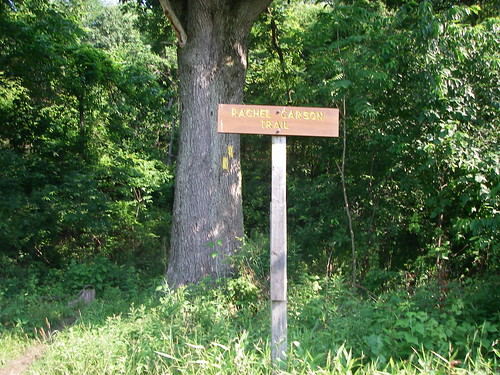
Rachel Carson trail sign
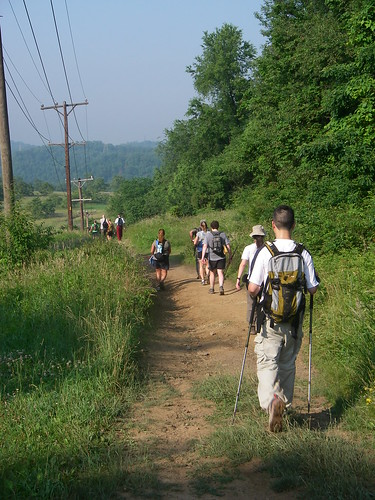
Every year, the Rachel Carson Trails Conservancy puts on the Rachel Carson Challenge ("The Challenge), ~34 mile hike from Harrison Hills Park to North Park, along whatever trail the conservancy has been able to stitch together with a myriad of agreements with private landowners, from Sunrise to Sunset on the Saturday closest to the Summer Solstice. In a world that is used to thinking in terms of digital precision, there is something gratifying about an event whose time and dimensions are based on physical reality instead of arbitrary human will. But there is nothing comforting about The Challenge itself. In fact it is brutal. By the time you are done you feel someone massaged your legs with a baseball bat. And it is deep pain, deep into the muscles of the thighs and calves.

Quote:
Mary Reed in her article at getoutzine.com says from her experience in the challenge last year

I ask my fellow participants why they are doing this. The answers fall into three general categories: for the challenge; because I’m crazy and/or stupid; I was drunk when I signed up.

I got to the North Hills parking area where I was ushered in by Mark, whom I know as a Red Cross volunteer. I made my way to the start with two people who I met on one of the training hikes. One of them was dressed in colonial era dress, reflecting this year's theme of General Forbes march across Pennsylvania, along with Pittsburgh's 250th anniversary.

Quote:
When we told some Revoluntionary reenactors what we were doing (34 miles, one day), they said that if a horse did that we would have to put it down.
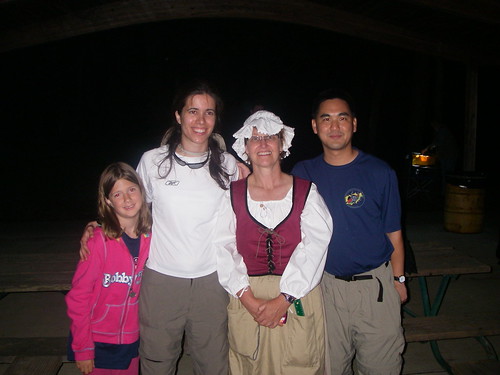
Colonial reenactor

We got to the start area and waited for sunrise. I met Steve there, setting up the tag scanning and radio. He remembered me from a computer donation a year ago.

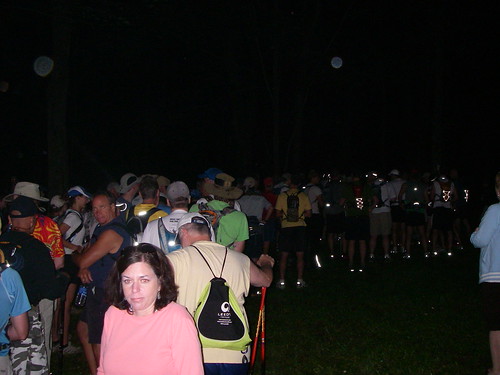
My friends arrived soon after, and we waited for the beginning of the challenge along with the gathering crowd.
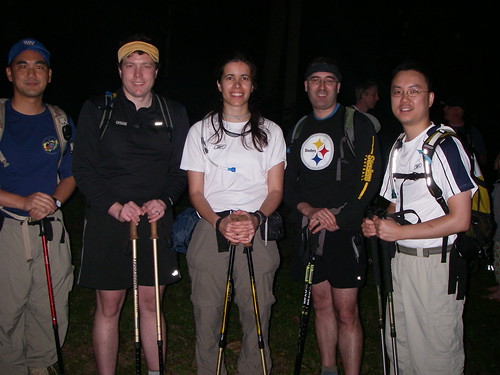
Five of us

Start area for the challenge


Quote:
M to me: "Oh, then you are normal"
T: "No, his fiancee would describe him as anything but normal"


The challenge itself began with the sunrise, with the moon still lit. In Harrison Hills park we were soon greeted by mist over a pond.
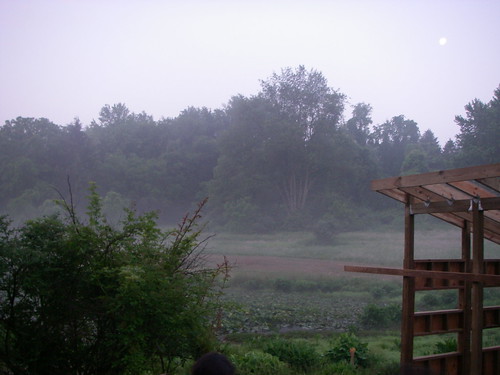
Misty pond with moon in Harrison Hills Park

And so it was, 34 miles of trails, some roads, fields of wildflowers to cross,
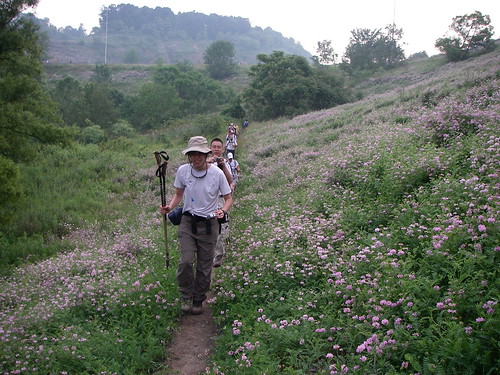
wildflowers on the trail

utility lines to follow,

IMGP0032

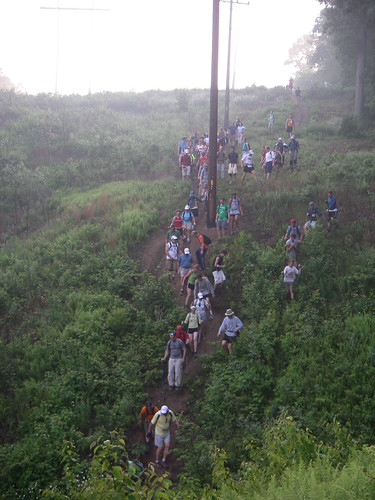
hills to descend,

Going down hills in the Rachel Carson Challenge

which always seemed to be followed by hills to climb.

The hills of Allegheny county

And along the way were the checkpoints, where volunteers checked us in, fed us, and encouraged us.
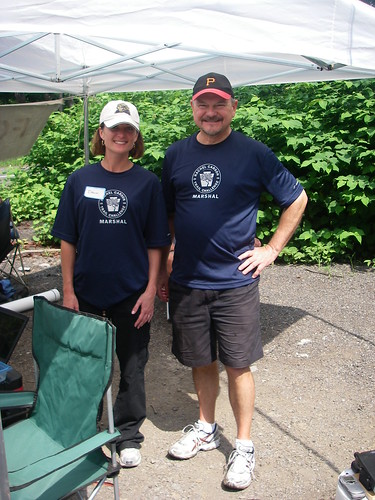
Volunteers at checkpoint 2

This year, also in keeping with the Pittsburgh 250th, the checkpoints also had names, after colonial era forts, like Fort Bedford.
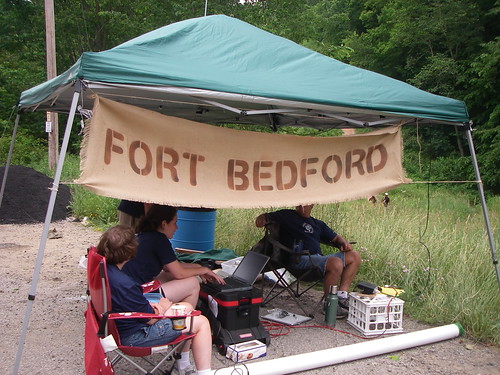
Welcome to Fort Bedford

Along the way we had many random conversations. Encouraging other hikers, joking around with how crazy this was. Untangling just who recruited or hoodwinked, whom to do The Challenge. And giving aid, carrying packs of people who just could not get further and needed to get somewhere to be picked up. Wrapping knees or treating blisters. Giving directions and advice. Encouraging people to push further, letting those who could not go further know just how well they did. And talking about life, of service in Iraq and Afghanistan, a WWII vet who gave out water, the neighbor on the trail who gave out water, talking about married life and kids (letting a soon-to-be-married type some hints on what is to come).

I'm a believer that when I go hiking, I am usually doing something else as well, be it photography, birding, cooking and eating, or socializing. Of course, The Challenge is big enough that it can certainly be its own reason. But I used this as a test to my ability to carry radio equipment to last through the day. The Challenge has ham radio support at all the checkpoints and accompanying key volunteer staff throughout the day, some of whom are recruited off of the Allegheny County Public Service Net/ARES/RACES, which I am a part. So I carried a handheld radio, several batteries, and listened in throughout the day.
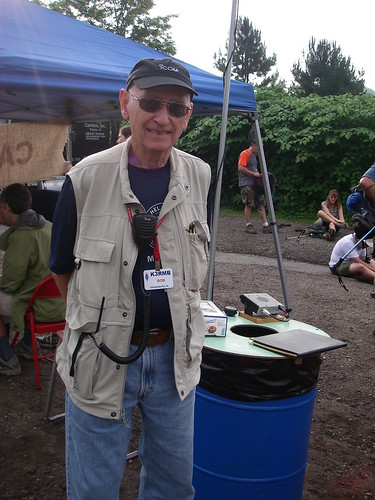
Ham at checkpoint one

As the day went on, the many things that go on were discussed over the radio net set up for The Challenge. From setting up the checkpoints, ensuring porta-potties were at all locations, to checking on supplies of food, water and ice. All the things that those of us on events are so thankful to see when we get to the checkpoints.
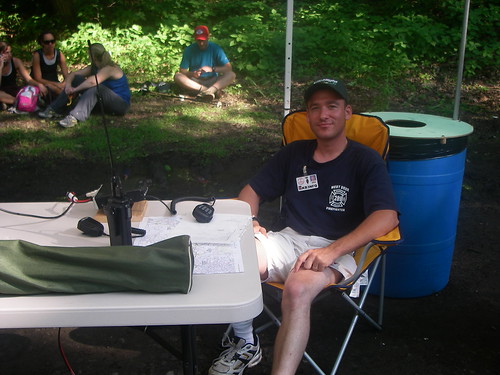
Radio at checkpoint 4

And the not so welcome messages. The tag numbers of the people dropping out. The questions about hikers not accounted for. Arranging for pickups of those who need help. And the warnings of the thunderstorm that was coming that evening.

As the miles went on and the knees were battered, I heard the warning coming of the thunderstorms for Ohio over the radio net, and that gave a sense of urgency to the last few miles. And on the trails of North Park the lightening and thunder started. My little group realized we were less than a mile from the finish, but took the better part of valor and jumped trail to the Sharon shelter to call for pickup. Not long after, we saw the sweep hikers shepherding other hikers off the trail and they brought us to the finish at Beaver shelter for food and rest for our battered legs.

Many thinks to all the volunteers, the training hike leaders (hi Bob and Donna), trail maintainers (hi Mark), everyone who manned checkpoints, logistics and management (hi Steve). And thanks to the radio support, for passing on their frequencies and letting me listen in, giving a bit of an education on the running of a net during an event. And for all the company on The Challenge. I'd welcome seeing you again on trails anywhere, anytime.

Monday, June 16, 2008

Gearing up for the Rachel Carson

Well, the Rachel Carson Challenge is this Saturday. Some things are not resolved just yet, like who will I be hiking with and when we are starting out, but there are options out there. But I'm a firm believer in I don't hike just for the sake of covering ground, I am always doing something else along the way. And that affects what I bring along.

Let's see, I am definitely bringing my VHF/UHF Handheld radio with me. I have a Yaesu FT-60R 2M/70cm radio. There are a few people on the Allegheny ARES/RACES who are assisting the Rachel Carson Trails Conservancy with radio support (whose members are busy obtaining their own licenses because this is so useful). So they will also let me know their frequencies, and I will be testing my ability to operate all day on foot, through forest and valley. I'm taking two extra batteries and I'm using a 1/4 wave antenna for the 2M band (Smiley 270A) I used a smaller MFJ-1717S on the practice hike, so I'll see if there is a difference. I've figured out my earpiece does not work so well on the move, so I'll use a handheld speaker mic. I'm using a Camelbak Maximal HAWG, so the FT-60 will be clipped to the MOLLE webbing on the side (and the side straps will help keep the whole thing stable).

Electrolytes became a problem on the last trip, so I got Camelbak elixir electrolyte tablets for use with the Camelbak. These are formulated without sugar, so they supposedly can be cleaned out of the bladder at the end of the day. We'll see how that works.

I'll have a Leatherman Micra as a multi-tool, and probably another knife. Last time I brought my CRKT M1. It and my Benchmade fixed Griptilian did yeoman's work on a camping trip this past weekend, cooking, cutting and even some batoning to break up some logs we were going to use for firewood. But the M1 is probably too heavy for this trip. And I could bring a Becker Necker, but a fixed blade is also probably too much, especially since I don't really need it. But I have a busted Kershaw Ken Onion Scallion sitting around (I took out a broken assist spring) that is probably not too much overkill. And it probably is big enough for anything that I may reasonably need.

Let's see, LED flashlight. A couple bandannas. I have an ankle reflecter that I'm putting on my camelbak for the early morning/early evening hours. A compass/whistle/thermometer. A cap with brim to keep the sun off my head. I'm bringing a single trekking pole. It is pretty much a necessity because of the hills. I usually only use one, because I like having one hand free to do things like eat, drink and take pictures.

Oh, and a new camera. A Pentax Optio W10, purchased because, well, it is small, and it is waterproof (and dustproof and sort of shock resistant). Because me and water go together. :-)

Tuesday, June 10, 2008

Rachel Carson Challenge 2008: Challenge training hike 3 of 4

I'm getting ready for the Rachel Carson Challenge, which is a 34 mile, one-day hike through trails across the northern part of Allegheny County, PA (Pittsburgh). Mary Reed in her article at getoutzine.com says:

I ask my fellow participants why they are doing this. The answers fall into three general categories: for the challenge; because I’m crazy and/or stupid; I was drunk when I signed up.

No points for guessng which category I fall into.

Last weekend was the last of the challenge training hikes. An ambitious 19.3 mile trek. And, in accordance to the plan for the actual challenge itself, I went in the slow group. With me were J (who I met on the last challenge training hike I did), S (friend of S. When S asked her to sign up for the challenge, it turned out that some details were left out. Like the actual challenge was 34 miles), and D (training hike organizer, and sweep, to make sure that no bodies were left on the trail when the training hike was over). (T, who is the guy who is getting me to do this thing, was a no show, some excuse about being out of the state) The plan was to start off of Bull Creek Road and Ridge Road by Tarantum (map link) and end up in Dorseyville (map link). And do this in 97F (!) heat.

Well, the most obvious thing about the day was, it was hot. D had made the comment that she has never seen it so hot on a challenge (or training hike) before. Along the way we made a stop at Sheetz, and I wolfed down a whole bottle of gatorade. The areas that were forested or in parks were nice. But things like Murray Hill (steepest hill on the Rachel Carson Trail) and the various power line cuts like the infamous Roller Coaster were out in the open, in the blazing sun. About four hours into the hike D started getting calls from people who were ahead, letting us know they were dropping out of the hike and were making pickup arrangements (because D was the organizer, just polite to let her know that your body is not on the trail somewhere needing to be picked up).

The heat was getting to us too. I was fighting off heat cramps (the gatorade I picked up at Sheets did wonders for that). And everyone was showing some signs of heat exaustion. At around 6 miles, one person was suffering from nausea, and on spotting a side trail that went to the road (we were on the Roller Coaster at the time), made the decision to quit while the getting was good. It turned out we were in Springdale, and close to the Rachel Carson Homestead. This made for a good pickup point and D's husband graciously came out to pick us up and bring us to our cars.

So, what did we get out of strenuous hiking in 97F weather for 6 hours. Well, there is definitely the workout. But these things are more then physical. There is the testing of mental preparation, both the amourphous mentally preparing oneself for a test, but also the practical aspects of being intelligent about doing something challenging. And the decision making. D had said she had never before bailed on a hike. But the mental capacity to recognize when a course of action should not be continued is vitally important, because it can mean the difference between an experience to remember, and a fatality. Because the backcountry (and nature) deals with physical realities, that do not bend to what you may want to believe, or what you wish was true, or mental will. And something like this, which is a test to the point of failure, makes you know exactly where you stand in the world.

Thursday, June 05, 2008

Introductory Econometrics with Applications by Ramu Ramanathan

Introductory Econometrics with Applications Introductory Econometrics with Applications by Ramu Ramanathan

My review at Goodreads
I've been realizing that most of the data I work with are observational as opposed to the experimental data that most statistics that I know are designed for. So I've been working through this econometrics text. By way of background, I've taken Statistics as undergrad using books and tables, as a master's, which was essentially using SAS, and as a grad student, in a very mathematical sense. Working through Intro. Econometrics with Applications was learning what all the math based stats in grad school, but actually understanding it. And the computer package Gretl makes the learning interactive.

Ramanathan's biggest strength is he does not stop at teaching definitions, formula and methods. And his example applications do not stop at working through methodology. He uses the computer output to build intuition, asking the question of why this variable is what it is, or why two models are different. The use of Gretl enhances this. The scripts and data sets make it easy to see the examples at work, but also make it very easy to explore. I found myself running the scripts, then exploring the data sets in Gretl to further analysis, and building my understanding. The mathematical derivations are there, but having both the theory and the computer outputs for discussion make for a good match.

The book datasets and examples are bundled into the econometrics package Gretl, which is an open source program (available for Windows, Mac, Linux). In addition to correctness (it passes completely the NIST datasets, which is something even SAS and SPSS don't do) the scripts let you see what is happening (as opposed to SAS which often seems like black boxes inside the PROC statement). And more flexible then the menu based packages like Minitab (or Excel based statistical packages). Compared to R/S-Plus there is a shorter learning curve, as Gretl displays more of the output immediately, while allowing various statistics to be exposed for later use if needed (the reverse of R, which exposes statistics, but makes you work to display them. Great for programming, but harder for exploring data to the neophyte.)

I think that texts like this that are integrated with a full fledged statistics package (as opposed to purely math or a demo version) make the learning and applying of statistics different. (other texts that have Gretl datasets available are listed at Data for gretl) The focus of the learning is not on the memorization of equations or definitions, but on the learning of methods and techniques. The chapter summaries become short forms of methodology (as opposed to formula) with the assumptions that the various methods repeated as well. I found this to be a particularly effective format for a first book on a subject (assumes a first sequence in undergrad statistics has been completed).

As of now, I've gone through 5 chapters of the book, working through the examples. As I do this, I am learning a lot about analysis, that is going to inform a project I am starting up. That is probably the best testimony for a book of this type.

View all my reviews.

Wednesday, June 04, 2008

Furies of Calderon by Jim Butcher

[Originally written at Goodreads]

A story of a boy Tavi, who is exceptional in his lack of identifyable talents. Where everyone has a semi-magical bond, he does not, and he survives on wits. And he does not have much of those either.

The story is in the backdrop of a insurrection, where one of the principles is one of the reigning governments greatest agents, who is set against a very talented protoge. What worked well was this sense of a insurgency raised by tribes along the frontier of civilization, where the wealthy center is mostly ignorant, and in the end the fight depends on the loyalties and goals of those who live on the frontier and not on the military who come from the center.

The characters are not as well developed as Jim Butcher's Dresden series. Of course, this is the first one. All of them have a tendency to slip into single-mindedness to the point of self-destruction (which is something that Jim seems to like). Maybe, like Dresden, they will learn as their characters become richer.

Thursday, May 29, 2008

Does anyone want to play a game?

There is a play by e-mail role playing game that I've been involved in over the past couple years. The guy running it is in England, and he is thinking of getting his setting published. The online games is turning into a playtest, and is now resetting itself to use a new set of rules, Fudge RPG (Wikipedia), which is considered a rules-lite set of rules.)

Anyway, if you are interested in role playing games, or writing fiction (role playing games are essentially interactive fiction), and might be interested, take a look. My character is a fairly low level type, with an established place in his society. The archives are online so you can have a sense of play, which is as much social as combat (actually, you don't have to be a combat type at all to have a place.)

The setting is Kalyr, which is a pre-industrial setting. Information is at the Kalyr playtest site including the current draft of character generation rules and setting information. The Kalyr blog has some entries with samples of play as well as some of the experimentation that he has done using the game (I am in a post on conflict resolution).

And let me know. I can walk you through character creation, and joining up in the game would be an option too.

Wednesday, May 21, 2008

Bush Assails ‘Appeasement,’ Touching Off Storm

New York Times

To jaw-jaw is always better than to war-war. - Winston Churchill (1954)

Let us never negotiate out of fear. But let us never fear to negotiate. - John F. Kennedy (1961)


In a speech to the Israeli Knesset, President Bush said (quoted in the New York Times)

“Some seem to believe that we should negotiate with the terrorists and radicals, as if some ingenious argument will persuade them they have been wrong all along, . . . We have an obligation to call this what it is: the false comfort of appeasement, which has been repeatedly discredited by history.”

It is a sound bite, but high school logic and rhetoric students will recognize it as a strawman argument. The purpose of speaking to opponents is not to persuade, but to understand. And the purpose of understanding is not to pretend that differences don't exist, but to make sure that we determine what the differences really are, and that noone has false assumptions about the severity. To forget this is to get into needless fights, make enemies out of those who would not otherwise be, make enemies out of friends, and make friends turn away.

Barack Obama has been criticized in the past for stating a situation that would lead him to order an attack on a sovereign country. The reality is that part of the role of leaders of sovereign nations is the decision to defend or pursue identified interests, and this includes the use of deadly force, and the placing at risk of its young men and women. In modern history (and probably also in history going to antiquity) few of those who became heads of government for any length of time have avoided this question. The question for nations is how to choose those people who make that decision and for what reasons. In democracies (of any form) the decision is made by citizen voting for its representatives (directly or indirectly). To think that there is no reason to go to war is denial, and it is a statement that nothing is of value, including your lives. But it should be a choice made soberly and wisely. As Churchill states, speaking is better than war. But he was also a man who was perfectly capable of using his time in jaw-jaw to make the choice to go to war.

In a democracy, people use many criteria for voting for a leader. Many of these are issues. But reality is situations change over time, even the short time of the term of a U.S. President. What we are electing are how people make decisions and their values. And one of the things we are voting for is a thought process and criteria on the use of force.

Tuesday, May 20, 2008

Modern Love: May I Have This Dance?

New York Times - Modern Love: May I Have This Dance? by Owen Powell

This week's Modern Love column is by Sergeant Owen Powell, an MP who has returned from an Iraq deployment and has now been assigned to Brooklyn New York. And he talks of being at war, the boredom, the banality, and thinking about his wife, and all the other little things he thought of to pass the time. I love his comment summerizing his experience:

It was everything I had ever hoped to experience in the military. It really was. Not that I would ever choose to do it again.

But the conclusion is a wonderful thing. While he may have whiled away his hours thinking of a famous pretty actress (whose identity is rather besides the point) and all of the things like dancing or romantic dinners they could be doing together (or not doing together, as some of his fantasies involve being dumped. I imagine that if you are being dumped in your dreams, life is not the greatest).

He goes on to talk about our celebrity and banality obsessed culture, one that we have more understanding of lives of people we only know on the TV screen then our neighbors.

But, then he also talks about being actually home. Not the United States that existed on TV, newspapers, or his dreams, but the real home. And in the city that the actress that he dreamed about was. But it turns out, dreams don't hold up against reality. And the reality is that he lives and goes home each night not to excitement, or dreams, but to his wife. And spends his Saturday's on a couch with his wife. And he is happy.

Next to that, dreams have no wonder for him. Not of the excitement of New York City in the skyline. Not the thoughts of a beautiful famous actress. And one month away, I'm looking forward to some of the same.

Monday, May 19, 2008

Telegraph (UK): China earthquake: Mudslides bury 200 relief workers

China earthquake: Mudslides bury 200 relief workers

On Monday, May 12 an earthquake registering 7.9 on the Richter scale hit Sichuan Province in China. It is feared some 70,000 dead and unknown numbers made homeless by this. Sichuan province is in the central part of China (Google imagery) (KML) , and the region is very mountainous, making access difficult in normal times, and downright treacherous during periods of geological instability as roads, bridges, and infrastructure are damaged to an unknown extent. The damage and difficulty is difficult to imagine, especially for westerners. The biggest events for Americans to compare to are the 2001 World Trade Center attack and 2005 Hurricane Katrina. But each of these only had a few thousand dead. The scale of the China earthquake and the Mynmar cyclone is beyond scale.

The China earthquake is remarkable for the government response. The free flow of information, in fact Sichuan province's openness with disseminating accurate information is amazing for a generally suspicious and paranoid government. The publicized punishment of a few local and regional party officials who made attempts to hide issues is another sign that this is being handled very differently then SARS and Harbin, which is a sign of lessons were observed, and even learned. Another notable response was the bringing in outsiders, in this case Japanese and Taiwanese disaster response and relief teams (I believe they were the national Red Cross societies and the Tzu Chi Foundation) were allowed in the country to assist with rescue and relief. The contrast with previous disasters, or especially the current Myanmar regieme is striking, and encouraging.

There is difficult work ahead. Many areas have yet to be reached, a difficulty remeniscient of the difficulty in reaching parts of the Louisiana Bayou after all roads were destroyed in 2005. Large populations are without infrastructure, including shelter, water and sanitation facilities. Disease becomes a major issue. And, in a mountainous area, roads and the very geography is unstable (see Visualizing China's Sichuan Earthquake in Google Earth blog). It is a serious business, underscored by reports of 200+ relief workers feard dead in landslides and other events. The United States Coast Guard has an unofficial motto "you have to go out, but you don't have to come back." The more sober of us realize that if the situation was not somewhat dangerous, we would not be there in the first place. And for all the others still at work, godspeed and stay safe.

Saturday, May 17, 2008

The world of Google

I'm slowly turning into a Google fan boy. Let's see, what started it all. Well, there was this blog, which started life as semi-secure and compartmentized from the rest of my life, which meant a nice new internet accounts that did not have the account name I've been using since my college days. Then the email address that came with it. But the kicker was wedding planning. Since there are two of us, Google Docs became the way both of us could work on the same spreadsheet or text document and keep track of the changes.

Now, that is not so hard. But wait, there is more. With Google Docs came Google Calendar, because it was just easier to use the same calendar. And it supports .ics files, which meant everything on Google Calendar, was also automatically sent to my Mac at home (and then to my iPod and Palm).

And now that I bought another computer, some other things just help. GMail uses IMAP, which means that every IMAP client logging into the same account sees the same thing, what is on the server. So now I have email on the web, on my Mac, and on my Linux laptop and no problems syncronizing. Google Gears puts everything I have on Google docs saved on my desktop(s) so I can work offline on any machine, and it gets saved and synced to all the others. And all this just works, using Thunderbird on Mac or Windows, iCal on the Mac, and Evolution on Linux.

And I've just discovered Remember the Milk, which works via Google calendar, email, text message, or whatever way I can get something on the internet, and goes out to Calendar, Thunderbird, Evolution, iGoogle, etc. One Todo list that goes everywhere.

This single data store stuff is getting to be nice, especially since I have a particularly disorganized life right now.

Thursday, May 01, 2008

Eclipse on the Hardy Heron (Ubuntu)

I took a bit of time with all the unpacking to getting my laptop up and running again. It seemed that the swap partition died, so I reinstalled everything. Well, at least I reinstalled Ubuntu, reinstalling Windows looks difficult. The first thing that I did after I reinstalled Ubuntu was run the Update Manager, which gave the option of upgrading to Ubuntu 8.04 (Hardy Heron). Well, if it is that easy, go for it. So I now have Hardy Heron on my laptop.

So for the past week, I've been upgrading packages, and figuring out what I need to get my system up. Most of it is pretty easy, just use the Ubuntu Synaptic Package manager and a few judicious searches get everything. And I got a few extras like Picasa and Google Earth. Evolution is now setup to use my Gmail and Google Calendar accounts. So almost all is good.

The big hiccup was getting Eclipse running. It was in the Ubuntu repositories, so I tried to load it from there. Problem, Ubuntu had Eclipse 3.2. The current version is 3.3, with 3.4 on the way. And the jump from 3.2 to 3.3 was big enough that some major applications that run in Eclipse require it. So I had to remove Eclipse 3.2 using the package manager, and install Eclipse from the website, just like I do with Windows. Annoying.

So, what do I have on Eclipse. Pydev is a must, as Python is my standard development language. Texlipse for LaTeX. Subclipse to use Subversion for source code. And StatET, for using with R (I've never used StatET before). And there are a couple other gotchas when installing Eclipse (like the need to have a directory $HOME/.mozilla/eclipse existing) that I would not have been able to figure out without some judicious web surfing). But just about everything is there now. I may not bother installing the Windows, but I may as well.

Saturday, April 26, 2008

Art in the City - Pittsburgh April 25, 2008

Friday night was the first Pittsburgh Cultural District Gallery Crawl of the summer.  And I had tickets for the Pittsburgh Symphony Orchestra for that night.  Ingredients that promised a fun evening.  

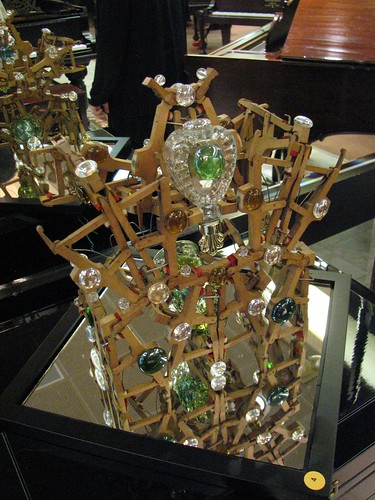
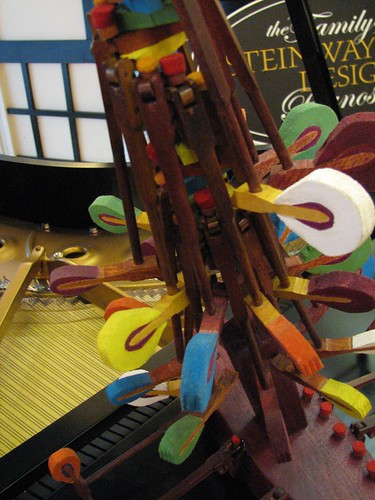
One of the fun things about the Gallery Crawl is the sheer variety of exhibits.  There are the usual film projects, photo projects of various kinds.  A few musical acts (I think if anyone can sit through a steel drum performance without smiling they should be checked for a pulse.)  But I really remember the cross media pieces.  At Trombino Piano they had sculptures up, made of piano parts! 

Piano parts


Hammers in colors

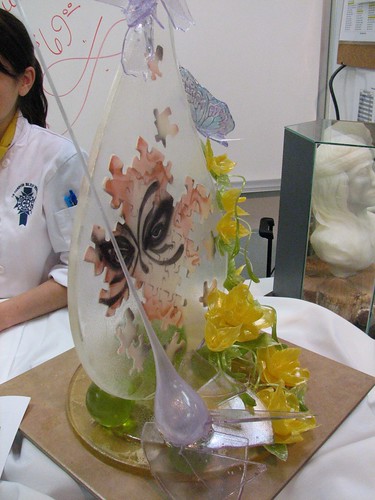
Over at the Pittsburgh Culinary Institute they had some food.  I was so happy that they gave the chili a bit of kick to it, like chili should have.  And they had a centerpiece that our local chef's in training do for fun.


All this followed by a concert with the PSO.  And even here the variety continued.  From the strident brass of Hindemith's Concert Music, to Chee Yun's violin singing with the orchestra on Mozart's Concert No. 3, the sheer range and variety of the night was something to be enjoyed.

New spaces

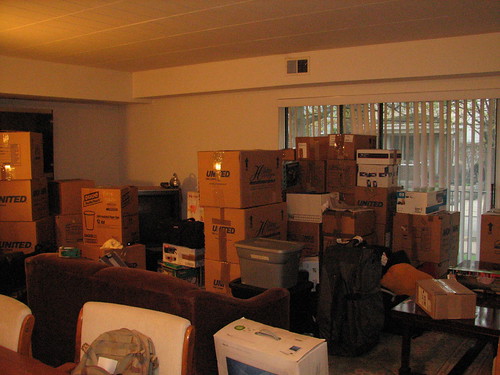
Moving is a funny thing. First, there is the shock of packing all of your worldly possessions. And if you do it right, you end up with everything you own in boxes in one room before the movers (hired or friends) show up. And you get something that looks like this.

All my worldly goods

Maintenance staff trying to be helpful: "Let me reserve the elevator for you"
Me: "I don't need it, I'm on the first floor"
Mover: "Good!"

Movers after going through my apartment to "see what we are in for": "He's ready. You should give classes on packing to our customers"

Quote (Movers and maintenance staff watching another moving truck come by): "good thing we got here first" (to get the spot next to the door to the outside)

Loading the truck was fairly easy. We had to take apart a bed that looked like it would fall apart if we picked it up. And I had a lot of camping stuff in bags that they put into one very big box (which was now very heavy), but other then that, it was just move the whole thing in.

Then we got to the townhouse. Which goes three up + basement

Mover: These things are pretty, but the architects do not like movers.

So the moving in was hard, and we had to take a couple of breaks along the way. Especially after bringing furnature to the top floor

Mover: When you move out, leave the ___ there as a housewarming present

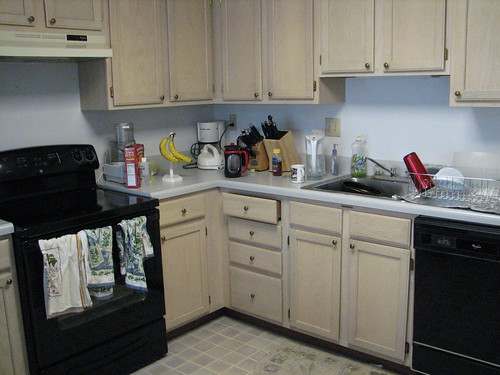
So now, I'm in a new (for me) house. And there is so much space around. I have a nice kitchen that two people can work in without bumping into each other (not that is a bad thing, especially if the other person is nice and soft to bump into :-) )

new kitchen


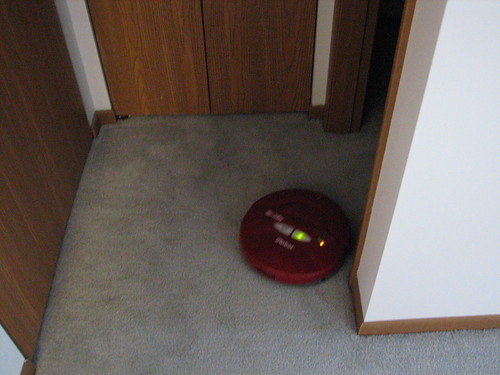
And lots of room for my Roomba, which used to be restricted to certain areas, to run around.

Roomba at work and play

And I'm sitting here, after a neighborhood run, eating breakfast and listening to the Roomba run around. This is nice.

Saturday, April 19, 2008

Who Lost the Debate? Moderators, Many Say

If none of us ever read a book that was "dangerous," had a friend who was "different," or joined an organization that advocated "change," we would all be just the kind of people Joe McCarthy wants.- Edward Murrow, to his staff before his "See It Now" broadcast on Joe McCarthy, 9 March 1954


You wonder what kind of campaign will we have. The candidates have somewhat refrained from direct character attacks, but this seems replaced by widespread collateral damage, as the candidates are being called on to repudiate staff, friends, former colleagues, former acquaintances, people they may or may not have met crossing the street (ok, I'm getting a little facetious, but not by much). And even if the candidates can restrain themselves from attacks (John McCain for one does not seem to have forgotten the Bush campaign of 2000, where an underground campaign painted John McCain as a "Manchurian Candidate" (as a reference to his time as a POW) and his daughter as a half-black illegitimate child (his daughter is a Bengledeshi adoptee). All indications are McCain has no intention of having a George Bush style presidential campaign.

But it may not matter. Because for both parties, it is not just the candidates, but the party organizations that are around them. The Clinton campaign has alluded to this expectation, fed by the dependence of the McCain campaign on the GOP due to financial issues, and the attempts of the McCain campaign to get the backing of the conservative wing of the Republican party (which would presumably include them acting in support of McCain, in ways McCain would approve or not.)

A marine colleague of mine made the comment, after the way that John McCain and John Kerry's combat zone service was portrayed in the 2000 and 2004 elections by the George Bush campaigns, he did not know how valuable his own combat zone service was worth anymore. And the same people who brought that, are on the sidelines waiting for the general election to begin. If McCain cannot or does not restrain them, then both of the Democratic candidates for President will agree on this, that the sniping and character attacks that are seen know (and described by some as distractions), will be nothing compared to what the RNC will come up with.

Sunday, April 13, 2008

Ritas on the River, San Antonio TX

Server 1: Hi. C is your server, but she asked if I can get you started. Do you want anything to drink?

Me: Can you tell me about Shiner Bock?

Server 1: Umm, let me ask the bartender about it. . . . Hey, can you come up with words to describe Shiner Bock?

C comes bounding up: Oh, Shiner Bock is my favorite beer, I drink it all the time at home . . .

Server 1: Oh, and (bartender) says

C: Oh, he does not like Shiner Bock, but let me tell you . . .


Earlier that day

Take off. *rumble* *shake* Me to neighbor: That did not sound too good.


Later, a bit before landing: This is that pilot speaking . . . That vibration you may have noticed on take off, one of our landing gear tires blew out. . . We'll be landing in . . . Please take out your safety cards as we review procedures for emergency landing.

I ended up explaining to my neighbor just what does one tire blowing out mean (not much, as long as its neighbor and the landing gear are ok), what the procedure is (the pilot had explained this in detail, but most people did not catch it), and yes, this was more complicated than the normal landing, but not out there on the difficulty/dangerous rating compared to what these fine (young) pilots are trained for, but it would be a good idea to count how many seats are between you and the two nearest exits. It probably helped my neighbors' comfort level that as we approached, the pilot did indeed do a few of the things I had explained in detail.

And of course, lots of joking around on the ground afterwards.

Neighbor on bus from plane to terminal: I wonder why they did not just have all of us get our bags at the plane since we were waiting for the buses.
Me: They probably were trying to get us off the runway. People who run airports get nervous when people who don't belong are wandering on runways. Like these buses that are normally parking shuttles (noticing the helpful placards for people going to/from parking lots on the bus). That is why all these SUVs with flashing lights are playing sheepdog with the buses.
Neighbor: *chuckling* yep, keeping everyone in line.

Man on escalator after I caught a lady with a baby who fell while trying to hold baby and bags: This has been an exciting day, hasn't it.

Saturday, April 12, 2008

Silk Elephant: A taste of things to come

Silk Elephant
1712 Murray Ave.
Pittsburgh, PA 15217

We went to Silk Elephant for dinner Friday night, after a day of work and practice. Silk Elephant opened in 2006, by the owners of Bangkok Balcony up the street in Squirrel Hill. The owners, Norraset and Eileen have greeted me on many occasions, both in their restaurant and in various functions serving the asian community around town. (I don't remember how Norraset and I were first introduced) In keeping with our desire to use vendors that are as close (social, geographic or otherwise) as possible, we are asking them to cater appetizers for our wedding reception.

The concept of Silk Elephant is a Thai Tapas and wine bar. To state it in more proper foodie terms, Silk Elephant is a thai tasting menu restaurant. Lots of small dishes that are expected to be shared (as opposed to the large entrees that are normal restaurant center pieces). And while the word 'fusion' has been used to describe it, I would just call it Thai inspired and creative (fusion implies that another style of cuisine was fused into it, which is usually the case with other more properly labeled Thai fusion restaurants). I have the opinion (surprise!) that their is a difference between a cook and a chef, a chef is creative. (which is why I don't take part in discussions about 'authentic' food at a restaurant)

When we (three of us) arrived, we told the hostess of our reservation, and we were recognized by the manager (who had helped us pick our dishes for the reception). Of course we were greeted, and the purpose of the meal was understood. Earlier he had sent me an email to remind me of our selection for the reception, which we were going to try today.

-Siam Paragon
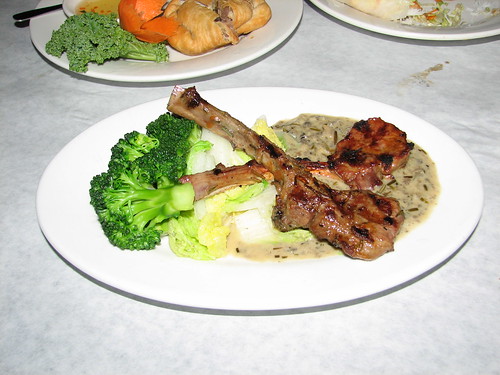
-Rack of Lamb
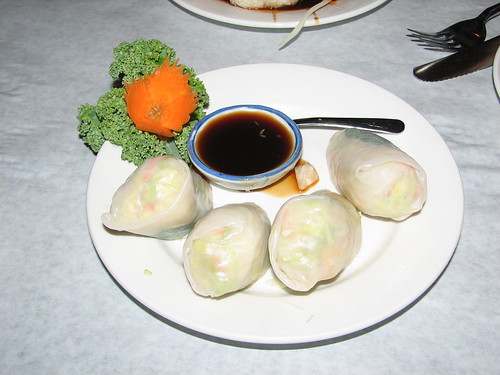
-Fresh Rolls
-Curry Puff - Taro
-Moon Goon Steamed Dumpling

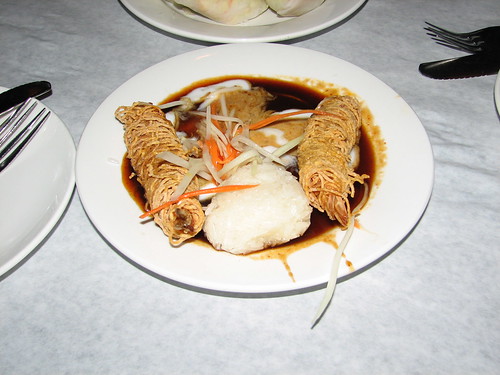
Siam Paragon
Siam Paragon at Silk Elephant

Rack of Lamb
Rack of Lamb at Siam Paragon

Fresh Rolls
Fresh Rolls at Siam Paragon

All in all, a pleasant and enjoyable meal. Dishes well prepared, and a nice mix. And the conversation and company were wonderful. Norraset came by and we talked of my going to Afghanistan and return, and about family, and about living in Pittsburgh.

There are many things that make life interesting, and we've come to appreciate the fact that Pittsburgh is the type of place where you can go to a restaurant and have a human conversation with owners, even if you are not a regular (I can count on my fingers the number of times I've been to Silk Elephant, although I've come across Norraset on many occasions outside of his restaurant.) He is a prior awardee of Pittsburgh 40 under 40, we were eating with a Steinway artist (i.e. a very good pianist), and we were two young, recently arrived people, still in the early stages of making our way in the world. It is a good life.

Wednesday, April 09, 2008

Randy Pausch: The Last Lecture AKA Keeping Priorities Straight, even at the End

Hat tip to Tara Parker-Pope, who writes The Well blog at the New York Times. And Freakonomics blog for pointing to The Well about this.

Randy Pausch is a professor at Carnegie-Mellon University, probably best known as one of the founders of the Entertainment Technology Center. The local wag is that is where you go to learn to make video games. CMU alumni know him as the one who started the class Building Virtual Worlds. He is also dying of pancreatic cancer.

Last September, Randy gave one last lecture. Watch it. (linked to YouTube below.) It is not about cancer, it is about achieving life dreams and lessons learned. But it is not really about that. It is about living life.

In contrast to the normal academic lecture, it is something that is paid attention to. And not just by students, by many around the world. A lecture on living life, with an audience of millions.


And as he says, it is not about cancer, and it is not about pity. He does not want any of that. And he does not even care about the audience of millions. He did this, so his kids can see him give a lecture. For them to learn lessons of life that he won't have the time to teach in person as they get older.

Tuesday, April 08, 2008

General Patraeus goes to Washington, Round 2

General David Patraeus, commander Multinational Force - Iraq (MNF-I), and Ambassador Crocker are currently in Washington DC giving testimony to the U.S. Congress regarding the current state of the U.S. and Coalition occupation of Iraq. The purpose of this is to give someone without background some of the background behind the testimony. Actual analysis and especially implications on the current U.S. Presidential candidates belong elsewhere.

First, why is a senior General of the U.S. Army, and the commanding officer of the largest and most decisively engaged component of the U.S. military subject to questioning by a legislative committee(s). The U.S. has a strong tradition of civilian control of the military. In addition, the U.S. tradition is that the instruments of military power, are outside the political process. For many years, the U.S. military has emphasized as a point of pride, they were (are?) the only military in the world whose officer's swear their oath of service, not to a person or a group of people, but to a piece of paper (the U.S. Constitution). This is in marked contrast to the usual oath, which is to a head of state, a government body, or a political party. One of the ways that this plays out is both the executive and legislative branches can call on him based on their constitutional authority. And, the legislature can call on him without viewing him as an agent of the executive branch. And as all general officers are confirmed by the U.S. Senate, the Senate has some room to say that generals work for them. Not something that is used lightly, but in terms of providing testimony, the Senate can call on anyone they please.

Why Gen. Patraeus and not higher? The chain of command in the U.S. starts at the President, then the Secretary of Defense (a cabinet/ministerial level position). Then, the combatant commander (COCOM) (who is responsible for all military forces in the region) who then commands subordinates to implement policy. In the U.S., there is a parallel structure called the Joint Chiefs of Staff (JCS), who also report to the Secretary of Defense. The JCS are responsible for the training and equipping of forces. The COCOMs are responsible for how those forces are actually used. For U.S. forces in Iraq, as employed forces, their actions are under the perview of the COCOM (although their training back home is a JCS issue). In times of war, it is not unusual to appoint a theater commander (MacArthur, Ridgeway in Korea, Westmoreland, Abrams in Vietnam) responsible for all activities in theater, within the regional command. Patraeus is the regional commander for Iraq, within the larger umbrella of the U.S. Central Command.

Where did Patraeus come from? Regarding the current war in Iraq, Patraeus was a division commanding general during the initial invasion. Most accounts view him as very innovative during the initial combat operations, as well as in reestablishing civil affairs afterwards, something that was not viewed as typical. After return to the states, he was assigned to Iraq again in charge of training the Iraqi forces. He then returned to command the Fort Leavenworth and the Combined Arms College (a graduate level institution) at Leavenworth he and Marine General Mattis oversaw the writing of the new U.S. Army and Marine Corps Counterinsurgency doctrine. After this, Patraeus was selected to command MNF-I as the senior U.S. officer in the theater.

What is his relationship with the Bush administration? Well, pretty rocky over time. He has long been known as a counter-insurgency expert, and the Bush administration was very adament for a long time that the conflict in Iraq was not an insurgency. Some commentators thought that the assignment of Patraeus and others to the various military schools was essentially professional exile. (what kind of career does a military officer have as a college dean instead of commanding combat troops in a war). And with the Iraq war going very badly, the view of many commentators is that the Bush administration essentially cried for help, and brought Patraeus back to the war, even with his not very liked counterinsurgency doctrine. Because it probably would not do any worse. And Patraeus brought along a number of other officers who did a lot of thinking about counterinsurgency with him (and who had helped write the new counterinsurgency doctrinal manual). Somewhat of a return from exile.

Wait, I thought counterinsurgency and the 'surge' was viewed as the Bush great idea? Counterinsurgency (COIN) is still a very debated concept in the U.S. military, even among those who have recent experience in a war zone. One source of opposition are those who are concerned that the business of the army is to wage high intensity combat, the kind with tanks and artillery and mass formations. Not this COIN that is mostly done with small numbers in very close contact with civilians. Another group says that building up communities is not the military's job, so they should not learn how (the "we don't do nation building" crowd) and let the civilians do it. More cynical observers point to another source of opposition. Since COIN requires resources be put into training people rather then heavy equipment, cynics note that the normal military contractors don't get rich building tanks and planes in COIN, so they are opposed (along with their friends in uniform).

So, what is happening now in Washington? Gen Patraeus and Ambassador Crocker are back for a second round of testimony before congress. The first was in September 2007. Six months was considered to be a decent interval. As both of them are confirmed by the Senate, the Senate deals with them as their agents, (which is why Gen Patraeus had no need to discuss his testimony with the executive branch last September. The Ambassador is the President's personal representative overseas, so he probably does have some requirement to discuss with the President what he will say.)

The committees in question are the foreign service and the defense committees. This is where the real power in congress lies. The staff of these committees for both of the major parties are presumed to be experts in their fields, and are expected to prepare their members well regarding lines of questioning. But while they can give testimony regarding the current state of affairs in Iraq, as well as some discussion of options and what can be done with resources available (or made available), the actual current policy of Iraq is not really the topic of discussion. That comes when instead of listening to testimony, Congress is debating policy. And part of the purpose of this testimony is for the various sides to ask their questions and shape the policy debate to come. And to gather information and ammunition for that conflict to come.