Showing posts with label Rep Fitness. Show all posts

Saturday, July 07, 2018

My current range of workouts.

Earlier, I posted the current state of my home gym.  Since I have been travelling for work and pleasure over the past two months, one thing I have done is to maintain a workout a day. Since I was either in places that really did not support running (a corrections facility, or as DD4 says, a jail), or it was incredibly hot/polluted/raining, unlike my trips in the past my workouts have been in a hotel gym or using exercise equipment/aids I brought along.


My workouts are being informed by two sources. First are the Stack52 line of exercise cards. I have bodyweight, dumbbell, kettlebell, suspension band, and resistance band sets.  Second, is the book by Myatt Murphy, Push, Pull, Swing: The Fat-Torching, Muscle-Building Dumbbell, Kettlebell & Sandbag Program.  So workouts will include exercises that cover upper body push and pull, lower body push and pull, and swing (rotation and core).   So, my workouts have settled into a number of categories.


  1. Bodyweight exercises.  For these, I use the Strength Stack 52 Exercise Cards set.  I draw 5-15 cards from the deck and do those exercises. The nice thing about these is that my kids can do the exercises with me.  This tends to be my light workout or the warmup before a heavy workout.
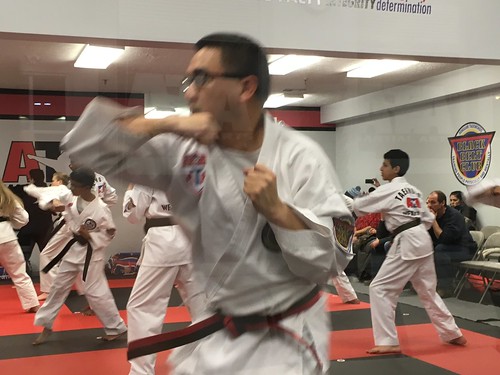
  2. Self defense testing at the ATA Taekwondo
    Drills before testing.
  3. Taekwondo.  This is either part of a class, or I will do this at home (sometimes with my son). This starts with stretches, then 5-7 Stack 52 cards for bodyweight exercises for warmup.  Then conditioning using a heavy bag (or I will do focus mitt or pad drills with my son).  Then forms/poomsae/kata.  Actually, other than heavy bag, this also tends to be a light workout.  If I am in class, I will often follow up with a light resistance exercises.
  4. Dumbbells.  This workout is a heavy workout.  I structure a workout based on push, pull, swing.   I will do sets in three groups:
    1. Heavy lift.  Deadlifts, Squats, and Chest presses  3 sets of 4-6 (when I am at 6, that is my clue to increase the weights soon)
    2. Mix. 2-3 Exercises that hit different muscle groups.  Changes each time.
    3. Conditioning.  2-3 of  Woodshops, one arm dead clean and presses, two arm swings. This is at 3 sets of 10-12 reps. For the swings, I do 50.  If I can do all three at 12 reps for woodshops and clean and presses, it is time to increase weights.
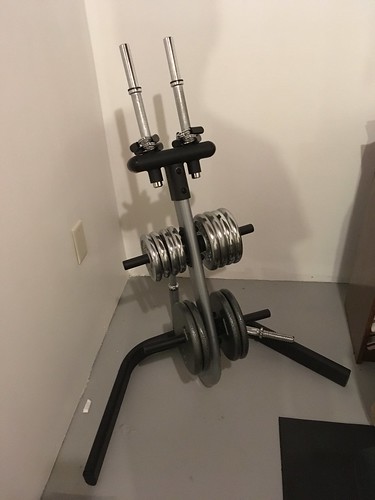
    4. CAP barbell standard plate and bar storage rack
      Dumbbell plate rack
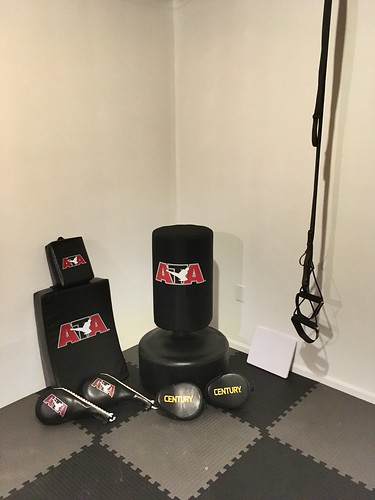
    TKD gear in the workout room
    Suspension straps
  5. Suspension straps.  I actually use this almost like a conditioning exercise. The big difference between this and body weight is that the suspension straps effectively redirect gravity, so instead of all exercises pushing against the floor, I have some that resistance aims down, some where resistance goes up, and some where resistance is lateral. However, it is limited to bodyweight (with need for stability), so this is a conditioning or cardio workout, not a strength workout.  I will pull out cards from the Resistance 
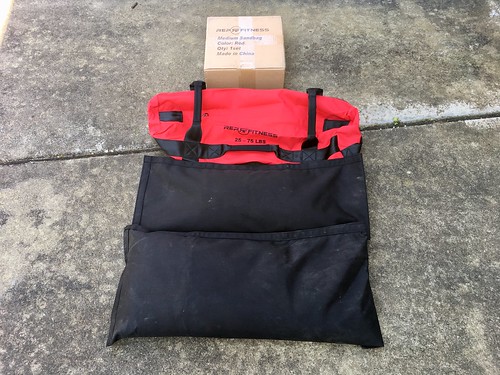
  6. Rep fitness medium sandbag filling
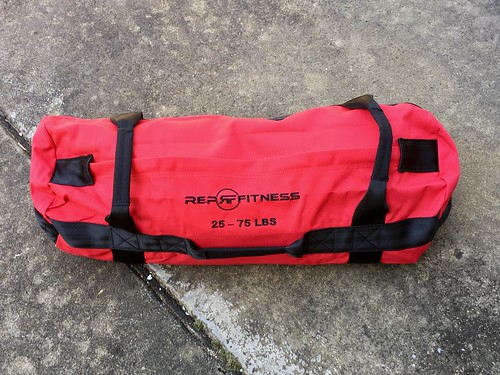
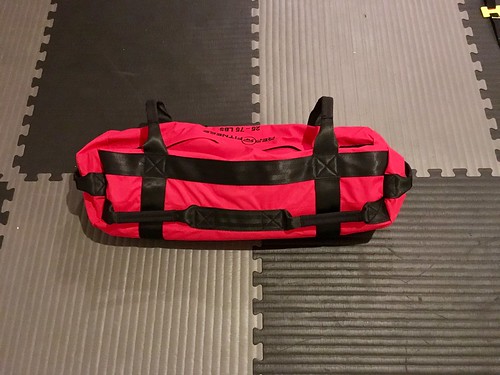
    Rep Fitness Sandbag
  7. Sandbags/sand kettlebell.  The other two tools of the Myatt Murphy book.  The difference between these and the dumbells is the instability due to the weight shifting, which makes the workout harder for the weight.  I have the sandbag to provide the two handed exercises that I do not have because I do not have barbells, and the sand kettlebell provides variety.  Since the dumbbells are for the heavy weights, I use these for the convenience.  Usually I use this after a light workout (like taekwondo class) where I want to add some conditioning.  With the kettlebell, I will do a set of woodshops, dead clean and presses, followed by kettlebell swings.  With the sandbags, I have not settled on a set. Usually I try two or three exercises from the Push, Pull, Swing book.
  8. Resistance bands.  I have a couple of flat loop bands.  These are more of a workout when I  did not get a workout piece of equipment.  I have not decided if it is worth it for me to get the heavier bands to get a useful level of resistance.

Of these, I probably do the heavy dumbbell workout 2 times a week.  Taekwondo 3 times a week (supplemented by either the sandbags or light kettlebell or suspension straps.  Suspension straps if I need to program in something light.

Tuesday, May 22, 2018

My home gym circa May 2018: martial arts and free weights

One of the first things we did when we moved to a house with a semi-finished basement was to declare that the basement would be a workout room.  And our primary exercise that time was taekwondo along with bodyweight exercises for DS5 (then) and I.  In addition, I had some lightly used exercise equipment (dumbbells, a weight bench, and a Total Gym exercise machine) and this became the start of the workout room.

First, we got 1" thick tatami foam puzzle type mats from IncStores that we laid on the floor.  The thickness was for normal martial arts (i.e. some impact, but we are not wrestlers or judoki.)  This was used to cover the larger portion of the basement floor in a checkerboard pattern (gray and black squares)  These mats were not difficult to cut with box cutters, so we cut them to fit the basement and the way the walls were laid out.  This was a good way of covering a concrete floor.  The way the basement is laid out, it is big enough for me to cover half a Songham (ATA style taekwondo) square for forms.  So as long as I start in an appropriate place, I can do a form with full extensions. (which I could not do at the old house).  So this floor gets used for TKD practice, forms, and drills, along with bodyweight exercises.
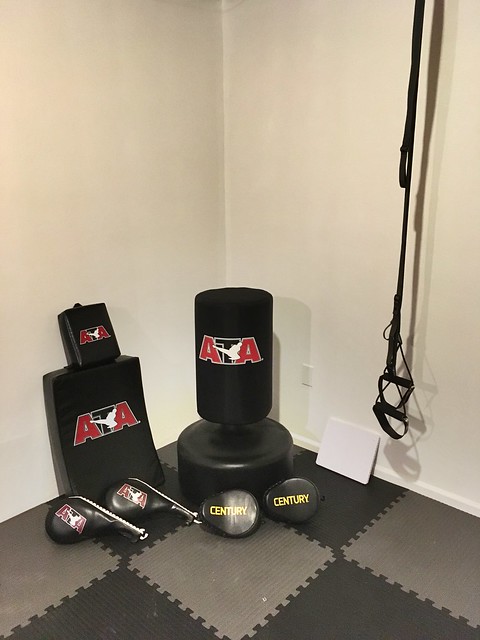

TKD gear in the workout room
Taekwondo training gear
For Taekwondo we have a assembled a fairly extensive list of practice gear.  For my son and I, we both have our gear bags with uniforms, bag gloves, sparring gloves, foot pads, chest pads, and head gear.  We also have sang jae baang (nunchucks), ba maang ee (escrima sticks), and jaang baang (bo stick).  (we have declared that jaang baang is not for indoor use because of the ceiling).  But we also have a junior standing bag (Wavemaster weighted with 80 lb of sand in the base), a double kick pad (claps when struck correctly, now we have 2), a small target, large kick pad, and a pair of focus mitts.  The matted area is good enough for pretty much any standard or sparring drill.

For bodyweight exercises, we are used to this from taekwondo, but our real use is based on a fitness cards based on Stack 52 Strength decks. (review)  So (now) DS 7 and I will draw 7-10 cards (he uses both beginner and intermediate cards) and we will do them.  DD 4 also joins in and does her analogue of the exercises as well.
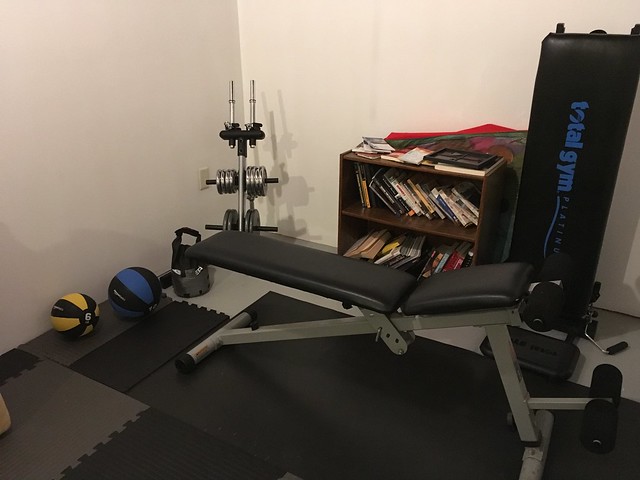
Workout room freeweight corner
Weights and Total Gym
For weights, from my pre-grad school days I had a cheap dumbbell set (the standard 4x5lb weights, 4x3lb weights, 2 handles with spin locks for a total of 40lb of dumbbells).  I had added the bench when I moved to my apartment when first started working after grad school.  Again, back then running was my primary workout, then the Total Gym for cardio.  I was not trying too hard with the dumbbells, but I knew a few exercises from when I did a few sessions with a trainer back in grad school.  And while I was not so concerned about strength, I pretty much maxed these out on the stronger exercises (e.g. bench press) soon after getting these.  Combined with not having a good place for this in my old house, I did not use this much.

After moving to the new house, I added a pair of medicine balls (6 lb and 10 lb) to the mix.  These were good complements to the bodyweight exercise, as they could be used with pretty much any bodyweight exercise to add more of a challenge. In fall, I decided that I would use the winter to add strength to my conditioning and I purchased 4x10lb weights and additional handles, which more than doubled the weight I had and allowed for switching between heavy, medium, and low weight exercises much easier.  More recently, I got the weight tree for the plates (which used to live on the mat underneath the weight bench) and a lot more weight plates (taking advantage of coupons and a sale from Dick's sporting goods), improving both the maximum weight and the range of different exercises I could be set up for in a workout.  Another use of the weight plates is for conditioning.  I have a military grade Camelbak HAWK backpack that I will load with 20 lbs of plates for rucking when going on walks with my family (so what is good exercise for the kids is also good exercise for me).  One big thing, weight training has gotten much more interesting and enjoyable once I got enough weights for it to be a challenge.  Working with the 40lb dumbbell set was essentially a messed up conditioning workout.  I could not go fast enough for a proper conditioning workout, but there was not enough resistance to actually get stronger.

For exercise equipment, I had a Total Gym from many years ago.  It was an incline based equipment that I have had from my apartment days.  It was always lightly used, generally it got the most use during winter when I ran outside less than before.  And after kids it got a little problematic because the track that the pad rolls on is an obvious pinch hazard.  And I probably had it on its steepest (hardest) setting from basically the time I bought it, so it really only was good for making my muscles move, not really for building strength or endurance.  To give me conditioning equipment to go along with the strength equipment, I got a suspension trainer (no longer available when the dominant company, which will remain nameless, used to court system to push them out of the market).  Since we have a semi-finished basement, the beams in the ceiling were exposed and I used one of these to mount the suspension trainer.  Similarly to the bodyweight exercises, I have a set of suspension exercise cards from Stack 52 to provide variety in my routine. This takes over from the Total Gym as it is easier to set up the exercise to be more difficult even as I am getting cardio in from lots of reps (at the end of the day, these are slightly harder versions of bodyweight exercises, but not as hard as using my dumbbells, so I use this for cardio as I am doing a large number of reps.  With the Stack 52 cards I have a range of exercises for upper body, core, and lower body.  And I can generate a fairly long circuit for conditioning.
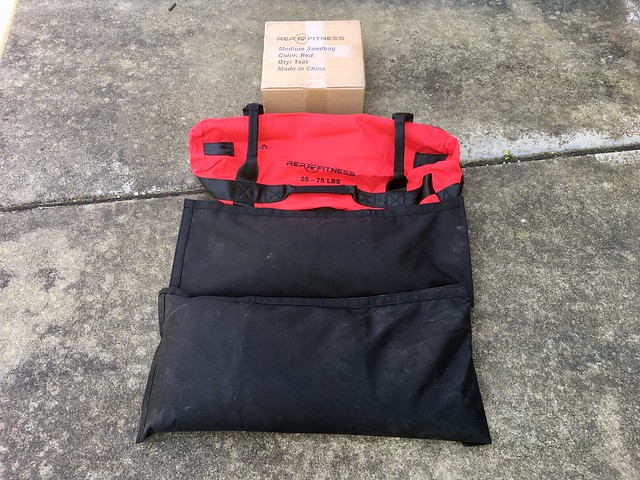

Rep fitness medium sandbag filling
Rep Fitness Sandbag with 15lb and 35lbs in filler bags
To the TKD, bodyweight, and cardio equipment, I recently added a sand kettlebell (20 lb) and sandbags (currently set at 15 and 35 lbs).  These are in the category of freeweights and along with dumbbells, were the featured equipment in the book Push, Pull, Swing by Myatt Murphy published by Mens' Health. The goal of the book was to explain that strength came from three types of motions (push, pull, swing), across three planes of motion. And if you did this, you would have all muscles in the body engaged (the contrast would be isolation training focusing on specific muscles, which is the principle behind the exercise machines you see at fitness clubs and home gym equipment).  The comparison between this and the dumbbells is that they are more unstable, so in addition to lifting the weight, you have to deal with the instability of the sand.  A second advantage is that they are made of sand, so I don't worry as much as the kids hitting or tripping over them since they have some give compared to iron plates in my dumbbells.  More recently, I've been building up my strength training so that in addition to the obvious presses and lifts, I learned more complex moves such as cleans, presses, and swings so that I can use strength training (dumbbells, kettlebell, sandbags) in exercises that hit a wide range of muscles and types of motion simultaneously.  Again, I also have Stack 52 decks for dumbbells and kettlebells. While I don't think the randomness is useful here, I have used the cards, the Push, Pull, Swing book, and YouTube to learn how to do even technically difficult exercise that require stability of the cores along with strength.
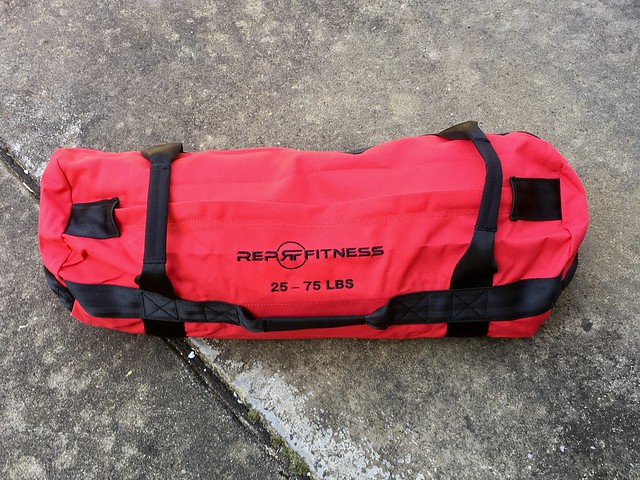

Rep fitness medium sandbag filling
Assembled 50 lb Rep Fitness sandbag
So, the current state of the home gym.  I know have 132 lbs of plates, and I am up to 86 lbs on bench presses and squats (the hightest weight exercise I do)  The dumbbells, kettlebell, and sandbag also  makes conditioning workouts more time efficient than the running or Total Gym used to be for me, with the suspension trainer and a range of kettlebell swings filling in for cardio.

I can see adding another sand kettlebell to round out my medicine ball and kettlebell weights, and I have room to add more weight to my sandbags.  My son has started using freeweights too.  I have him doing bodyweight exercises with the medicine ball (and I join in using the kettlebell) so this adds resistance. There are a few exercises designed for the kettlebell that medicine balls also work with so this will add to strength while maintaining stability and balanced development of many muscle groups at a time.  To add to the bodyweight exercises, I recently purchased an agility ladder, which both of the kids enjoy immensely.
Friday, May 11, 2018

Product unboxing and setup: Rep Fitness Medium Sandbag

Rep Fitness is currently offering a sale on sandbags, and I was looking at the fact that I was on pace to maxing out my strength equipment so I was beginning to plan what I was going to do next.  I currently have dumbbells, medicine balls, a sand kettlebell, and suspension trainers.  I was not interested in barbells because of their size and I think with a pre-schooler in the house I thought it would be a hazard.  So sandbags seemed like a good addition as it is two handed, but not as dangerous in the house as a barbell.


Rep fitness medium sandbag filling
Rep Fitness Medium Sandbag with 50 lbs sand


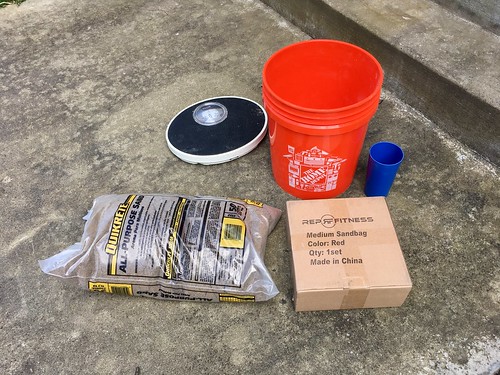
The Rep Fitness bag is essentially a reinforced duffle bag with two filler bags to hold the sand.  They are supposed to be 25 lb and 50 lb, but I filled them to 15 and 35 (i.e. I used one 50 lb bag of construction sand to fill them with).  Like all sand based weights, the Rep Fitness is shipped without sand, so I needed to fill it.

Rep fitness medium sandbag filling
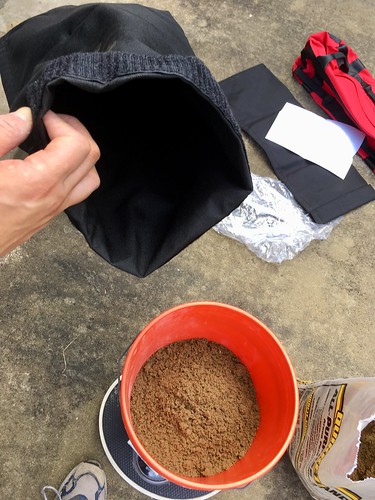
The box with the sandbag, along with the sand, Homer (Home Depot) bucket, and a scale for filling the filler bags

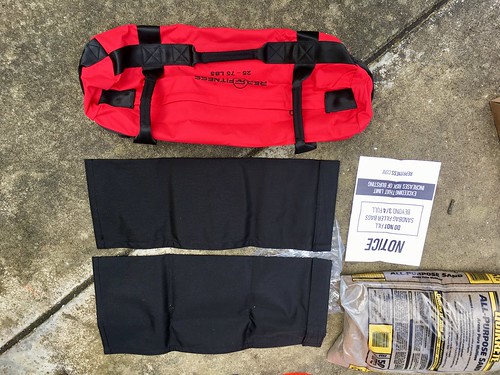
First step is opening the box.  The bag comes with two filler bags that are intended to span the length of the bag. Note that this is different than some of the cheaper ones, which would have more square filler bags.

Rep fitness medium sandbag filling
Shipping contents.

The next step was to pour sand into the bags.  I poured the construction sand into a bucket, and poured from the bucket into the filler bag.

Rep fitness medium sandbag filling
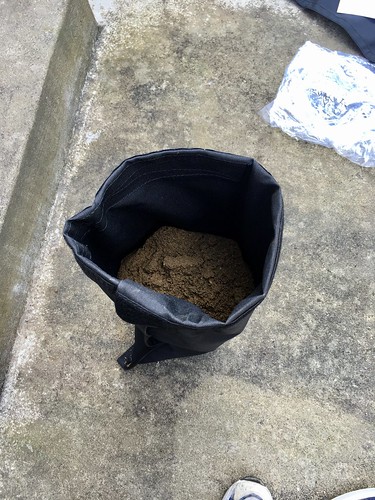
Loading sand into the filler bags.
To start out filling the bag, I would hold the bag standing with the opening open, and folding the top over the outside to keep the bag open while I was pouring in.


Rep fitness medium sandbag filling
Bag with 15 lbs of sand

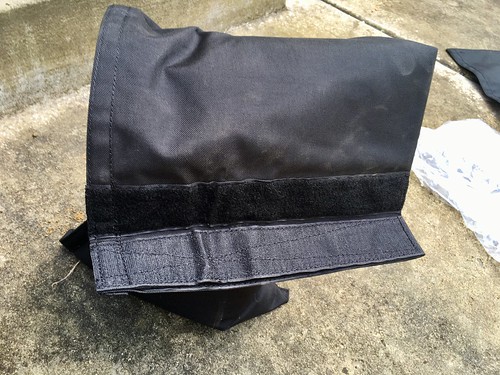
After filling in the bag, I closed it folded it to remove as much air as possible, then folded it down (there is velcro on the inside of the bag, and velcro to fold the top down one.)


Rep fitness medium sandbag filling
Folding down the top after putting in sand.

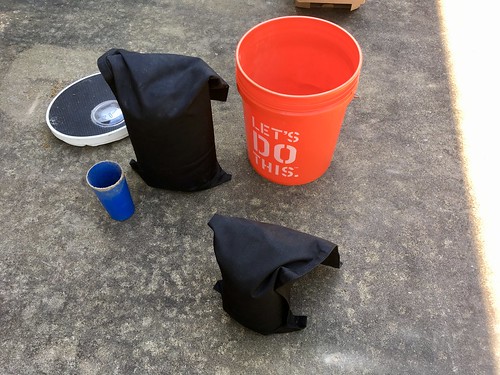
After closing off the bag, I shaked it so the sand that was in the bag could shift naturall from side-to-side.  Next I filled up the other bag, then laid the bags down and spread the sand out on both filler bags.  I then used duct tape to further seal the end and keep the end folded down.


Rep fitness medium sandbag filling
50 lbs of filled sandbag

Rep fitness medium sandbag filling
Filled filler bags with sand spread across the length


Rep fitness medium sandbag filling
Filled sandbag

The bag has seven handles.  One pair on the ends, one pair vertical, one pair oriented horizontally, and one centerline handle.  The first time I tried to do a clean with the bag I smacked my nose, which I gather from videos is not uncommon.  

When I only have 35 lbs, the bag is harder to manage than I expect comparing it to using dumbbells.  And when the bag is only partially full, there is a lot of flopping around, so cleans and swings tend to fly around more than expected, making workouts harder.

I have used it for a few workouts.  I especially use it when I want something heavy (compared to my 20 lb sand kettlebell) but my kids are around, because sand is not as rough as metal.  I use it for clean, deadlifts, bicep curls, shouldering, and rotations.  The big difference compared to dumbbell weights is the fact that weight is not concentrated on the handle, so all dynamic movements have a big inertia component that I have to fight to stop a dynamic move. 

All in all, a good addition to the home gym. It provides a different type of load, and I don't mind having it on the floor where the kids might kick it as the sand is not an issue.

With this, and the sand kettlebell, and the dumbbells, I have the full set of equipment that Myatt Murphy describes in his book Push, Pull, Swing: The Fat-burning, Muscle-building Dumbbell, Kettle-bell, & Sandbag Program.  So I will be reviewing that book soon.