Saturday, June 01, 2013

Building the Handyman Club tool-tote

The first real project was the tool-tote found at the Handyman club.  It was supposed to be a combination tool-tote and workbench/stool/sawhorse.  I figured it would be something S could use for gardening (since we don't have any organization for gardening stuff).  And a toolbox is high up on the list of early wood working projects (along with a sawhorse and workbench)

I got the plywood and the wooden dowel from Lowes.  (the rest of the plywood became the workbench top discussed in an earlier post.)  They cut it into rectangular pieces (which accounted for most of them.  I have to do any shaping, such as for the sides and rounding the handle brackets (and putting in holes for the handle to fit into later.

Cut and shaped plywood for the tool tote. The paint bottles were to size the box later.  One compartment was to be sized to fit those cans.

First, was the box part of the tool tote.  In addition to the base, there were two sides and a divider to put in. Using the vise part of the Workmate workbench, this was pretty straight forward.  Only complication was adding in the divider.  Because the divider was sized to be the attachment of a lid made up of plywood, I used two scrap pieces of plywood to brace the sides and the divider was just the right height.


Next was adding the box to the sides.  This is where it helped that my earlier project was to build a workbench.  One side of the workbench became an assembly area and the other half became a tool storage and part layout area.  The Workmate was for sawing and power sanding.  One problem here was putting everything together.  The plans called for 1 5/8" Deck screws.  But when they had to go in a piece of plywood on a 3/4" edge, sometimes the plywood would split.  Especially when countersinking the screws.

The main part of the tool tote. You can see the Workmate in the back set up for cutting a wood dowel handle.

The other difficult part was the handle.  First, the 1" dowel was just a little too large for the whole that I made using a 1" spade bit.  Not much of a problem, I took a file and filed down about an inch of each end.  The other mistake I made was where I located the brace.  It was offset from the center because I needed to make room for the handle.  But because this deck screw was going into the narrow part of the plywood, it did not want to countersink in.  So I had to move the brace to be far enough from the handle that it would not interfere with the handle rotating.

Completed tool tote / sawhorse

This tool tote was very solid.  I got up and stood on it and it did not even think of moving.  The result of building something using screws and plywood instead of tacks and particle board.  And it was designed to double as a sawhorse style workstool, so it turns out it is pretty big (18" long, 16" high).  So it may not be my wife's garden tool caddy after all.  We'll find a use for it. It may go to my in-laws when they move.

The point of starting out by making things like sawhorses, workbenches, and tool caddies is to practice skills.  I've never done stuff like this before, other than the occasional kit. And I've never really used power tools before.  Now in addition to the cordless screwdriver/drill, we have the oscillating multi-tool and a jigsaw.  And we added a number of new bits for the drill and I'll be looking at more blades for the multi-tool and jigsaw so we can handle 2x lumber in addition to plywood.  Skills are another area of growth.  I got a lot of practice with the combination square and speed square, and use some tips and techniques that were part of YouTube videos.  Also learned some of the limitations of the jigsaw and multi-tool (part of it was that I only have a limited number of blades) and my jigsaw skills in particular have improved over the three projects.

Next steps, inventory the scrap lumber and plywood to see what else I can make :-)


Friday, May 31, 2013

Parenting 31 months: The Ego has landed

We made it halfway through the 2 year old time with a very agreeable child.  His goto word when he did not know what he was just asked was 'yeah'.  His version of rebellion was "I do it."  This month, he has learned to appreciate the word 'no' and all of its friends and relations.    This comes along with being possessive of things (i.e. not letting go of his toys), and being generally willful.  Of course, being us, our response is to tease him for saying no for any reason at all.

Grandma was visiting at the first part of the month.  And she joined us for one of our favorite activities: going to a concert.  Fittingly, the concert was based on the book Where the Wild Things Are.


I'm going to a concert with Grandma

This concert also involved a train, which is something T does not get to do all that much.

Riding on the train with grandma

Now that summer has started, and our winter that did not want to leave is over, we are trying to get out more.  Swimming lessons have started.  But T is pretty bad at swimming.  Doesn't follow directions like blowing bubbles on demand or kicking or scooping (forward crawl).  It does not look like he is going to be prepared for graduation to the next level.

He is also highly imitative.  His new favorite toy is Handy Manny, which is based on a cartoon centered on a handy man and his tools.  He has the toolbox with the dancing/singing tools.  And he has enjoyed watching us do projects around the house.  And he likes to help out.  After all, he has Pat the Hammer, Rusty the Wrench, Squeeze the Pliers, and Turner and Filippe the Screwdrivers and he grabs the right tool for the job (ok, I think he sees what we grab and gets his version of it).


Riding on the train with grandma

Next month.  More projects around the house.  More outings outside (and hiking).  And grandma and grandpa come to stay!


Hiking in North Park in a ring sling

Tuesday, May 28, 2013

Building a sawhorse workbench

My memorial day weekend project was to build a workbench.  Now, I have not done real woodworking before, but a workbench is one of those traditional first projects.  And since we really don't have a place to put a workbench I decided to make a sawhorse workbench with a plywood top that I can breakdown and bring it into the backyard when I want to work.

First the size.  Well, actually, I was thinking of something less ambitious, like a toolbox.  But I found this nice set of plans for a toolbox that could do double duty as a stool for working in the garden, and it required a 4' X 4' piece of plywood.  But plywood does not come in that size.  It comes in 2' X 4' or 4' X 8'.  So I figured I'd get a 4' X 8' and whatever was left would become a workbench top.  Which means I'm making a workbench.  Now, that makes perfect sense, right?

First part, making the sawhorses.  As a bonus we have a couple cabinet doors that we want to make into a table for T, so it is ok to mess up one set.

I did the first pair of sawhorses using a couple of sawhorse brackets.  The idea is you put 2"X4" as the legs into the brackets, and the jaws of the brackets close down on another 2X4. (with everything screwed in for permanence.  Problem:  The brackets are just a little to small to fit in a 2X4.  A quick search on Amazon.com reveals this is a common complaint.  Apparently at least one manufacturer of these things doesn't recognize the difference between inner and outer diameter (I figure they are too small by just about the thickness of the metal.  So after way too much work shaving the ends of the 2X4's, I had the first pair of sawhorses.  These will someday turn into legs for a table for T.

Building sawhorse using sawhorse brackets.  I'm going to saw these down to size so everything is clamped up.

So, let's try again.  This time I'm building these from lumber.  There is a set of plans that basically call for making an I-beam and putting legs on them, so that is what I'll do.  Now, I did a layout of the 4'X8' and figured I can fit the toolbox all in 4' X 37", which leaves 4' X 59" for the workbench.  Cut that in half and I get a two-ply 4' X 29 1/2".  I wanted a little more stability than you get from just a pair of sawhorses 3' apart so I will put in joist hangers so I can have a pair of crossbeams for more stability.

First, make the sawhorses.  The joist hangers really don't work with an I-beam, so I'm making a T-beam, and attaching joist hangers to the vertical.

Joist hangers for the sawhorses

Next, complete the crossbeam.  The Workmate workbench is good for holding the vertical in place while I work.  Also have a couple of blocks to help hold everything steady while I put in the horizontal beam.
Finishing the sawhorse beam.  I'm a member of the "You can't have too many clamps" club

Two crossbeams, then attach the legs (all this is using 3" drywall screws and a cordless screwdriver).  Now I have two sawhorses with joist hangers for crossbeams.
Here is the frame of the sawhorse table.

For the top, I took the two layers of plywood, then glued and screwed them together (using Elmer's wood glue and 1" wood screws)  Clamp everything together overnight and I end up with a nice size worktable.  (oh, this is after taking apart one of the sawhorses and putting it back together because it wasn't really square on one side)

My first workbench

Some things still to do:
  1. Sand everything.
  2. Once I decide just where I want the table top in relation to the legs, I'll attach the crossbeams to the table top to give it more stability.
  3. Add in 3/4" bench dog holes.  Once I figure out where they should go.
  4. Probably fut a finish on the top (Danish oil?  Tung oil?)
  5. If I'm satisfied with the sawhorses (I probably will try to level them a bit better), I'll add in braces on the legs.  And probably a shelf on one of them (just one, so they will still be stackable)
Some things I learned along the way:

1.  Sawhorse brackets suck. Big thumbs down.  I'll never get those again.
2.  I probably was way too careful with clamping down while making the sawhorse.  It was a lot easier when I broke one of them down to put back together just bracing everything by hand.
3.  2X4 are not all alike in size.  Even when they come from the same batch.  Measure according to the actual piece you are going to put in.
4.  Jigsaws have to go real slow through 2X4's or they will bend.

Once I'm done sanding, I will actually get around to making that garden tool box that was the excuse for getting that plywood :-)



Saturday, May 25, 2013

A tale of two faucets


This week's task was to replace two faucets, to go along with the renovation of the bathrooms that my wife has been steadily doing.  We figure that the faucets are original with the house, and, well, they are in pretty bad shape.  Replacing the faucet was not hard, the problem was taking the old ones out.

Faucet 1
Faucet #2 with a base that has corroded through.

So the first task it get the tools.  Home Depot had some good instructions on replacing a faucet.  They also allude to the fact that hardest part is getting the old faucet off and I would need some extra tools.

iPad with instructions and some plumbing tools
So, I got a basin wrench for those nuts that were hard to reach under the sink and a locknut wrench for the locknuts that were holding the faucet in place.  The first faucet resisted the locknut wrench.  It finally came off after several days of using penetrating solvent into the faucet hookup.

The locknuts of faucet 1

And so faucet one was done.
One faucet done


The recalcitrant locknut and the beat up locknut wrench

Now for the second faucet.  This was harder because it was in a cabinet.  The standard nuts came off fairly easily.  But these locknuts were of tougher  stuff.


This locknuts did not just beat up the locknut wrench, they cracked it.

Locknut wrench showing battle damage in defeat

I finally decided to forget it and I cut off the stuck locknuts using an oscillating multi-tool.  After all, the faucet was so corroded that it was well beyond saving anyway.

The remnants of the locknuts and the tools that took them apart.

The replaced faucet

The end result, a second faucet done.


Wednesday, May 15, 2013

Stryker: The Seige of Sadr City by Konrad Ludwig

Stryker: The Siege of Sadr CityStryker: The Siege of Sadr City by Konrad R.K. Ludwig
My rating: 4 of 5 stars

Ludwig gives the story of the Siege of Sadr City as he saw it, as an infantry part of the 2nd Cavalry. And as in all stories that do this right, he does not start with the battle itself, but with how the elements were prepared to be sent into battle, so this book is a story of how a U.S. infantryman is trained, then equipped, then prepared for battle.

The first parts of the book could be subtitled as the making of an infantryman. Ludwig writes of his state of mind in choosing infantry as a branch when his recruiter told him that he had options. He focuses on his desire to challenge himself, and demonstrate that he could meet all challenges. And the disappointment he had when after finishing school he gets sent to a unit that was not deploying into combat anytime soon. The goal here is to explain the aggressiveness of infantry, why it is needed, and how it is distilled. We also get the source of their pride. It is not just the aggressiveness, it is also the excessive attention to detail required even under stress that is developed in training and emphasized and honed when infantrymen arrive at their units and are further trained by the NCO masters of their craft.

The second part was his unit deploying to Iraq, as part of the 2007 surge. I remember this period as the time I was preparing for deployment and my actual deployment into Afghanistan. And I also remember at this time we laughed at people who said that we (the U.S.) were doing well or even that we really had a handle on what kind of wars we were in. Ludwig's stories here are of what that confusion looked like on the ground. Of soldiers in combat who completed the tasks assigned to them, whether they be kinetic combat or direct interaction with Iraqi civilians or training Iraqi security forces, but those of us who were trying to direct them were still feeling our way through. And then there were those who liked to think they actually understood what they were doing, which made things harder on those who were in direct contact with reality like Ludwig. We see the conflict that he had of being highly trained, focused instrument, but with those who were directing that instrument blind and not willing to admit it, and the combat troops were the ones who paid the consequence, physically and mentally. And this was up against Iraqi militants who were the ones who had survived three years of battle with U.S. forces, and they had no trouble with recognizing reality. It was an environment that U.S. soldiers entering for the first time had to grow up in a hurry. And they did.

The third was the actual battle of Sadr City. Here we see both the situation in contact, the overall situation, and the situation as seen by the platoon and squad level (Ludwig's understanding is probably informed by the time he spent in the tactical operations center). Ludwig shows the effects of some policies that we put into place by people who were removed from the reality of contact with either the Iraqi people or the militants we were in combat with. But he also shows how some leaders could adapt when confronted with reality. What makes this part shine is how you can see the battle changing character as both sides are adapting and responding to each others actions. The U.S. utilizing their training and resources, the Iraqi militants using the lessons learned by the survivors of years of combat. This part is probably more interesting because I've read some reports that were from the viewpoint at the company and battalion level. And I can see this narrative on the ground interweaving with how this battle was reported at higher levels. There is one scene where Ludwig leaves his unit to see General Petraeus. It was an amusing scene, and one where Ludwig depicts Petraeus in a highly positive light, unlike how he tends to view those removed from actual combat.

The last part is the aftermath. And Ludwig's goal is not to talk about the war in general, but to continue what he has done and what the aftermath looked like to the individual infantryman. And this meant what happens after they return to the U.S. For those who did not re-enlist, this meant re-entering the civilian economy with all of its difficulties. But this is the part that makes the book different, it starts with the young man who leaves his home to find the challenge of infantry, and ends with him returning after serving his nation in combat, and struggling to reintegrate himself after his nation has prepared him to face challenges under stress, but it itself is a society that does not value that.

I would put his as one of the books that should be read. Maybe even up there with Caputo A Rumor of War or The Things They Carried because of its completeness, for starting with the formation of a soldier to the return of that soldier to a not always remembering nation. And maybe we can remember what we have created with our Army. Men who are disciplined and focused to meet any challenge and mission under stress, but out of place in a society that works so hard to remove challenge and stress from life.

View all my reviews

Wednesday, May 08, 2013

Heinz Hall, Where the Wild Things Are

Waiting to see some Wild Things

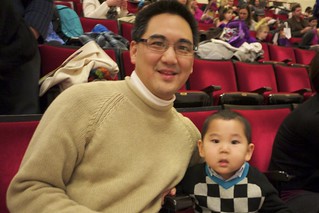
When we found out about the 'Where the Wild Things Are', we started to prepare my two year old for it. We don't have the book, but I found videos of dramatic readings and readings set to music to get T familiar with the story. So we talked about it every day this week. Finally the day came. Today was a daytime father and son (and grandma) outing. Part 1. The train. Because while the train is a favorite toy in the house, T does not actually get to ride in one very often, and a concert during the day in Heinz Hall is a good excuse. Part 2. The concert. We said hi to one of the Pittsburgh Symphony staff who recognized T from Fiddlesticks concerts. And after walking around Heinz Hall to burn off some two year old energy, we got our seats in the family section. Front center of the Grand Tier. The best seats I have ever had!

We did not check the program, but I found the format to be a lot of fun. There was a piece with every scene of the story to fit the mood of the story. A Mendelssohn for the conversion of the room into the forest. Schumann for the voyage on the sea. Music to go with meeting the terrible Wild Things and for the rumpus. And the voyage home where there was good food to eat.

The kids enjoyed it. One of the nice things about this is that there is no artificial constraint to not respond to the music like normal concerts. So you had kids dancing in their seats. T would alternately huddle in nervousness and laugh and wiggle in glee as the scenes and the music changed.

But by the end he was ready. As the voyage home started T picked up on his cue and asked to 'go home.' And this very happy little boy enjoyed a train back home. My wife has informed me that 'Wild Things' has entered his vocabulary, so I think we are declaring this to be a successful outing.

Monday, May 06, 2013

Parenting 30 months: Toddler in motion


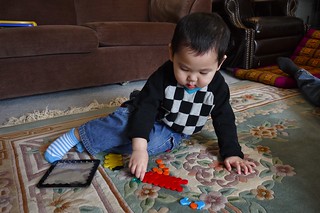
This past month T has turned into a proper toddler boy. Constantly in motion and talking. Some well used phrases include "I needs a ___" and the related "Is that a ___?" (where ___ is usually food) "Look daddy/mommy" "This way" "go home" (when he is tired). And then his favorite toys "marble run!" "Handy mandy" And some favorite videos "Pocoyo" "fun fun elmo" "three-two-one" (a video that includes a rocket)
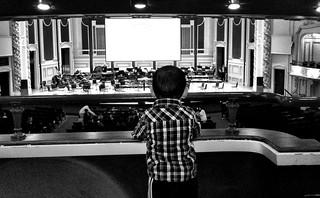
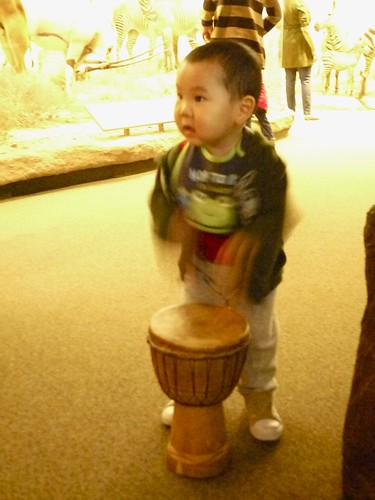
 I can play drums on the rail in Heinz Hall
He also has the proper toddler attention span where he switches activities about every minute. We think that this is a result of being socialized at day care. He is having more fun there. He plays with a couple of other kids (who seem to have selected each other on the basis of equal verbal skills). Actually, some of the kids in the day care act like moms and as one of the least verbal kids there, these kids like to act like he is the little brother (I think they do this with any of the less verbal kids) Its funny when I come to pick him up, if he did not notice me come, one of the mommy type kids will announce "T's daddy" and go get him, and his jacket, and maybe other things that he needs to bring home. He is still a very curious little boy and likes to explore. Of course, this seems to be more true when either mommy or daddy are around. One of his latests interests is rockets. He likes to watch rocket launches "five four three two one zero liftoff!" and the Lego set is currently set up as two rockets ready for launch.


Learning how to use a glovebox

The next month highlights will be visits from auntie and grandma, and the end of school for mommy and daddy, which means mommy and daddy school begins in earnest :-)
Wednesday, May 01, 2013

A recap on work flow, note takers and task organizers

Some experiments I have been doing with workflow over the past semester as introduced on this post back in January

1.  Using Pandoc, Markdown, and pweave for class preparation.  

I did the notes for my Logistics and Supply Chain course completely in Markdown.  This included slides for in class presentation, writing homework solutions, and everything else with the class preparation.  I wrote a Makefile that took care of everything.  Basically what it meant is that to create slides for class prep I wrote it as a text file.  It does force some simplicity because there is no ability to tweak a slide or an image.  But that is probably a good thing because it forces efficiency.

One nice advantage of using pweave for homework and exam solutions is that it makes it easy to have multiple versions of an exam.  If I have equations and steps in place, I can change a few parameters, and maybe an assumption or two and I have a new problem with not much extra work.  Also I did a lot of cut and pasting of code.  The code I wrote for presenting in class became the code that I used to solve the homework.  And since I let them see the code (and I also copied over the equations needed to solve the homework) it connected the homework solution to the lectures.  One issue is that so few of my students were competent programmers in any language that the Python code was not all that helpful to them (other than proving that I did indeed solve the problem)  But this was a definite success.

2.  Using Mercurial as a hosted version control system.  

I had to work with a new team on one project I was working on, so the first thing I did was to move the  former post-doc's work into a version control (Mercurial) and put it on a hosted repository (bitbucket).  And we spent a month refactoring the entire thing to separate out the code from the site specific bits (because we were going to apply it to a new location).  The repository meant that we were able to be aggressive in refactoring (yes, I did have to completely through out a day of work at one point because what I was thinking was not going to work.  All I did was wipe my directory and reclone the repository)  The others got into the hang of putting everything in the repository as well.  Now, the comments are not all that good on the part of the post-doc and grad student working with me, and we tended to work in separate areas so it was not true collaborative programming, but it was not bad.

I plan on continuing this over the summer with a few students who are learning agent based modeling together.  The intent is that if all of us are putting our models in the repository, we can ask questions like "why does ___ not work" and we can have their model to look at.  We'll see how that works.

3.  Google Tasks as a task organizer  

This worked out pretty well.  I ended up using Google tasks as a note taker (more on that later)  I was off an on regarding being consistent, but there were periods where I had a lot going on that this to-do list being available on all of my computers, my iphone and ipad was very useful.  Keep doing this.

4.  Tomboy as a notes organizer. 

Note taking sounds like a no-brainer.  Not.  This one pretty much died.  In February Canonical eliminated an API that enabled use of Ubuntu One as a storage place.  So I ended up storing the notes data on Dropbox (so my Windows and Linux machines were synced).  But the iPad app that integrated with Tomboy no longer worked, so if I was using the iPad, the notes were not integrated.  And this pretty much meant I was not using Tomboy notes.  Sometimes I would create a task in Google tasks and create a note if I needed something.  But generally this went unused.

I'm going to try this again.  But since I realize now that having it on my iPad and syncing to my computers is the key to the whole affair, my main focus was on the iPad integration.  So I am looking at Simplenote for the note-taking. It is originally designed for iPhone/iPad, and there are applications on Windows and Linux that integrate with it (and also the Google Chrome browser)

Sunday, April 28, 2013

Lean Analytics: by Croll and Yoskovitz (book review)

Lean Analytics: Use Data to Build a Better Startup FasterLean Analytics: Use Data to Build a Better Startup Faster by Alistair Croll
My rating: 4 of 5 stars

Lean Analytics bills itself as how data can be used as a startup. But it really is how you use data to make and check business decisions. And it takes the discussion of key performance indicators and puts them into a context where 1. data is readily available and 2. analyzing the data is relatively easy if you knew what data to look for and what and why you are analyzing it.

The first part is fairly standard fare for metrics oriented organizations. A discussion of what data is, how to choose measures, recognizing that data is never clean. But the rest of the book starts through a range of scenarios. Different types of businesses. Different stages of business development. Different competitive environments. With the variety presented, the point is not to find the chapter that matches your situation or to pick at a description and find ways that it does not apply, the point here is that data-informed decisions have a place in a wide range of contexts. The goal with metrics is not to decide that because it is not perfect it cannot be used, the goal is to use data in a way that complements experience, instinct, and intuition in making better decisions. For that, Lean Analytics is good to read for anyone thinking about how data can be made to work, not just in internet based startups.

Disclaimer: I received an free electronic book edition of Lean Analytics through the O'Reilly Press bloggers program.


View all my reviews

Saturday, April 20, 2013

Fernando Perez: "Literate computing" and computational reproducibi...

Fernando Perez: "Literate computing" and computational reproducibi...: As "software eats the world" and we become awash in the flood of quantitative information denoted by the "Big Data" b...


I am teaching a course in logistics and supply chain.  Because the course is focused on the modeling of supply chains, and the students are generally using Excel (I actually did all of the homework solutions in Python) I used the Reinhart and Rogoff’s “Growth in a Time of Debt” discussion as a mini-case (every class I find an article to discuss.  Usually it focuses on business decisions, but this time I chose this topic.)

The focus on the class discussion was on how you look for errors.  Because Excel makes this nearly impossible, the real question was on how you focus your time.

But the real answer, as Perez mentions, it to use tools that make reproducible research simple.  The homework assignments I gave resulted in spreadsheets that covered 4 tabs and were a couple hundred columns and thousands of rows.  My solution in python was about a page of commented code which had a near one to one correspondence with the mathematical formulation of the model (with the addition of a few lines to read and massage the data.)  The spreadsheets were pretty much un-auditable.  My code had comments that would tell a reviewer what to look for.  Even for smaller problems, my students spreadsheets were fairly obtuse while my Python programs (I use Pweave) alternated between the explanation of each step with the calculations described.

The Thomas Herndon, Michael Ash, and Robert Pollin paper included R code that both demonstrated the effects of the errors of Reinhart and Rogoff.

http://www.peri.umass.edu/236/hash/31e2ff374b6377b2ddec04deaa6388b1/publication/566/

For fun, Vincent Arel-Bundock has converted the Herndon, Ash, and Pollin into an iPython notebook, suitable for looking at (and reading) as well as downloading it and playing with the data to test any thoughts someone may have about testing the impact of various types of errors.

http://nbviewer.ipython.org/urls/raw.github.com/vincentarelbundock/Reinhart-Rogoff/master/reinhart-rogoff.ipynb

Saturday, April 06, 2013

Going to Fiddlesticks concert, and it was a MEOW

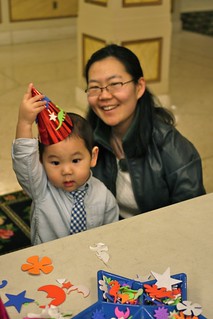
This was our second Fiddlesticks concert. And this time around S joined T and I. First, we got early so we could enjoy the pre-concert festivities. To celebrate Fiddlestick's birthday, T decorated a birthday party hat.
Here is the hat I made.  It has a dinosaur.
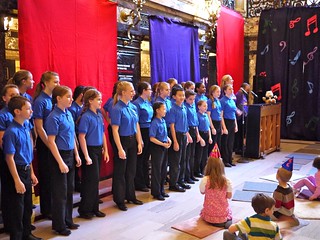
Next was learning the songs for the concert. The Pittsburgh Children’s Festival Chorus was performing some of the singalong songs along with some movements. The first time T sees anything he does not really react but is very intent so we never know what he is understanding
The Children's Festival Chorus at the Fiddlesticks pre-concert
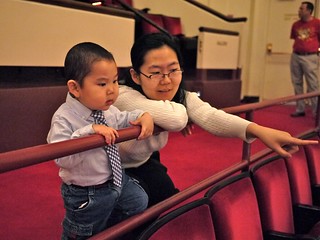
Leading up to the start of the concert we brought T up the concert hall. He loved the view from the balcony where he could see everything going on. The instruments, the performers coming on stage, the audience filing in.
What instrument is that on the stage?
But (surprisingly enough) it was the music that took first place for T. Since the theme was Fiddlestick's 20th birthday, the theme was cats (Fiddlesticks is a cat). So the first song was The Waltzing Cat by Anderson and Ms. Williams cued the audience on when the 'meow' came up so the kids could join in. Then the Cat Duet by Rossini was performed featuring Ms. Williams and Ms. Maloney. By this point T was very happy, enjoying the music, the silliness presented on stage, and generally responding to the music. When we got home, it was clear that he remembered everything. We found a video of a performance of the Cat Duet that we played in the background while eating lunch. And if we were wondering about his remembering the concert, we found that he remembered the Fiddlesticks Theme Song dance. Clearly, he spent the sing-a-long session committing it to memory. A thoroughly fun time. And something that we will do again someday. [Preconcert thoughts at the Pittsburgh Symphony Blog]

Thursday, April 04, 2013

Let's go sing Happy Birthday to Fiddlesticks! at the Pittsburgh Symphony Orchestra

[This is also at the Pittsburgh Symphony Orchestra Blog Site] It's Fiddlesticks' birthday! And we are going to a concert! This coming Saturday will be the second time we have gone to one of the PSO Fiddlesticks' Family concert. The first time we did not know what to expect. But now that we do, we'll be ready to enjoy it. Fiddlesticks Happy Birthday Concert

For both of us, music had become a part of our lives, something that we can share and we wanted our now two year old son to do so too. But the question we had was what did that meant. We've seen the fads that listening to music would make a child smarter but we did not want any part of that. Because we were also not interested in a passive child. As we have exposed him to music in our lives, he has listened to my wife's playing the piano, watched videos with music in the background and of performances, and yes, even some videos aimed at toddlers that included classical music. But he does not just listen and watch. we are thoroughly entertained by his response to the music. In the ways of a two year old with limited oral skills and coordination, he sometimes just listens, sometimes he sings along, sometimes he pretends like he is conducting the piece, and sometimes he tries to dance ballet, sometimes hip-hop, and sometimes just jumping and moving to the rhythm.

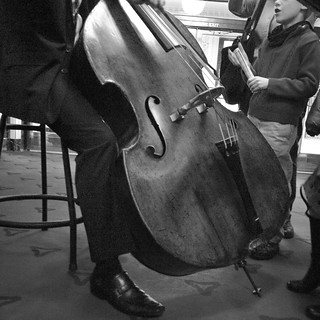
Talking about a Bass

We've brought him to concerts, recitals, and performances and appreciate the venues where you are not just a spectator, but you can react and respond to music as you experience it. And that is what I most enjoy about Fiddlesticks. The relatively modern traditions of being quiet and not responding to a performance are put aside, and we can react to what we see. We enjoy the performers interacting with the kids sharing their joy of playing.

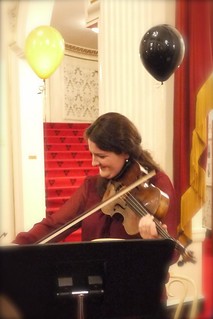
PSO viola working the crowd before Fiddlesticks

And this is what we want our son to experience as he grows. Not a world where he is a spectator, but a world where he takes in the environment and responds to it. And someday, create something to add to this environment.

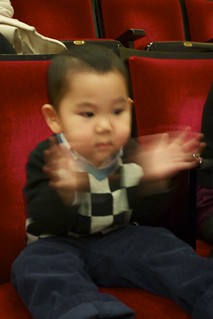
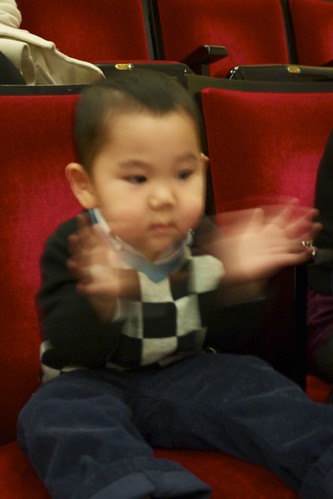
Clapping for the PSO

Monday, April 01, 2013

Parenting 29 months: Playing around

Playing with Marble Run by LugerLA
Playing with Marble Run, a photo by LugerLA on Flickr.
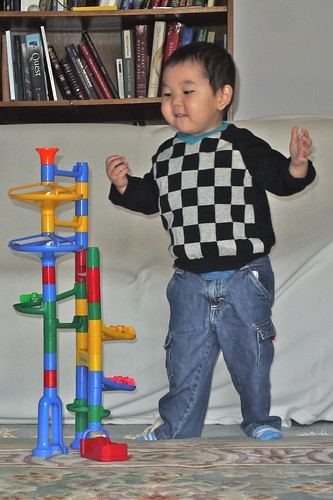
This month was one of learning about playing. He loves the marble run toy. The learning development people say it is because he can handle the fine motor skills involved and there are lots of movements that are consequences. At this point, we build it and he just makes the marbles go around. But we figure that this has a long lifetime since someday he will learn how to build designs as well.  Legos and trains are the same way, he likes to play with them, but does not yet have the coordination to design.  But he is starting to have some creativity in design.  We have another puzzle game that he has figured out his own way to play.  He calls it choo-choo, because he likes to line up like pieces in a row, like a train.

I think that this is how to do this puzzle.
 The other task has been trying to maintain his chinese with his grandparents gone. TV actually helps here. Sesame Street has a series of shorts called "Fun Fun Elmo" which is aimed at Chinese-american kids in Brooklin and Queens, NY. Pocoyo has a Chinese translation (including a narrator whose day job is as a comic). And there are a number of CCTV videos available on YouTube as well. Fun Fun Elmo actually is doing a reasonable job. We (well, S) has noticed that his pronunciation of words in the show is improving. And through repetition he can actually recognize a few characters.
 
More recently, he has started to become more sociable. Latest report from day care reports him causing trouble along with another boy in the class (a drinking game no less). So that is a change from him finding his own corner to play in. Probably a good thing. And the attention span has seemed to return, so we can get him to sit and read along for a couple books at a time. All in all a good month.

Tuesday, March 12, 2013

Digital Capture After Dark by Amanda Quintenz-Fiedler

Digital Capture After DarkDigital Capture After Dark by Amanda Quintenz-Fiedler
My rating: 3 of 5 stars

Digital Capture After Dark focuses on the taking of pictures in low-light conditions. It provides a compilation of techniques covering equipment, the actual taking of the image, and post-production. It does a good job of putting together in one place a wide range of considerations from technical to practical that are involved in various forms of low-light photography and the effects that these have on the final image, but while it does provide some nice examples, I would have appreciated more discussion on why certain effects are worth having or what makes the pictures that were printed worth looking as examples of the art.

One important characteristic of low-light photography is the inability for camera automatic systems to adequately observe and set the camera controls for the image. Because of this, low-light photography requires more understanding of what you are doing than normal, especially for those who are used to either automatic cameras or using the camera auto-exposure settings. Having learned photography using a manual camera, many of the techniques and advice given here were familiar to me from learning how to take photographs efficiently without the computer aids. Quintenz-Fiedler provides these types of tips, along with many practical pieces of advice on working in non-ideal environments (both natural and social) that come with low-light settings such as night, indoors, and oddly lit areas. She covers preparation (getting ready for the shoot), the capture of the image itself (traditional low-light photography as well as some more current techniques such as light painting) and post-processing using image manipulation programs.

The methods are all good, although I feel these are things I've seen in many articles and other books. But the one advantage of a long form such as books is the space to discuss why you want to do something in addition to how to do it, and that is an opportunity missed. There are many photographs scattered throughout, and in several places pages of photographs in succession, but she does not generally take the time to say why particular images were chosen or what to about the image makes it notable. (She gets better at this when discussing light painting and image processing.) In particular the 'Capture' chapters on taking the photograph itself would have benefited from this. It is not just the technical issues that need highlighting, it is the artistic choices that the technical issues enable. If this were there, this would have been a good book on photography in low-light rather than a set of how-tos that happen to focus on a particular theme.

Note: I received a free copy of this ebook as part of the Oreilly Press Blogger program.
I review for the O'Reilly Blogger Review Program
View all my reviews

Sunday, March 03, 2013

Parenting 28 months: Back to daycare

Clapping for the PSO by LugerLA
Clapping for the PSO, a photo by LugerLA on Flickr.
With the grandparents gone, it was back to daycare for T. And he picked up right where he left off. With full days of crying for the first few days. With time this has improved so he almost enjoys it now. He even says that he wants to 'go to school.'

Day care does have certain consequences. First, he is now sick all the time. They definitely learn to share in day care. And he brings it home. So we have had a sick household this past month. And we have had to skip our usual museum outings (daddy is very unhappy about this).

Some other things that come with daycare and being sick. We've noticed that his attention span has declined. So he does not focus on one thing for extended periods such as a single toy or reading multiple books in succession like he used to. Almost like a normal toddler.

The months seem to settle in a rhythm. Get up. Get him ready for day care. All of us leave the house. Someone picks him up after work. Eat, play, put him to bed. More work after he goes to bed. Repeat. Hoping that he gets better this month.

Via Flickr:
Applause for the Pittsburgh Symphony

Thursday, February 07, 2013

Review of the R Graphics Cookbook by Winston Chang

R Graphics CookbookR Graphics Cookbook by Winston Chang
My rating: 4 of 5 stars

If using the grammer of graphics as implemented in ggplot2 is like learning a new language, the R Graphics Cookbook is not a book that tries to teach you a new language, rather it is like learning a language through using it and is a different take on ggplot2 and graphics in R than other ggplot2 books.

ggplot2 has always presented itself as learning another language. And while it seems that a grammer of graphics is the right way to go I have always had a hard time getting a handle on it. But while the idea that you can build graphs through a grammer with a consistent meaning is elegant, sometimes you need to start by accomplishing a task. R Graphics Cookbook becomes very much like a phrase book you need to get started. Some of the earlier chapters cover categories of graphs and work you through the variations. Other chapters focus on the graph annotations, titles, axis, labels, etc. And since this is a grammer, you are assured that this is applicable to all of the types of graphs that were covered earlier.

Another aspect of this book that is helpful is the chapter on data munging. While this book focuses on graphics, the principle library, ggplot2, requires that data has been shaped into data frames before using it. But this becomes an overhead that I'm not used to coming from other graphics and plotting paradigms such as in Matlab, Python, Excel, etc. So the chapter on getting data into shape is important. This includes creating data frames, creating new data frames for purposes of generating graphics, and modifying data frames so that they yield more elegant graphics.

I still think I will have to understand the gglot2 book to understand the grammer of graphics in detail, but this book is better for me to get work done, and may make the difference between using ggplot with its elegance rather than other graphics libraries that I use when I get frustrated by the overhead to get started.

View all my reviews

 I review for the O'Reilly Blogger Review Program

Saturday, February 02, 2013

Parenting: 27 months - Back to daycare

I want to go that way

We have had the benefit of having my in-laws staying with us for several months again. Alas, all good things come to an end and they returned to China. My son is especially sad because that means he had to go back to day care. And he reacted the same way as before. With marathon crying sessions (he has the endurance that befits the son of two marathon runners.) But by the end of the first week, he was at the point where he was not crying all the time. And we suspect he even played enough to learn a song or two. He has never been good about playing with other kids, so that would be the next milestone to hope for.


This month also saw being more engaged with the world. Doors are meant to be opened and passed through. Button's are to be pushed.

He has turned into a little recorder, with a surprising ability to repeat words. Fortunately, these have been pleasant surprises, like 'Fiddlesticks', not embarrassing ones :-)  There are a number of books in the bedtime rotation that he know can say most of the stories.  I joke that when it is bedtime his job is to read to daddy, not the other way around. Current favorites are "Someone is coming to this house (a story of the nativity from the point of view of barn animals anticipating a visit) and A Book of Sleep (a story of an owl observing everyone else going to sleep at night).  Before he started day care we went to a performance night at the daycare and taught him some of the songs and dances that they learned there.  That was very easy to pick up and we can set songs on repeat for him to dance away on his own.
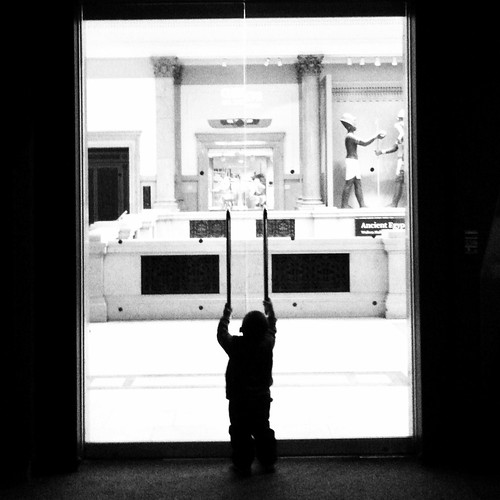
Next goals:  playing well with others.  Hopefully daycare will help here.

My companion at the PSO Fiddlesticks

Tuesday, January 15, 2013

PSO: A life with companions for the journey

It has been a while since I've been to the symphony.  On occasion I get asked why go through the trouble and expense of hearing symphonic music live. Every time I go to a concert it I remember.  It is the richness of the sound, the interaction between the instruments, and the range of the instruments, as they call out and respond to each other.

For this concert was a piece written by a composer with an equally illustrious friend and musician who would play it. There are a few ways this could play out, but with the maturity of age, what comes across is the range of expression.  Some somber, some light and almost whimsical, and some parts bursting with excitement.  And you could see this in Noseda and Dindo on stage. Noseda with his expressiveness ranging from delicate to so much energy I thought he would fly from his podium.  Dindo's feeling in his playing reflected in his expressions showing as he played.

And that is how you hope that friendships will be.  Full of memories, some somber, some whimsical, some bursting with excitement.  Not everything in life should be burdened with the requirement to be deep and full of meaning, but the realities of life's journey means parts of it may very well be, and you want to have friends and companions along the way.  And there are parts of life which do not have meaning beyond the moment, which companions to share in the ephemera.  But even better is when you have companions along the way in both the special and the mundane, in life's milestones and the somber and contemplative parts of life.  Because your relationships should be with people in their fullness, not to be casually cast aside.  And the cello concerto was like that as well, full of the richness of life in its grandeur and the mundane weaved together like a life to be lived will among friends that deserved to be remembered until the end of your days.


Sunday, January 06, 2013

2012 Python meme

I think the official rules are here.  I don't have a Twitter feed, so I'll just put this tag in my labels.
  • copy-paste the questions and answer them in your blog
  • tweet it with #2012pythonmeme hashtag

1. What’s the coolest Python application, framework, or library you have discovered in 2012?

Hmm, I got to know alot about pandas this year, but I discovered it before.  So I have to say pweave.  I learned the whole concept of combining the narrative discussion, code, and output in literate programming through Sweave in R, and I love the idea of doing the same in Python.  Combined with Pandoc, this means I can write explanation, code, and results, have the data or code change, and my slides or documents are updated automatically.  And that makes a lot of things work better.

2. What new programming technique did you learn in 2012?
Using list comprehensions and other functional programming based patterns in data analysis.  Most of the programming I do tends to be data analysis (because the students and post-docs I work with are not skilled in this), and my code has been turning more functional over the year.

3. Which open source project did you contribute to the most in 2012? What did you do? 
Not much in the way of direct contributions.  I filled out bug reports with both pandas and R Studio.  I actually enjoyed the interactions I had with developers (both have developers employed by companies that are focused on these products) as we trouble shot the code and developed working solutions.

4. Which Python blog or website did you read the most in 2012?
I cheat and use Planet SciPy and get all of the scientific programming in Python blogs.

5. What are the top things you want to learn in 2013?
Working with both simulation libraries (SimPy) and optimization modeling languages (Pyomo or PuLP) and working them into a real problem.

6. What is the top software, application, or library you wish someone would write in 2013?  
Round trip between iPython Notebook and Python with Markdown.  Right now I think I have to choose between workflows, and there are some nice parts about each that I would like to keep.

I could say more Python 3 migration, but there are so many pieces that have to be moved, this would hardly result in a top N list for any reasonable value of N.

Personal experiments on workflow, note takers and task organizers

This semester I'm undertaking a few experiments in productivity.  Now, most of my work as a professor does involve computers, either developing and implementing models and methodology, preparing course lectures and materials, and communicating, and managing others.  And this spring, I have a fairly challenging schedule from an organizational standpoint.  In addition to the standard course and research projects I am working with a new (to me) graduate student and post-doc, I am running the department senior project course (with the department chair to back me up), and I am involved in one of those long-term career milestones.  So part of this past winter break was spent setting up systems to improve productivity.  Some minor workflow issues.  And some larger ones.

1.  Using Pandoc, Markdown, and pweave for class preparation.  

I long ago decided on Beamer as my preferred method for preparing presentations.  Using LaTeX essentially forces the use of styles instead of fiddling with page layout (or having your styles get overridden without notice) and I can focus on content rather than form.  But there is alot of scaffolding that goes into any LaTeX document.  Enter Markdown.  I already use Markdown with R using knitr, which allows me to keep both the documentation about a method along with its coded implementation and the output of the code in a single document with a syntax that is not that far off what you would naturally do if you had to format a document using plain text (e.g. using Underlining and blank lines to set off headings or '*' to identify emphasized words.)  So Pandoc is a utility that allows me to use Markdown format to generate slides in HTML5 or as PDF files (via Beamer).  And pweave does for Python what knitr and Sweave do for R, combine the documentation of algorithms, the implementation, and the output in a single document where the output will automatically update as the implementation or the input data changes.

So now, I can build slides in Markdown that includes the lecture, the math model, a Python implementation of the math model, and the output of the implementation.  And since Markdown is a lot less complex than LaTeX, hopefully do this faster than I was before.

2.  Using Mercurial as a hosted version control system.  

I was running a project that was based on a simulation being built over a period of years by a post-doc.  However, he was really the only one working on the code.  It was at the point where I wanted to do some side experiments with our model, so I wrote another implementation in Python. (note, using SimPy, it took me two weeks).  But now he has moved on, and I'm still working on the project with another post-doc and grad student. So, since they are new, and we are jointly working on the model to apply it to a new system, I've taken the model from Dropbox (shared folders) to distributed version control, namely Mercurial on Bitbucket.

While Git is the more popular (at least among hipster elite programmers), Mercurial uses commands similar to Subversion (which the post-doc already knew) and tools were readily and obviously available for both Windows and Linux.

I've been using Mercurial and Bitbucket for my own projects including coding and writing papers in LaTeX for a while now, but this is the first project of my own that I have other people working with the same repository.  So I'm training them along the way.

3.  Google Tasks as a task organizer

I've started using Google Tasks. At one point I was using Remember the Milk, but I stopped because it was not integrating well with Google Calendar (which is how I do my scheduling). (RTM put an entry into every calendar day, which means I had to open my calendar to see if the marker was real or empty)

So with Google tasks, I can create a task in the Google Calendar sidebar, in the sidebar of Google mail, or there is an iOS app (GoTasks). The interface is not as pretty as Remember the Milk, but it works better with my Calendar. And the iOS version is not crippled (RTM is limited to one update a day on the free version).  The main criteria here was the fact that it worked on all of my computers (I use Windows, Mac OS X, and Linux in different settings) as well as my iPhone and iPad (because I often go to meetings and trips with just my iPad and not my laptop)

4.  Tomboy as a notes organizer.

This past fall I was working with an undergraduate who learned the use of MS OneNote while a summer associate with McKinsey and I was impressed about how well he could organize and use these free form notes. I had been using Google Docs to do this, but the need to get on the internet, fire up the browser, and then work was sometimes too much, and it was hard to organize.

Tomboy is a fairly lightweight application.  It provides a formattable and linkable text area, but not as heavy as most desktop applications.  Tomboy can also work with a cloud storage account such as Dropbox or Ubuntu One to keep the data in the cloud, to be synced whenever your computer is on-line.  So now, I have set up a notes folder for the senior design project, with subfolders for each team, a folder for my major research project (with the grad student and post-doc), and my other project.  And I know have collections of short notes that are each dated, identified with keywords, and linked to each other as much as needed.  And I can access and edit them from each of my computers, my iPhone and iPad.

So, here is the great experiment, cobbled together in the midst of all the other work and writing I was doing over the winter break.  And next week is when the fun starts.

Monday, December 31, 2012

Parenting 26 months: For your entertainment, tonight's concert is . . .

This month T has been learning how to use his voice.  And he practices by singing. Unfortunately, he does not come with a volume control.  But he gets lots of points for singing with enthusiasm.

Some favorite performance pieces include Old MacDonald has a farm and Twinkle, Twinkle, Little Star.  But the absolute favorite is Da hai-guxiang.  He has been asking grandma (lao-lao) to sing this for him at naptime.  Now, he wants to do the singing.  And from watching videos he knows that a proper singer needs a microphone, so if he can get hold of any microphone shaped object (markers are the main standby) and an audience he bursts into song.

He also likes reading.  Now, part of the nighttime reading routine is we read a book, but he reads at least one.  Christmas saw the Who is coming to our house? as one he quickly learned most of the words to.  Other books that he reads in part include "Freddie Frog is Hungry",  "Little Pea," and "That's Not My Dinosaur!"   And then there are the books that he reads out loud in full.  "Brown Bear, Brown Bear, What do you see?" and "I am Sam"

My wife has been packing up older toys to give away.  He had a fun time going through the boxes playing with some of them, but he has never been all that serious about toys.  When his older cousin visited for Thanksgiving one of his first comments was that we did not have any toys (slight exaggeration, he is only four).  While he does play, we are far and away still his favorite playtime accessory (followed very closely by grandparents).


Sunday, December 30, 2012

Book review of Statistics in a Nutshell 2nd ed. by Sarah Boslaugh

Statistics in a NutshellStatistics in a Nutshell by Sarah Boslaugh
My rating: 4 of 5 stars

One of the biggest problems faced in teaching statistics is the gap between learning the methods to actually using them. Statistics classes that are based on learning formulas fail due to the disconnect between learning formulas and the reality that very rarely are these methods used by implementing the formulas that are so painstakingly taught. But learning statistics as a set of steps or functions in a computer package only gets a little further. The real goal should be what methods should be used and why. The how is almost secondary. Statistics in a Nutshell focuses on the what and the why. I would not use this to learn how to perform a technique or its formulas, but this is where to go to understanding how the various methods of statistical analysis should be used and their qualities. It is meant to be read, not just studied, and as such it holds a different place than other statistics texts.

When I first learned statistics, the focus was on learning formulas that calculated various values. But the problems I could work on were only toys, and it took so long that we did not get into much of understanding what we were dong. Now with readily available software packages, the temptation is to focus on the mechanics of implementing a procedure on a set of data and reading the computer output. But software documentation and even books that teach statistics fall into the trap of focusing on how a method works then applying it and not as much on why. Part of this is because of the pressure of having to cover topics, but the fact that the methods are presented in isolation, without their application context so it is rare to grapple with the question of how to know what needs to be done and instead the focus is on how to do it.

Statistics in a Nutshell is the other kind of book. I was taught that for computer programming for any language you wanted a book that focused on methods, but also a book that focused on morals, the why you use a language feature. This is the morals book for statistical programming. You read it, not to learn how to calculate statistical output or implement visualizations, but to think about what method or visualization is appropriate to help understand the data and environment and to communicate those truths to an audience.

Because of the expectation that any course that teaches statistics gives the students a toolkit, this would never be a good book for teaching a course. But in the real world, what is more important is that you understand what these statistical methods are and why you use one over the other. So for the data analyst or a student who needs an overview of everything this is ideal. It would also be ideal for someone who may not have the time to go into detailed study of statistical methods, but needs to interpret the results or work with statisticians and data analysts. This book will help interpret what you get and ask the right questions to both understand statistical results and perhaps point those who are doing the analysis in the right direction so that they are answering the right questions.

Note: I received a free electronic copy of Statistics in a Nutshell through the O'Reilly Press Bloggers program.

View all my reviews
I review for the O'Reilly Blogger Review Program

Saturday, December 22, 2012

Engineers can read! A book review of Against the Gods by Peter Bernstein

Against the Gods: The Remarkable Story of RiskAgainst the Gods: The Remarkable Story of Risk by Peter L. Bernstein
My rating: 4 of 5 stars

One problem with the teaching of math and statistics as practiced in the U.S. is that it often seems like a series of topics that are sprung out of whole cloth with no context. Against the Gods has two parts: a history of how views of risk developed within western civilization and then a examination of the tools and (mis)use of risk managements in modern finance. In doing so it paints a picture of not only what the principles of probability and risk management are, but why they were developed and how they are used (and misused).

I had assigned this book as part of a course in decision analysis within an engineering department to a mix of upperclassmen and graduate students. Most found the first have to be fairly uninteresting. But the payoff came later as Bernstein tracked the growth of the development of probability to its application in insurance then to financial instruments in general By the end of the book we were discussing the purpose of modern financial instruments in terms of risk management using both modern examples and the 15th century patrons of renaissance explorers. And seeing how not understanding the principles and purposes behind the techniques leads to trouble, many of my students said the book gave a greater appreciation for the probability and statistics they have been learning.

And a gratifying note, in their report, many of the students stated that they did not read outside of their technical books, but after this experience they developed an appreciation for non-fiction and planned on looking for more such books to read in the years to come.

View all my reviews

Friday, December 21, 2012

Book Review: 21st Century C by Ben Klemens

21st Century C: C Tips from the New School21st Century C: C Tips from the New School by Ben Klemens
My rating: 4 of 5 stars

All engineering students take a one semester course fairly early in their education. My experience as a professor is that most of them promptly forget it and never make use of it again. I get alternately amused and discouraged at the lengths some of the students I work with go to avoid programming again. Because that one semester course teaches a programming language, but does not teach someone how to program. This book is meant to take someone through that step. It is sometimes hard to follow (my heavy programming in C was years ago) but it gets someone to where they can be productive.

When someone is referred to me an claims to have some programming background, I have learned to ask a simple question: have you programmed with libraries? I usually get a blank stare, and I know that this person may have taken a class, but cannot do anything useful. What this is how to make programming in C useful. So it builds in working with the various utilities that make C programming useful (I learned pkg-config and profiling with valgrind with this book. And before I used to be able to edit Makefiles but I would not try to write one from scratch) And, of course, working with C using some fairly useful libraries (if I am programming I am general pulling data from databases and using numerical methods, so I am rather pleased at the use of SQLite and GSL as example libraries).

The various tools are very useful. Programming without learning to use the various utilities such as debuggers, library managers, packaging, etc. is an exercise in frustration (and is how the standard introduction to programming course is set up).

Am I a convert? I still regard Python and R as my preferred environments, and I'm not swayed by his arguments that C is a "punk" language. I still find that all the little cruft such as pointers and their management something I'm glad to avoid. But I also regard one of the best features of Python and R the fact that I can dive into C when I need something fast and efficient. So being able to do this more effectively is good to improve my toolkit.

The book is not really for pure beginners. If you did not already have some background in C, you need to get that somewhere else. I got in trouble with some of the examples, so it helped that I have used many of these tools before (even if not all that effectively). It also is opinionated, presenting one way to do things. (of course, that is very useful to someone starting out, knowing one good way is better than having a dozen options in front of you when you don't know what is what). But it can be very good for someone who needs to go from "I have learned C" to "I know how to effectively use C."

Note: I received a free electronic copy of this book from the O'Reilly Bloggers program.

View all my reviews

I review for the O'Reilly Blogger Review Program

Wednesday, December 19, 2012

Public transit: 2012 update

List of cities/metro areas that I have used public transit

Washington, DC
Chicago, IL
Boston, MA
Champaign-Urbana, IL
New York City, NY
Denver, CO
Vienna, Austria
London, United Kingdom
Singapore, Singapore
Bangkok, Thailand
Los Angelos, CA
San Francisco, CA
Seattle, WA
San Jose, CA
Portland, OR
Philadelphia, PA
Charlotte, NC
Montreal, QC
Phoenix, AZ
Berlin, DE

Sunday, December 09, 2012

Lessons observed from using cases in teaching decision analysis

I taught a course in Decision Models last semester. While there was a text, instead of relying on the text for the assignments, I used cases to provide practice in applying the concepts.

I chose two cases from the INFORMS Transactions on Education, Home Depot and the OVA1 case. In addition, I had them read a book "Against the Gods" by Bernstein, and a personal case. The class as a mix of undergraduate and graduate students. All of the undergraduates were US born while the graduate students were more varied in background including US born, Chinese, Indian, Turkish, and one Western European. A few had work experience.

The Home Depot case was a multi-attribute decision making case. I had the students form teams of two and take a point of view in the case: HomeDepot, competitor, the local government, or local residents. While the case writers used one method, I had them structure according to SMART, which is what was used in out textbook and the class. Some notes. The students often had trouble staying in a point of view. This led to some strange arguments during the course of the case report. Also it made the assessment of values difficult for the students, as observed in their discussions and the values they assigned to attributes. Noone had background in the issue, except for one student who witnessed a similar debate in his hometown. They found assigning numbers to values difficult, But one result that I pointed out, also noted by the case writers, was they were remarkably in agreement in their final recommendations, even though their choices of. numbers varied wildly. As noted in the book and by the case writers, this was one of the justifications for the value of structured decision analysis methods in a highly subjective environment. I think that this exercise gave the course validity.

We also covered the eventual outcome. As the case writers expected, they generally came to the same conclusions as the decision in real life. But the eventual outcome s not very good, and in real life it is being revisited, so we could talk about if the decision was good even if the outcome was not as good as hoped for.

The OVA1 case was on medical decision making, and teams could be the doctor, the patient, or an insurance company. There was one person considering medical school in the course, This was used as an exercise in developing decision trees and assigning utility in the face of uncertainty. in addition, this was before they covered the value of information, so they essentially, they were developing the techniques of determining the value of information as they went along. They did much better with keeping with their assigned role this time around. And it took work, but they figured out the expected value of information method, which made teaching it later very easy. Also, the case got across the idea that decisions look very different when looking over a large number of instances (doctor and insurance company) compared to when you looked at a sample of one (patient).

The real question is the use of cases instead of homework. In an engineering department, this would naturally be one of the less quantitative courses. However, I presented it as an integrative course, meaning that the other courses teach methodology that are used to support decisions. Even with the case that was supposed to be based on a personal issue (I gave them some leeway by saying that it could be based on something or someone they personally know instead of just themselves)they commented on how hard it was to find data or determine utility in a quantifiable form. I think that presenting this in the form of cases made them work harder at it and gave them a deeper understanding than if I had them do a homework questions from the book where the numbers were given and they did not have to think about where they came from. I had many people comment in their reports that this class was making them think about many issues differently. (especially the personal case, where most of them even thought to include such considerations of their romantic relationships in their evaluation of decisions.)

Sunday, December 02, 2012

Parenting 25 months: I can do it

Here is a drum to work with by LugerLA
Here is a drum to work with, a photo by LugerLA on Flickr.
Highlight of the month was Thanksgiving. We hosted my sisters, along with my brother-in-law and nephew. It made for a crowded holiday. It was also a lot of fun as my nephew got to be the big cousin again and we went around to the places we like to play. In particular, we took everyone to the Carnegie Museum of Natural History, where T is a frequent and experienced visitor.

The major development this month is a lot more talking. Like most toddlers, it is mostly repetition. And he has taken advantage of many sources of repetition. In addition to the four of us (two of us + my in-laws) he draws from videos but especially books and iphone apps. Especially the books and apps, because of the repetition. We have been surprised by the vocabulary he has picked up that we could find no source except the iphone apps that he likes to play with.

His favorite books are the Little Pea/Hoot/Pig series by Amy Rosenthal. Actually, we let him do the talking when it comes time to read. He does a pretty good job of getting most of it, with the skipping of words declining weekly. What is most amusing is when he is pretty sure what is happening, but does not know all the words, so he improvises. We know what he means :-)

His newest catch phase comes from Potty by Leslie Patricelli. At the end, after a successful potty engagement, the toddler says "I did it!" Somehow, T has also learned "I can do it" along the way, and has started using it at any reasonable opportunity. There are worse phrases a 2 year old can learn, so we don't mind this one.