Saturday, April 12, 2008

Silk Elephant: A taste of things to come

Silk Elephant
1712 Murray Ave.
Pittsburgh, PA 15217

We went to Silk Elephant for dinner Friday night, after a day of work and practice. Silk Elephant opened in 2006, by the owners of Bangkok Balcony up the street in Squirrel Hill. The owners, Norraset and Eileen have greeted me on many occasions, both in their restaurant and in various functions serving the asian community around town. (I don't remember how Norraset and I were first introduced) In keeping with our desire to use vendors that are as close (social, geographic or otherwise) as possible, we are asking them to cater appetizers for our wedding reception.

The concept of Silk Elephant is a Thai Tapas and wine bar. To state it in more proper foodie terms, Silk Elephant is a thai tasting menu restaurant. Lots of small dishes that are expected to be shared (as opposed to the large entrees that are normal restaurant center pieces). And while the word 'fusion' has been used to describe it, I would just call it Thai inspired and creative (fusion implies that another style of cuisine was fused into it, which is usually the case with other more properly labeled Thai fusion restaurants). I have the opinion (surprise!) that their is a difference between a cook and a chef, a chef is creative. (which is why I don't take part in discussions about 'authentic' food at a restaurant)

When we (three of us) arrived, we told the hostess of our reservation, and we were recognized by the manager (who had helped us pick our dishes for the reception). Of course we were greeted, and the purpose of the meal was understood. Earlier he had sent me an email to remind me of our selection for the reception, which we were going to try today.

-Siam Paragon
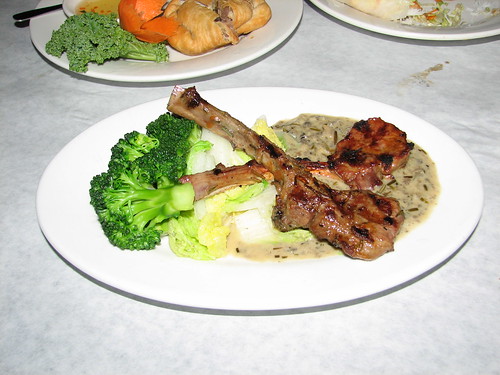
-Rack of Lamb
-Fresh Rolls
-Curry Puff - Taro
-Moon Goon Steamed Dumpling

Siam Paragon
Siam Paragon at Silk Elephant

Rack of Lamb
Rack of Lamb at Siam Paragon

Fresh Rolls
Fresh Rolls at Siam Paragon

All in all, a pleasant and enjoyable meal. Dishes well prepared, and a nice mix. And the conversation and company were wonderful. Norraset came by and we talked of my going to Afghanistan and return, and about family, and about living in Pittsburgh.

There are many things that make life interesting, and we've come to appreciate the fact that Pittsburgh is the type of place where you can go to a restaurant and have a human conversation with owners, even if you are not a regular (I can count on my fingers the number of times I've been to Silk Elephant, although I've come across Norraset on many occasions outside of his restaurant.) He is a prior awardee of Pittsburgh 40 under 40, we were eating with a Steinway artist (i.e. a very good pianist), and we were two young, recently arrived people, still in the early stages of making our way in the world. It is a good life.

Wednesday, April 09, 2008

Randy Pausch: The Last Lecture AKA Keeping Priorities Straight, even at the End

Hat tip to Tara Parker-Pope, who writes The Well blog at the New York Times. And Freakonomics blog for pointing to The Well about this.

Randy Pausch is a professor at Carnegie-Mellon University, probably best known as one of the founders of the Entertainment Technology Center. The local wag is that is where you go to learn to make video games. CMU alumni know him as the one who started the class Building Virtual Worlds. He is also dying of pancreatic cancer.

Last September, Randy gave one last lecture. Watch it. (linked to YouTube below.) It is not about cancer, it is about achieving life dreams and lessons learned. But it is not really about that. It is about living life.

In contrast to the normal academic lecture, it is something that is paid attention to. And not just by students, by many around the world. A lecture on living life, with an audience of millions.


And as he says, it is not about cancer, and it is not about pity. He does not want any of that. And he does not even care about the audience of millions. He did this, so his kids can see him give a lecture. For them to learn lessons of life that he won't have the time to teach in person as they get older.

Tuesday, April 08, 2008

General Patraeus goes to Washington, Round 2

General David Patraeus, commander Multinational Force - Iraq (MNF-I), and Ambassador Crocker are currently in Washington DC giving testimony to the U.S. Congress regarding the current state of the U.S. and Coalition occupation of Iraq. The purpose of this is to give someone without background some of the background behind the testimony. Actual analysis and especially implications on the current U.S. Presidential candidates belong elsewhere.

First, why is a senior General of the U.S. Army, and the commanding officer of the largest and most decisively engaged component of the U.S. military subject to questioning by a legislative committee(s). The U.S. has a strong tradition of civilian control of the military. In addition, the U.S. tradition is that the instruments of military power, are outside the political process. For many years, the U.S. military has emphasized as a point of pride, they were (are?) the only military in the world whose officer's swear their oath of service, not to a person or a group of people, but to a piece of paper (the U.S. Constitution). This is in marked contrast to the usual oath, which is to a head of state, a government body, or a political party. One of the ways that this plays out is both the executive and legislative branches can call on him based on their constitutional authority. And, the legislature can call on him without viewing him as an agent of the executive branch. And as all general officers are confirmed by the U.S. Senate, the Senate has some room to say that generals work for them. Not something that is used lightly, but in terms of providing testimony, the Senate can call on anyone they please.

Why Gen. Patraeus and not higher? The chain of command in the U.S. starts at the President, then the Secretary of Defense (a cabinet/ministerial level position). Then, the combatant commander (COCOM) (who is responsible for all military forces in the region) who then commands subordinates to implement policy. In the U.S., there is a parallel structure called the Joint Chiefs of Staff (JCS), who also report to the Secretary of Defense. The JCS are responsible for the training and equipping of forces. The COCOMs are responsible for how those forces are actually used. For U.S. forces in Iraq, as employed forces, their actions are under the perview of the COCOM (although their training back home is a JCS issue). In times of war, it is not unusual to appoint a theater commander (MacArthur, Ridgeway in Korea, Westmoreland, Abrams in Vietnam) responsible for all activities in theater, within the regional command. Patraeus is the regional commander for Iraq, within the larger umbrella of the U.S. Central Command.

Where did Patraeus come from? Regarding the current war in Iraq, Patraeus was a division commanding general during the initial invasion. Most accounts view him as very innovative during the initial combat operations, as well as in reestablishing civil affairs afterwards, something that was not viewed as typical. After return to the states, he was assigned to Iraq again in charge of training the Iraqi forces. He then returned to command the Fort Leavenworth and the Combined Arms College (a graduate level institution) at Leavenworth he and Marine General Mattis oversaw the writing of the new U.S. Army and Marine Corps Counterinsurgency doctrine. After this, Patraeus was selected to command MNF-I as the senior U.S. officer in the theater.

What is his relationship with the Bush administration? Well, pretty rocky over time. He has long been known as a counter-insurgency expert, and the Bush administration was very adament for a long time that the conflict in Iraq was not an insurgency. Some commentators thought that the assignment of Patraeus and others to the various military schools was essentially professional exile. (what kind of career does a military officer have as a college dean instead of commanding combat troops in a war). And with the Iraq war going very badly, the view of many commentators is that the Bush administration essentially cried for help, and brought Patraeus back to the war, even with his not very liked counterinsurgency doctrine. Because it probably would not do any worse. And Patraeus brought along a number of other officers who did a lot of thinking about counterinsurgency with him (and who had helped write the new counterinsurgency doctrinal manual). Somewhat of a return from exile.

Wait, I thought counterinsurgency and the 'surge' was viewed as the Bush great idea? Counterinsurgency (COIN) is still a very debated concept in the U.S. military, even among those who have recent experience in a war zone. One source of opposition are those who are concerned that the business of the army is to wage high intensity combat, the kind with tanks and artillery and mass formations. Not this COIN that is mostly done with small numbers in very close contact with civilians. Another group says that building up communities is not the military's job, so they should not learn how (the "we don't do nation building" crowd) and let the civilians do it. More cynical observers point to another source of opposition. Since COIN requires resources be put into training people rather then heavy equipment, cynics note that the normal military contractors don't get rich building tanks and planes in COIN, so they are opposed (along with their friends in uniform).

So, what is happening now in Washington? Gen Patraeus and Ambassador Crocker are back for a second round of testimony before congress. The first was in September 2007. Six months was considered to be a decent interval. As both of them are confirmed by the Senate, the Senate deals with them as their agents, (which is why Gen Patraeus had no need to discuss his testimony with the executive branch last September. The Ambassador is the President's personal representative overseas, so he probably does have some requirement to discuss with the President what he will say.)

The committees in question are the foreign service and the defense committees. This is where the real power in congress lies. The staff of these committees for both of the major parties are presumed to be experts in their fields, and are expected to prepare their members well regarding lines of questioning. But while they can give testimony regarding the current state of affairs in Iraq, as well as some discussion of options and what can be done with resources available (or made available), the actual current policy of Iraq is not really the topic of discussion. That comes when instead of listening to testimony, Congress is debating policy. And part of the purpose of this testimony is for the various sides to ask their questions and shape the policy debate to come. And to gather information and ammunition for that conflict to come.

Friday, April 04, 2008

PSO: a game of searching

My fiancee and I went Friday night for the PSO, with Emanuel Ax, for the second time this season. This time we came with four college music students, bringing them down to experience the Cultural district on a Friday night. Dinner was learning all about college life, and my fiancee quizzing the students, among other things asking if any of them looked up that night's program. None of us (including me) did.

The evening's concert featured a couple Debussy pieces, and Emanuel Ax playing Chopin Concerto No. 2. Ax also played an Encore by Liszt. But it was the Jeux (poeme dance) by Debussy that caught my attention. Listening to it, the impression I had was of encounering a sweeping expanse, and a period of searching for something. Later on, my fiancee pointed out that the Jeux was in fact a game of tennis, and in the piece, the players find themselves looking for lost tennis balls, and later the pursuit of romance. It is not obvious to me that the game was tennis in the absence of the choreography of dance, but that is almost beside the point.

One of many opposing views in the understanding of classical music as art is the question of meaning, does the music require an underlying story or meaning, or can the music exist in and of itself. (I'm sure there are technical terms for the opposing sides) I have taken the view on this blog that the best of music has intended meaning that the artist seeks to transmit, and the audience can hear it (or not) and has the right to develop its own interpretation. But the fact that the artist intended a specific meaning is still important (my fiancee leans toward the other view. We fight gently.) And so in this piece, I, as an untrained listener with no knowledge of the piece its origins, or the composer (for all practical purposes) can interpret the piece in a way, has similarities (and some differences) with the original 'intended' meaning. And this is an example of music used to transmit meaning (although even this is more blunt than required).

Why does this matter to me? I was at a party a few weeks ago, hosted by a musician. As part of the party several musicians present played some pieces. It was the very meaning of chamber music, music played in a private chamber, and it was a wonderful evening, of performers and audience, enjoying each others company, and sharing music, but the listening and the playing. While talking with another of the non-musician guests, they gathered that I write this blog, and were impressed by the association. They later learned that I am one who has gone of to fields of war, and exclaimed how big the difference between the two worlds, the beauty and wonder of classical music in one of its purest settings, and the harshness of the reality of modern war. And my reply was that music (as all the arts) has as its purpose addressing the whole of what it means to be human. And that means both the ability to appreciate and create beauty and wonder and hope, as well as the ability to bear through hardship and horror. More stark reminders of this exist in plenty. I've written here of Vedran Smailović, the cellist who played in the streets of Sarajevo during this midst of seige. Many of this nation's newspapers have printed incredible letters from those who have gone to war, some after the writer has died in battle, whose mastery of language stands alongside the greatest poets and writers the english speaking world has known.

The difference can be jarring. I've gone from galas with tuxedo and evening gown, to stepping off a plane in a dusty field wearing boots within a space of weeks, and the reverse when I returned. But it really is not two different worlds, a world of art as escape and a world of harsh reality, it is one. And art (including classical music) is at its finest when it has something to say, both to recognize the reality of the harshness of the world and what man can create, as well as the hope and beauty of the world and what man can aspire to. And even something as light as the music of young men chasing a tennis ball on the court is an example of art transmitting meaning, and just like life, sometimes that meaning is lighthearted, sometimes weighty. But considerably more than only an escape (even if escape does have its place..

Thursday, April 03, 2008

White Night, book 9 of The Dresden Files by Jim Butcher

By this point, Harry Dresden, the protagonist, has more responsibility in the form of Molly, who is in the same position he was at the beginning of the series. In probation. The threats are bigger, and with the responsibility of training someone else in discipline, his own discipline is improved.

You see Harry growing through the series. His earlier self-destructive attitudes of always protecting others, even from knowledge of danger, is slowly going away. And he has learned how to ask and receive help, and he finds out many of the people he used to try to protect, are quite competent in their own ways.

The growing sense of trust and learning to depend on others shows considerable growth, which makes this book a delight to read, and watching him engage the dangers and obstacles along the way that much more interesting.

Monday, March 31, 2008

How to Cook Everything by Mark Bittman

There are many different types of cookbooks. The most basic type is a collection of recipes, presumably built around some theme. Another type is the picture book, filled with pages of pictures of beautiful gourmet dishes. Then there are the celebrity chefs, with books that promise something akin to what you can get from their restaurants, or results like their TV shows. I have one cookbook that is basically a travelogue, beckoning the reader to distant exotic lands. But the one that every household is supposed to have, is the big, basic cookbook. The one that has a general range and, more importantly, general instructions on cooking technique and everything that has to do with a kitchen, without assuming that the reader has learned everything at her grandmother's knee (especially the readers that are not a 'her'). This latter type includes classics like The Joy of Cooking and the Betty Crocker's Cookbook. And Mark Bittman's How to Cook Everything (HTCE): Simple Recipes for Great Food.

Mark Bittman opens the book with a general statement of philosophy which identifies his audience. In this case, his audience are precisely those who are starting from nothing, new households of people who did not grow up learning from their mothers and grandmothers on how to cook. Second, it is aimed at those who desire to cook, not necessarily gourmet, but food that is good, and not complicated. And because his readers are assumed to be starting from no base, Bittman takes on the role of teacher, not just a publisher. And as a professor (lit. one who professes) he has opinions that he shares, based on his philosophy that cooking can be done, and there is no value in making things harder, more complicated, more fancy, then necessary. The assumption is that people who want something like this, will also know how to find it elsewhere. The first section is basically a tour through the kitchen, equipment, basic ingredients, and basic techniques. All this with advice on what was necessary, and what was optional. No doubt there is room for disagreement. But for someone starting from nothing, the opinions given are useful. And once people learn more and gain more skills, they can form their own opinions starting from what he gives.

So, how are the recipes? There are many cookbooks that I avoid because their too complicated, many due to the shear number of ingredients required. HTCE does not have this problem. It does not go as far as a 5 ingredient list, but the ingredients are constrained to a number that someone without a full spice rack could conceivably have. Throughout the book, there are tips on how to work with various ingredients. In addition, there would be a small essay for major meat and vegetables.

So far, I've probably done a couple dozen recipes over the past couple years. Some for myself, some just me and my fiancee, some for a group. I have found the recipes to be complex enough to be interesting and worthy of something nice, but easy enough so I can gauge difficulty and effort from reading alone, (I only have limited background in cooking). In contrast, I find most cookbooks on the market to be way to simple (and just a list of recipes) or overly complicated and impractical (especially for someone who lives alone and would end up throwing out most of the purchased ingredients as they spoiled.)

I think HTCE a very good baseline cookbook. For the starter, Bittman teaches without intimidation, the recipes are complex enough to impress (if that is the goal), but basic enough to be achievable. The advice and options given are enough that the reader can understand how to adapt and experiment, and thus learn how to cook to a level that should satisfy anyone, and a jumping off point to learn in the future.

Tuesday, March 11, 2008

Geek Love: Gary Gygax, Game Pioneer, passes away

Geek Love
GARY GYGAX died last week and the universe did not collapse. This surprises me a little bit, because he built it. . . (from the New York Times)

Last week Gary Gygax, co-creater of the role-playing game Dungeons & Dragons, passed away. In a somewhat real sense, he created something that changed the world. Not that role-playing games was new (Cowboys and Indians anyone? How about playing 'House'? Or 'Let's have tea') or the having mechanics (H.G. Wells Tin Men) or playing someone else (pick anyone who had thoughts of acting). But it gave a way of thinking and viewing a world, through another's eyes in a way that could be repeated and reapplied. Nowadays, computer role-playing games are more prevalent, but these don't have that same character of having to understand reality through another person's eyes and history. And the social aspect of interacting with people is not there (as opposed to interacting with only characters.) Acting does not require that either (anyone healthy can separate their acting from real relationships. Presumably actors can have actual friendships outside their roles, but it is not required.) Things, situations, and abilities only read about or seen in movies can be played, and choices made, and consequences experienced. It even forced players to declare their version of morality, and act on it with all its freedom, constraints, benefits, and consequences, something that is not in your average board game.

Anyway, do I have anything deep to say? Not really. But I got a message of a somewhat quiet e-mail list that was a game. The organizer was writing a book that was built around the game we were playing, and wanted us to test out the rules. I had made a character some time ago, so dug out his history and the stories of him growing up, becoming an adult and making his way in the world. And translated it into the game. And sent it in. And for a few minutes, thought of the life of someone who does not exist, in a far away world, living a life very different then the nice, safe one I live now.

Sunday, March 09, 2008

A Game of Thrones by George R. R. Martin

A Game of Thrones is the first of the 'A Song of Ice and Fire' series. It follows several people involved in the various kingdoms. And in this world, these conflicts have as a backdrop the beginning of the long winter cycle, with unknown beings from a northern wasteland which come south during that barren time.

It is a story of duty, honor, of people having to decide where their loyalties lie. There is jealousy, selfishness, the wisdom of age. The hardheadedness of age. Folly of youth. And innocence (taken in both the good and the bad senses.) This book follows mostly the young, a generation of leaders that are rising, but full-fledge participants in a war started by the elder generation, some of whom have old scars.

What I appreciate is that it is following people from different sides (as well as some that do not have a side, such as the Black Watch who watches the northern wastelands). It shows even opposing actors acting out of their conflicting desires, fears, and duty. Noble, deceitful, brave, cowardly, lust, greedy and pragmatic are all present, on both sides, and among all the characters in various degrees. And you can see the unintended consequences of actions, even those that on seeing them for the first time, one could regard as noble. And those that are cast as cowardly, you see great nobility and sacrifice.

There are some good characterizations for a not-so-large book, and it makes the rest of the series promising. The focus on high-born (or at least related to nobility) characters is initially off-putting, as I usually prefer more down-to-earth characters, but the fact that some of these nobles are forced (because of not being all that noble or by circumstance) into situations that put them down in the mud, it is ok. Recommended for the characterizations that have much depth to explore.

Saturday, March 01, 2008

PSO: Corigliano 5*-4*-3* Triple Play!

We went to the Pittsburgh Symphony last Saturday, looking forward to another Corigliano piece, this time a TriplePlay, which the PSO gets to premiere. My first question: Has John Corigliano, in his many visits to Heinz Hall, found a closet to hide in when his piece is being performed for the first time?

Sandwiched in the program between two russian interpretations of Romeo and Juliet was this percussion concerto. And from that description alone, I had no idea what was to come, but I was looking forward to it. And as the Tchaikovsky closed and the musicians rearranged themselves, Corigliano came out to talk.

And what about? About creating a percussion concerto, of featuring instruments and sounds that normally support an orchestra. He spoke of removing sounds from the orchestra to make a part stand out, and of grouping the percussion into material groups, and prepared us for the flow of the piece to come.

And what a piece. It started with the sparseness of struck wood blocks morphing into the marimba and xylophone over strings. Ms. Glennie (percussion soloist) moved to metals, with chimes being punctuated by cymbals played as gongs. With and end of drums (skins) building in speed and volume.

There is a concept of creativity that creativity is enhanced by putting restrictions on the artist, and forcing the artist to use his/her creativity to create something inside the restrictions. That the artist struggles against the rules and constraints given can lead to something wonderful, unlike anything else. And here, stripping the range of sounds the orchestra contains and spotlighting the percussion, in its variety and sparseness, created something original and wonderful to behold.

And I hope that when Corigliano listened in his closet, that he knew on coming out that this was a piece well done.

Thursday, February 28, 2008

CQ CQ CQ DE KB3OGQ/AG

Passed the exam this evening. Some quotes of the night:

VE1: He is doing this the hard way, he keeps getting deployed so he doesn't get his ticket punched (take the exams)

VE1: Do you want to try the Extra exam? You already paid the fee and you are already here.

later

VE2: He is taking this just for giggles.

VE2: You know what this means, know you know what you have to study.
Me: Yes, everything.

VE2: Is this a guy thing to look at each other's knives? (the other volunteer examiners had taken out their pocket knives and were looking at them on the table)

Monday, February 18, 2008

Coco's Cupcakes

The first time I went to Coco's Cupcakes was not long after it opened last winter.

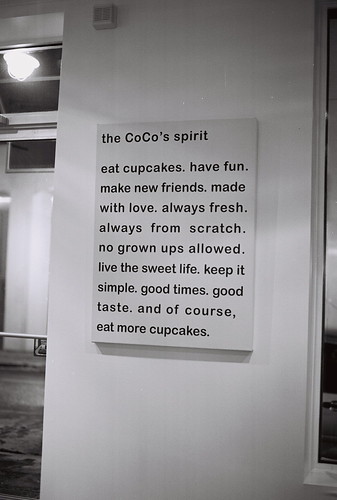
The CoCo's spirit

A cute little place on Ellsworth, sparse, friendly, and inviting. Oh, they have good cupcakes.

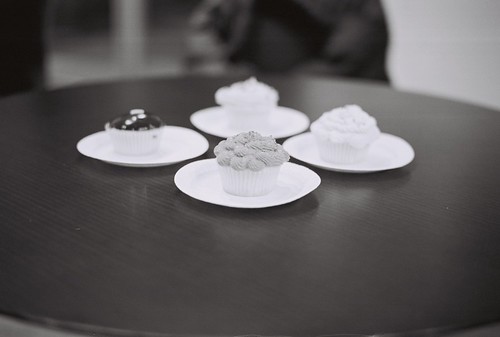
Cupcakes on a table

Anyway, not very long ago was Valentine's Day. And, well, my fiancee and I have not ever done anything on Valentine's day. Which is not something either of us is in a particular hurry to change. Neither of us is particular focused on particular days of the calendar, whether it comes pre-printed or of our own doing. Which does occasionally result in some comment, like when my fiancee's department secretary asks her on February 14 what plans she has (none) and does seem to be slightly disappointed.

So, Saturday, February 16, I come up to her office with a box.

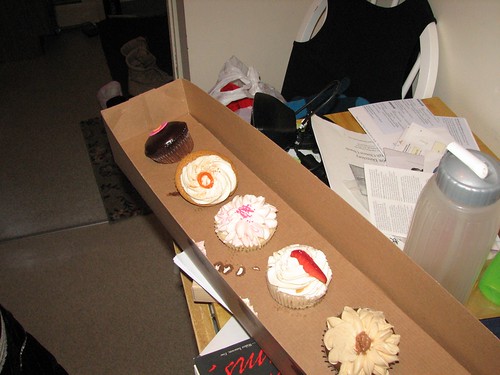
A nice long box with a ribbon

And a bunch of her co-workers were there (a bit of a project that weekend). And I believe they were looking on approvingly. So today, Monday my fiancee gets asked

'Did the roses help?' (she was complaining about being worn out from the weekend)

Umm, roses? Now why would I give my fiancee roses?

Stuff inside long box with ribbon

And yes, the answer was in the affirmative, the cupcakes helped.

Sunday, February 17, 2008

Movie review: Brokeback Mountain

Brokeback mountain follows two men, who worked on a job in the Wyoming mountains together, fall in love, go their separate ways, and the complications in their lives. And, it is a story of an affair, that causes trouble.

Most of the movie follows Ellis Del Mar, who is engaged to his sweatheart Alma at the beginning of the movie. After Ellis and Jack Twist finish their summer job herding sheep on Brokeback Mountain, he gets married. And the movie skips through the next four years, as Ellis has two daughters, and Jack goes back to rodeoing in Texas. But, with two daughters, and not much money, Ellis' life and marriage become hard, and he never quite gets the hang of having a life that goes beyond being a ranch hand. And when Jack Twist comes by for a visit after four years, Ellis remembers that time on Brokeback mountain, and takes leave of his wife and kids for a few days. They end up doing this on and off for the next 15+ years. And along the way, Alma divorces Ellis, Jack's marriage becomes more distant and angry, and eventually, Jack is killed, and we are led to believe it was a hate crime.

Brokeback Mountain is a story of an affair. Ellis sees in Jack a relationship that is all happiness, in contrast to his marriage to Alma with all its responsibilities and troubles. And I think he realizes to a certain extant the mess he has gotten himself into. He repeatedly refuses Jack's entreaties to take the easy way out an run off with Jack, but the stress of dealing with Jack also seems to lead to him cutting of Alma and his kids emotionally. And the result is he with neither and both relationships are filled with conflict because he neither fully opens up to either, but defends each (Alma and Jack) against the other. Both Alma and Jack desire Ellis, but each only sees Ellis being loyal to the other. And Ellis either is angry, or completely passive, unable to resolve his conflict. And in the end, Ellis has nothing, all lost because he would not choose. Jack is dead, presumably killed when his homosexual side was seen by the wrong people. Alma has remarried, to someone what it seems that neither her or the daughters seem to have much respect for. Cassie (girlfriend) has left, and is confused and hurt because she has no idea why Ellis is so withdrawn despite her efforts. And all Ellis has is an unending series of small time ranch jobs, and no future ahead, or any desire for such.

What this does well is to show the costs of an affair. While Ellis is loyal in a way to the marriage, refusing to go run away with Jack even after the divorce, the affair resulted in Jack never being really there when he was with those who cared for him (wife, daughters, girlfriend). And his distractions with trying to manage them all don't work. And he knows his life is messed up.

Does the homosexual aspect of the story line matter? Actually, it works out well here. It creates another level of tension in a story about an affair, where there is that much more resistance to following your feelings and running away from responsibility. More reason for Ellis to stay in town with wife and daughters, that even the 'follow your heart' types can recognize. Having the other principle, Jack, who embodies the more 'act on your feelings' answer get violently killed was almost a distraction.

How is this as a movie? It somewhat suffers since its main character (Ellis) has as a personality quality the unwillingness to communicate (whether just his personality or also because he is hiding from everyone). Very intentionally, you do not know what he is thinking, only how everyone else responds to it and is affected by it. It requires the audience to fill in the holes (I believe the author of the short story this was based on did this intentionally) as I have. So it does turn into a 'it is whatever you make of it' movie. Compared to the Oscar winner of its year, Crash, it suffers from its unwillingness to say anything. Crash had lots to say, and much of it people dealing with contradictory messages about race. Brokeback Mountain is a story of an affair. A well done one. But not one that strikes me as one to remember down the ages.

Sunday, February 03, 2008

Wilderness First Aid: Arlington County, VA Feb 2-3, 2008

I took a Wilderness First Aid class over the weekend. Why? Well, it has been a long time since I did outdoors activities with people who knew more than I did, and I like to make a practice of learning from others. And there were times in Afghanistan where I was designated medic, because I was the most highly trained and I was judged as having the attitude that the convoy commander figured I would act appropriately if needed. My 10-year expired EMT certificate and Red Cross first-aid really were not the things I would have thought as being quite the right set of qualifications. But these are folks who are quite serious when the judge people, and are generally good at it.

Wilderness First Aid is very different than standard first aid taught around the country. The big difference is the level of self-reliance. The expectation in most of suburban and urban United States is professional emergency response is available within 10 minutes, and hospital transport is within 15 minutes (or so). In wilderness, these times are measured in hours, so the medical protocol reflects that. So this is something that is more on par with first responder training then first aid training. Many organizations that work in the backcountry require this as a safety measure, because their activities can be hours away from outside help. Some organizations use this as a proxy for trained personnel that is lower then EMT, but higher then first aid, because they need personnel of a certain competence. And some organizations that operate in the third world like it, because they also are hours away from medical assistance.

It is a different attitude than most people in the U.S. The focus here is on leadership that can watches the people around them, and teaches them to avoid disaster. I've been in organizations that resist people watching after each others safety (or anything else). The students here were mostly people who would go on to lead Boy Scouts outings, or camp counselors in outdoor settings, teaching self-reliance and the ability to watch for each other and survive to others. Which a contrast to people who have told me that we don't do anything, just trust authority. (which is not very fun if authority is far away and someone would be dead before authority could do anything.)

Things we learn (1) do not create a second victim (2) always think, "what will kill the patient first. Lots of thinking about priorities. And especially, leadership in prevention of problem situations. How to look at a group, identify the signs of problems build, and take precautions before there is a problem. How to demonstrate leadership, in many different forms and switch as needed. Medical folks will appreciate this one: how to ignore a patient. Realizing that you did not get this great training so the patient can self-diagnose a problem. That is your job. And how to communicate, to communicate problems in a way that many hours later, someone can hear the message, and respond in a way that helps in a place where resources and carrying capacity is limited.

It is an honest class. A couple of other students and I were joking that we hoped all the real outdoors people in the class did not mind us amateurs taking up space. We talked about the issues we faced in the places we worked and volunteered in. And the challenges of working with the populations that we do this with. And we talked in a straightforward way, what can kill a person. And how to overcome the psychological and social barriers that would prevent us from giving care that makes the difference between someone living and dying that day.

The goal is to live. And live well. It was a great group of people, and I would put my life in any of their hands. I have known people that probably would not want anything to do any of us out of principle. That is their loss.

What is this for? Yes, some of it is because if I am expected to be the group medic, it helps if I have competent and recent training. But also, I have a philosophy that I should be involved with things that I am not good at. And with people who are good. This was one of those places.

Tuesday, January 29, 2008

Restaurant Review: NAAAP-Pittsburgh goes to Cambod-ican

January Dinner Club, The Cambod-ican Kitchen,
1701 E. Carson St., South Side. 412-381-6199

The January dinner club adds yet another restaurant this month, this time going to The Cambod-ican Kitchen on Carson St. Join us for this taste of street food that moved up in the world and became a restaurant with walls and a roof.


We went to Cambod-ican on Carson St (on the Southside) last week for the monthly dinner club, continuing a two year string of monthly dinner clubs without having to revisit a restaurant. Cambod-ican is a bit different then the normal. While there are some asian restaurants, and many restaurants that try (sort of) to be some variety of asian, Cambod-ican's tie with asian food is purely random, the wife (of the husband-wife team) is Cambodian. But the food is definitely Pittsburgh, with a Cambodian flavor (not the other way around). And it is Pittsburgh street food that stands out.

Cambod-ican Kitchen used to be a street stall on Carson St, before being kicked out to make way for Nakama (which is across the street). And so after looking for a place, they ended up moving indoors. Interacting with them was fun. When I called, I think a daughter answered the phone, and had to take a message. Then when we got there, we had to hang out for a bit waiting for everyone to show up. The husband came out and chatted with us (as well as everyone else) and generally gave suggestions and teased the ladies. Lots of fun. And he explained how to pronounce Cambod-ican (portmanteau of Cambodian and American, no he did not use the word 'portmanteau') And the chant that goes with it among some of the regulars (I can, you can, Cambod-ican)

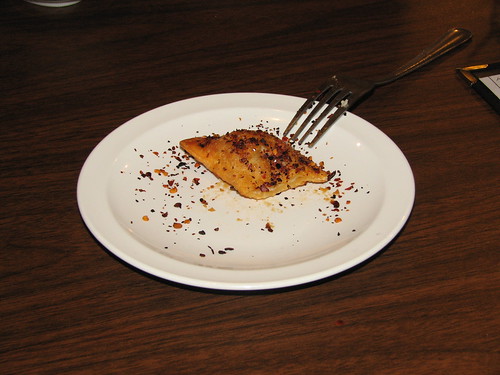
Food, like everything else that is Pittsburgh street food, is lots of fried stuff, and some other stuff. We had a fried wonton, which is really fried perogies

Fried Wonton at Cambod-ican

And the steamed spring rolls for appetizer

Fresh Spring Rolls at Cambod-ican

Even the dishes, not exactly gourmet (this is grown up street food) but fun for what it is. The setting is not much, but the staff was friendly, and we enjoyed ourselves. Which is the point.


NAAAP-Pittsburgh at Cambod-ican

Sunday, January 27, 2008

Eclipse and 'TODO'

I can be so easily impressed sometimes. I was working on a model, and basically looking over some stuff I had put together in a couple of days to incorporate some feedback before a presentation. So it is a bit rough. And it is a bit late, so what I'm really doing is putting in a bunch of comments about what some of the code actually does and some things that I should do after I get some more sleep into me. And as I go along, I suddenly noticed that my screen was changing, other then just the fact that I was typing in code.

There was this little box to the left of the code.


So I was trying to figure out what was going on, because then I noticed I had a couple of these along with my debugging breakpoints. Then I figured it out. Among my many notes-to-self, I had put in some comments # TODO. And Eclipse was catching this and automatically building a task list for me.

Just a random note on the day. :-)

Thursday, January 24, 2008

In memoriam: Andrew Olmsted

I saw this some time ago over at The Sandbox (AKA the Doonesbury military blog) Maj Olmsted was killed January 3 in Iraq. And these are his words . . .

Final Post

"I am leaving this message for you because it appears I must leave sooner than I intended. I would have preferred to say this in person, but since I cannot, let me say it here."
G'Kar, Babylon 5

"Only the dead have seen the end of war."
Plato*

This is an entry I would have preferred not to have published, but there are limits to what we can control in life, and apparently I have passed one of those limits. And so, like G'Kar, I must say here what I would much prefer to say in person. I want to thank hilzoy for putting it up for me. It's not easy asking anyone to do something for you in the event of your death, and it is a testament to her quality that she didn't hesitate to accept the charge. As with many bloggers, I have a disgustingly large ego, and so I just couldn't bear the thought of not being able to have the last word if the need arose. Perhaps I take that further than most, I don't know. I hope so. It's frightening to think there are many people as neurotic as I am in the world. In any case, since I won't get another chance to say what I think, I wanted to take advantage of this opportunity. Such as it is.

. . .

The rest is here.

Friday, January 18, 2008

Jawbreaker by Gary Bernsten

Jawbreaker: the Attack on Bin Laden and Al Qaeda: a Personal Account By the Cia's Key Field Commander

When you think about the CIA and special forces going off to war, a number of movies come to mind. This is real life. And it is different, but better and more interesting.

Gary Berntsen is a CIA officer who was sent to Afghanistan as part of the U.S. response to the World Trade Center attack of September 11, 2001 in New York City. After the attack we see him put together a team (there is already a team in place that is laying the groundwork) to go in. It is a story of people who are realistic and practical, even as they are patriotic. And they run into many obstacles. Berntsen has to deal with prejudice amongst Americans as some of his desired team are Iranian or Arab. Bureaucratic rules cause trouble for him as well as some team members who are not released by their bosses. And finally they make it into Afghanistan.

In Afghanistan they are the small team of CIA agents and special forces personnel who build the alliances with the Northern Alliance to fight the Taliban. They deal with the personalities, the shifting loyalties, the oneupmanship and dealing both sides against the middle that is part of war in the Hindu Kush.

It is realistic in the sense that the job of these highly trained men is to coordinate, join with the local forces, and be the eyes and ears of the U.S. commanders, not to fight. And the protagonists of the book are usually away from the main fighting, even through they are in danger because of the unknowns they deal with. They are aggressive, daring, practical, and wise to the ways of people, as they have to deal with the many motivations among the various military commanders they dealt with.

The other special aspect of this book is how Bernsten deals with his own thoughts about life. At times during the narrative he suddenly starts thinking about his bosses back home or his family for a few sentences, then go back into the narrative. And this is very humanizing, and very familiar (as I did the same thing during my deployment). The scenes in the opening chapters where his wife and grown children have to deal with his going into harms way are refreshingly honest and ring true, and the distractions of having to help them through the U.S. government bureaucracy when they are dealing with unhelpful superiors is also shown.

Definitely recommend the book. To both those who are going to war, to give a feel of what it is like to work with a population whose motives are hard to understand, and their families, to let them know that their worries for those going into harms way are normal.

Saturday, January 12, 2008

Pittsburgh Symphony: a composer, a violinist and a Red Violin

I remember a year ago, my then girlfriend asking about going to a specific concert, by some violinist named Joshua Bell. And not going because we would be out of town in the weekend in question. Fast forward to the summer, while reading the Washington Post reading about an experiment, where one of the most talented and sought after violinists of our generation would bring skills and talent, and play in front of a Washington DC Metro (train) station. Whose name was Joshua Bell. And my thought then was "Brilliant". And so when this year's schedule came out, I was looking forward to this concert.

The hall was packed! I was so impressed. We knew something was up when some of the garages were marked as full, and the poster up front bore the notice "Standing room only." And going to the pre-talk with (PSO assistant conductor) Lawrence Koh and (composer) John Corigliano it was a larger and more varied crowd then we are used to seeing at these.

The excitement was palpable in the audience. Before the start of the Red Violin Concerto, Leonard Slatkin came on stage with . . . John Corigliano and felt the need to apologize and promise that Joshua Bell was coming. It showed after the first movement, when there was quite a bit of applause (I know that it is not 'proper' and I don't myself, but I always view it as a good sign when it happens as it means there are new people in the audience, and it is honest applause. It also reminded me of the Washington Post article. Most people at the Washington DC Metro station ignored Joshua Bell's playing, but everytime a child came by, the mother had to tear them away because they were so attracted by it.) The whole piece was a treat.

One aspect making the evening different was the incredible interaction between the composer and the audience. Corigliano came out with Koh for the pre-talk to discuss the work. Both Bell and Corigliano worked the autograph line after the first half (which was one of the largest autograph lines I've seen at Heinz Hall). And they both came for the post-concert talk (which was also much larger then the norm).

I've been exposed to the debate on whether music should be able to stand on its own. And my feeling has always been no, it is part of a context (well, sometimes it is not, but sometimes I walk away from a performance wondering what it was all about.) I have the same attitude towards art (painting and sculpture, literature, and other media. And for something like this, does it really matter that why Corigliano was never a musician (which is a story that my fiancee and I found so honest and realistic about life), or the fear he has when a new piece is first played and how this comes from the days of listening to his father perform? Or that Joshua Bell's violin was also once upon a time stolen and played in cafes, much like the referenced Red Violin of the movie. Maybe not, although it does make it more human. But understanding that the alternative to The Red Violin Concerto was pieces by period composers such as Bach, Vivaldi and Paganini, the desire to have a theme cross through musical styles, the fact (and techniques) that the violin was sometimes played in ways that changed the quality of the sound to achieve effects, and identifying some of the themes did enhance my listening. While the music is able to stand by itself (I have enjoyed my CD, and I'm listening to it as I write), knowing the choices made in its creation, the composing, and its performance has greatly enhanced my enjoyment of it. And the richness of sound as played live by Bell and the PSO in Heinz Hall only added to it.

Thursday, January 03, 2008

QOTD: I should have found a fiancee before I went

S: I heard you got engaged, is this something new?
Me: We were dating before I went (to Afghanistan). She was watching my things while I was away, We even wrote pen and paper letters to each other.
S: Wow, you must have some great momentos for the grandchildren about how you courted their grandmother while you were in a war zone. I should have found a fiancee before I went so I could do that.