Saturday, October 01, 2016

The Honor Was Mine: A Look Inside the Struggles of Military Veterans by Elizabeth Heaney: Book Review

The Honor Was Mine: A Look Inside the Struggles of Military VeteransThe Honor Was Mine: A Look Inside the Struggles of Military Veterans by Elizabeth Heaney
My rating: 5 of 5 stars

This is the story of a civilian counselor who joined a program to provide off-the-record counseling services at domestic military bases. She spent short term assignments at each base, with the intention that it was part of a portfolio of provided services, attracting members of the military community who would not be willing to engage the more traditional mental health resources that were already available. It is a view of the military that I very much relate to, as I was attached to a deployed unit as a civilian for a similar period of time.

The first chapter starts slow, she talks about the trauma in her life prior to her taking this assignment as a way of resetting her life (and this gets dropped in the rest of the book). But once you get past the first chapter you get into the story. Two themes that permeate are her being a civilian learning her way around the military environment, which sets up the theme of veterans returning from deployment and those around them responding in their different ways.

The first theme is that of a civilian entering the military community and the differences. She tells the story of her first assignment, of encountering military discipline and curtsy first as a shock, but then respect for the stability that it provides. She goes on to what she realizes the purpose of many of attitudes and rhythms of the military. First, the realization that those in the military must be prepared for anything at any time, and military discipline and curtsy is intended to build the attitudes needed to enable that. Second, that there are a range of overall attitudes held by those in the military, with a considerable more diversity than she expected when she was in a civilian life. But one set of values that holds people together is a focus on duty (towards country and each other, not necessarily in that order) and integrity. And the dissonances between those values and what they see in the civilian world (and in what I called Big Army for that matter) causes many of the problems they have in adapting to home.

But what this long discussion of the difficulties she had in getting used to the military culture does is leads to her discussion about the issues that veterans and their families and the problems that veterans who have returned from a combat zone and their families. And she has gone through the same type of struggle in the first chapter with what she dealt with in her life and the reactions of those around her, and dealing with the same culture shift in the other direction. This part is the deepest, she alternates between telling the stories of the people she meets during the course of her assignments and the story of her processing these. Stories of working with the returning soldiers, the transition between combat and their families, soldiers and spouses trying to deal with the uncertainty of life in general and of soldiers returning after a year of combat, spouses worried about infidelity when the returning soldier is still working through the transition between combat and peacetime, of the care that soldiers have of the wounded and fallen brothers (and sisters) in arms.

Through it all, what shows through is her thankfulness that she has seen this part of life, the pride, dedication, and duty to others that permeates the military. And the recognition that this is not the norm in U.S. society at large. In my own experience, I've been told to view the lives of companions as not precious, had offers to refer me to counselors who would tell me that I should have ignored the calls for help from someone in the backcountry. And this contrasting incredibly with being deployed to a combat zone where I was with people who did their duty and tried to do right by those that they were along side. And when I returned, my then girlfriend and I spent a month trying to figure out if I had changed. (and when we were all settled, I figured that I had a good thing going and proposed to her!)

It is a wonderful book. It has a great treatment of PTSD, because it takes the first step of having to experience some of the causes (the need to be constantly aware, the sense that your world and your attitude may have to shift in a heartbeat, and you have to be ready for it, and having to deal with a civilian world that does not generally value duty or integrity) It does not preach, but it gives a set of eyes that had to go through similar experiences and uses that as an analogy into that world.

Note: I received a free electronic copy of this through the Goodreads Giveaways program. The opinions are my own and were not subject to any review.

View all my reviews

Saturday, August 27, 2016

Parenting: Month 70 - A summer vacation ends

So, tomorrow we head back for the back-to-school social. There have been some preliminaries. We were amused to learn at the mommy coffee time (no, I was not there) that T was the subject of some of his K classmates conversations over the summer (T is too internally focused to talk about people whom he has not recently been in contact).

For our first summer since school started, we ended with a trip, and lots of family time.  The kids were remarkably happy when on vacation. We think it is all of the constant attention from the parents in addition to all of the novelty. My son still regularly asks when are we going back to the places we went.

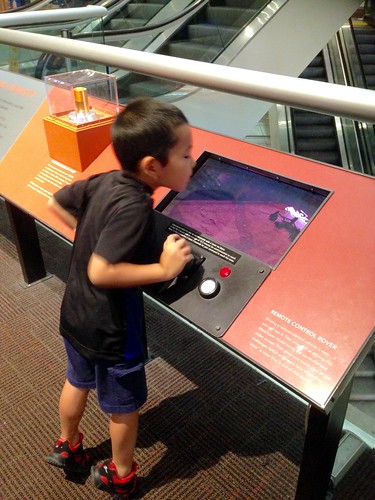
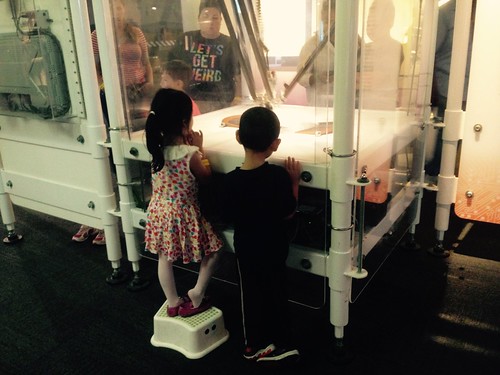
Great Lakes Science Center in Cleveland
Driving a rover at the Great Lakes Science Center in Cleveland

Some other summer notables:
1. First baseball game. And completely spoiled, he got to go on the field and take part in a high five line of the home team. He probably thinks that this is normal.
2. Mommy school and daddy school. Mommy school was as expected. Daily piano and chinese. Daddy school still means lots of LEGO, and this summer we added Technic and simple machines.  We also had a little Scratch, board games, electronics, and an average of a session (5 problems) of math a week.
3. Grandma and grandpa school turned into a not-success.  We are starting to have discipline problems. Given that we pretty much has a free pass on the toddler years with T, it was not going to be that easy forever.
4. A has gone from a little chatterbox babbling along to a little chatterbox that is talking all the time. Usually about something she wants. Alternatively, singing (which is much more entertaining). But there are not very many quiet moments.


Washington Wild Things game
High fiving a Washington Wild Things baseball player
Things to come
1. Sports. T is signed up for soccer this year, after much pleading from the school team.  Given that he did not take part in the various camps in spring and summer, we are not expecting much. But he may have fun.
2.  Taekwondo - T is taking a break, which will allow daddy to catch up somewhat in rank.
3.  School. One of T's favorite teachers is not coming back. One thing that we really liked about her was that she let T essentially find his own level, letting him do things well in advanced of grade level in and out of class. It was one of the things that highlighted his Kindergarten year, so we are somewhat apprehensive in how the coming year will work out.


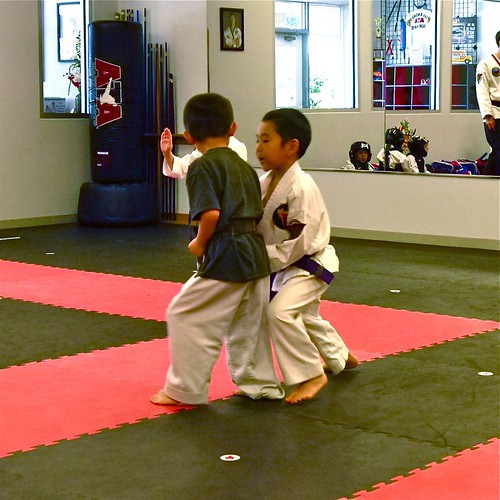
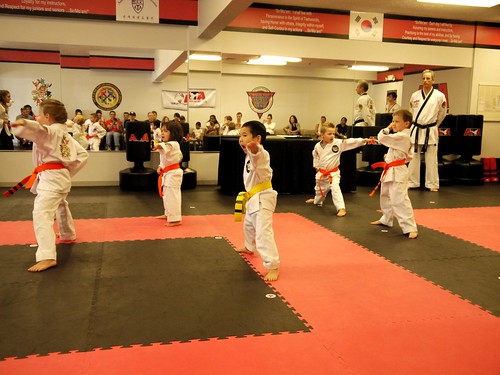
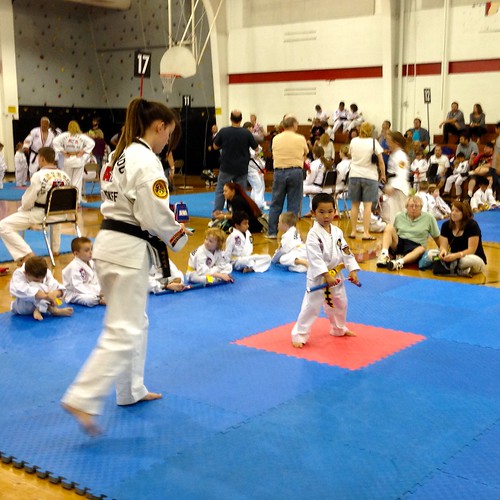
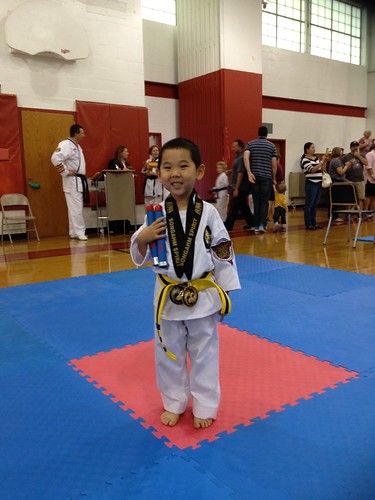
Self defense color belt testing
Taekwondo self defense testing

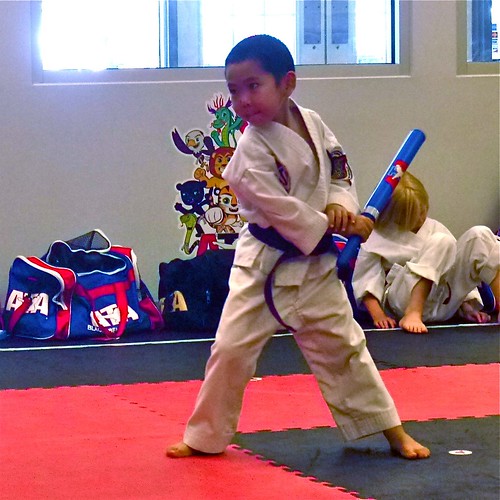
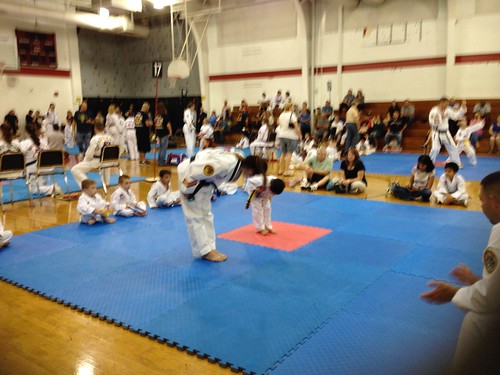
Ba mang ee form
Ba mang ee form

Thursday, August 04, 2016

Book review: The Three Body Problem by Liu Cixin

The Three-Body Problem (Remembrance of Earth’s Past, #1)The Three-Body Problem by Liu Cixin
My rating: 4 of 5 stars

The Three body problem is a hard sci-fi novel that is a combination of a detective thriller and a horror story.

The detective thriller is what the main POV character thinks he is in, and how most of the novel reads. The backdrop are top scientists in China suffering strange accidental deaths, and the protagonist having strange results in his experiments. As part of the backdrop, is the cultural revolution. The nature of science means that senior scientists in the present day all had to survive the cultural revolution, and a large part of the story is through a secondary POV character who lived through it, and as the book goes on you see the actions and experiences of those who were were targeted by the cultural revolution, who were the ones who carried out its actions, and who were instigators, then targets. This comes to a head as providing the motivation of several of the key actors in the book.

The horror story has two aspects. One as experienced by the main POV character. Like a good horror story, it is a case of an impending and unstoppable doom that is made known to a generally competent subject, who, for all of his/her knowledge and skills, cannot stop. The second is an online computer game, which initially presents itself as a side line. In the game, the players take I he role within a civilization, which because of its environment is doomed to failure, the players try to understand their environment and build a civilization that can survive and thrive.

The trick to having several parallel story lines is to bring them together naturally. And this is what I experienced in this book. The horror thread that is in the book makes you understand the POV of the characters who experienced the Cultural Revolution as their motivations are revealed. The actions and beliefs of the principle characters make sense. The temptations faced by the main character are definitely there (as he had been courted by both sides that are revealed) and you can see how he could have turned the other way.

I, like most, do not have much exposure to Chinese fiction that deals so directly with the events of the Cultural Revolution, which I have always thought to be a sensitive topic even through i have had informal conversations with those who went through that and the generation of their offspring. It was well worth the time.

View all my reviews
Saturday, July 30, 2016

Parenting Month 69: enrichment

This summer is the first time that we have participated in the suburban parenting practice of (non-school) enrichment activities in earnest. We've noted others in activities started when T was 3, but we always favored grandparent time over putting him in things after school, weekends, or summers. Now that we have a full year of real school behind him, we did enroll him a few activities, piano, a couple of weeks at the natural history museum, and a computing/robotics course (in addition to continuing Tae Kwon Do).

What were the results? In a sense, it should not be necessary, we are regular visitors to the natural history museum and have covered multiple times every corner. We certainly have the expertise for piano in the house, and we could have done computing and robots as well.  Why not? In addition to the fact that we have jobs, what we got was interaction with other, older kids (the staff of these camps). I once read that the reason that kids should interact with kids of a range of ages is so they learn how to be bossed around by others, how to boss others, and how to take and give instruction. In addition, T interacted with a wider range of kids.  Our first questions after every day were "what did you do?" and "who were you partnered with?"

The other thing that was good was the fact that the economics of summer camps mean that the kids do get more autonomy than the usual school year (otherwise, staff would get overwhelmed with the workload) so what T got was a lot more initiative and curiosity. And more confidence which shows in his playing piano and more exploration in his play.

Yes, we probably could push him further than any enrichment program would in piano, science, programming, math, or robotics; but that is not the goal. The goal is someone who learns how to learn, has curiosity, and enjoys himself along the way.  We are skeptical of a lot of the offerings that we have seen, but what T did do, we think went a long way towards this goal.


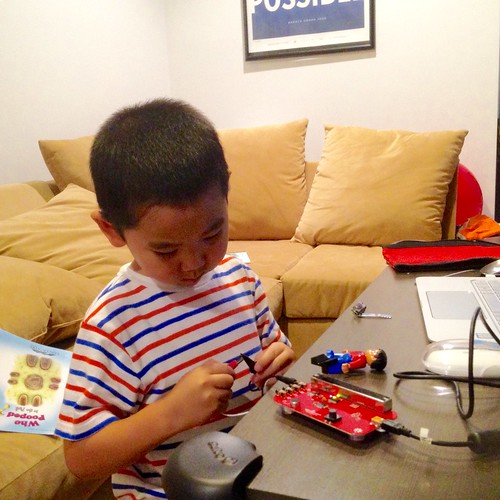
Conducting an experiment with a SparkFun Picoboard
Testing something for conductivity using a Picoboard

Saturday, July 02, 2016

Parenting month 68: One year of school in the books

And we have survived our first year of Kindergarten!  At the beginning of the year we considered this to be the time when as parents are overwhelmingly dominant influence on our child's life is melded with the large amounts of time now spent with school teachers and classmates (not that we are no longer important, but others now play a role).  We also find out where he is in comparison with others in all aspects of life.

Things that have changed over the past academic year:

1.  His confidence has increased greatly. He had always been uncertain in public, especially when the object of attention. The first area that his confidence grew was in internalizing the curtesies of taekwondo and Catholic school.  This became a safe way for him to interact with others.  Then, as he grew in confidence that he was competent, and that he could be listened to, he began to be more confident in dealing with others, speaking to people we interact with on a daily basis (like those working at stores, restaurants) or with people he interacts with in activities (like those at the same exhibit as him in museums).
2.  His confidence has grown almost too much. He is much willing to interact with others and also to speak his mind and give his opinions (catching up to his peers in this respect). Also, he is less afraid to go off and strike out on his own, which means we need to keep an eye on him to make sure he does not get too far since we cannot rely on his cautiousness to keep him in check anymore.
3.  He is much more social. Our shy quiet boy somehow became the one everyone knows at school. Part of it is the notoriety of being the smallest kid in the school (everyone knows who the smallest and who the tallest kids in the school are).  And apparently he says hi (or returns 'hi') to pretty much everyone.  His other source of notoriety is that he seems to be happy all the time, every day.  He is pretty happy by the time we get to school (the wake up sequence is not always so), and after school in the pickup line he is the bouncing bean among the kids waiting for pickup.
4.  He is starting to attend to the needs of others. We have been surprised to watch him at play in public settings where he keeps an eye on those smaller than him and tells other kids not to play too rough. I remember watching him at an Easter egg hunt, where after he got his allowed limit he started helping the little kids find eggs.
5.  At Taekwondo, he is someone that gives the instructors flexibility when doing paired activities (sparring, self-defense practice, two-person drills). He is good enough to pair with better or most bigger kids (as long as they don't get too wild and run people over, but there are not many of those at his rank), and he does not overwhelm the kids who are less secure in themselves (especially smaller and shy kids. Several of the moms mention that their kids specifically mention liking being paired with T). Not that long ago, he was the smaller and shy kid.  When he is in a class of mixed ages, he can be with his own age group (4-6), but if he is the only one, the instructors are comfortable putting him in the next group up (normally, the 4-6 group has simplified combinations and they use 1/2 forms, so putting him in the next group requires more physical coordination and stamina than he is used to).The other nice thing about taekwondo is that his teachers are deliberately harder on him than other kids of his age and experience, meaning they do not let him get away with sloppiness when they know he can do better.
6.  Over-confidence pt 2.  He takes advantage of the fact that he can read (and most kindergarteners cannot do so effectively). His teachers report that he has taken to reading the instructions for activities instead of waiting for the teachers to read the instructions for everyone. The effect is that he is done with the activity before everyone else has started. This causes problems because it means he is not practicing listening to instructions from the teachers. It also means he gets bored because he has nothing to do when everyone else is doing the activity.
7.  Ahead academically.  The school he goes to has one member of the staff who does not really believe that kids differentiate early. One time she was visiting a class and she noted that T was going through an exercise very smoothly. His teacher noted that it was easy for him, because "it was only first grade material."

Our major concern for the future.  We know a lot of kids who are very bright, their parents report that they find their school exercises very easy, who have lost their ability to handle difficulty or correction.  Many research articles suggest that part of the issue is that they have a lot of feedback from school and other settings saying they are good and smart, so they resist hearing it from parents or others who suggest that they are not attaining mastery without effort. On our end, we are trying to nip this early. We make sure he is challenged at least some of the time with reading (if he reads with us, it is material that stretches him), our math activities are selected from a source designed to focus on thinking (by using material they are very unlikely to learn in school). And it is very easy to make sure his piano and taekwondo are pushing him at all times.  My way of wording our goal is that we try to make sure he is challenged, but he can still succeed (if he does not give up along the way).  For the school, they are instituting a framework for kids to move ahead in reading (individualized reading based on standardized test results), and they are looking at ways to do something similar in math.

Our other major concern is about the areas he is not strong in, how much should we care? He is still adverse to public performance (a major concern of mommy, who is a concert pianist) and he is not always self-assertive (although this may be due to a lack of desires to assert for).  He will probably always be among the smallest of his grade, which makes contact team sports problematic.  And there is a cultural thing about not being better than peers, which has an implication we should not let him move forward where he is capable of doing so.


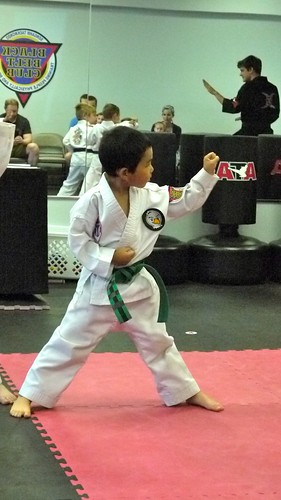
Double forearm block in taekwondo poomsae
Double forearm block as part of his ATA Taekwondo poomsae

Sunday, May 29, 2016

Parenting Month 67: independence and dependence

This is the end of the first year of kindergarten for T (5 1/2), and the first time we have truly experienced the chaos that comes with the end of a school year. I suppose we should have seen it in the past, since we are exposed to older kids, but the full impact escaped us.

We have been dealing with the contrast between independence and dependence. On one hand, we want him to be competent and confident in his dealings with the world, and being more daring is probably something we desired in the days when he was seemingly scared by everything under the sun. However, he is often too comfortable and we now wish he felt more of a need to check that he was still with us (or that he comes back when called!). To use the usual analogy of a rubber band to describe this tension in children, our rubber band suddenly got a lot longer in the past few months.

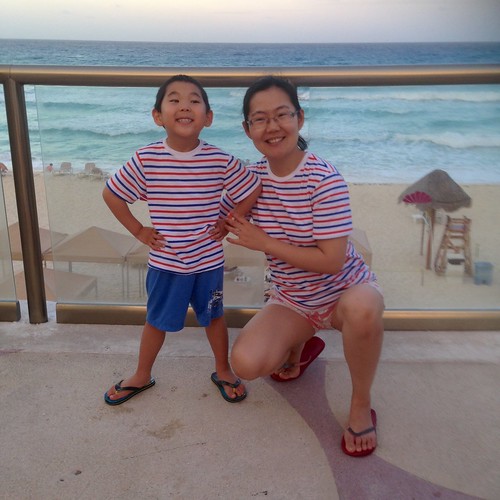
Matching shirts on vacation


Along with this greater independence is a greater amount of rebelliousness. We have noted an increased rate of tantrums and anger episodes (ok, this was low beyond expectation before, but it is noticeably increasing). Part of this may be due to socialization as he picks up behaviors in his classmates and older kids in school. Part of this may be a dichotomy between school (where he seems to be viewed as exceedingly competent and capable, given that he is in Kindergarten) and home (where we always have expectations one (or many) steps above where he is now).  Some of the old tactics, such as presenting him with options for him to choose, don't work as well now (now he points out that he does not like any of the options!)
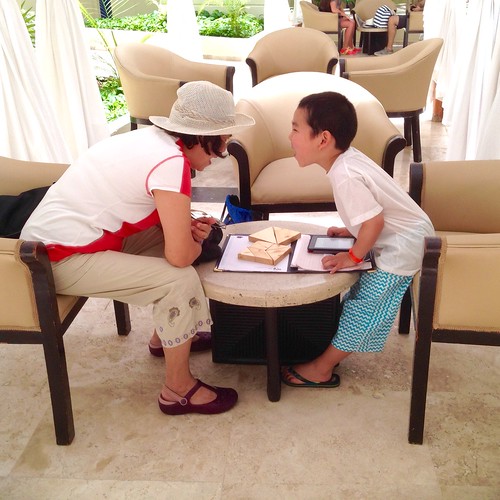
Reading a book to grandma
Talking with Khun Ya (grandma)(
In other news, A (2yrs) has been steadily increasing her command of language. She uses it to identify things everywhere (to the great amusement of spectators), negotiate agreements (perplexing parents), state her will and defiance (which exasperates parents and grandparents).

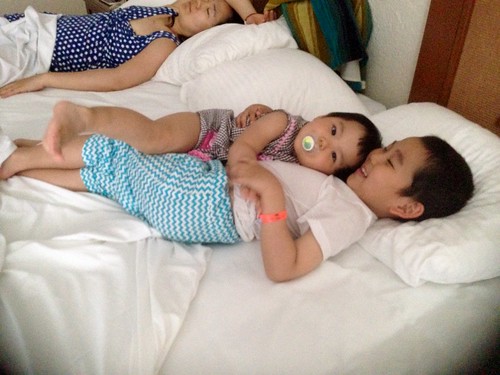
Naptime on vacation
Their version of taking a nap on vacation

Sunday, May 15, 2016

Ronin Games by Harmon: Book review

Ronin Games (Wearing the Cape #5)Ronin Games by Marion G. Harmon
My rating: 4 of 5 stars

This is a superhero story about Americans in Japan. In this case, the POV is Hope, an American teenager who has been given responsibility beyond her years, and she ends up having to go to Japan to figure out how to stop a potentially very dangerous person, who happens to have diplomatic immunity and there are several levels of deniability that need to be established.

This can be read as a set of four stories: first is straight up superhero story (which has a spy story as a prologue). Second is a ghost story. Third is a horror/magic/superhero/martial arts story. Last is a superhero/kaiju(monster) story. (I read this once myself, then a second time with my 5 yr old son, so I actually skipped the horror story part for him)

Things I liked:
1. Characters where rounded out. Everyone has a different set of motivations based on their different backgrounds. While much is made of the cultural concept of duty in Japan, it leads each person in a different direction in subtle ways that drive the story. If anything, the Japanese characters are guilty of stereotype here when some of them don't recognize that within the culture there are many ways that duty can play out. This discussion of what is duty shows up repeatedly.
2. The hero is NOT the one with all of the answers. Something I like about the entire series. Hope, the hero of the story, is at times being carried along by her teammates and friends. And sometimes said teammates are consciously trying to help her without telling her (and they had good reason). In this case, the teammates are not token, they are legitimate heroes in their own right, with their own characterizations, motivations, strengths and weaknesses. And a big part of the series is that to be the best they can be, they have to work in combination.
3. I start loosing my suspension of disbelief when the story consequences start rising out of control. They suddenly find themselves in a position where the fate of nations ride in the background of decisions and becoming myth.

View all my reviews
Saturday, April 30, 2016

Parenting Month 66: Compare and contrast

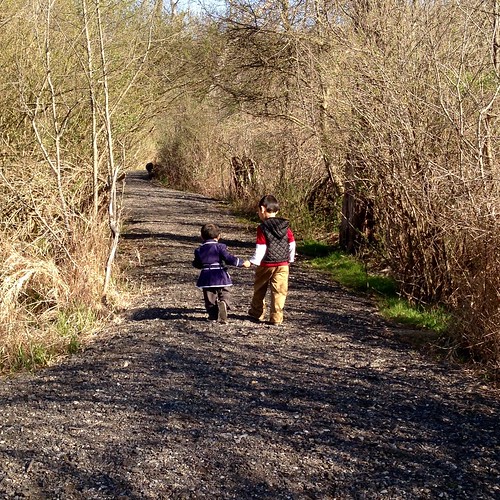
Taking a walk on the trail together
Walking together on a trail


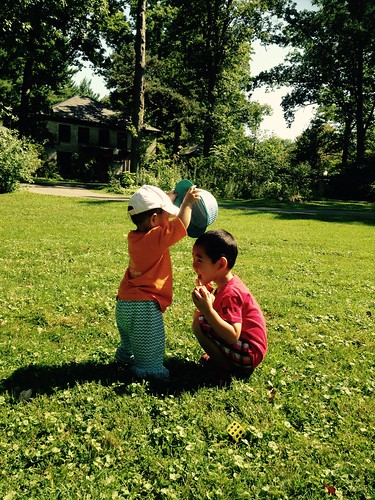
The little one is about to turn two. While children, much like runners, are experiments of one, it is somewhat inevitable to compare two children. In the discussion of nature vs. nurture, it is tempting to wonder what the differences are due to nature, under the assumption that since the parents are the same, the nurture part of the equation should be the same. 

This is in some ways a very unfair comparison. The older one was a nearly ideal (to parents) toddler. We joked that he was practically an advertisement for having kids (as two people who were not given to sentimentality about children). And frankly, when we take the two kids out in public, they still give the appearance of being ideal children (being alert and engaged in the public, but under control and well mannered. Following the middle path avoiding both being stone faced zombies and out of control monsters.) 

Some notes and obvious comparisons as the youngest finishes her second year of life:

  1.  She is very verbal.  At this point, T was not talking much, and certainly not too strangers.  A also is reserved in her attention, but is otherwise well engaged in the world in the presence of others. She is certainly braver; curiosity leads her to exploring her world, touching things, petting dogs.  And she is much more expressive. The expressiveness has a cost to the caregivers.  She can express her will and desires and be defiant in english and chinese.  She has also shown signs of understanding both english and chinese grammar (she can construct grammatically and contextually correct sentences in combinations that are new to her.)
  2. Songs. The knows quite a number of songs, both english and chinese.  Similarly to many toddlers, most of these songs she learned off of YouTube and such (nursery rhymes, Sesame Street). Also conventionally, she knows the ends of words and phrases before she learns the beginnings (because of rhyming).
  3. Reading.  She knows her letters and numbers. But, unlike T, she has not gotten to the point where she can recite entire books. She can point to and identify things within the book. But does not have the same desire that T did (at this point, T had several board books memorized and could improvise following the pattern of a few of them)
  4. Expressive.  Like other toddlers, she dances, expresses happiness, and unhappiness. She can also engage in toddler speak for extended periods of time. This follows naturally from the period where she was babbling for extended periods of time. To her it is probably the same, but to us, we can understand what it is she is saying. She also gets the language correct. (Chinese exclusively for grandparents, mostly english for daddy, switches back and forth for mommy and gege.)
  5. Focus. Well, A has a typical toddler focus, meaning her current mood lasts about 15 minutes. This shows in many places. The more conventional view towards books (she does not mind being read to, but does not enjoy nearly to the same extent T did), nothing keeps her attention for very long, 
  6. Daring.  A is more confident in doing pretty much anything. So she does the standard toddler activities such as scribbling (which is a precursor to drawing), climbing and jumping off of any surface she can access, playing with toys and blocks (much faster than T was). She is also more willing to work her will in crowds, claiming and defending her space in play areas, not afraid to be part of the rough and tumble of toddler play.
A is a different child than what T was. And our parenting is different. The most obvious differences day to day are focus (T) vs will (A).   One thing different that was not as intentional was weekly outings. By this point, daddy was regularly taking T out to museums, parks, etc. on Saturday mornings. While A sometimes joins in, even now, it is mostly only two of us. While T appreciated it more at this age (because he could focus on one thing at a time), when A does come, she enjoys it (although more of generally being out of the house than anything else)

Some notes on T this month.
  1. He gets many complements on being well mannered. Both when we are out and about (e.g. restaurants and museums) and in more standard settings. (his teacher commented about how he said thank you for helping him clean when he spilled his lunch tray on the floor, instead of taking it for granted. He also says please and thank you to waitresses, opens and holds doors for others (this is very cute, because he barely has the mass to be able to do this)
  2. He is continuing to make shy kids comfortable. We have gotten reports from other kids parents at taekwondo, saying their shy kids like being paired up with T. 
  3. An extension of 2, this month T started getting notes from a girl in his class, who is one of the quiet ones. 
  4. Still working on freezing in public. We have had occurrences of freezing when it is time to play piano in a group. On the other hand, he participated in a taekwondo tournament with no problem.  This is still a work in progress.
  5. T is getting more rebellious, but at this point a big part of it is trying on roles.  He copies his little sister (ironic) in being defiant (trying to get attention?). He also picks up on things at school, videos, we also caught him trying out lines that originated from the school play.

Saturday, April 16, 2016

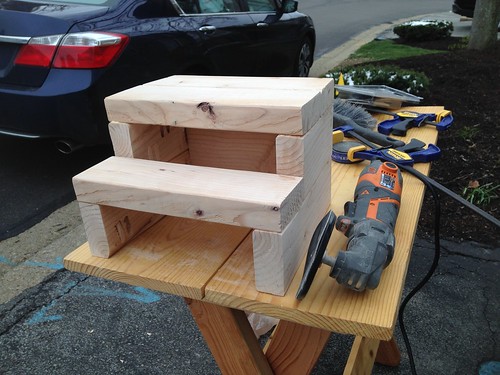
Simple 2x4 step stool

It has been a while since I posted a project.  And reality is that the winter months are not conducive to woodworking when your shop is either the backyard, driveway, or garage.  And work and life have a way of getting in the way. (ok, and some of my hobby time has been taken by a new hobby, I remember telling someone a year ago that I did not have any room for one of those.)  So, here is one of the easiest things in the world, a step stool made from 2x4.


Diagram of 2x4 step stool
2x4 step stool diagram

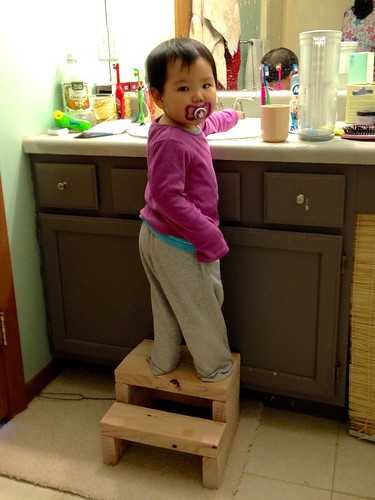
What brought this on is that a step stool made by my father-in-law collapsed while we were dealing with a tantrum.  While the shock of the collapse did end the tantrum, we now did not have a step stool for the kids in the upstairs bathroom (which is needed so they can use the sink on their own).  And, to be honest, I had a few purchases over the past few months that needed a workout.

I used a design described in the blog MoreLikeHome.Net that built a stool from a single 2x4 (I think that I've seen this design in response to a contest of what can you make from a single 8' 2x4).  So, went to our favorite Home Depot to get a 2x4 while my son was at a birthday party not too far away.

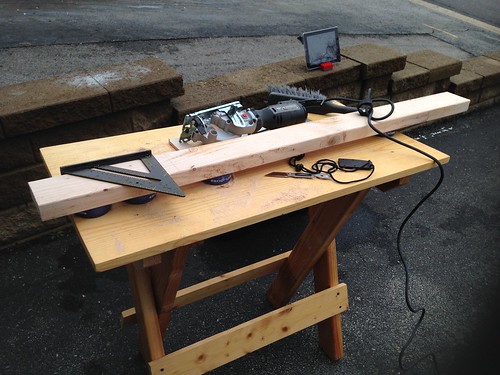
Speed square and circular saw
A 2x4 full of potential. Yes, the iPad stand is made from LEGO. My folding workbench was project I made just before my daughter was born.

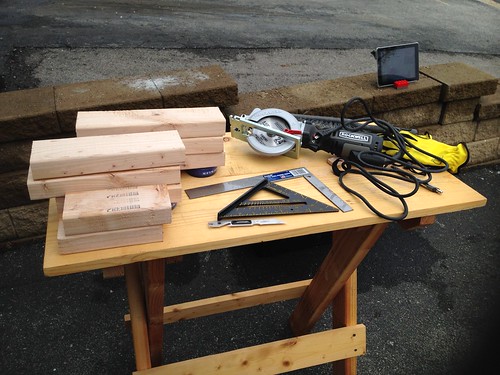
First step, cutting down the 2x4. I had the Home Depot do one cut at 37" (which represents 3 12" steps with a little more to account for the kerf. This also made two pieces small enough to transport in my car.)  Further cuts were made with a 4 1/4" circular saw and a speed square. (A framing square was large enough to measure the cuts and a utility knife was used to mark the wood. Wood was supported by bench cookies, which meant that I did not need clamps for cutting.)

2x4s cut into pieces for step stool
2x4 pieces cut by compact circular saw

Next was sanding all the pieces down.  I have a Ridgid Jobmax multi-tool, and over the winter I bought the Fein Multimaster 4" sanding disc attachment. It is a lot larger than the detail sanding pad that usually comes with an oscillating multi-tool and delays the need for a palm sander. (and doing this by hand takes way too long :-)  )  I sanded everything down using 60 grit paper, with the plan to leave the final sanding for after the project was complete.

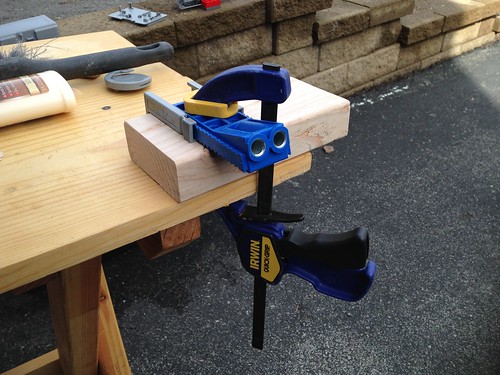
Next was assembly.  I used the Kreg pocket hole system (another winter purchase) and 2 1/2" pocket screws (because I was working with 2x dimensional lumber. Note to self: Kreg was delivered with 1 1/2" screws that are meant for 3/4" boards) I used my Quick Grip clamps on the flat part of the Kreg R3 (jr).  My first time using pocket holes. I am a believer.



Using Kreg Pocket Hole system
Kreg R3 Jig with Irwin Quick Grip clamp

Next step: assembling the step stool. I used a corded Jobmax with the right angle drill head to drive in the pocket hole screws. One issue with the right angle head compared to standard pistol grips is that it is harder to control the torque, so my first leg did not go on straight.  Instead of taking the whole thing apart, after I assembled the legs, I put a wood blade on the multi-tool and cut off any overhang and cut down the back stretcher to size.

Finally, I put in fillers into the pocket holes and sanded the whole thing down with the new sanding disc.  I actually did this right and worked my way through three grades of sanding pads. This does make a difference, as the stool is noticeably smoother to the touch than my previous projects using dimensional lumber.


Sanding 2x4 step stool using multi-tool with sanding disc
Fein 4" sanding disc attached to Ridgid Jobmax multitool

A nice quick project. I did not stain it yet (waiting for the weather to warm up). But now that it is in use, I'm thinking about if I will stain it at all.  Certainly the kids like it (it is a lot more stable than what was there before.)

Using the new stepstool
2x4 step stool in action

Some notes:

  1. Tools used
    1. Rockwell 4 1/2" Compact Circular Saw
    2. Ridgid Jobmax Corded Multi-tool
      1. Right angle drill head
      2. Fein Sanding Disc attachment
    3. Kreg Jig Jr (R3)
    4. Framing square
    5. Speed square
    6. Bench cookies
    7. CRKT SpareTool (for marking wood)
  2. My  Folding worktable is getting a good workout. Maybe not as good a a full sized workbench, but much better than any purchased metal and plastic table would be.
  3. The advantage of having the multitool with wood saw blades, I can cut away any evidence of mistakes.
  4. Pocket hole fillers cannot be cut using a multitool saw. Either I sand it or cut it before it is in place. Maybe if I glue in the fillers and wait for the glue to set, it may be amenable to a saw.
  5. I like pocket holes. Much nicer to not have screws showing on outside surfaces.
  6. Mommy noted that the first step is not that deep (made from a single 2x4). But since it is only used to get to the second step, it is probably ok.
  7. Circular saws are a lot faster and more precise than jig saws at going through 2x4. I think a lot of my older projects would have been faster with it. I suppose that the jigsaw was useful as a first power saw with out of nervousness, but I would tell any beginner to start with a compact circular saw that can cut through a 2x4.

Monday, March 28, 2016

Parenting month 65: kindness and confidence

We have always been concerned about T being too shy and quiet in public. Getting into kindergarten was a near thing, not because of his abilities or behavior (preschool staff could testify that was not a problem), but the fact that he had to be able to perform in front of strangers at some point in any assessment. In the end the kindergarten assessment was helped by the fact that the school took a very sane approach to how the assessment was done (observation over a period long enough for him to get comfortable with the setting, and long term assessments by the preschool carried weight), and the fact that he was changing himself (right around the same time preschool staff happily noted he went from a very quiet kid to someone who occasionally had to be told to be quiet.)  But the next step is how he would act as he got exposed to a larger world.

One advantage of not having many scheduled activities for my son is that I get a lot of time with him as he has been growing up. So we get to interact with many people and things. And he loves it. I think even from the beginning all of these outings have been mini-adventures and he got to practice being brave, even though he knew he was not.  As he has gotten older we've been giving him more space to interact with others (and his little sister).

I got your hat!
This is my hat
This month was marked with play dates, a trip to Chicago, and some other events in new spaces. Some anecdotes:

1.  Playing with a couple of older and more rambunctious boys. At one point T told them that they needed to play gentler around his younger sister and be more provident (that is a word that they use at his Catholic school). That got a "what does that mean" type of reaction as they went on their way. We were surprised that he could be so confrontational.

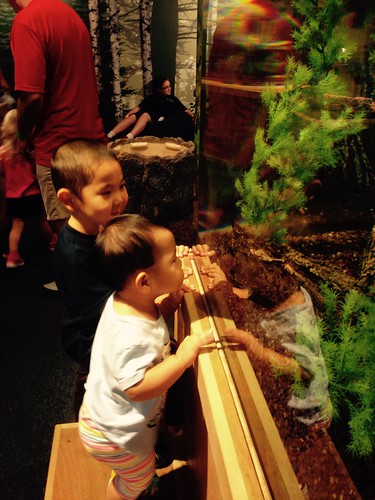
Look, there is a catfish hiding in that log
Can you see the catfish in there?
2. Chicago. We went for my father's 100 day remembrance. There were a couple of times where we stationed him in front of a door to greet people. And he did (in a place where he knew almost noone, and certainly not any of the aunties and uncles who wanted to talk to him). Curtesy is turning into his way of dealing with the big unknown world. And there are worse ways to react.

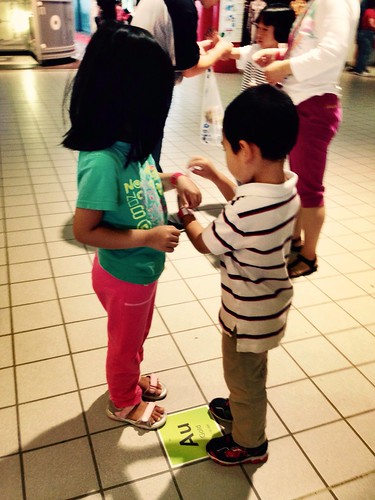
Helping a friend put on her wristband
Here is how to put on a wristband
3.  At a church event where we were invited by a chinese family who did not know what was going on, he  taught the kids the games and cheered when they won. Later at the Easter egg hunt, once he got his limit, he went around the field helping the younger kids find Easter eggs.

4.  Taekwondo. One of the moms commented that her daughter liked it when T was at class, because her daughter is also one of the smaller ones and T is closer to her size, and because T is controlled enough that he does not threaten to run her over during sparring.

Like a lot of asian american upper middle class suburban parents, we are somewhat ambitious about where we think our kids will be academically (*pause as people who know us, especially my wife, finish laughing*)  But as we learn what some of the practices in our area are like, we also want our children to be sane. When we watch T and how he has grown, we often jokingly ask "can we keep him?", because we realize that while he is still a kid, he behaves much better than we can reasonably expect kids of his age to behave. While in no way we are going to cut back on our quest to keep him academically challenged, we are very thankful that he is turning out kind.

Saturday, March 05, 2016

Parenting Month 64: Focus and persistance

The parenting topic that has been on our minds the most this month was what to do about summer. We have not done any formal activities in the past, but we are aware that the other kids in suburbia have been sending their kids to various week long summer camps for art, music, dance, and a whole range of academic and semi-academic camps in addition to the outdoor activity camps. (to be fair, my wife runs one of these, so we probably are a part of that ecosystem, just not from the side of the consumer). But we had not done this with T, instead having mommy school (piano, chinese), daddy school (which involved museums, hikes, and something that had a strong resemblance to playing with LEGO), and grandparent school (swimming) supplemented with taekwondo. But we were aware this whole time that our neighbors (especially the asian ones) were enrolling kids in multiple programs.

So this coming summer, with the end of kindergarten we started looking at what the market had.  We found numerous offerings at various private schools in the area, a couple of colleges had offerings (alas, C-MITES at Carnegie Mellon University is no more), YMCA camps and a plethora of dance, sports, arts and crafts, and general activity camps. But what we noticed is that the majority of these were in one week chunks, and the ones that were longer had a large list of activities that they had planned for their campers. Which means that they will be moving from activity to activity throughout the day.

Our goal was to find activities that would reward focus and persistence (and make sure he got a reasonable amount of outside time!) So this summer will be in three acts. June is mommy and daddy school. July is a series of one week camps (piano, LEGO, and science) and August is decompression/getting ready to go back to school.  Mommy school is piano and chinese (with curriculum!), daddy school is going to be computers (Raspberry Pi and Scratch) and LEGO (simple machines and storytelling). And we are going to continue taekwondo.

Ready for testing
Ready before testing
Other developments. We are starting to note a slightly more rebellious attitude in T (5yr old). Considerable resistance to mommy, grandma, and grandpa (oddly enough, daddy does not get to experience this very much) (And A(1 yr old) is like this too, we actually do not know who is feeding off of whom.)  Some of this may just be the standard testing of boundaries, another may be the fact that he is now picking this up from other kids (peer pressure really did not do anything to him in preschool). I remind mommy that this is incredibly mild compared to most 5 yr old or kindergartners. Of course, this does not help. Neither does the fact that teachers (school and outside) routinely comment about how well behaved T is.
Self defense exercises
Back stance during self-defense testing
Taekwondo is continuing along. He is still quite good for his age. One benefit of going up the ranks is that most of the kids in the middle color belts are a year older than him and better coordinated. So the standard surrounding him is better than him. Another development is that I started taekwondo as well, and once a week we go to the family class together. The general comment is that he is watching me with a big smile the entire time we are in class.  Since he is a few belts ahead of me, he gets a kick about going into teacher mode when we practice at home. We have been getting some training gear from the school because of students that we have referred to them. So our house is generating an overall background noise of martial arts and Star Wars. Mommy is not sure about how that happened in her house.

His sense of sequence still needs work. He essentially has three time periods, past, now, and future. And, consistent with age, all things past tends to get mixed together.

School is still working on finding his level. We are happy that they have continued escalating his reading. The books he is bringing home from the school library are getting harder. Actually, I think that they are too hard, because he discovered the Star Wars section of the library. Fortunately, we have a reasonable amount of appropriate books at home as well as what I read to him.
Round kick during sparring
A is adding willful to being a babbler. And that means she can express desires deliberately and strongly in two languages. I commented that with T we pretty much got a pass on the terrible twos and threes. While A can communicate (which does eliminate a good portion of tantrums), we are not going to get a pass on this one.

Wednesday, February 03, 2016

Parenting Month 63: Reading is fun

This past month both kids have been progressing in reading. The little one now recognizes upper and lower case letters on a pretty reliable basis. The next thing in line are colors. At the beginning of the month she only identified "purple". Now she knows "blue" "yellow" "red" "green" (which are the colors of her blocks that I carry around whenever we go out).

One of her favorite things to do is to read. There are books mommy reads, and books daddy reads. (unfortunately, she does not have a category of books big brother reads, or this would get much easier on us, he is certainly willing to take part on part of the work). Then, there are books she reads.  This tends to be a lot of fun to watch, and I could watch for hours (mommy would say that she would happily babble for hours as well if we would let her).  She also recognizes that my Kindle holds books, and can identify a few of her favorites that are currently loaded on it.


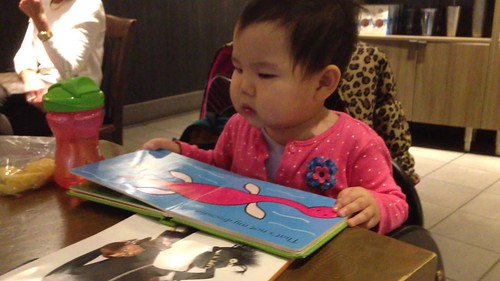
Reading in a coffee shop
Reading in a coffeeshop. She can keep this up for a while, especially every night before bedtime.
The older one also reads regularly. For him, it is one of the things that he goes to for play. I remember being told that when kids learn to read, the parent workload drops tremendously because it means that kids can entertain themselves. This is the case with him as well (actually, once the little one gets going, she can be left for a while as well, until she decides she really needs an audience again).

One thing we are concerned about is that the reading is getting too easy, especially at school. There was a period where he was coming home saying that every class was too easy. Fortunately, they have been escalating the difficulty level for him and a couple of other kindergarten readers. And they have assigned staff time to do work with him (and the others) to check on comprehension (which has the effect of slowing them down). At the open house tonight, his teachers let us know that he has completed the first grade book series, and he is now on second grade reading material (at a school where the average second grader is a full year ahead of grade level).  He is probably aware that we are concerned that he is not being challenged by reading. This week he came home with a book from the school library (they have one book checked out each week) proclaiming to mommy "I got a difficult book for you." (and it turned out to be way too high level for him)

So, like other things, we are thinking about how mommy and daddy school will keep him progressing outside of school. Of course, daddy school looks a little fishy to mommy, as it involves reading graphic novels (Usagi Yojimbo) and talking about story lines (and activities that look suspiciously like playing LEGO and computer games). But we are in agreement that we don't want him to have the attitude of only doing things that are easy.

Thursday, December 31, 2015

Parenting month 62: Culture, community, and raising children

The major milestone this month was the passing away of my father.  As the funeral was in Thailand, I had gone without the kids. We also had a small memorial service in the city where I grew up, so we took a week there.  It is probably the most intensive exposure to Thai culture that my kids have had to date. (My son had gone to Thailand as a infant, so he would have been too small to remember anything.)
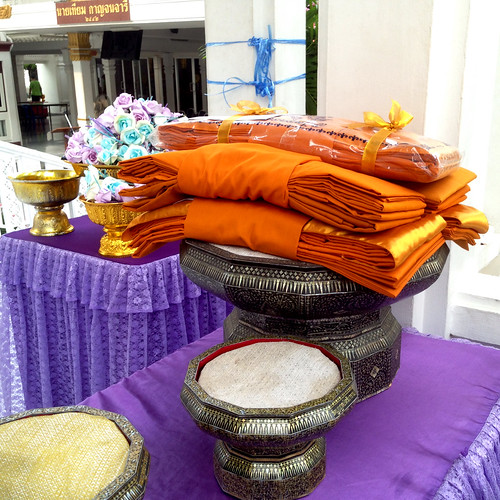
Robes for gifts
Robes for an offering
One problem with living in Pittsburgh is a relative lack of diversity compared to other big cities. And one consequence is that there are not many Thai.  One estimate I heard at one gathering that there were about 40 Thai families in the Pittsburgh region. (Not counting students, who are considered transient) and only about half interacted on a regular basis. So we have been essentially raising our kids as Chinese, where we would have a reasonable number of other Chinese kids around for our kids to learn Chinese together.

To prepare for the service at the Thai temple, we subjected our kids to a crash course in Thai greetings and courtesy via YouTube. One thing my son (an introvert) can handle is curtesy, so he picked up on that and handled himself as well as can be expected for a Kindergartener who does not spend time in a Thai environment. He greeting people with a wai, and when it was time to perform his role in the service, he did his part (doing things alongside daddy is also something he can do). My daughter is also well behaved toddler in public, and performed admirably for a toddler girl, presenting a charming and well behaved face to the world.
Remembering Khun Bu. Watering a tree
Wai before pouring out water
Remembering Khun Bu. Watering a tree
Watering a tree

The main result of the trip was a lot of time spent with old friends, mostly a mix of Chinese-American and Thai-American families, now with children.  And we talked about the raising of children (and sometimes grandchildren). We talked about choices that we make, our kids personalities, and how they are different and lead to different challenges and opportunities. While I do have conversations about parenting in Pittsburgh with other parents at our kids school, day care, activities, and with others in community organizations I'm active in, the big difference with living in the place you grew up and being part of the mobile generation like I am is that those conversations are lacking in much of the context that comes from growing up in a community.

The conversations I have with other parents tend to be about immediate issues.  Getting in school, participating in activities, dealing with health issues. But the things that I talk with my wife, long term issues of guiding our children's growth in the context of their specific personalities, affinities, and strengths is done just with ourselves. But returning home, the conversations include how the personalities of the children compare to the personalities of the parent (current and past). And the conversations are more long term. How our children's personalities will help or hinder them in the future, and how it impacts how they deal with the world around them. And how to prepare them, not just what can be done now, but over the years to come.


Untitled
Add caption

Wednesday, December 30, 2015

One year of taekwondo

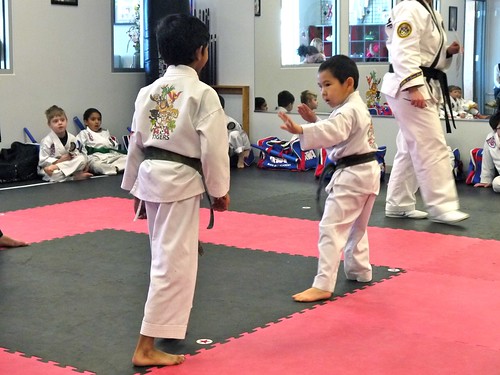
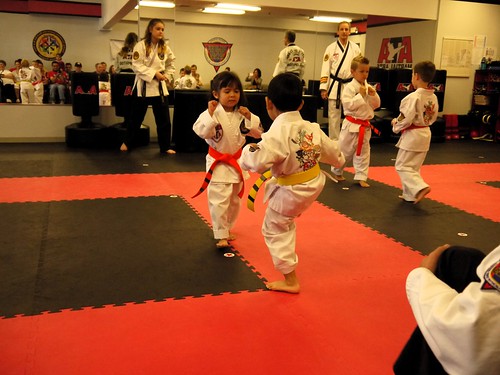
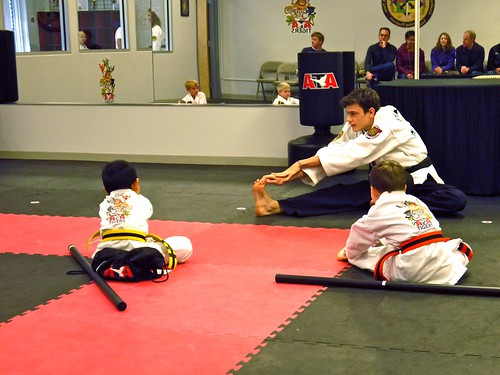
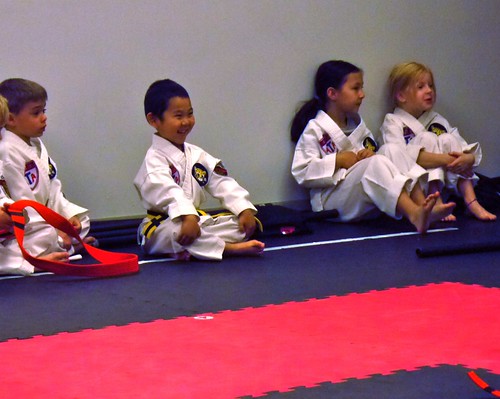
Our son started Taekwondo soon after he turned four. We have had the fortune to be able to spend a lot of time doing activities with him, and being fairly competent ourselves, but also realized that there were things missing that we (and daycare) were not filling. One, we wanted him to be engaged in something physical and two, we wanted him to be engaged in the world apart from us.  At this point, while he was a very happy, engaged, curious, and reasonably empathetic child, he also was an introvert (not terribly surprising as both parents are as well). In his case it showed as shyness in the presence of new people, and no assertiveness of will (although this may be attributed to lack of attachment in things,) So we were looking for something that engaged him physically and grew his confidence in interacting with others. There are two sales pitches for martial arts for yourg children,  one is that it installs discipline and an outlet for rowdy, physical kids. That was not our problem.  The second is that it installs confidence. That was our goal.

Knife hand strike
Knife hand strike in Songham 2
We went to a relatively new school that was part of the American Taekwondo Association (ATA) . The impact of being fairly new are that it was still fairly small and it had not generated any black belts yet, so the first benefit was he got a lot of individual attention.  The first times he went he looked but did not do anything, which was expected. The school staff spent a lot of individual time with him talking to him and getting him comfortable. In the meantime he observed what was happening.  Eventually, he got onto the floor and started participating.

The first benefit we saw was increased confidence. Taekwondo represented a set of skills that he could learn and be competent in, and his attention span helped greatly here. He dealt with the instructors and interacted more freely with the other kids than he did before.   A few months in, he had an interview with a prospective kindergarten, and he warmed up to the staff much easier than he had to any other adult (e.g. Day care staff) before. (He usually took 3 months to warm up to new day care staff, either new hires or for when he moved rooms). The curtesies of the school have helped him navigate everyday life in interacting with adults.
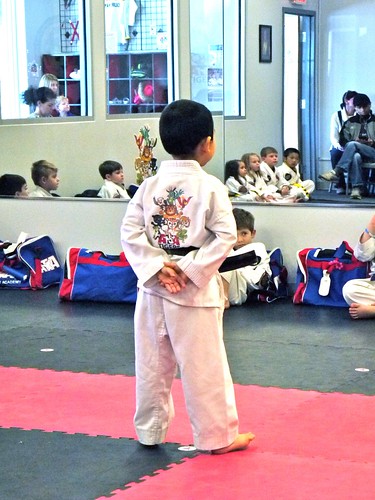
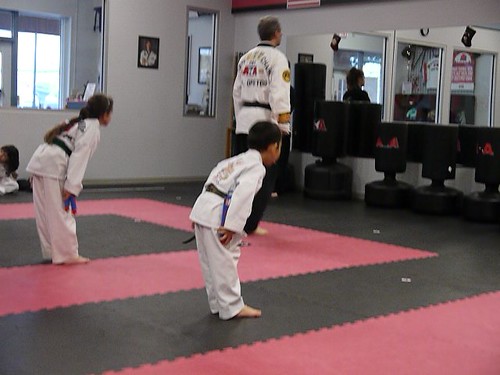
Bowing before forms
Bowing before testing
The second benefit was concentration and focus, T always had a good attention span, his day care noted that he was a child who stayed in place while the chaos of preschoolers moved around him from activity to activity. Taekwondo added a long term focus onto this, coupled with his natural attention span, meant that the forms and patterns were something he could develop competency in. So, in contrast to the usual criticism of youth Taekwondo as being merely moving limbs, he learned to put power in his moves. And having an object of focus has helped in his usual shyness and tendency to freeze in public view.

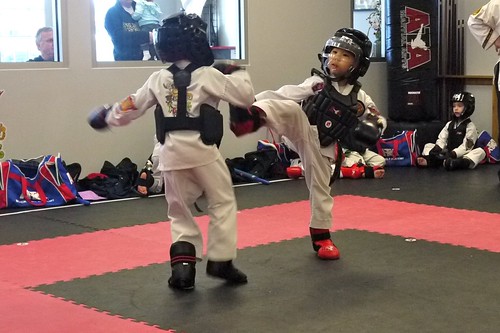
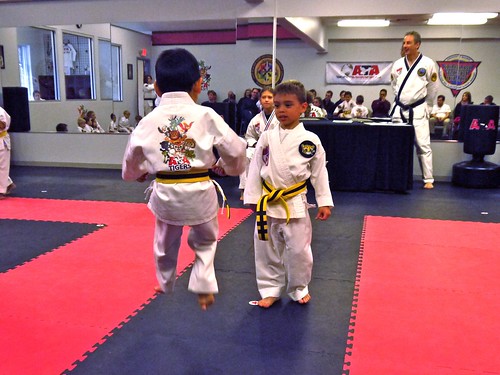
jump front kick in line sparring
Jump front kick while line sparring

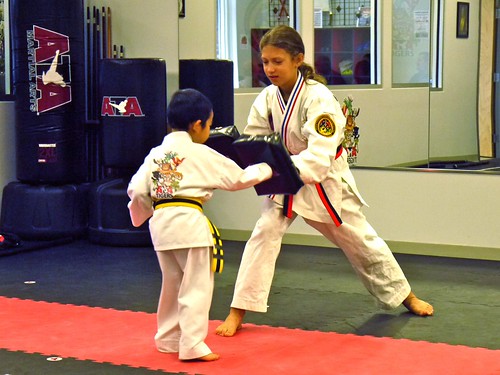
The other thing we are looking at in the school is how the older kids are like. Once we figured out that T liked this, and we were in this for the long term, we wanted to know who would be influencing him. In a martial arts school, this would mean the kids who reach black belt and become assistant instructors themselves. We have had some interaction as some of the teens have started assisting with classes. But my real interaction has started when I started taking Taekwondo myself. The classes are small, as it is only  two years old, but you see the teens supporting one another, and also you see the older ones, who are approaching the black belt ranks, taking seriously the role of encouraging the others, it was a different experience to have a group of teens providing encouragement to an adult (me) in my first month.
Line sparring
Line sparring

One other thing that we are looking forward to is that as the years go on, he will know people in his life who have taken this path before, and unlike sports heroes, these are people he knows in the flesh. In addition to Masters level black belts he will meet in the course of his training, he knows people with black belts or equivalent in various disciplines, and people who compete at the highest levels. So the people he sees on YouTube or in other media are real people, and represent something that can be realistically aspired to.

Saturday, December 05, 2015

21 questions to ask a child about daddy

T (5 yr old) decided that it was wakeup time. Note that today is a Saturday, and this was his school day wake up time.  So I decided that if he was going to wake up, he would (1) eat breakfast and (2) play 21 questions (https://www.pinterest.com/pin/169166529725642521/)

1.  What is something daddy always says to you?
I don't want to play that game

2.  What makes daddy happy?
Not fighting with T. (Note: fighting refers to the morning routine of waking t up, eating breakfast and getting to school)

3.  What makes daddy sad?
Fighting with T.

4.  How does daddy make you laugh?
Tickling T

5.  What was daddy like as a child?
Crawl a lot. When you (daddy) was really little you did not know how to walk.

6.  How old is daddy?
25

7.  How tall is daddy?
51 inches (T is 40 inches)

8.  What is daddy's favorite thing to do?
Play LEGO

9.  What does daddy do when you're not around?
Working or doing ATA (Note: taekwondo)

10.  If daddy becomes famous what will it be for?
I don't know

11. What is daddy really good at?
Pushing LEGOs together

12. What is daddy not very good at?
Playing piano

13. What does daddy do for his job?
Type letters

14. What is daddy's favorite food?
Turkey (Note: Thanksgiving was last week)

15. What makes you proud of daddy?
When daddy draws in the lines

16. If daddy was a cartoon character who would he be?
Superman

17. What do you and daddy do together?
Make LEGO

18. How are you and daddy the same?
We are both boys

19. How are you and daddy different
I (T) am short and you (daddy) are tall

20. How do you know daddy loves you?
Daddy reads to T

21. Where is daddy's favorite place to go?
ATA (taekwondo school)

Saturday, November 28, 2015

Parenting Month 61: Sibling relationships

There is a giraffe way up there
There is a giraffe up there


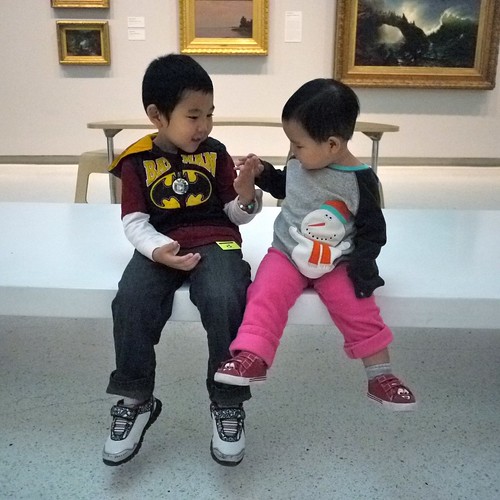
We've been fortunate that our kids get along well with each other. My son likes being a big brother and watching over her and showing her around places, and the little one adores her big brother. So they play with each other, they cheer each other on, and she has even started letting him read to her (she still has a strong preference for mommy or daddy).  About the closest thing we get to conflict is the fact that she is only 18 months old and at that age kids kinda hit each other without thinking about it.  And sometimes ge-ge (older brother) just isn't enough for what she wants.


Carnegie Science Center
Siblings running at the Carnegie Science Center Sportsworks


Let me show you something in the art gallery
How do you like the art museum?

The other major issue of development is courage. A is an 18 month old who does not know fear. T, has always been the careful one. He was among the slow ones to interact with others in day care, and he was slow to socialize at his new school. And we note that things that he is quite competent in around us, he freezes when others are observing him. While Taekwondo is a big help in this area (competence does help in this), with testing and tournaments, this does not get all of the way there. Using the curtesies of TKD and catholic school has been one tool he can sometimes use to get over his general nervousness, and I'm teaching him some techniques from Red Cross Pillowcase Project training as well. There are a few opportunities coming for him to practice engaging the world in public, but this will a be something to deal with for a long time (both of us parents are naturally introverts, and we expect the same is true with him)


Jumping on trampoline at the Carnegie Science Center Sportsworks
Trampoline at Carnegie Science Center

In other notes, T saw his first movie in a theater, The Martian.  A now knows a fair number of letters and numbers. While slightly behind where her brother was at this point, this is without putting in any work (we think she is picking it up from two alphabet books that are on her chosen rotation).

T's first movie
Tickets to The Martian

Sunday, November 01, 2015

Parenting Month 60: Confidence and public performance

Some lists for the elder one.
  1. Favorite book: The Martian.  Runner up: Rosie Revere, Engineer
  2. Wake up song: Level Up by Vienna Teng
  3. Favorite color: Yellow, Green, and Red are the current rotation. (The concept of favorite needs some work)
  4. Favorite toy: LEGO
  5. Favorite taekwondo move: round kick
  6. Programming environment: Kodable Runner up: Scratch Jr.
  7. Museum: Carnegie Science Center
Stretching before testing
Stretching before belt testing


We are starting to get some feedback from his first year in school (Kindergarten).  The first month, there was some concern that he was not really socializing (which we expected), but that has largely ended. He is still relatively quiet, but he does interact with the other kids and all of the other teachers more. We have noticed that it seems like all of the other students (K-8) at his school seem to know who he is. We think it is a combination of being the smallest one in the school, and that he now has an identity as the kindergartener who practices piano during the after school programming.

One of the effects of school is socialization and comparison. And it seems that he has figured out that he is ahead in most areas. His reading is at least a grade level ahead. Math is actually unmeasured, but in what they are doing he has pretty down (at least if he is paying attention). Robotics and art he is ahead (basically this means he is very good at interpreting and following instructions, he really is not that good in art, no creativity. But robotics (LEGO and Scratch) is probably justified. That is called the effects of daddy school.) not sure so about Spanish or gym, but I suspect he is just fine there. The real problem right now is that he knows he is ahead.

Punching pads
Reverse punch with pads
The big issue with kids who are ahead in school is that they start to put worth in succeeding at something. And it makes struggling at something doubly problematic. In the past, he was not paying close enough attention to the other kids to matter, and mommy and daddy school was pretty challenging. So success in the past was valued in part as a reward for the effort it took. And he developed the focus and value of work to make things happen. But what we have started to notice is that he no longer can keep focused on task, and we think it is because at school, nothing he is doing requires extended effort on his part. Daddy school (museums and LEGO, woodworking, and games), is somewhat rare nowadays. But where we really see the effect is in piano. He actually does not have the endurance he used to for practicing. And he responds much worse to difficult passages. So this is a danger that we have heard about, but now we have to think about what to do about it.  On the other hand, we are really glad we accelerated him and put him in Catholic school.  Another year of Pre-K would have made things worse, and we think that in a public school, they probably would not even have noticed he was ahead at everything (he is neither behind, nor does he act up or talk a lot, so he would go right under the radar of a Kindergarten teacher with 20 kids for 2 hours the whole day.)

Watching others go through testing
Watching the others test
The other area that we are looking at is performance anxiety. While shyness is not overwhelming (he has started to learn to fall on the courtesies of taekwondo or Catholic school during regular interaction), he still freezes when he becomes the focus of attention.  We were hoping that had largely gone after a successful taekwondo tournament experience, but it is definitely still there. While he will never be the loudest or among the talkative kids in the group, we would like him to learn how to comport himself in the public eye, or at least learn methods of focusing on the task and ignoring a crowd around him.
For the younger, she now babbles with purpose. I'm convinced she is telling stories. Most fun is when she babbles while paging through a book, now we know what we sound like when we read to her :-D. Her favorite books are A Baby's First Book of Zombies and Hands, Hands, Finger, Thumb. And with those two she can do appropriate sounds effects for most of the page.

Tuesday, September 29, 2015

Parenting 59: First steps out into the world

One thing that makes Kindergarten such a major milestone is the fact that the kids start being comparable.  Now that they are in a setting where there are actual goals at the end of the year, we see the results of parenting and the time spent in play and exploring the world. And there is an outsider making assessments (as the Kindergarten teacher establishes where each child is and how to nurture them to be ready for first grade).


Watching a drawing robot
Two Kindergarteners watching a robot.


Some things are easy to establish because they are skills. Can the child count, read letters, read books, draw? But some things are harder to figure out by the parent, does the child show empathy, care for others, handle adversity, is the child eager to learn? These are harder to see because you cannot tell the difference between the child interacting with the parent and the child interacting with the outside world. In our case, we have to start off by admitting we think highly of our 4-yr old, seeing as we have accelerated him into an early start in Kindergarten. (specifically, a catholic full-day Kindergarten) But having the outside assessment is helpful.

Our Kindergarten teacher opened the parent orientation by telling us that they were going to be taking it slow the first two months so she could assess their levels. At that point, we knew we were in good shape because in two months in a fairly small environment (20 total Kindergarteners in two classes), we were pretty sure that T will have adjusted to give a proper accounting of himself.  At one month, they are still looking for his reading level (we note that the library books that he brings from school are gradually increasing in difficulty), math is focused on sorting and shape (no challenge yet). His robotics teacher stating that he is doing well (essentially, at this point it means he can follow instructions to put together LEGO Technic and introduction to Scratch, both of which daddy school has covered.) His writing and drawing skills are noticably better (yeah!).  He practices piano on his own (for some definition of practice), he has started playing with other kids, and his gym teacher states he is a joy to have in class.  And more interesting, since we are not Catholic, is him talking about being 'provident' (attitude derived from the name of the order that sponsors the school).

He is still an introvert, and we do not expect that to change (after all, so are we). But we want him to develop the skills of interacting with the outside world. And the small class that he is provides him a safe place to do that. And we see it in how he carries himself around us, and in public. We like watching him try to take care of others, teaching other kids how to do things at museums, being polite to adults, he has even started holding doors open for people. And we note that one thing that being taught curtesy does, it provides a framework for approaching the world. A child showing curtesy is not at a loss in how to act and removing uncertainty makes everything more comfortable.

Another major milestone is T's first taekwondo tournament.  T is in a American Taekwondo Association (ATA) class as a Tiny Tiger (4-6 yrs old). And our main concern was if he would completely freeze. I had even taught him the breathing technique for dealing with emergency that we teach in the Red Cross Pillowcase Project.  But what got him started was the fact the he had to deal with the judges, and judges were just like instructors. And T knew how to treat instructors with respect and follow instructions.

Starting his Ssang jeol baang form
junbee! Ready to start his ssang joel baang (nunchucku) form at the tournament

What makes the tournament useful was not the prize (at this age, there are enough potential classifications of awards than there are participants, so everyone gets a prize, but some sound more 'real' than others), but the opportunity for him to be in an environment of strangers and perform. And for us to see how he is compared to the other 4-6 year olds.  Just like every other environment he is in, he is clearly one of the smallest. But he is also self controlled. I found it amusing that as they were waiting (having 4-6 year old boys wait without anything to hold their attention is a loosing proposition). He would go between the standard figiting and moving to almost an exaggerated version of attention when he remembered where he was.  We also saw him around kids from the various other area schools, and we realize that our school is just like all the others, and he gets compared in the same light. His memory (in the ATA, 4-6 yr olds are not expected to have memorized their poomsae, but he was clearly doing his with the leader instead of following as most of the kids did), focus (kicks and punches with snaps) and general lack of hesitation. Given that he was among the youngest of the bunch (the others were 5 1/2-6) he compares well. And doing well in his first tournament was a great confidence booster.
Bowing out
Bowing out after his form


Tiny Tiger with Medals
Medals for "Best power" in forms, one-steps, and weapons
The other one is turning into a toddler.  She has always had a will, now she is trying to enforce it.  And for a toddler, this means being greedy, grabbing things (especially something that someone else has), toddler tantrums, and yelling. On top of that, she seems to be quite smart, able to precisely specify her desires, demonstrating a good memory, so she is very good at causing trouble.  This one is going to be a fighter, and we see ourselves having much more trouble with the little one than we did with T.