Saturday, August 25, 2018

My fitness journey: one week into CrossFit

I finished a week of CrossFit, which I started after a summer that was primarily strength training and making the move over August.  This week included a session in a CrossFit box (gym) that was hosting a #22toomany fundraiser for prevention of Veteran suicides, a week starting the StreetParking Workout of the Day's, and finally, a HeroWOD as my BirthdayWOD.  For anyone my age, where we are in fitness is a state in a long running journey.

I started running recreationally in college. After college I lived in the Washington DC area, and I started running consistently.  Over my DC years, I built up my running to the point that 5K and 10K runs were nothing special. I was not very fast, but I could put up miles.

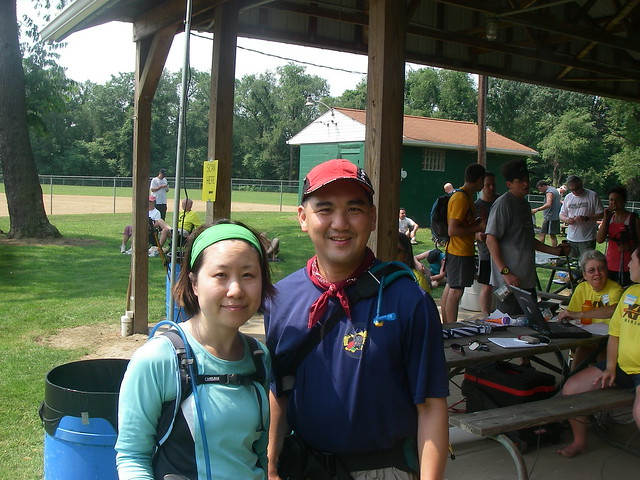
Support team
Chicago Marathon support crew
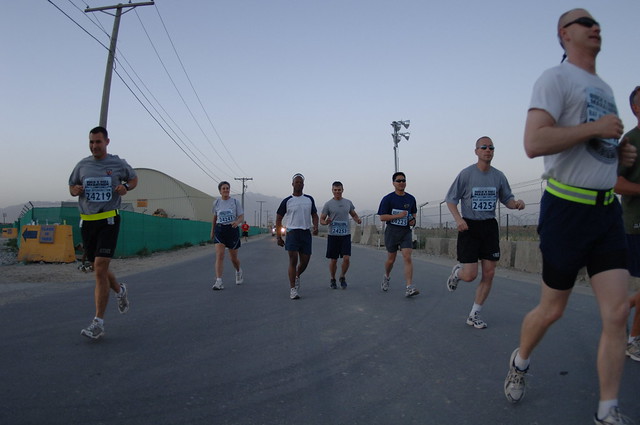
Running and biking were constants in grad school.  I often commuted by bike.  I also did more hiking and backpacking.  After a weekend backpacking, I realized that the hours I put in were more than the time it took to run a marathon.  So I spent the rest of that year building up to the Chicago marathon.  Over the years, I've run 6 marathons (Chicago three times, Ottawa, Philadelphia, Bagram) and numerous half marathons.  During this period, I could run a 2 hour half marathon without training specifically for it. I also did the Rachel Carson Challenge three time (32 miles, dawn to dusk over hills and terrain).
We happy few
Rock and Roll Marathon - Bagram Air Base (Afghanistan)

Checkpoint two - not quite so good looking
Rachel Carson Challenge

Going down hills in the Rachel Carson Challenge
Hills on the Rachel Carson Challeng
So the big interruption was kids.  I no longer justified multiple hour training runs on my weekend mornings.  And actually driving to work meant that it was harder to get time for regular runs on workdays.  So that started to stagnate.  The next milestone was when my son started taekwondo.  Once we figured out that this was going to stick, I started TKD myself.  (I said, half-jokingly, that my real purpose was so I can get a good look at the kids who would become my son's instructors once they became teenagers).  This turned out to be very good.  TKD forms were essentially skill work (which I appreciate in all of its forms). The bodyweight exercises were the beginnings of strength training, and sparring and bagwork provided good conditioning training.  And I still ran enough that my general conditioning was good enough to keep up with the teens who shared class with the adults.

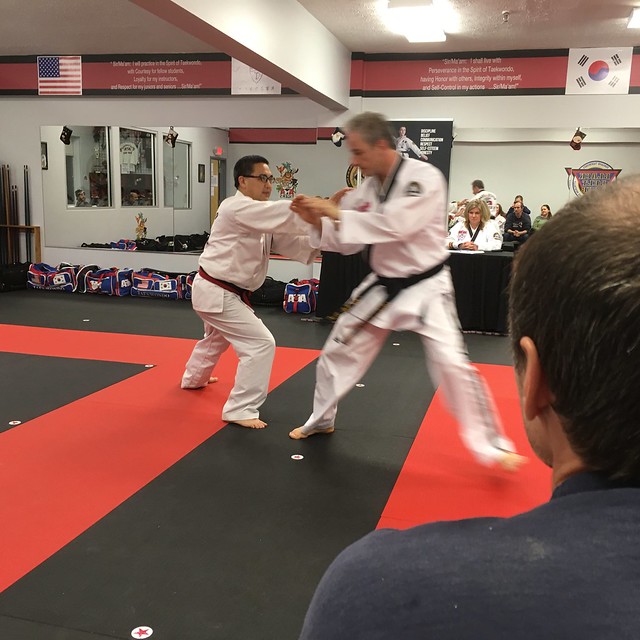
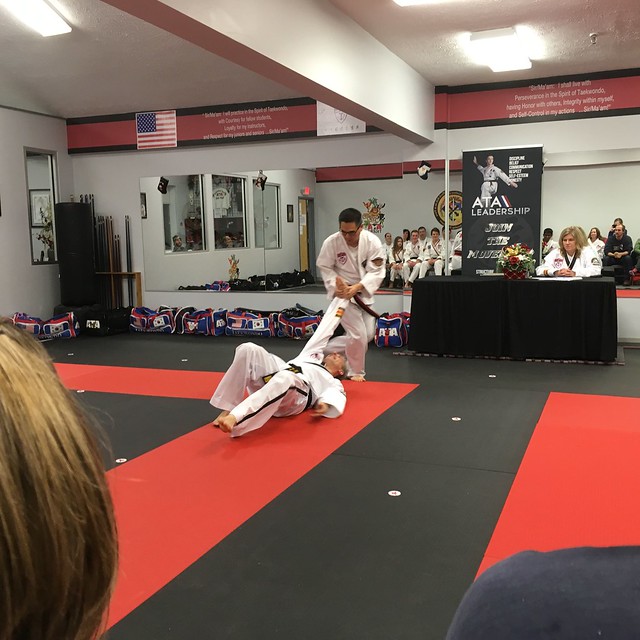
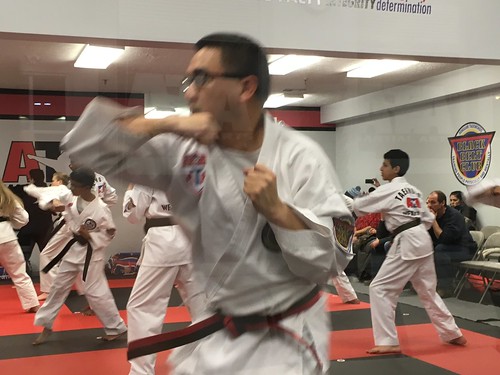
Self defense testing at the ATA Taekwondo
Self-defense technique testing at ATA TKD
A few years of TKD and I was approaching my black belt.  So I started looking to see how I could supplement that (as a blackbelt is no longer considered a beginner). Last year I started looking at strength training.  I had already been using Stack 52 bodyweight exercise cards with my son, so I started with their cards for dumbbells (I had an old set) and resistance bands.  I also started buying additional plates.  I got a bit more serious in Winter, getting a book on strength training (Push, pull, swing by Wyatt Murphy) which gave me principles on starting a workout.  I settled into a routine where twice a week I would have a workout that focused on strength, with deadlifts, squats, and bench presses getting primacy, then other exercises, finishing with conditioning (high rep swings and compound movements).  By the beginning of the summer, I had to buy additional plates.  Over my vacation in June I found the hotel weight room, and I continued my 5 day a week of workouts including 2 days a week of strength.  By this point I was using 45 lb dumbbells for my deadlifts, squats and bench presses,  30 lb dumbbells for swings and related exercises.

When I got home, I realized that I was at a point that getting some instruction would be useful so I bought a set of 5 personal trainer sessions at the YMCA.  While I did achieve my goal of improving form on deadlifts, squats, and bench presses, I realized that what I really got out of it was a range of other workouts.  Also I realized that I really was not interested in the machines (they had only one power rack, two benches, and one smith machine as well as one deadlift platform, so not all that much room for free weights compared to the rows of machines).  Third, I also realized that I wanted my non-TKD workouts to provide both strength and conditioning.  And while I was good at pushing strength (I had been on the linear curve for 8 months by then), good conditioning workouts require outside intervention.  And, while I liked my trainer, $40 per session (and that is factoring in the free intro) was more than I wanted to pay, because at some point, he was more of a programmer and cheerleader than an instructor.

So, what did I want?  I was looking for programming, that provided strength and conditioning, that was reasonably fast (1/2~1 hour in a session), and I could do at home (mats on floor for bodyweight, dumbbells, suspension straps, medicine ball, punching bags.)  And I had no intention of buying a barbell and rack (because then I would have to figure out where to put them)

Given that my goal was strength and conditioning, I started looking at CrossFit. A CrossFit gym membership was looking expensive, especially considering this would be my second fitness cost (I am continuing TKD).  So I was looking at the online only programs.  Problem I found here is that most online programs were aimed at people who were competitive, e.g. who had a goal of doing well in competitive fitness such as the CrossFit Open (and highlighted their athletes who qualified for regional and national level competitions.)  Strength based training all had as a starting point a barbell and a powerrack as basic equipment (actually, they all had an attitude that being able to work with a barbell and power rack counted as minimalism) StreetParking stood out in that they scaled (had variations of workouts using either lower weight or easier movements for people who could not do the prescribed workout) and they guaranteed that one of the three main variations on the WOD would be for people who only had dumbbells and a jump rope, which was a unique variation on minimalism that counted me in.

In August I started doing a few sample workouts they had posted on their YouTube channel, as well as some workouts being done by other people who were posting sample workouts as reviews on the programming. These were hard, but I could do them with scaling.  And I was pretty wiped out when I was done.  This was a good combination of characteristics, so I signed up.

What is CrossFit? The definition comes from Greg Glassman, the founder:

CrossFit is constantly varied functional movements performed at high intensity.


  • Constantly varied means that workouts will change daily, with many variations on exercises to ensure that all muscles get targeted over any reasonable period of time.  More notes to follow
  • Functional movements means that workouts would be in a manner similar to that experienced in the real world. This means multiple muscle groups and multiple planes of motion.  This contrasts with isolation exercises (single muscle) and exercise machines (which are all designed to focus on one plane or axis of motion per machine)
  • High intensity means that the workouts are designed to increase power, which is Force * Distance/time.  So this means maximizing the combination of weight and distance traveled over the course of a period of time.  This is in contrast to focusing only on force (i.e. powerlifting) or only on distance (which is what endurance or cardio workouts do) 
In their definition of fitness, CrossFit recognizes that there are 10 broad areas of fitness: What is Fitness?. They are cardiovascular/respiratory endurance, stamina, strength, flexibility, power, speed, coordination, agility, balance and accuracy.  And the exercises they use to get there are taken from gymnastics, power and olympic lifting, and endurance sports.  

One thing that CrossFit shares with its other weightlifting cousins (powerlifting, bodybuilding, olympic lifting) is the need to collect data on progress.  This is more difficult for CrossFit because of the large number of different workouts.  But there are a number of benchmark workouts, known as The girls (because they are all given girls names) that serve as touchstones.  And every CrossFit program will include them periodically to give their members personal benchmarks of progress over time, and to allow comparisons across programs.

In the week (seven days) of my official CrossFit journey (not counting the sample workouts I tried out), I went going to a fundraising event (22 too many by Active Heroes) at a local CrossFit gym on Sunday, where they essentially did a hero Workout of the Day (WOD).  I did 4 of 5 workouts at Street Parking. Then for my birthday I did a Hero WOD (Saman).  In CrossFit, Hero WOD are named after those who die in service (i.e. military or first responders).  One way I have read it described was that a Hero WOD is supposed to remind you of a young man at the peak of their physical prowess, who died in action.  So these are much harder than the norm. Often, it is a favored workout of that hero. Other times it is designed symbolically (the Saman workout is one of these). But it is not designed for the average person to be able to complete.


Some thoughts:
  • I definitely get the constantly varied part.  So far, I have been keeping my weights down because every workout has at least one movement that I have not yet gotten into a good rhythm.  
  • There is still strength training. I have seen deadlifts, squats, thrusters (variation on presses),  cleans, and snatches.  No bench presses, but that is the only one of the standard powerlifting and olympic lifting moves that I have not seen in only one week.  And I am nowhere near the prescribed weights for any of them (My best deadlift is 150, squat is 135, bench press is 125 using bars) so I have a long way to go.  There are also a mix of reps, sometimes low (4-6), sometimes the high reps that CrossFit is infamous for, but those high rep exercises are also prescribed to lower weights.
  • I believe in scaling. Scaling in CrossFit is the practice of doing an exercise at a lower weight so that you can do it correctly over the reps given.  Alternatively, if an exercise is beyond the skill/strength of the athlete, alternative exercises that target the same muscles and motions can be substituted, presumably keeping the athlete on the path towards achieving the correct exercise someday. This should still make the last set very difficult. 
  • I still get endurance.  There was a 22 Cal row at the CrossFit gym. The workouts I have done also have included 3 medium distance runs. (1 mile, 400m, 3.2km).  Strength plus cardio in a single workout becomes incredibly efficient use of workout time.
  • For conditioning, I am consistently worn out by the end of the workout. More workouts than not include a time where my shirt is off and I am on my back. Funny story.  I lay down in the middle of the 22toomany workout (after exercise #18 or so out of 22, and my 4 year old comes next to me and shakes me saying "exercise, exercise"
  • I have done my first benchmark WOD (Fran, but embedded in another workout), and my first hero WOD (Saman)

For my #birthdaywod instead of following #streetparking I did the #samanherowod, created by #crossfitchangmai and named after Saman Kunan, the former Thai Navy SEAL who died while part of the #thamluang cave rescue. 8 rounds, 400 m run, 13 deadlifts (@repfitnessequipment sandbag) 17 wall balls (10#medicine ball) representing 13 rescuees, 17 days trapped, and the 3.2 km of cave. The hard part of the workout was actually the wall balls, because I have not gotten a good rhythm for those. This workout took care of that. By the time I was done, my counting skills were suspect, and form was falling apart. But I think that is not uncommon on a #herowod . This mark the end of one week of #streetparking . Sunday was @cfironcity with my daughter for the #22toomany🇺🇸 workout then 4 Street Parking workouts and today. Many thanks to @thegymlabrat , @myleslifts , @schoes84 @jecker @streetparkingmembers @009julian @fearlessmiranda @ryanpkillacky @trulychiro and @cfironcity for encouragement and companions along the way. #garagegym #homegym #thamluangcave #hillworkout #trainoutside
A post shared by Louis L (@lluang70) on

Sunday, August 05, 2018

Parenting Month 92: camps and martial arts

Now that we are back from travels we are back to the summer. And when kids are involved, this means summer camps. The thing about these summer camps, there are basically half-day camps and full day camps.  And every after school activity under the sun has them. They typically go on for a week at a time.  Because the population changes every week, there really is not an opportunity to go really deep in anything, and get the idea that kids are basically using the summer to get a range of activities in, but not really depth.  And for families like ours that take half the summer to go on vacation, that format works well, take vacation then do camps to fill in the rest of the time.

T had three camps.  Swimming, taekwondo, and robotics.  A now joined in the summer camp fun with swimming, exercise (YMCA), and ballet.  There are some obvious benefits.  For both of them their swimming improved in describable and measurable ways.  The exercise camp seemed fun, but she did not remember much from it. (she thinks that the teachers are using exercise cards like we do at home to create random workouts).  And ballet was fun, but like a typical 4 year old she was sort of doing her own thing.

There is an advantage to socialization, but that will not really be there until we figure out how to be a part of the group negotiating process of kids figuring out what camps they will attend together.  Another advantage is for the longer term relationships.  The TKD camp at his normal TKD school, and the robotics camp where there people who remember T from year to year.

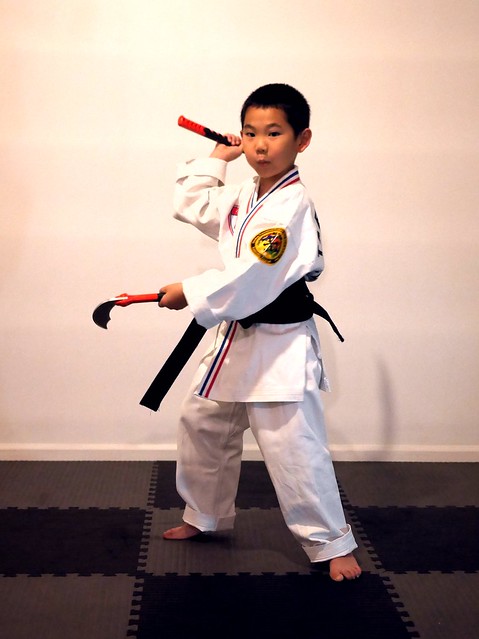
The other bigger event was T joining the Leadership class at his TKD school.  Many martial arts schools have a class where they give additional training. In this school, this includes additional weapons, closer attention to techniques, and closer attention in general.  In addition, this provides the pool for future instructors as well as the training for those who wish to more seriously compete (most of T's competitors in his last tournament were in this program at their schools).

We have been looking at this for some time, but decided to put it off until he finished 2nd grade and had advanced to black belt. Our feelings were that he already is pretty identifiably as the smallest kid in whatever he is in (in his ATA school, there was one smaller around his rank)  We had discussed this with some other parents of kids as they were advancing in rank together to coordinate this decision knowing our kids will want to talk about this at some point.  But what we thought of is that T is the kid who responds well to close attention, and this makes a difference for him. And certainly, his history of placing at both tournaments he has gone to is also a good sign.


Saang nat

Up for August, a visit from a cousin, and one more month before back to school.

Saturday, July 07, 2018

My current range of workouts.

Earlier, I posted the current state of my home gym.  Since I have been travelling for work and pleasure over the past two months, one thing I have done is to maintain a workout a day. Since I was either in places that really did not support running (a corrections facility, or as DD4 says, a jail), or it was incredibly hot/polluted/raining, unlike my trips in the past my workouts have been in a hotel gym or using exercise equipment/aids I brought along.


My workouts are being informed by two sources. First are the Stack52 line of exercise cards. I have bodyweight, dumbbell, kettlebell, suspension band, and resistance band sets.  Second, is the book by Myatt Murphy, Push, Pull, Swing: The Fat-Torching, Muscle-Building Dumbbell, Kettlebell & Sandbag Program.  So workouts will include exercises that cover upper body push and pull, lower body push and pull, and swing (rotation and core).   So, my workouts have settled into a number of categories.


  1. Bodyweight exercises.  For these, I use the Strength Stack 52 Exercise Cards set.  I draw 5-15 cards from the deck and do those exercises. The nice thing about these is that my kids can do the exercises with me.  This tends to be my light workout or the warmup before a heavy workout.
  2. Self defense testing at the ATA Taekwondo
    Drills before testing.
  3. Taekwondo.  This is either part of a class, or I will do this at home (sometimes with my son). This starts with stretches, then 5-7 Stack 52 cards for bodyweight exercises for warmup.  Then conditioning using a heavy bag (or I will do focus mitt or pad drills with my son).  Then forms/poomsae/kata.  Actually, other than heavy bag, this also tends to be a light workout.  If I am in class, I will often follow up with a light resistance exercises.
  4. Dumbbells.  This workout is a heavy workout.  I structure a workout based on push, pull, swing.   I will do sets in three groups:
    1. Heavy lift.  Deadlifts, Squats, and Chest presses  3 sets of 4-6 (when I am at 6, that is my clue to increase the weights soon)
    2. Mix. 2-3 Exercises that hit different muscle groups.  Changes each time.
    3. Conditioning.  2-3 of  Woodshops, one arm dead clean and presses, two arm swings. This is at 3 sets of 10-12 reps. For the swings, I do 50.  If I can do all three at 12 reps for woodshops and clean and presses, it is time to increase weights.
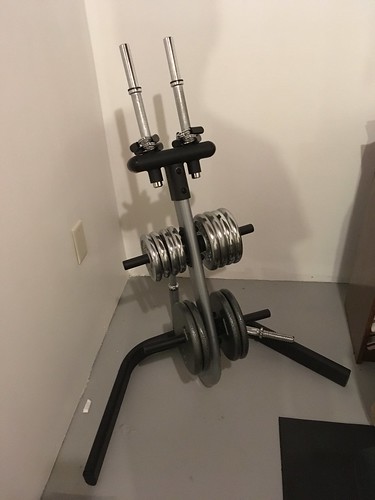
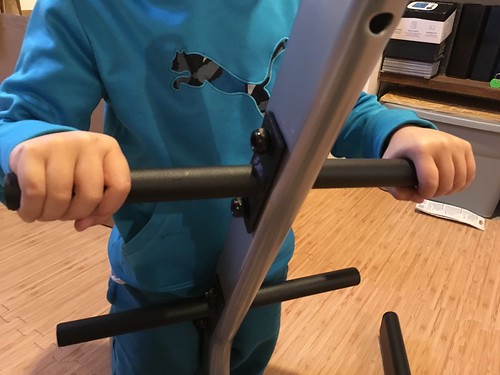
    4. CAP barbell standard plate and bar storage rack
      Dumbbell plate rack
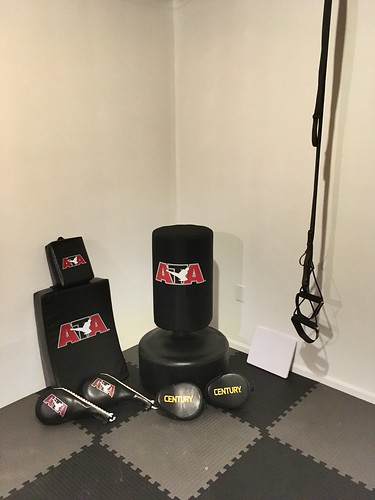
    TKD gear in the workout room
    Suspension straps
  5. Suspension straps.  I actually use this almost like a conditioning exercise. The big difference between this and body weight is that the suspension straps effectively redirect gravity, so instead of all exercises pushing against the floor, I have some that resistance aims down, some where resistance goes up, and some where resistance is lateral. However, it is limited to bodyweight (with need for stability), so this is a conditioning or cardio workout, not a strength workout.  I will pull out cards from the Resistance 
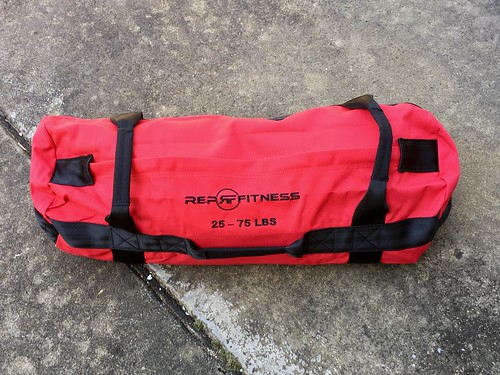
  6. Rep fitness medium sandbag filling
    Rep Fitness Sandbag
  7. Sandbags/sand kettlebell.  The other two tools of the Myatt Murphy book.  The difference between these and the dumbells is the instability due to the weight shifting, which makes the workout harder for the weight.  I have the sandbag to provide the two handed exercises that I do not have because I do not have barbells, and the sand kettlebell provides variety.  Since the dumbbells are for the heavy weights, I use these for the convenience.  Usually I use this after a light workout (like taekwondo class) where I want to add some conditioning.  With the kettlebell, I will do a set of woodshops, dead clean and presses, followed by kettlebell swings.  With the sandbags, I have not settled on a set. Usually I try two or three exercises from the Push, Pull, Swing book.
  8. Resistance bands.  I have a couple of flat loop bands.  These are more of a workout when I  did not get a workout piece of equipment.  I have not decided if it is worth it for me to get the heavier bands to get a useful level of resistance.

Of these, I probably do the heavy dumbbell workout 2 times a week.  Taekwondo 3 times a week (supplemented by either the sandbags or light kettlebell or suspension straps.  Suspension straps if I need to program in something light.

Tuesday, July 03, 2018

Parenting Month 91: We're going to China and we're so happy we just want to sing

The last month was marked by a family wedding and a visit to China.  The wedding was a reason for lots of cousins and family from around the world to congregate in one place, and get another generation picture of cousins, the last one was soon after my son was born.


P6930362
Cousins on stairs


An additional wedding standard are the kids on both sides playing together, DD4 (A) provided much amusement as she became fast friends with a 4 year old daughter on the other side of the wedding aisle, and they spent the entire weekend playing and dancing together at every opportunity.

The next step was a visit to China, mostly Tianjin and a couple days in Beijing.  This was the first trip to China for both (DS7 has been to Thailand twice, DD4 visited Thailand once).  

We stayed at a historical hotel in Tianjin.  Unfortunately, it was not near a subway line, so we had to walk a distance to get to anything we would want to do (it was geared for people working with banks). And it was more formal than we would like.  But, it was a location of much history during the Foreign Concession era and the Chinese Communist Party, so it had its own museum which we visited.

Astor Hotel Museum, Tianjin
Museum at the Astor Hotel, Tianjin

We did a bit of the tourist thing.  The ancient town for souvenir shopping, historical sights like the liberation of Tianjin bridge, and modern sights like the Tianjin Eye.

Crickets, birds, turtles for sale
Live crickets for sale
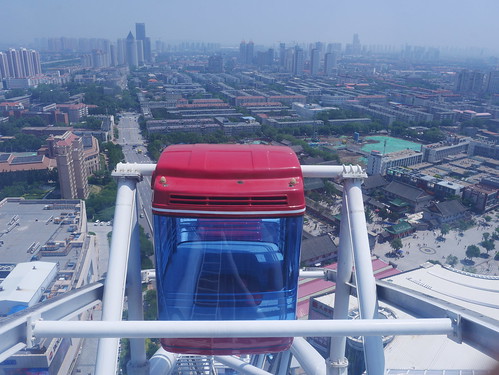
Tianjin Eye cab
Tianjin from the Eye


Park monument for the liberation of Tianjin
Liberation of Tianjin bridge


We also did a number of kids activities. We took advantage of the fact that all the kids were in school so the crowds were thin.

Orange umbrellas in Tianjin Museum of Nature
Umbrellas in the lobby of the Museum of Nature, Tianjin

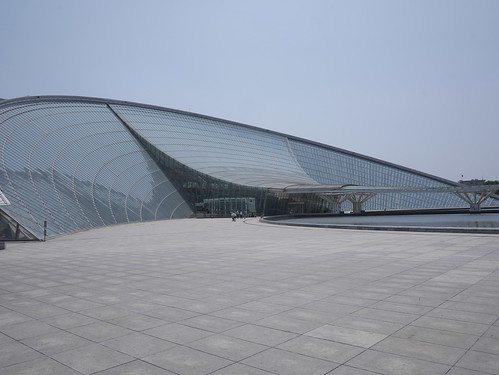
Tianjin Museum of Nature
Museum of Nature, Tianjin


Steps at the concert hall at the Tianjin Cultural Center
Tianjin Culteral Center


Tianjin Library Lobby
Tianjin Library


Three ball gravity race at the Tianjin Museum of Science and technology
At the Tianjin Museum of Science


The highlight was playing with cousins in China. One "cousin" is an old friend, and we hope they see and play with each other throughout their growing years, both in the U.S. and in China.

And there were some places that were clearly for parents, such as the China Military Museum in Beijing.


PLA tank at exhibit remembering the liberation of Tianjin at Chinese Military Museum
Liberation of Tianjin exhibit at China Military Museum


And food

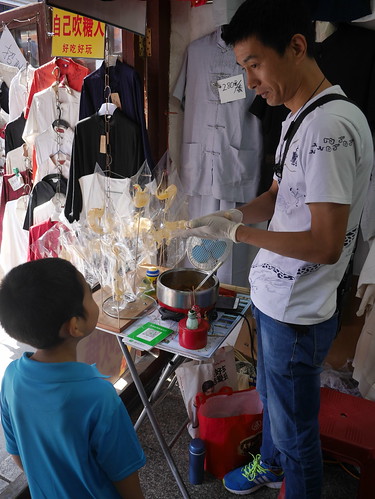
Making candy in Tianjin street
Making sugar animal candies in Tianjin
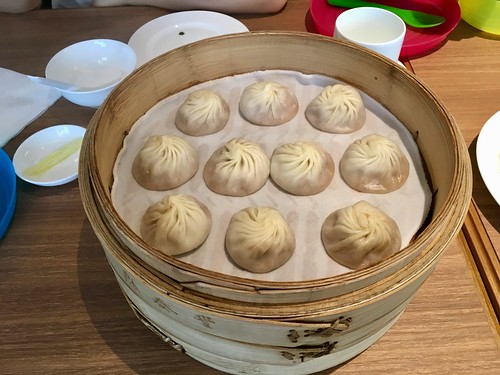
Xiaolongbao at DinTaiFung, Beijing
Steamed dumplings a Dan Tai Fung, Beijing

Some observations on the kids.

  1. We enjoyed watching them play with cousins in China.  There is a cousin that is close in age for each of them, and we are hoping that they get to grow up together  Note that because of the one child policy, "cousins" tends to be more broadly defined than we would normally do in the U.S.
  2. T (DS7) is not as adventurous or as willing to engage in new things and experiences as he had been when he was 5-6.  We are thinking that years in the school system have led him to regress towards the mean.
  3. A (DS4) provokes the observation that she talks a lot from pretty much everyone.
  4. A does not travel quite as well as T did at the same age.
  5. T has figured out that almost everything has a QR code that is accessed through WeChat.


Tuesday, May 22, 2018

My home gym circa May 2018: martial arts and free weights

One of the first things we did when we moved to a house with a semi-finished basement was to declare that the basement would be a workout room.  And our primary exercise that time was taekwondo along with bodyweight exercises for DS5 (then) and I.  In addition, I had some lightly used exercise equipment (dumbbells, a weight bench, and a Total Gym exercise machine) and this became the start of the workout room.

First, we got 1" thick tatami foam puzzle type mats from IncStores that we laid on the floor.  The thickness was for normal martial arts (i.e. some impact, but we are not wrestlers or judoki.)  This was used to cover the larger portion of the basement floor in a checkerboard pattern (gray and black squares)  These mats were not difficult to cut with box cutters, so we cut them to fit the basement and the way the walls were laid out.  This was a good way of covering a concrete floor.  The way the basement is laid out, it is big enough for me to cover half a Songham (ATA style taekwondo) square for forms.  So as long as I start in an appropriate place, I can do a form with full extensions. (which I could not do at the old house).  So this floor gets used for TKD practice, forms, and drills, along with bodyweight exercises.


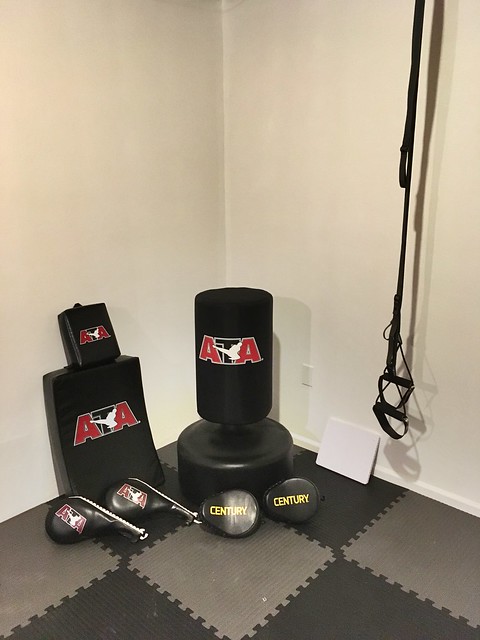
TKD gear in the workout room
Taekwondo training gear
For Taekwondo we have a assembled a fairly extensive list of practice gear.  For my son and I, we both have our gear bags with uniforms, bag gloves, sparring gloves, foot pads, chest pads, and head gear.  We also have sang jae baang (nunchucks), ba maang ee (escrima sticks), and jaang baang (bo stick).  (we have declared that jaang baang is not for indoor use because of the ceiling).  But we also have a junior standing bag (Wavemaster weighted with 80 lb of sand in the base), a double kick pad (claps when struck correctly, now we have 2), a small target, large kick pad, and a pair of focus mitts.  The matted area is good enough for pretty much any standard or sparring drill.

For bodyweight exercises, we are used to this from taekwondo, but our real use is based on a fitness cards based on Stack 52 Strength decks. (review)  So (now) DS 7 and I will draw 7-10 cards (he uses both beginner and intermediate cards) and we will do them.  DD 4 also joins in and does her analogue of the exercises as well.

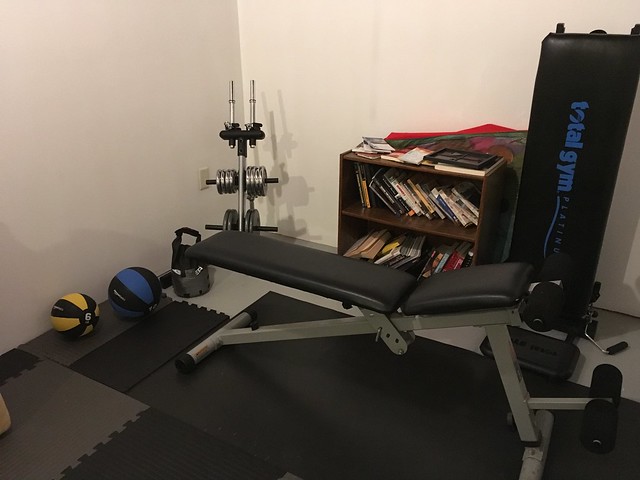
Workout room freeweight corner
Weights and Total Gym
For weights, from my pre-grad school days I had a cheap dumbbell set (the standard 4x5lb weights, 4x3lb weights, 2 handles with spin locks for a total of 40lb of dumbbells).  I had added the bench when I moved to my apartment when first started working after grad school.  Again, back then running was my primary workout, then the Total Gym for cardio.  I was not trying too hard with the dumbbells, but I knew a few exercises from when I did a few sessions with a trainer back in grad school.  And while I was not so concerned about strength, I pretty much maxed these out on the stronger exercises (e.g. bench press) soon after getting these.  Combined with not having a good place for this in my old house, I did not use this much.

After moving to the new house, I added a pair of medicine balls (6 lb and 10 lb) to the mix.  These were good complements to the bodyweight exercise, as they could be used with pretty much any bodyweight exercise to add more of a challenge. In fall, I decided that I would use the winter to add strength to my conditioning and I purchased 4x10lb weights and additional handles, which more than doubled the weight I had and allowed for switching between heavy, medium, and low weight exercises much easier.  More recently, I got the weight tree for the plates (which used to live on the mat underneath the weight bench) and a lot more weight plates (taking advantage of coupons and a sale from Dick's sporting goods), improving both the maximum weight and the range of different exercises I could be set up for in a workout.  Another use of the weight plates is for conditioning.  I have a military grade Camelbak HAWK backpack that I will load with 20 lbs of plates for rucking when going on walks with my family (so what is good exercise for the kids is also good exercise for me).  One big thing, weight training has gotten much more interesting and enjoyable once I got enough weights for it to be a challenge.  Working with the 40lb dumbbell set was essentially a messed up conditioning workout.  I could not go fast enough for a proper conditioning workout, but there was not enough resistance to actually get stronger.

For exercise equipment, I had a Total Gym from many years ago.  It was an incline based equipment that I have had from my apartment days.  It was always lightly used, generally it got the most use during winter when I ran outside less than before.  And after kids it got a little problematic because the track that the pad rolls on is an obvious pinch hazard.  And I probably had it on its steepest (hardest) setting from basically the time I bought it, so it really only was good for making my muscles move, not really for building strength or endurance.  To give me conditioning equipment to go along with the strength equipment, I got a suspension trainer (no longer available when the dominant company, which will remain nameless, used to court system to push them out of the market).  Since we have a semi-finished basement, the beams in the ceiling were exposed and I used one of these to mount the suspension trainer.  Similarly to the bodyweight exercises, I have a set of suspension exercise cards from Stack 52 to provide variety in my routine. This takes over from the Total Gym as it is easier to set up the exercise to be more difficult even as I am getting cardio in from lots of reps (at the end of the day, these are slightly harder versions of bodyweight exercises, but not as hard as using my dumbbells, so I use this for cardio as I am doing a large number of reps.  With the Stack 52 cards I have a range of exercises for upper body, core, and lower body.  And I can generate a fairly long circuit for conditioning.


Rep fitness medium sandbag filling
Rep Fitness Sandbag with 15lb and 35lbs in filler bags
To the TKD, bodyweight, and cardio equipment, I recently added a sand kettlebell (20 lb) and sandbags (currently set at 15 and 35 lbs).  These are in the category of freeweights and along with dumbbells, were the featured equipment in the book Push, Pull, Swing by Myatt Murphy published by Mens' Health. The goal of the book was to explain that strength came from three types of motions (push, pull, swing), across three planes of motion. And if you did this, you would have all muscles in the body engaged (the contrast would be isolation training focusing on specific muscles, which is the principle behind the exercise machines you see at fitness clubs and home gym equipment).  The comparison between this and the dumbbells is that they are more unstable, so in addition to lifting the weight, you have to deal with the instability of the sand.  A second advantage is that they are made of sand, so I don't worry as much as the kids hitting or tripping over them since they have some give compared to iron plates in my dumbbells.  More recently, I've been building up my strength training so that in addition to the obvious presses and lifts, I learned more complex moves such as cleans, presses, and swings so that I can use strength training (dumbbells, kettlebell, sandbags) in exercises that hit a wide range of muscles and types of motion simultaneously.  Again, I also have Stack 52 decks for dumbbells and kettlebells. While I don't think the randomness is useful here, I have used the cards, the Push, Pull, Swing book, and YouTube to learn how to do even technically difficult exercise that require stability of the cores along with strength.


Rep fitness medium sandbag filling
Assembled 50 lb Rep Fitness sandbag
So, the current state of the home gym.  I know have 132 lbs of plates, and I am up to 86 lbs on bench presses and squats (the hightest weight exercise I do)  The dumbbells, kettlebell, and sandbag also  makes conditioning workouts more time efficient than the running or Total Gym used to be for me, with the suspension trainer and a range of kettlebell swings filling in for cardio.

I can see adding another sand kettlebell to round out my medicine ball and kettlebell weights, and I have room to add more weight to my sandbags.  My son has started using freeweights too.  I have him doing bodyweight exercises with the medicine ball (and I join in using the kettlebell) so this adds resistance. There are a few exercises designed for the kettlebell that medicine balls also work with so this will add to strength while maintaining stability and balanced development of many muscle groups at a time.  To add to the bodyweight exercises, I recently purchased an agility ladder, which both of the kids enjoy immensely.

Sunday, May 13, 2018

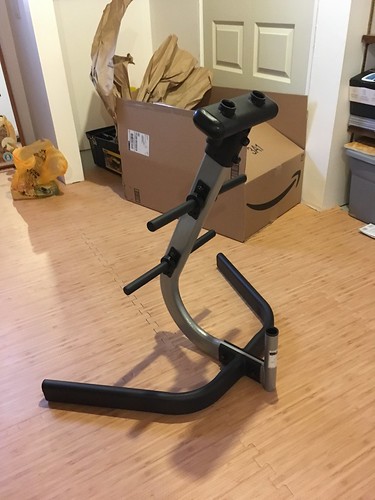
Product setup: CAP Barbell Standard Plate and Bar storage rack

The basement workout room had a problem.  I had a 40 lb dumbbell set and an adjustable bench for many years (I think I had it pre-grad school).  Last fall I finally got additional weight plates since it was getting too easy. But now there were too many plates on the floor, and we were worried about the 3 yr old kicking the weights (she liked to play acting like the bench was a sales stall).  Solution: get a weight tree.

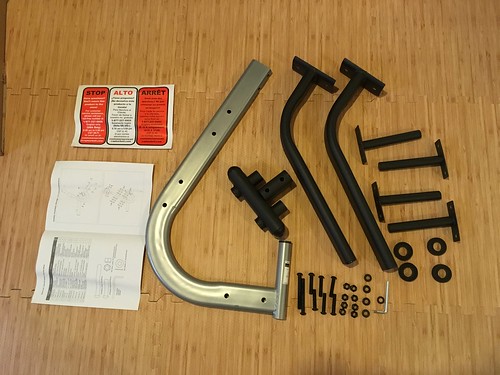
We got the rack unassembled.  Included were:


  • Main support.  
  • Two legs.  
  • Four standard plate holders.  
  • Two long 90mm bolts, 
  • six 50mm bolts.  
  • 6 nylon ocktight nuts. 
  • 17 washers (one spare).  
  • One 6 mm allen wrench.  
  • Instructions and "please call for help before declaring that this product does not work because you could not put it together properly notice"


CAP Barbell Standard Plate and Bar Storage Rack unboxed
Plate and bar storage rack parts
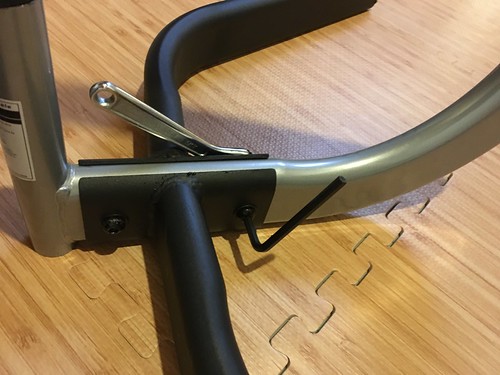
CAP says you do not need additional tools, but I don't see anyway that I could have generated the required torque on the locking nuts with the included allen wrench. So I supplied a 6mm allen wrench and a wrench to work the nuts and bolts.

Locktight nuts and bolts
Tightening locking nuts
The order of assembly is to start with the legs on the main support.  Next are the four plate holders.  This is where it really helps to have additional hands, as the bolts want to fall out before you start putting on nuts.


Adding on the standard plate holders
Adding on standard (1") plate holders

Assembled, the legs splay out 33".  The back of the main support to the line drawn between the ends of the legs is 21".  The height of the rack itself is 31".  Of particular importance is 33" for the legs. This gives it a wide base of support, wider than other plate trees so it feels very stable.

Completed weight tree and bar holder
Assembled CAP Barbell Standard plate and bar storage rack.

In addition to the four plate holders, there is room for two standard dumbbell bars on top, and a post that is meant for a standard barbell bar.


CAP barbell standard plate and bar storage rack
With dumbbell bars and weight plates
As it is, it holds a pair of dumbbell handles and I have a second pair laying across the legs (i.e. off the ground).  It feels very stable, and well able to manage the weights I have, as well as my next planned purchase of weights.  Each bar looks like they can hold 8 plates if I am careful, and 7 plates each easily.  I like the fact that it has room for the dumbbell handles and gets them off the floor and organized as well. And the fact that the base is wide discourages the kids from getting too close (and I'm not worried about the whole thing tipping over.

Overall, easy to assemble. Feels solid after tightening everything up. Feels stable.  I like the dumbbell handle holders (not a part of alternative racks).  Certainly good for dumbbell use.  I can see that if someone lifts a standard barbell, four plate holders may not be enough and you could run out of space quickly.

Friday, May 11, 2018

Product unboxing and setup: Rep Fitness Medium Sandbag

Rep Fitness is currently offering a sale on sandbags, and I was looking at the fact that I was on pace to maxing out my strength equipment so I was beginning to plan what I was going to do next.  I currently have dumbbells, medicine balls, a sand kettlebell, and suspension trainers.  I was not interested in barbells because of their size and I think with a pre-schooler in the house I thought it would be a hazard.  So sandbags seemed like a good addition as it is two handed, but not as dangerous in the house as a barbell.


Rep fitness medium sandbag filling
Rep Fitness Medium Sandbag with 50 lbs sand


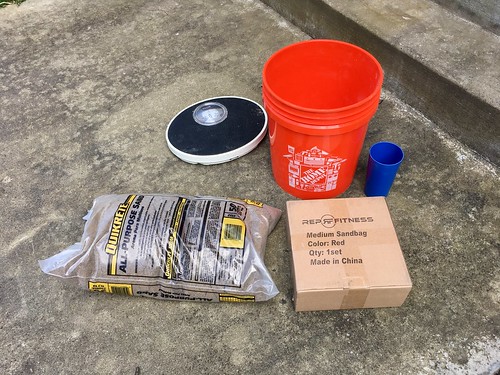
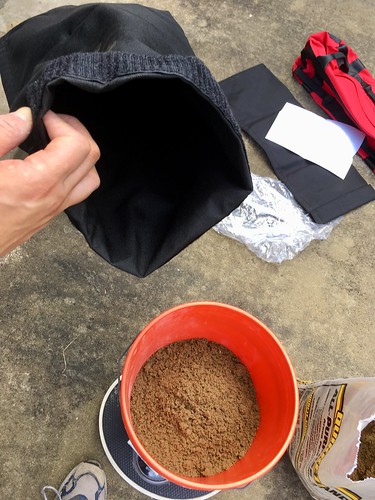
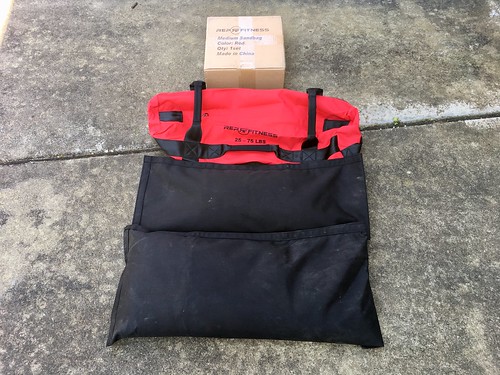
The Rep Fitness bag is essentially a reinforced duffle bag with two filler bags to hold the sand.  They are supposed to be 25 lb and 50 lb, but I filled them to 15 and 35 (i.e. I used one 50 lb bag of construction sand to fill them with).  Like all sand based weights, the Rep Fitness is shipped without sand, so I needed to fill it.

Rep fitness medium sandbag filling
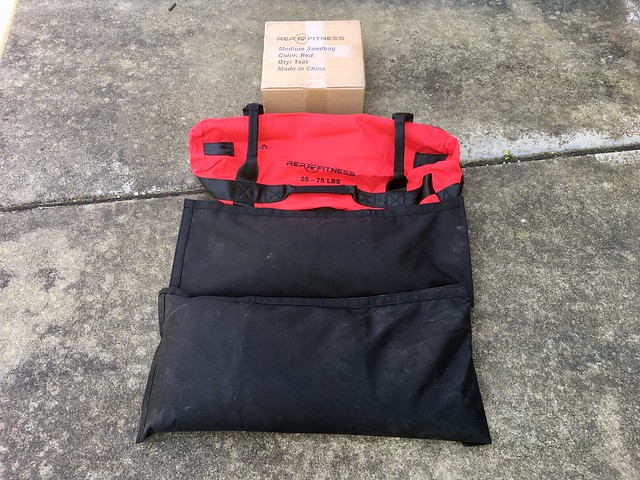
The box with the sandbag, along with the sand, Homer (Home Depot) bucket, and a scale for filling the filler bags

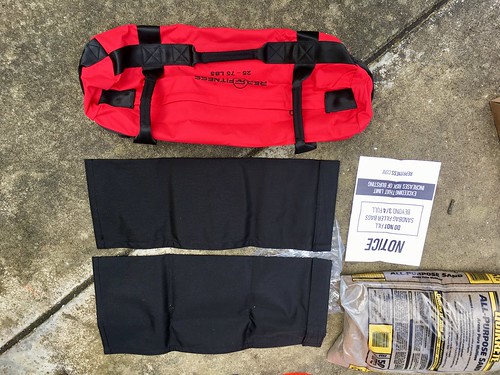
First step is opening the box.  The bag comes with two filler bags that are intended to span the length of the bag. Note that this is different than some of the cheaper ones, which would have more square filler bags.

Rep fitness medium sandbag filling
Shipping contents.

The next step was to pour sand into the bags.  I poured the construction sand into a bucket, and poured from the bucket into the filler bag.

Rep fitness medium sandbag filling
Loading sand into the filler bags.
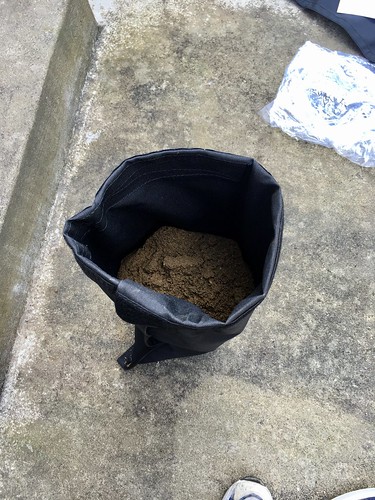
To start out filling the bag, I would hold the bag standing with the opening open, and folding the top over the outside to keep the bag open while I was pouring in.


Rep fitness medium sandbag filling
Bag with 15 lbs of sand

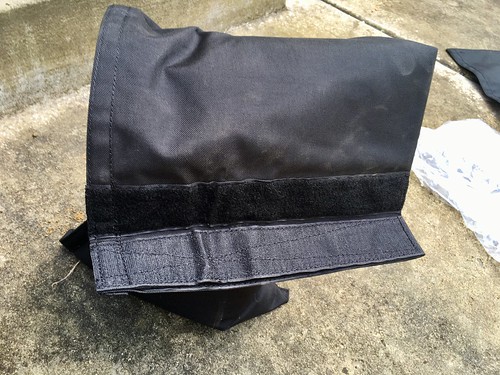
After filling in the bag, I closed it folded it to remove as much air as possible, then folded it down (there is velcro on the inside of the bag, and velcro to fold the top down one.)


Rep fitness medium sandbag filling
Folding down the top after putting in sand.

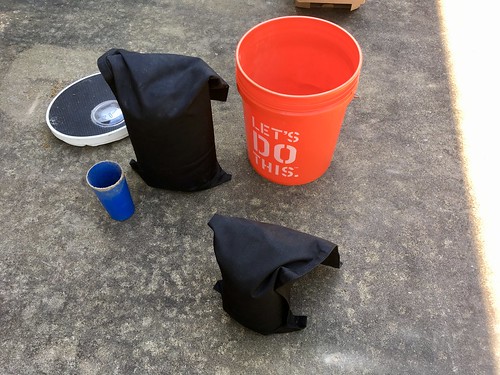
After closing off the bag, I shaked it so the sand that was in the bag could shift naturall from side-to-side.  Next I filled up the other bag, then laid the bags down and spread the sand out on both filler bags.  I then used duct tape to further seal the end and keep the end folded down.


Rep fitness medium sandbag filling
50 lbs of filled sandbag

Rep fitness medium sandbag filling
Filled filler bags with sand spread across the length


Rep fitness medium sandbag filling
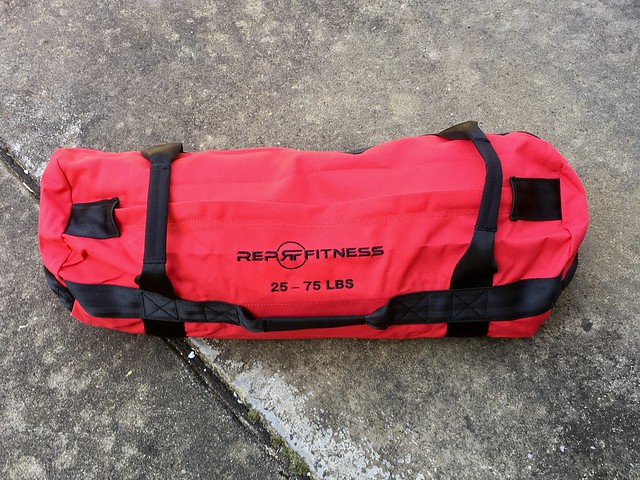
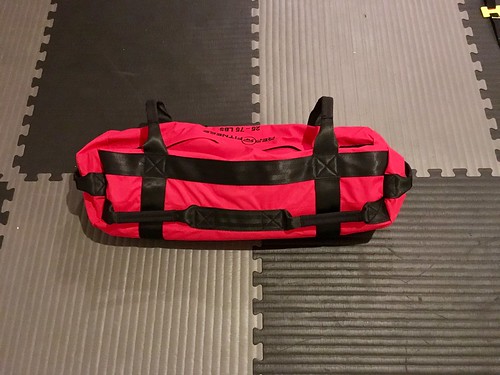
Filled sandbag

The bag has seven handles.  One pair on the ends, one pair vertical, one pair oriented horizontally, and one centerline handle.  The first time I tried to do a clean with the bag I smacked my nose, which I gather from videos is not uncommon.  

When I only have 35 lbs, the bag is harder to manage than I expect comparing it to using dumbbells.  And when the bag is only partially full, there is a lot of flopping around, so cleans and swings tend to fly around more than expected, making workouts harder.

I have used it for a few workouts.  I especially use it when I want something heavy (compared to my 20 lb sand kettlebell) but my kids are around, because sand is not as rough as metal.  I use it for clean, deadlifts, bicep curls, shouldering, and rotations.  The big difference compared to dumbbell weights is the fact that weight is not concentrated on the handle, so all dynamic movements have a big inertia component that I have to fight to stop a dynamic move. 

All in all, a good addition to the home gym. It provides a different type of load, and I don't mind having it on the floor where the kids might kick it as the sand is not an issue.

With this, and the sand kettlebell, and the dumbbells, I have the full set of equipment that Myatt Murphy describes in his book Push, Pull, Swing: The Fat-burning, Muscle-building Dumbbell, Kettle-bell, & Sandbag Program.  So I will be reviewing that book soon.

Monday, May 07, 2018

Product review: Stack 52 strength (bodyweight), dumbbell, and suspension trainer workout cards

Currently, my main exercise has been taekwondo.  And on the side I also run.  As part of taekwondo training, we use a number of bodyweight exercises as part of warmup.  I've wanted to start doing workouts at home, but I was not terribly interested in joining a gym, as strength workouts for me were a secondary workout.  But I really did not have much variety and lacked a trainer (other than the workouts we do in taekwondo class).  The Stack 52 workout cards proved to be a great way to both try new exercises, see how they are done, and generate workouts so they don't get old.

The Stack 52 cards have a series of 52 exercises per deck.  Some of the exercises are familiar, but then there are variations on a theme.  The thing is (and the weightlifting types already know this) that small variations in form will change which muscles are the most challenged.  So the 52 exercises, if done correctly, will challenge different muscles so they are in fact different.  There are three levels of difficulty (beginner, intermediate, advanced) and the primary muscle groups are identified.  However, these are not isolation exercises, so you will not get diagrams that identify specific muscles.

The Strength cards work as promised.  I use them to create random sets for warmup workouts.  And they are fun.  My kids (3 and 7) like to use them with me (when I'm with my kids I only use the beginner and intermediate cards).

With the suspension trainer deck I was in a similar position of not knowing many exercises.  One thing that is different about the suspension trainers is that the exercises have different positions: facing the mount, facing away, on your back facing up, on your front facing down.  So it is not convenient to constantly switch.  When I use the deck I would pull up cards, then I would reorder them in groups so that I would only do minor changes in between exercises, and major position changes as few times as possible.  But I still see a lot of value as I learned how to use my suspension trainer in new ways.  Here especially, the videos that are linked on the cards via QR code were very useful.

The dumbbell cards were probably the least useful set.  I quickly learned that there really needed to be an indication of how much weight should be used, low, medium, high (where low medium and high could be defined by the number of reps you can do a specific exercise)

Great for quick workouts. The many cards add to the variety in my warmups and for conditioning. I find that I can do the basic and intermediate cards, but the advanced workouts stretch me, and having them mingled keeps things interesting. My 7 yr old son loves them to. When we have workouts together, we use the beginner cards, and he flips over 7 and he leads us in the exercise. My 3 yr old daughter also likes to join in. She looks at her cards and does her own thing while I do the workout for real. I also enjoy taking these on travel. I usually take the extension deck and use these for morning and evening workouts in my hotel room or in their exercise room.

I already had the Strength Stack 52 cards and got these to add more variety to my workouts with dumbbells and suspension trainers (I have not broken open the resistance band or kettlebells decks yet, because at this point those are supplements for me). Note: I primarily run and do martial arts, so these decks for for strength and conditioning, but these are not my main workouts.

PROS: variety and instruction. For me, whose primary workout is not strength training, I don't have good access to trainers who could give me a workout and instruction, so these cards are good for giving me ideas on what exercises to do and basic instruction on how to do them. I had a set of dumbbells before getting this deck, but I really did not do much with them or my suspension trainer. These decks made both of them interesting.

CONS:
1. Unlike the bodyweight exercises of the Strength decks, the dumbbell and suspension exercises can actually require setup between exercises. So while I would use the bodyweight exercises in whatever random order they came up in, with the dubmbell and suspension decks, after I flipped the cards, I would reorder the cards to be in a natural order to reduce the setup (body position, position in the suspension handles, weights on dumbbells).
2. the dumbbell exercises probably require a range of weights (i.e. a low, medium, and heavy set) as these exercises are not meant to be at the same weight (e.g. you would not do circles with extended arms at the same weight that you would do presses or other high weight exercises) Given that part of the appeal of these decks is for those who do not have a large repertoire of exercises, it would have been useful to classify the dumbbell exercises by the type of dumbbell needed (I use light, medium, and heavy as these are specific to the person, and you can help people define them appropriately)

Overall, for general fitness and conditioning, I recommend the bodyweight cards without reservation.  I think that the suspension strap cards also work out pretty well.  I don't think the dumbbell cards would be helpful if your goal is strength or building mass, but could be useful as part of a general conditioning routine if you have a few pairs of hex dumbbell's available to you.

My kids, also give the bodyweight cards an unqualified endorsement.


Wednesday, May 02, 2018

Parenting Month 89: competition in youth

These past two month was dominated by competitions.  T went to a regional Taekwondo tournament, participated in a piano competition, and earned his black belt in Taekwondo. Along the way, we saw a lot of the culture around kids competitions.


Regional ATA TKD Tournament
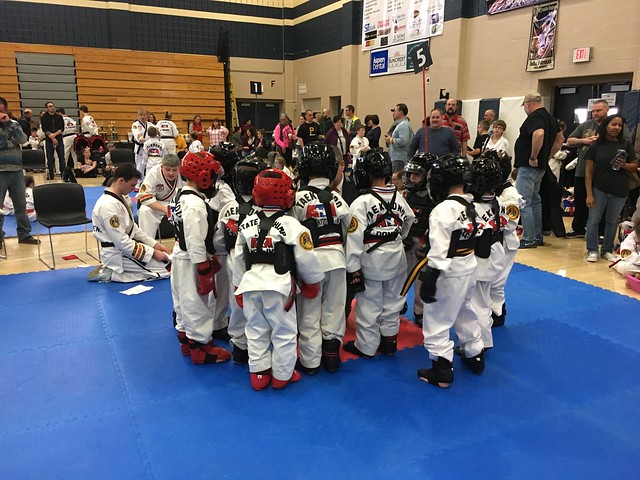
Receiving instructions prior to sparring.


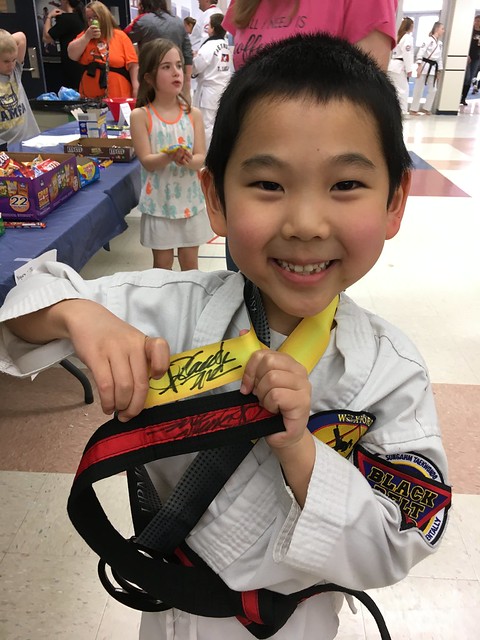
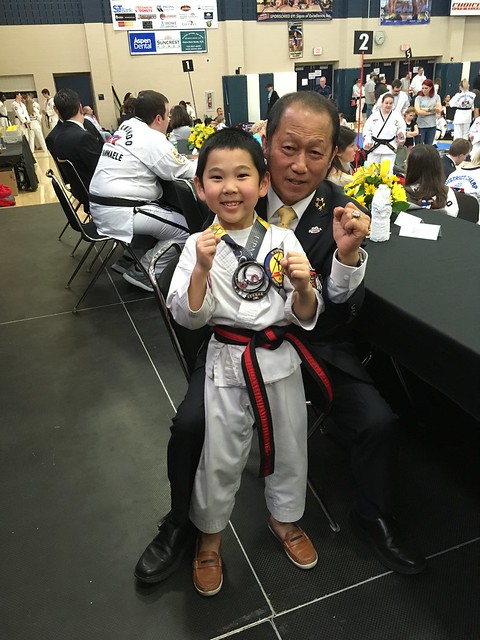
T went to a regional tournament last month. This was his second competitive tournament (meaning they award places) and much larger and more prestigious than the other one we went to in fall. But we are not competitive, so we signed up for the novice division. (as opposed to competitive). He did well, we were not expecting everything when we realized that most of the boys in his ring were in the ATA leadership program, but he got a 3rd place medal in sparring (which goes along with this 1st place medals in forms and weapons from his last tournament.)  He especially liked the fact that he met the American Taekwondo Association  Grand Master (only one of them!) and got his medals and belt signed.


Regional ATA TKD Tournament
Medals signed by Grand Master In Ho Lee
One of the things we noticed was that even though this was the novice division (as opposed to competitive, where points count over the year), most of the boys clearly had tournament experience.  The parents were very sophisticated, with several of them keeping track of judges points.  The boys were also reasonably sophisticated with outcomes. The boys were all aware that a "Spirit" award implied that they did not get any of the place awards in any category. Some of the boys were not interested at all in collecting their Spirit medals.

We also noticed that many of the "novice" boys were clearly serious about competing.  We saw a former state champion (meaning they had the most tournament points when competing in the "competitive" category in tournaments last year).  Several of the boys clearly had trained above their belt level (this was a red belt ring, and above belt level means they used moves and forms that were part of the black belt curriculum.  And our thought is why would they sign up for a novice division when they clearly usually were competitive. And if it was they were worried about being in a high prestige tournament so going novice would make the competition easier, the fact that so many others did the same thing made that fail.


Piano competitionthey
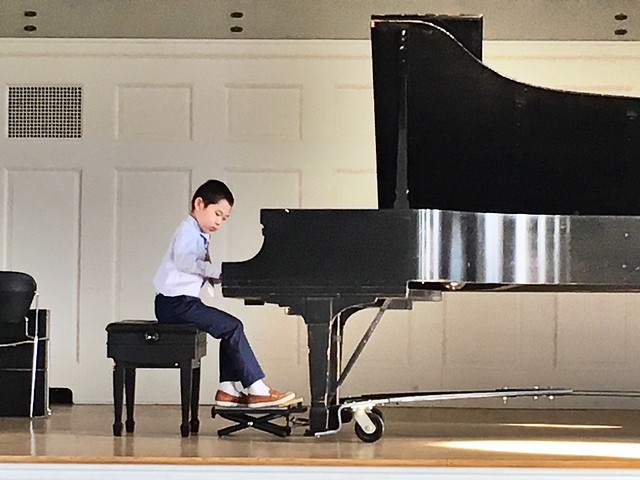
Piano Competition hosted by Chatham College

The reason we have T (and someday A) enter competitions is not because he will win. But we want him to get a sense of how good people other than the ones they saw every day could be. And that means that we do this so he can connect with the best people in real life.  And if he is going to compete with any seriousness, that means we would enter the competitive rings. He may not win, but at this point we are pretty sure that he will win his share of things as he grows up. But he will be tested in the best way possible, where he can see and be in contact with others and get an idea of how much work it takes to be very good at something. And hopefully realize that being very good at something is both possible and enjoyable.  Whether or not medals and prizes are involved.


Regional ATA TKD Tournament
Medals and belt signed by the ATA Grandmaster In Ho Lee

Friday, March 09, 2018

My black belt journey

There is a cliche that the path to a black belt is about the journey, not the destination.  And that is true for anything that takes multiple years to complete, because anything that takes years is no longer an impulse decision.


Self defense testing at the ATA Taekwondo
Elbow strike drills

My fitness journey started when I was young. I was always one of the small kids in the class, which is a problem in the organized sports that phys ed was centered around in those days.  But, even then, my phys ed teachers made the comment that while I never was strong or skilled, there were many points where I made up for it by shear effort.  College was marked by suddenly realizing I was getting winded, and I started running then.  After college when working in DC, I continued running longer distances, with 1/2 hour and hour long runs being weekly events. (my roommate also did this, of course, we were completely overshadowed by his then girlfriend).  I continued running and hiking in grad school, and started 5K and 10K races.  Once when backpacking, I realized that if I was spending days going up and down ridgelines, I could certainly pull of the five hours of running needed for a marathon.  So I ran 1/2 marathon, then my first marathon (which was just under 5 hours).  I continued this after grad school while working.  And by now I have six marathons (Chicago; Ottawa, Canada; Philadelphia; and Bagram, Afghanistan) along with numerous half marathons and three Rachel Carson Challenges (34 miles hike in rugged terrain in daylight)
But reality, especially when kids entered the equation, was that my running had diminished.  I was no longer the neighborhood crazy who was running in all weather conditions. My weekly long runs were not much longer than my daily runs from when I was training seriously. And we were concerned about my four year old son (who gets to tell his own story).

After my son started taekwondo, we did the first month, then six more.  As we were thinking that this was something he could stick with, I decided to start as well.


Self defense testing at the ATA Taekwondo
Self defense technique testing, with the school head instructor as designated attacker.  For this particular rank, all the self defense techniques learned since the beginning were practiced in sequence, which made for a very entertaining testing session.
At the beginning, I did not join my son. And my reasoning is that there should be something in his life that was apart from us (parents).  But a few thoughts led to changing that idea.

1. I was confronting the reality that I was not a regular runner like I was. And the days when a 10K was easy were past, and 5K were now the long run, and I did not even make that every week.  While I was never structured in the past, having a bit of structure in my physical fitness was probably a good idea.

2. I always liked the idea of having some area in my life that I was active in that I was not very good.  I like learning, and this could be a new thing for me.

3. Because we were thinking of committing our son to years of future in taekwondo (and with my son being very enthusiastic about this prospect), I wanted to know what kind of kids my son would be learning from and looking up to.  Because one thing about the structure of martial arts, in any reasonable school, the senior students end up being teachers and role models for the younger students. And since in this school teens and adults were together, that means I got to see the kids who were growing into the future instructors of the school as they grew, and I would get a look at what my son was going to become (this was a young school, so I was watching the first group of students reach the point where they could start teaching)

Did this work?  

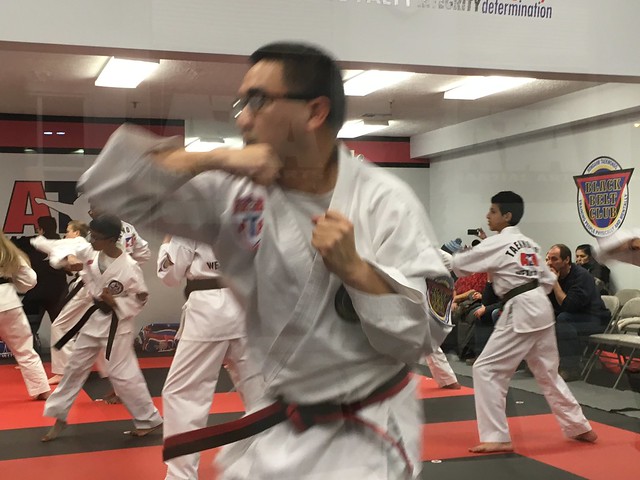
1. In addition to 2-3 classes a week (sometimes including classes my son and I attend together), I regularly train on my own (sometimes with my son), and we also do other fitness workouts outside the school (bodyweight exercises in addition to drills and practice). 

2.  It is not just learning something new, but it is also having someone pushing me on to be better, in the standard sense that the role of the teacher is to help you be better than you are today. And the art part of martial arts has certain appeal.  The head instructor at the school calls me a technician, because of the way I work on forms/poomsae.  (kata for the Japanese types)

3.  And I do get a very close up view of the kids who are on the instructor track now as we train together in class, and I get to watch them help instruct the classes that my son is in.  And confirm that they hold him to the highest standard that he can reach!

There are other fun moments.  When we started, my son was higher rank, so I reminded him that the job of high rank was to ensure that the lower ranks were training properly.  (later, we crossed over as at my school the younger kids take twice as long to advance in rank than not quite as young students.)  At the family classes, my son and I would find ourselves in races doing fitness warmups (pushups, situps) with the pre-teens and teens. (implication is that I was faster (more fit) than most of the kids, so they could only catch up when during my son's turn).  And I like to joke that the adults in the class have to remind the teenagers that we can still keep up.


Testing for black belt in ATA TKD
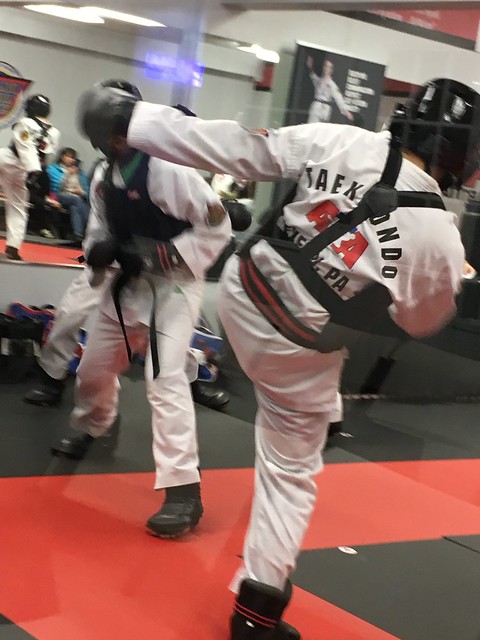
Sparring during belt testing

Black belt testing was a show, as it should be.  Board breaks with smoothness and power, and a poomsae that was crisp with satisfying pops of the uniform sleeves and legs on punches, blocks, and kicks. As it should be.

What next?  I like the discipline of regular feedback, and martial arts (especially forms) has the mindset that there is a perfect form, that we strive for but never reach, that I find appealing from an artistic point of view.  So I plan on continuing for the indefinite future.  Would I go on?  The standard pathways (as I tell people who are thinking of how this goes on college applications) are competitions, teaching, and judging.  And the reality is that I have multiple avenues that my time could be applied in setting where I am in a role of leadership (formal or informal), so going down those avenues in martial arts is probably not the best use of my time. (other than it is a point of reference with my son for the foreseeable future)

In my fitness area of things to learn (since Black Belt means I no longer count as a beginner), I am starting to branch out into other areas of fitness.  Many more forms of bodyweight training (which my kids are very happy partners), but also using resistance equipment such as dumbbells, suspension trainers, and resistance bands for strength training.  Which means someday I will have to do more sessions with a trainer to get the most use out of this.

The numeric designation of a Black Belt is 1st degree. The karate term shodan also carries the connotation that attaining the black belt is merely the end of the beginning of the journey. And I look forward to the years to come.


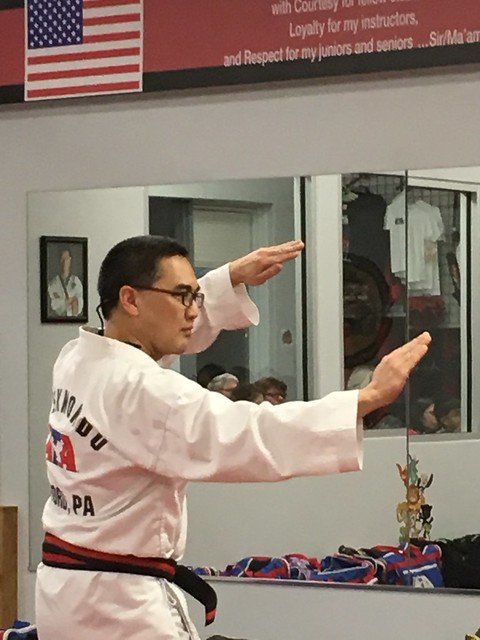
Testing for black belt in ATA TKD
Square block in Choong Jung 2 form