Thursday, June 18, 2015

Applied Predictive Modeling By Kuhn and Johnson: Book Review

Applied Predictive ModelingApplied Predictive Modeling by Max Kuhn
My rating: 5 of 5 stars

I regard this as a more applied counterpart to more methodology oriented resources like Elements of Statistical Learning. So it applies machine learning methods that are found in readily available R libraries. In addition, the author is also the lead on the caret package in R, which provides a consistent interface between a large number of the common machine learning packages.

1. Built around case studies that are woven through the text. For each chapter, the math/stats is developed first, then the computational example is at the end, so that the example can develop data manipulation, application of method, then model evaluation. I like this as it allows for more complex and messy data sets than when using a new, small example for each problem. Also allows for better discussions when illustrating the differences between methods.
2. Data manipulation/data processing is given a separate chapter early on. I appreciate the attention given to working with the data (e.g. missing value imputation). There are other resources in data handling, but not in the same place as those that address the statistics methodology.
3. Emphasis on model evaluation. There is an early chapter devoted to model evaluation. Then each major section of the book has an early chapter devoted to model evaluation of that class of problem. This is in contrast to many books that are built around types of algorithms, and model evaluation is fit in. Methods and algorithms are relatively easy compared to the thought process of determining what is the right thing to do. It figures that this book will be strong in model evaluation when one of the authors is the lead on the caret package in R.

I used this as a supplement in teaching a data science course that I use a range of different resources because I need to cover working with data, model evaluation, and machine learning methods. The next time I teach this course, I will use only this book because it covers all of these aspects of the field.

View all my reviews

Monday, June 01, 2015

There are pirates at Fiddlesticks!

Fiddlesticks Pittsburgh Symphony Summer Escape Concert
Bippity-Boppity-Boo

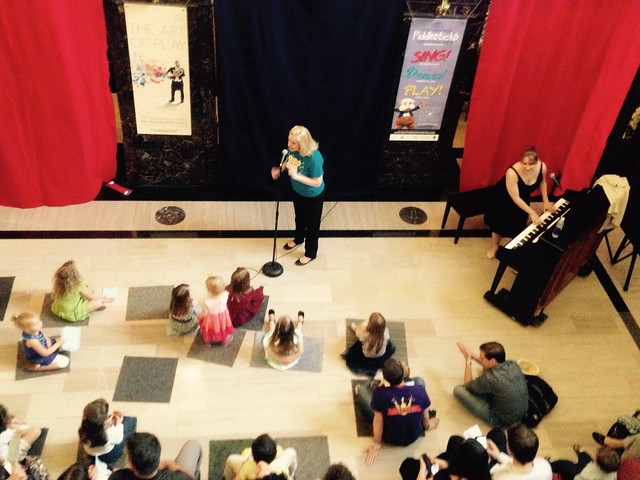
Today's Fiddlestick's concert theme was summer vacations, and as we had recently taken one we were all prepped for this concert. So we very much enjoyed having the thread and mini-story of finding a vacation story for Fiddlesticks.  And as my son is getting older, he appreciates more aspects of this. 

Now that my son is old enough to be learning to play piano himself, we are more like the intended audience of the Fiddlesticks concerts.  So what do we want to see.

1.  The experience of hearing a symphony live, in concert, in a venue with the right proportions, which sounds richer and with more layers than anything that can be played on home speakers.
2.  A sense that music can exist in a context and communicates something.
3.  An experience in a place where responding to music is acceptable.


Fiddlesticks Pittsburgh Symphony Summer Escape Concert
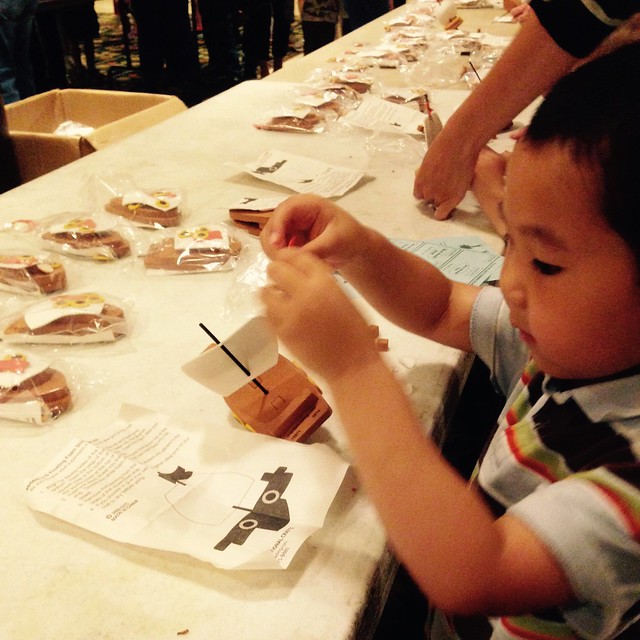
Making a pirate ship

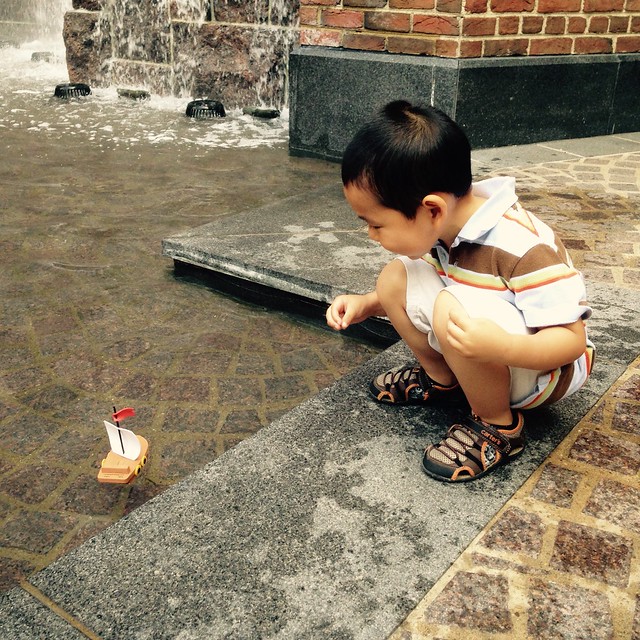
Certainly, the discovery time activities are meant to put the kids at ease. We watched and listened to the contra bassoon and heard a talk and got an autograph from an oboist.  We sang with Katy Williams to Bippity-Boppity-Boo and the Fiddlesticks song. We made a pirate ship and sailed it in the outside fountain. All of this was to make the kids comfortable.


Fiddlesticks Pittsburgh Symphony Summer Escape Concert
Sailing in the courtyard fountain

The activities in large part are making what is obviously adult space (Heinz Hall) into a place where kids have the freedom to explore, play, and interact with things musical, or even peripherally related to music. So making a pirate ship and sailing it in the fountain is related to a sing-a-long at the piano and watching and listening to symphony musicians playing in the lobby. And by the time they get to the hall, the kids and adults are comfortable with the setting.

In the concert itself, the sense is that music is meant to be responded to. Whether it is Katy, Fawzi, or Fiddlesticks running around on-stage or the symphony playing a piece, unlike a normal PSO concert, there is no need to try to stop a child (or adult for that matter) to express amusement, recognition, joy, or empathy in the moment. When an audience member reacts, we can acknowledge the reaction instead of trying to contain it. and it makes for a different experience (I noted that there were a number of adults in the audience without any obviously attached children, so this may go beyond kids.)

My son enjoyed the experience. I spent the concert watching his expressions change as the pieces developed and listening to his observations. Then the story he told my wife about the concert when we got back. We enjoy having music part of our lives, and want our kids to share the wonder and delight in listening and creating music themselves as they grow up,  And Fiddlesticks is a part of that.

Sunday, May 31, 2015

Parenting month 55: ability vs. effort

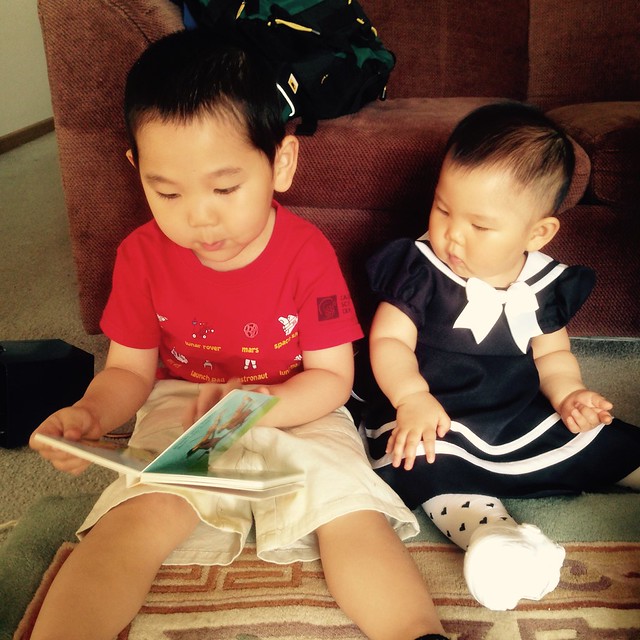
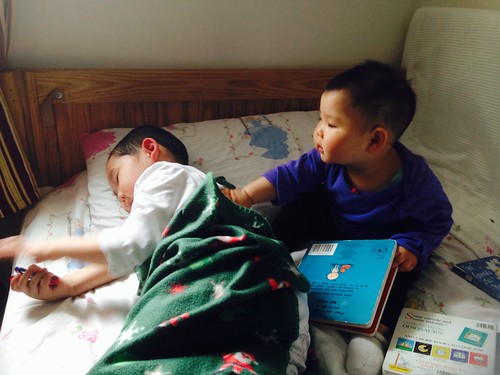
Reading Dr Seuss for his baby sister
Reading Dr. Seuss for his little sister
In addition to our little Mexican vacation, this month saw A (12 months) becoming much more capable. She is beginning to stand, manipulate objects with her hand, and can communicate her desires.  The last is very important, because it means that the biggest obstacle to toilet training is taken care of, and her being able to communicate her desires removes much of the frustration that leads to tantrums.

T has begun copying his pre-kindergarten classmates more, and unfortunately the group he imitates is going through a baby talk phase. (we (the parents) have been able to trace it back to one girl in particular who is the origin of this).  We are hoping this is something that will pass in short order. In the meantime, we do not hesitate in letting him know we don't like it (generally emphasizing that to do fun stuff with us he has to make sure we know what he is saying!)

As A grows up, we are starting to identify divergence in how A and T developed. By the end of the first year, colic had already passed for T, although this still showed in delayed development.  But by this point T had begun displaying the focus and attention span that was beyond the norm for a toddler.  In contrast, A has the standard 1 year old length of focus (almost none) but she gives the impression of being thoughtful and smart. First, the fact that she is able to effectively communicate relatively specific and complex desires (given the fact that she cannot actually say any words.) She also can multi-task. If she is prevented from doing something, she can shift tasks until her original goal becomes attainable, she then drops what she is doing to get the original goal.  In contrast, T's main characteristic was persistence and focus, which in many cases overcomes lack of raw ability.

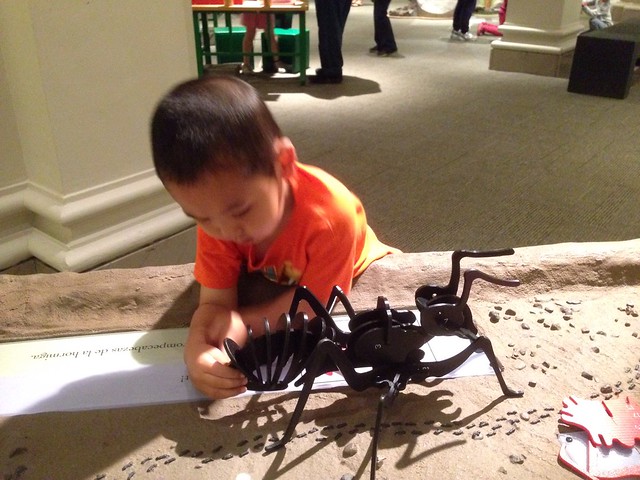
Making an ant at Animal Secrets, Carnegie Museum of Natural History
Building an ant

We are seeing that this will lead to different sets of challenges. Discipline with T was based on providing an object of focus, then encouraging him as he achieved his object.  A is more like other toddlers, shifts from object to object, but she will either succeed or fail quickly.  T liked to stay with things to completion. A will shift focus once her objective is realized.

All that is in the future.  Our current task, getting T ready for Kindergarten.  Mommy summer school is in full force.  Daddy school is going on outing and playing games :-P

Monday, May 25, 2015

Building The Family Handyman Ridiculously Simple Shop Stool

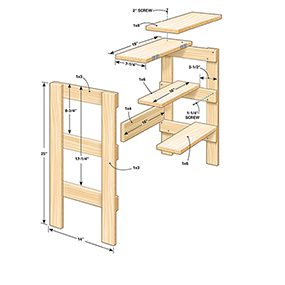
My latest project was the Ridiculously Simple Shop Stool. The goal of such a thing is to have something that is useful for sitting, a short step ladder, or as a fairly portable work surface. It is not necessarily pretty (hence it is called a 'shop stool' instead of a 'stepstool')
Plans for the Ridiculously Simple Shop Stool from The Family Handyman
Some important characteristics is that it is built from 1X dimensional lumber (so the wood is cheap) and it is all short straight cuts, which is important because I do not have a mitre saw, a table saw, or a router. 

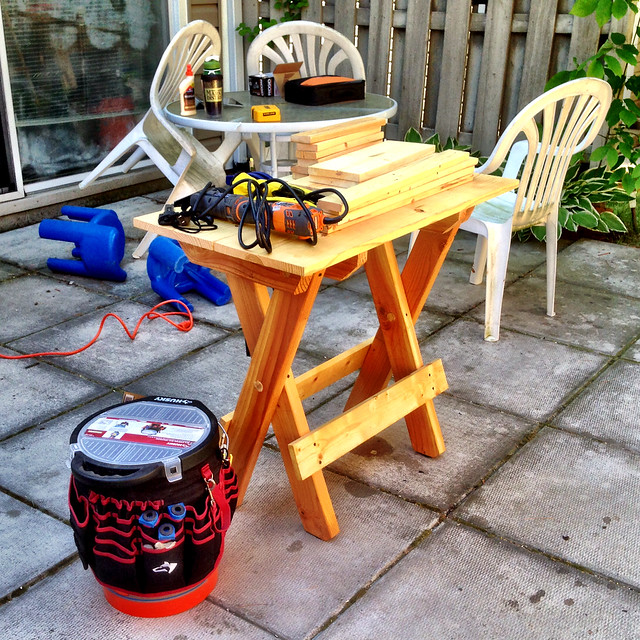
My backyard workshop
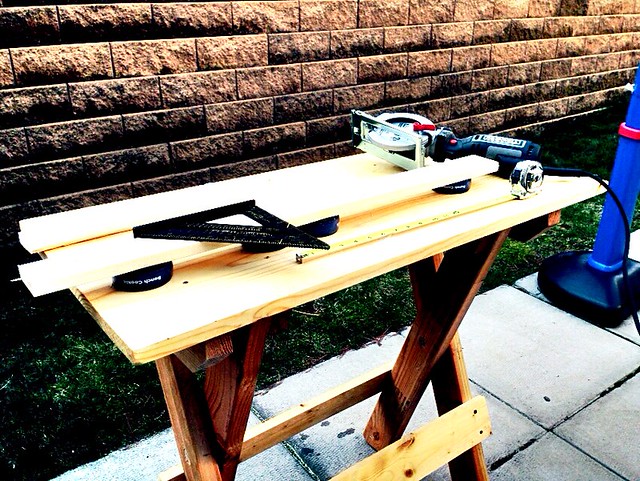
First step was to cut the lumber. I got 1X3, 1X4, 1X6, and 1X8 lumber from The Home Depot. They cut each board once (that is there policy) so that I can fit it in my car.  I recently purchased a Rockwell Compact Circular Saw so I now could make straight cuts on 1X or 2X lumber, which was very helpful for this project.  A couple of nice features included the fact that it is small for a circular saw (single hand operation), so I could use it and a carpenters square without clamping.  Also, using bench cookies would stabilize the board by itself (small circular saw means less vibration).


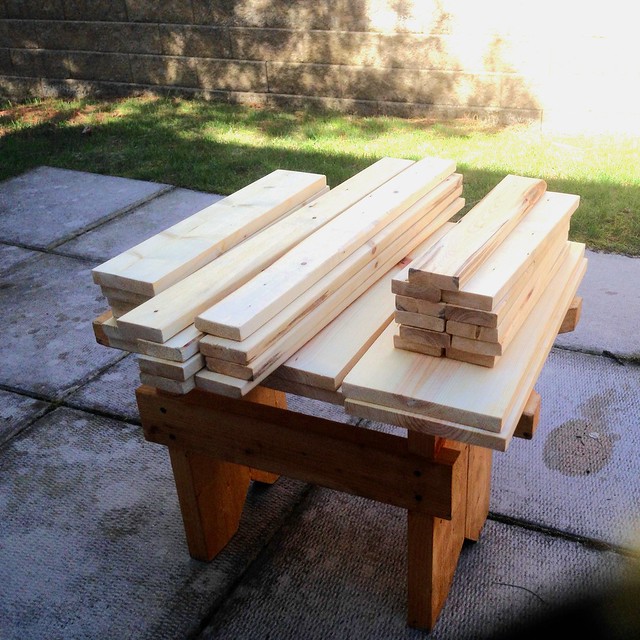
Cut boards for making the Ridiculously Simple shop stool
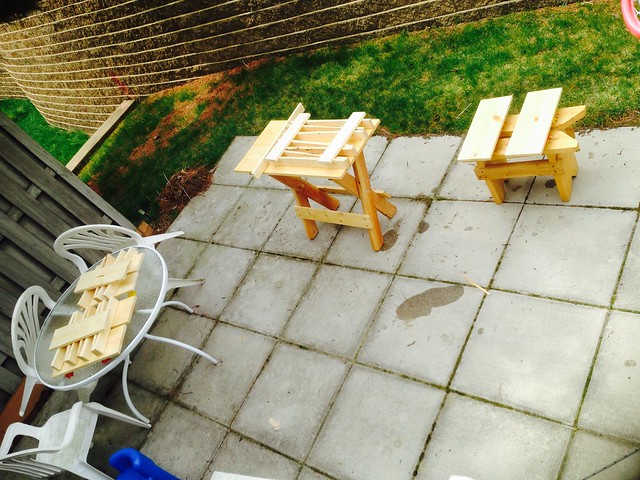
Cut wood for two shop stools

Measure twice, cut once
Cutting boards with a Compact Circular Saw and a Carpenters square.

Next step was sanding the boards and staining them. I used a rasp to break the corners, then three rounds with sand paper.  Staining was with Dutch Oil.

Staining wood for step stools
Staining boards

For assembly the hard part was the fact that 1X dimensional lumber is prone to splitting. I split my first two, then I noted that the instructions say to pre-drill holes to prevent splitting.  After that it was a lot easier.

The next tricky part was getting the steps in. The side slabs make it hard to get access to the tops of the steps. I think pocket screws would work, if I was up to learning how to do pocket screws.  Another new purchase was a right-angle driver/drill head for my Rigdig Jobmax multi-tool. The advantage is that I can drive in wood screws without as much space as the average cordless screwdriver.

After getting all the supports and steps glued, pre-drilled, and screwed in, we had the structure of the shop stool.


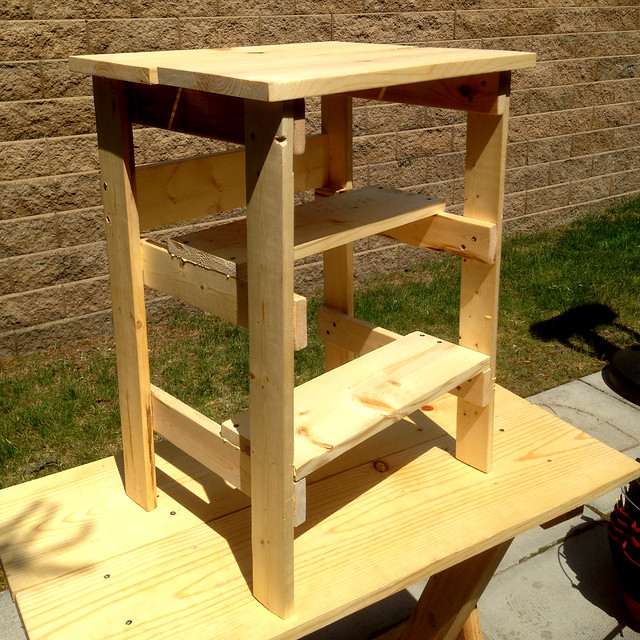
Ridiculously Simple Shop Stool completed
Complete shop stool

Next was to put finishing touches on it.  Scrapped off the excess glue.  Added non-stick safety tape on the steps.  Added hinges so that the second half of the top can be opened to make a stool top or folded to allow for steps. Added felt pads on the feet and on the top to protect the floor and to soften the sound when the top is opened or closed.

Ridiculously Simple Shop Stool
Two completed shop stools in the kitchen

A nice little project. It turns out to require use of two new tools (the Rockwell compact circular saw and the Rigdig Jobmax Right Angle driver). It will get multiple uses, as stools my in-laws like to eat at the kitchen counter when they are at our place so they can use two stools.  The steps are tall enough that my 4-yr old son can now help food prep and operate the microwave. The stool tops are good for side tables in our living room (so we can sit at our couches and eat). They also make for good work surfaces in the kitchen (that will always be clear because we need to use them for other reasons).

Very nice project. Thanks to The Family Handyman for providing the plans.

Saturday, May 16, 2015

Cancun family vacation

We had a rare pure family vacation (meaning the trip did not include visiting friends, family, or other business). With two kids (preschooler and baby) and two grandparents, we went the easy way out and took a trip to a family-friendly all-inclusive resort in Cancun, Mexico. The benefits of an all-inclusive resort is that very little thinking or planning is required. The knock against these sort of things is that they are completely removed from the host area, which is true. But some memories and thoughts:
Touching the sea in Cancun
Touching the sea for the first time in Cancun, Mexico

1.  Using an all-inclusive resort made it possible to have a vacation while we are caring for two grandparents, and two small children. No worries about getting food, everything is in short walking distance, and we don't have to worry about getting lost in the general traffic of everyday life. And right now, that is important.  Someday, when T and A are older and going to different cities is meaningful, we will have that kind of vacation.

2.  We think that most of the staff are recruited from Quintana Roo>. And a large fraction of the guests were Mexican. So the resort we were at was not a Little America that I thought that these places would be.  We had T do greetings and simple questions in Spanish (e.g. hola, buenos dias, buenos tardes, __ por favor, donde es ___, gracias, de nada, numbers) And staff responded properly to a four year old American using Spanish. For T, who learns Spanish in pre-school, that means that he experienced hearing and using Spanish as a working language, not a memorization exercise that pre-school Spanish is. Bonus, there were a couple of times when S and T were interacting with housekeeping (which were not generally bilingual) and T knew just enough Spanish to get the point across.

3.  We provided the staff great amusement with my high-school Spanish. Sometimes, when the staff recognized me (or T) we would have our entire exchange in Spanish. We noticed this would happen when there was another staff observing in surprise, and the staff we interacted it would give them an amused smile at their surprise. This has the obvious implication that if my not-significantly-different-from-zero Spanish was cause of notice and amusement, the typical level of Spanish for an American is actually zero.

4.  T is still the very cautious and generally shy self. He had a few scary (for a four year old) experiences over the trip. He slipped and got stuck on a bunk bed ladder, he got turned on a water slide and went underwater, and he was on a jetski (being used as a lighter to another boat) punching its way through waves and up on a beach. So we had many conversations on how being brave was doing things that were scary, and not stopping even when things go wrong.

5.  For both T and A, the best part of the trip is clearly the fact that they had mommy and daddy close at hand for large parts of every day.  Frankly, they would have enjoyed this if we stayed at home too. But they also saw us interacting with the hotel staff. And (especially since we were trying to get T to practice his Spanish) doing so with courtesy, even when there were problems with the room and travel. (ok, if you asked T, he probably would say that parasailing and always-available ice cream were pretty significant too.)

6.  A is a very expressive one-year old. That means she babbles, dances, looks at people, and acts and speaks with intent. Very clear and specific intent. In a one-year old, this is seriously cute (and we hope this means we will skip the worst of the tantrum stage). But another part of us thinks that if she is like this now, just wait until she actually has language skills. As I recall, in daycare, there was a clear hierarchy based on who had language skills (they could communicate with each other, and communicate their desires to the teachers). T was on the bottom end of this until he was 3 1/2 or so. A is going to be at the upper end.

7.  T definitely recognized that he has to compete for attention. And it is very hard to compete for attention with an expressive one-year old. Especially when you are naturally an introvert. Knowing a little bit of Spanish helped in this weekend with the staff and the other Mexican guests, a preschooler trying to speak a second language is pretty cute too.

8.  We somehow chose a resort that was also hosting a Korean church conference.That was something you don't experience on the average vacation.

9.  Grandpa and T (and daddy) went parasailing (which involved using a jetski to get to and from the boat).  Grandpa was very happy at this little adventure.

We are glad we did this. Grandparents can probably only do this for a limited number of years, and the kids are not in a position to appreciate anything more complex. When our kids get older, they will better appreciate things that are more complex, more adventurous, or more immersive.  But this is a good start.

Thursday, May 07, 2015

Parenting Month 54: Many things to talk about

Wood tangrams
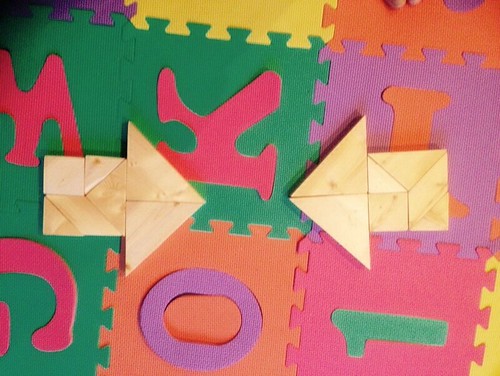
Homemade wood tangrams

This month's theme for both children has been expressiveness. Both of them have been growing in expressing themselves, which is a far cry from the previously very quiet in public T and a baby A.

T's expressiveness and confidence in public we still attribute to ATA (tae kwon do school).  He enjoys being good at something (which comes with practice), and now having passed two rounds of belt testing and one session of board breaking, he is gaining confidence that he can perform in public. So now in ATA class he cheerfully shouts out answers and ki-yup and yes sir/yes ma'am appropriately.  In preschool he now speaks regularly, which is a considerable change from even 6 months ago when he was very quiet. He still a relative island of stillness in the chaos that is the typical pre-school classroom, but he interacts more with others.

A has also become quite expressive. Last month she babbled and sounded like she was having a conversation.  Now when she babbles she is clearly doing so with intent, and she gets upset if you do not respond appropriately! Among things she can distinguish are toys, DVDs, books, and food.

Can you read this for me?
Will you read this book about going to the potty for me?
In other news, T has had his kindergarten orientation. After testing, and visiting the school for various events over the past two years, he is getting comfortable there. We were bemused to see that T was NOT the shy kid of the group, instead he was a bouncing little pea going along (he is young, and even for his age he is short, but not skinny).  His future teachers have noted that he has a good attention span, made evident during his visits to the classrooms, testing, and when he came to watch the school play (watched the play without the parents having to closely manage him).

A has become mobile. While she still really wants to walk (she cruises and occasionally attempts to stand without support), she does crawl. And she does crawl with intent (a destination in mind). Sometimes that intent may or may not include us, so we have to keep an eye on her (gege has to be tasked with being a watchdog at times).  Among other things, she has figured out how to get up the stairs (she is ok with backing down). Since she has determination, she has made it to the top floor before we've figured out where she was.

Saturday, March 28, 2015

Parenting Month 53: When Eagles fly

T's major events for the month were taking a trip and our first experience with high stakes testing.  By all accounts both went quite well. T has always been a good traveler, and the high stakes testing experience was one that was sane.
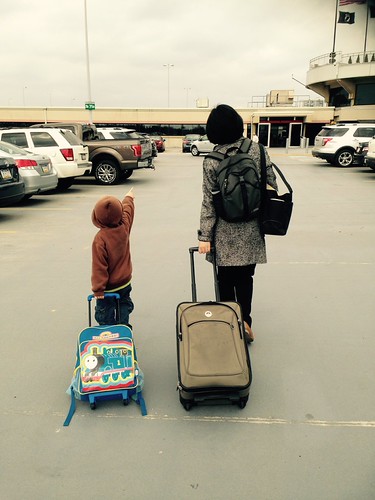

On their way to a flight
We need to go that way to get on our plane
This month was noted by mommy taking a work trip to Las Vegas, and we took T out of day care for the week and had him go along. Auntie P also went along, having been to Las Vegas before, but not in the company of a 4-year old. So amid lots of walking in the hotel, through a casino, to other hotels on the strip, we got many comments that he was a good traveler, standing patiently through many lines, and doing his job of pulling his own bag around and staying with mommy (or auntie). The flight itself was spent reading and playing. Even when tired, the worst he got was asking for a carry. It would be hard to expect any better from a pre-schooler. This was another instance where we pulled the 'you need to be a very good boy' on him prior to the trip. Of course, he also knew when the trip was over, so he reverted back to normal (which is still pretty good, but there is a notable difference. Weeks like this are where we want to ask if we can keep this child :-)

The other major event for the month was kindergarten testing. This is known as high-stakes testing in the pre-elementary world, because the test is being used to make choices on admission into a school.  Because T's birthday is in October, he would not be eligible for kindergarten next fall in our school district. Since he started pre-Kindergarten in November, that would imply that he has to repeat a year of something, either he takes Kindergarten next year at our daycare (which does offer Kindergarten) and then goes to Kindergarten again (when he is eligible for Kindergarten) or he repeats pre-K at the day care and goes to Kindergarten when he is eligible.  While there are arrangements to test into pre-K at the local school district, word on the street is that almost no one passes (to get into Kindergarten early, apparently the standard is test at a level of passing the year after the one you want to test into).  In addition, the public school Kindergarten is a half day kindergarten, so you still need to make arrangements for the other half day (which our day care offers).

So we are looking at a nearby Catholic school K-8. It is very highly regarded. In visits to the school we have noted the interaction between the kids and the staff, and also between older and younger kids (the 6-8th graders mentor the K-2 grade students). We like the smaller class sizes (our day care had a pre-K with 20 and a pre-K with 8 students. T responds to the difference).

The issue with high-stakes testing is that pre-school kids do not perform on demand, to having to make decisions with long-term effects based on a one time event, and the parents are fully aware that the kid's behavior is essentially random.

While the general concept of testing is rather insane, the concept of evaluation is not, a school needs to do an evaluation to determine if a child is ready, especially in a case like this where a child is trying to go above grade level (in the U.S. the pattern is to hold children back, so the effect of some parents holding children back and other parents pushing kids ahead is that there can be a 3 year range in ages. Later, the difference almost disappears, but at age 6, a three year range is very significant, so the school needs to know that the younger end of the range can handle it.

Hence, there is a little cottage industry of preparing pre-schoolers for high-stakes testing, especially in places like New York City where the better pre-schools and kindergartens are known and they get full. Because how the child performs in a span over a couple hours does make a long-term difference.

Fortunately for use, the evaluation at this school was sane. We have an ongoing relationship with the school, so T has visited a couple of open houses, another event, and has visited during a normal day. The school staff were aware that he has a record of not interacting with strangers, so we have been building the level of recognition over time with the staff who would do the evaluation. And the testing was only one part of an overall evaluation (which included observation of multiple interactions with the current Kindergarten students).

So he did pass and got accepted for next year. Does test preparation make a difference? We actually got test prep materials (yes there are such a thing), but in the end, while we did read them, we did not use them, with life generally getting in the way, and we spent our time with him doing other things. The book we have, Testing for Kindergarten by Karen Quinn, probably would have preferred it that way. The core of the advise was that the best way to prepare was to interact with the child over a long period of time and develop the skills needed that way.  But the reality is that formal test prep could have made a very big difference in a child's performance. I joked that in the efforts to make a test that was cultural and background neutral, the tests give a big advantage to one major group. People who prepare for pre-school hish-stakes testing. Many of the questions are based on the fact that a person understands the concept being tested and the form of correct answers. The test prep books and programs are somewhat built around making sure the child is exposed to the types of questions being asked and how they get answered. They also run through the various topics. While the topics of questions are all topics that children can get exposed to, to be exposed to the whole range almost requires deliberate test preparation.

Tiger mommy finds it ironic that having geared up for preparing for high-stakes testing a year ago (as we realized the effects of an October birthday and the implication that it would have essentially meant repeating a year someplace), we did not actually put time into test preparation. Instead, while mommy school did involve reading and arithmetic workbooks (and recently, music), daddy school involved going to museums and other places, doing wood projects, and building LEGO.  And we were applying to a place that did assessment, but did so in a sane manner as part of an overall assessment that worked with the characteristics of the child in question.

In other news, A also had an assessment done. She is somewhat behind in motor skills development (does not crawl) so we had the Alliance for Infants and Children come (a free program for those under 3 in PA). The assessments results were highly encouraging, they think that the delay in crawling is due to a physical characteristic, which is not a long term problem. But, they also evaluated other aspects of development. I was very amused at the report. It frequently references the fact that A likes to play with her older brother.and how that relates to the way she babbles and plays (even if she does not crawl).  I even had T read those parts of the report. :-)
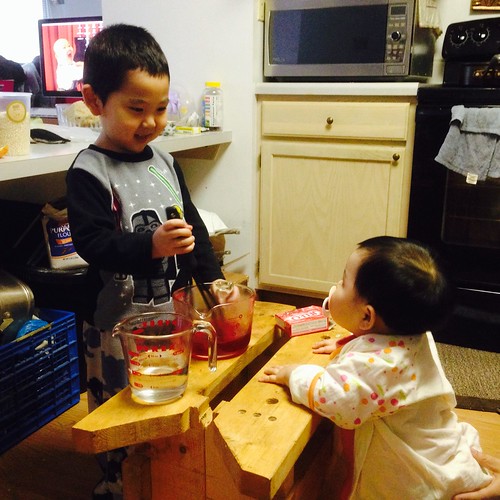

Big brother is making Jello
Gege is making Jello. Can I have some?

A does not really crawl, although she is now at the point that she will get on all fours and rock (and sometimes even move!)  But she does enjoy pitcking up things, banging them together (almost) stacking items Particularly amusing is when she goes into babbling mode. It is as if she is trying to hold a conversation.

This past month of parenting has had its share of concerns, but we leave it thankful that our children are active and engaged in their world, even for any faults they may have.

Saturday, February 28, 2015

Parenting Month 52: Passing tests

A new belt

This month's milestone was T's advancement testing for Taekwondo. He passed! Of course, the issue is not if the dojang passes him, when dealing with pre-schoolers, it is silly to hold them to a real serious standard. The question at hand is how does he handle himself in a setting where he needs to perform on demand. The norm is to be scattered and play around, another common reaction is to freeze in nervousness (which is T's historical norm), the goal of a preschooler in a martial arts program is to pay attention and follow when being specifically addressed (and generally you accept being relatively stationary the rest of the time.)

Under those standards, T did very well.  As a child who does not like crowds, he handled the crowd and structure of testing day well (much bigger group than I have ever seen there). So we were gratified to see him dealing with it through chatting with the instructors (benefit of being one of the first to show up), concentrating on his forms, and even paying attention as it was everyone's turn. (of course, it probably was because he was trying to remember the forms of the upper ranks)

Another source of gratification is that he was focused during his turns. He was grouped with the smaller (i.e. younger) kids (4 year olds) and the obvious thing that makes 4 yr olds different than 6 yr olds is that 6 yr olds pay attention to what they are doing and the 4 yr olds generally did not.  So that he did focus on what he was supposed to was good to see. We don't often get a chance to see him in a setting with other kids his age, but being able to focus on what he is doing is something we have tried to encourage in many areas.

Other activities for the month include more cooking. I've been letting him work on the stove for making jello, pudding, and pies from mixes. And having him stir while the pot is on the stove. This has two problems, one the danger from a hot pot or stove, which is not as visually apparent as a knife blade is, second, that these required continuous stirring over a period of time. Reality is that his endurance is just short of what is needed here. If he gets to the point where he can stretch out another minute, he will reach the point where he can see the transitions in form caused by the food being exposed to heat. But for now, he likes the activity of doing something that we tell him is dangerous and that he needs to be careful around. And it provides another way of discussing perseverance and focus on task. (in addition to the usual comments about cooking being a good way to talk about math)

He continues to read more. This past month we have realized that he is pretty much out of the emerging reader series.  His current reading level is Dr. Seuss. The shorter books he reads happily away (including reading them to his baby sister) Long books such as Cat in the Hat are possible, but when he finished Cat in the Hat, he was tired (he did not realize how long the book was going to be.

Another area is preparation for kindergarden. I took T to an open house for one school that we are looking at (because they will take in someone who has not turned 5 before September). It looks promising. After a couple of rooms he warmed up to our student guides and was chatting away with them. I have noticed on previous occasions that the older kids are used to interacting with the younger ones, and had an opportunity to discuss it with some of the staff who explained how they encourage it. And we talked about how the evaluation would be done (basically, the primary evaluation would be from his preschool, which is not something that we will worry about).  There is a clear difference in T thriving in a smaller environment, and this is besides the fact that we don't like the idea of T being in pre-Kindergarden for a period approaching two years, then being in a half-day kindergarden (which is what our area is like). So this school has a lot of things going for it in our book.

A also had a big 9 month milestone.  Her first deliberate word (i.e. not counting the various vocalizations like mamamabababagagaga *sqwawk*)  ah-ooh, to be used when something drops or falls.  I'm particularly happy because I've been trying to train her to say this over breakfast all month.  And this was actually T's first deliberate word as well..  S thinks that ai-yaah is a candidate for a second word, which she clearly picked up from her big brother.  I'm not convinced that it is deliberate as opposed to mere mimicking.

Saturday, January 31, 2015

Parenting Month 51: I can do that

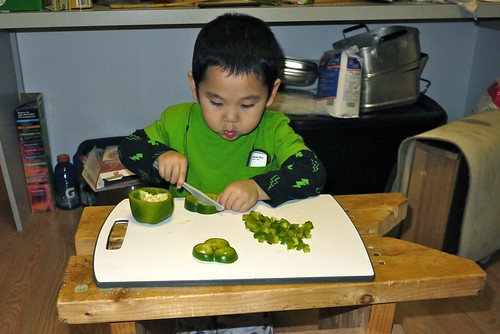
Cutting peppers to go on a pizza

This month's catch phrase is "I can do that."  I think that a characteristic of the pre-school years is the see-saw back and forth between a child wanting to become independent, but wanting the security of the parents. In our case, it expresses itself in the form of competency. And right now, we are well into the development of competency side of the spectrum.  

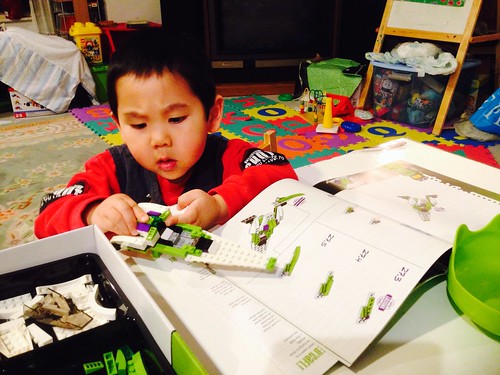
Competency has a number of manifestations with T.  One is the reading. At this point, he is at the Dr. Seuss level of reading. The small books are easy. The longer classics are not hard, but they are long and they test his endurance more than his reading ability.  We are at the point where it is possible to put him on the floor or couch with a pile of books and he will read away.  What is really cute is when we put him next to A and he reads to his little sister (and she pays attention!).  The other place this shows up are LEGO sets. He can now read instructions well enough to follow instructions on reasonably complex sets (where the recommended age range begins at 8 or lower).  His most recent one was the LEGO Movie trash chomper (recommended age begins at 8). It took him three days to complete it, but he did it pretty much on his own.

Building the LEGO Master Builder Academy Space Fighter
Building a LEGO Master Builder Academy Space design #3
The second place that competency manifests is in taking part of tasks around the house. He can handle simple tools (hammer, screwdriver) and can do set tasks (nail in place, screw already set) and we have him at least touch many such tasks as they come up (he does not have the strength to finish the job).  Also light vegetable cutting (with a plastic knife) and food prep (mixing) is within his level of competence.

And while he has better and worse days, there are the days where he is very helpful around the house (cleaning up, clearing the table). Actually, there are days where he is hyper-polite and helpful. It is cute and almost funny as he says please and thank you and does things like get food, help prepare, put the used dishes in the sink, and even help take care of mei-mei (little sister), and he keeps this up all day! (the consistent use of polite words after an half an hour or so drives S and I to the point where we have to make an effort to keep from laughing)

Dinner time. Is this yummy?
Dinner time for mei-mei

The Taikwondo classes have been a contributor to this. Each month has a character building theme, and this month the theme was 'goals.' And part of the assessment is to develop a list of 10 goals, and for T, these were dominated by goals to do standard daily tasks himself (put on/take off shoes, jacket, clothes, etc.). He has gotten into it. He thinks of goals at all sorts of times (especially at night when we talk about what he did during the day) and he immediately wants to add it to the list (which he will remember the next morning!).  And reminding him that he declared something a goal is incentive enough for him to give it a good try.

Sibling interaction is another area where we are quite fortunate. T and A are quite fond of each other. A is easily amused by T's activities, and T actively assists in entertaining and taking care of A (given his size as a four year old). What is amusing is now that A is semi-mobile and can scoot, she tries to join in with whatever T is doing if he is close to reaching distance. And sometime he is not careful and she turns out to be a lot closer than he thought and can grab something.

A is turning into a babbler.  Typically, after she eats, she is good for an extended period of babbling away if there is a willing conversation partner. I usually get this dark and early in the morning when I get her when she is awake and everyone else wants to sleep longer. (typically after she gets fed) I get breakfast for myself and she babbles away.  Today I brought her to a Red Cross meeting and she amused everyone by babbling after eating (I took her out to a hallway) until she finally stopped, because she fell asleep!  Everyone joked that it sounded like she was telling a story, not just vocalizing.

As far as parenting was concerned, this was a very pleasant month. Both children being engaged in their worlds, and increasing their competencies at the level they are at. And both being well behaved in the outside world. While both are not pass around kids (neither of them takes well to strangers), we joke that they are both advertisements for having children and we both get encouraging comments while out and about.

Up next, getting ready for pre-kindergarden assessments for T (we really don't want to have him do pre-K again next year like his birthday would require, and his reactions to stranger can lead to problems when it is time to do assessment).  And we probably should try to get A out and about more for more interaction with people (even if we are in a cold northeastern winter!)

Friday, January 30, 2015

Lessons in teaching: Fall 2014 edition - Using the news

I had started using news articles to illustrate class concepts last year, but this year I started doing so from the very beginning and made it a standing part of the class to do this once a week in both of my classes last semester.  Of course, taking 10~30 minutes a week out of class came at a price.  In both cases it meant a chapter not being covered. And I pointed this out to the class when time came for course evaluations.

Every week I would identify news articles, magazine articles, or blog posts to discuss in class.  (or sometimes it was a historical case).  The discussion would always open by evaluating the article through a standard technique.  In my decision analysis class it was either generating a value tree or a decision tree.  In my simulation class it was generally generating an event diagram (i.e. a white board exercise).

The cases included the international and domestic (U.S.) handling of the Ebola outbreak, health care provider reactions to the rise of independent urgent care clinics, potential expansion of a light manufacturer, pulling a goalie in hockey in the final minutes, flu vaccinations, Corporate restructuring, the construction of super containerships, NASA Commercial Space initiatives, waving a (baseball) runner home, handling of death threats (Gamergate), Space Shuttle Challenger launch decision, automation of warehouses and manufacturing, delivery of disaster response services, and hub and spoke airline operations.

For the discussions themselves, it was a great way of getting students interested. Because of the wide range of topics, international, domestic US, health, industrial, sports, space, different people tended to get into different discussion topics, so across all of the cases, a very large portion of the classes contributed to the conversation at some point.

The other big benefit of the cases was to reinforce the modeling aspect of both classes. For decision models this meant many opportunities to consider the value tree and decision trees, even as we moved to other techniques and topics. For simulation, this was the chance to work on modeling while the course focused on analytical and statistical methods.  Even for those who did not take part in the class discussion, there were a few discussions that I think were particularly memorable.

One unexpected benefit was that I had an opportunity to engage in give and take.  Once we got past the first few sessions, we were comfortable with me questioning some of the responses, or asking to go a little deeper than the first answer.  (without scaring the student into a shell) Students also started asking questions, so we occasionally got a real discussion going.

Sometimes it was fairly light and even entertaining discussion (sports were good for that). And there were times that it went very serious (we looked at the decision not to provide protection from threats of mass murder with plans in Utah with Anita Sarkeesian (meaning it also involved the politics of gender oppression). Ebola was also a big one in September.

So, when compared to the loss of a chapter of coverage, I think that this was a worthwhile direction. The course evaluations commented on how much the students liked using current events as examples of material, and that they felt confident in modeling (which is only one or two chapters in each subject).  Compared to a chapter of material that would probably be forgotten, I'll take the tradeoff.

Thursday, January 15, 2015

Small Town Heroes by Harmon: Book Review

Small Town Heroes (Wearing the Cape, #4)Small Town Heroes by Marion G. Harmon
My rating: 4 of 5 stars

So the main character of the series, Astra, gets herself taken away from Chicago, her home, and her friends, because she sees a vision of something she should not know anything about. She makes new friends, learns how to work with others who are extremely competent, and her old team gets to meet the new ones.

I liked this book because it maintains that in the world of superheroes, the most dangerous ones are the ones that can plan. Astra is depicted as someone who is learning how to do this, and she spends the book recognizing she is around people who do it well. A team of third-string supersoldiers is depicted as being a match for a first-string villian because of teamwork, and these opponents are the most dangerous, not because they are the most powerful that Astra has faced, nor because the Young Sentinals are weaker than the main Sentinal team, but because this group works well together. All of the supers (and other leadership figures) are highly competent and dangerous, and that makes for a better story than many.

The book can get a little corny/sappy occasionally, and that may be because the main character is a pixie teenage girl. But it helps that everyone is competent, and the main hero, while competent and universally accepted, still has much to learn and the others around her have much to teach

View all my reviews

Monday, December 29, 2014

Parenting Month 50: A-T-A yaaa! enrichment and assertiveness

Carnegie museum of natural history
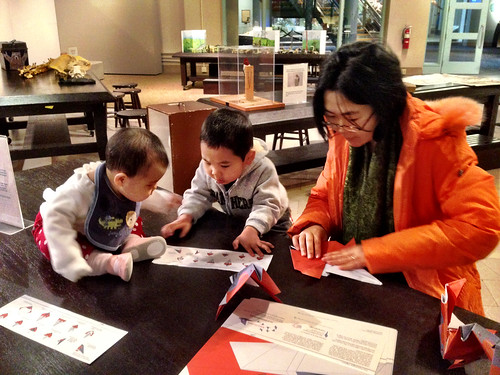
We're reading instructions for mommy at the Carnegie Science Center.  This is the next step.   http://foldtheflock.org

We have finally caved in to the suburban parenting pattern of enrichment classes.  In our case we focused on the one thing that we do not provide: lessons in assertiveness.  And the vehicle we chose was a local taekwondo studio that had started out around two years ago.  We are not particularly interested in mastery, although if T wants this to be his sport for his growing up years, we would not be particularly disappointed. But we want him to relate to other adults (or at least older people) who are authority figures and can give instruction for him to follow and command respect.

Actually, we are more interested in that he can build confidence in action outside the safe harbor that we provide when we teach him things.  When we first went, they were telling us about how martial arts classes in pre-schoolers helps in the case of pre-schoolers who need to burn off energy and bounce of the walls at home. As we have a child whose worst episodes of acting up are probably laughable to most parents of pre-schoolers, we replied that was not the problem. But what we are worried about is that he grow in confidence in action.

He is an introvert, and the son of two introverts, who are fully aware that much of the world is organized and evaluated with extroverts in mind.  And we see that in his daycare. He was part of a trio of introverted boys. They have separated on their fourth birthdays to another daycare, the pre-K at our daycare, and the second pre-K class. And the one in the other pre-K class is worried of him being lost in the shuffle (it is large, the size is at the room physical limit.  While on academic and artistic levels he is expressive (he is in a small class), when it comes to crowds (they merge in the afternoon) he still withdraws amidst the hurly burly of 20+ preschoolers running around.

The first sessions were what would be expected. As the class does their warmups, exercises, and yells, he withdraws.  But, in a credit for this school (and the fact that there are few beginners at any point in time) he got some personal assistance from the school owner.  So the first few session, he essentially had private classes, and now he takes his place with the rest of the (small) class.  Progress!, and kudos for the school!

In other areas, he is enjoying his small, pre-K class. There are only around 8 students, and reports are that he is active talker in the group activities; circle time, singing, etc.  Arts are slow, as he is very deliberate so projects take much longer than others, but he does them.  He reverts to form when the classes merge in the afternoon (the extra space for the second pre-K class has another purpose in the afternoon).

He is increasing his academic abilities.  With LEGO we went through the City Advent Calendar, which required that he take a small number of blocks and figure out how to make the object based on an iso-picture, as the month progressed, he was getting noticeably better at the spatial awareness, and doing the Christmas presents was much better at figuring out instructions by himself. He is also getting better at working with random pieces, as we build things and make up story lines to go with them.

He enjoys reading, especially as he is much more competent at phonics. He will pick out new books, and while he may ask us to read it, by 3-4 pages in he is doing most of the reading. We find it especially amusing when we he reads books to his little sister, because he does it using a teacher voice (as much as a four year old can imitate a teacher).

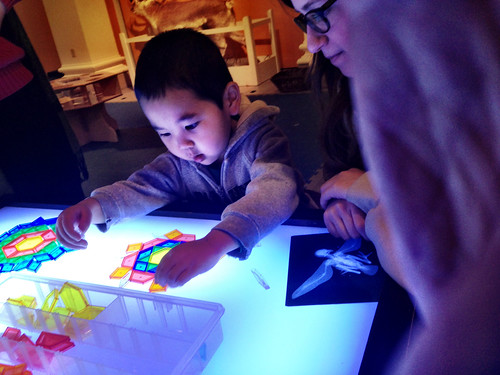
Lighttable at Carnegie museum of Natural History
Making patterns with shapes on a light table

A is becoming a sneaky little baby girl. She has started manipulative play, taking toys and waving them around. She can move things to her mouth, such as a toy, or more useful, her pacifier (funny event, sometimes when she wants to cry, she will use her hand to move the pacifier over so she can cry more effectively).  Our other big observation was that she is now mobile.  She can scoot. At the beginning of the month, we were not sure, because she does not move that fast.  But give her a few minutes, she will have noticeably scooted on the playmat towards a desired goal.  Our funny moment was when T was trying to play with A's toys (on the pretext of teaching A how to play with them), and she scooted over a couple feet and picked up one of his completed LEGO sets.  We see a lot of that in the future.

Friday, December 26, 2014

The Way Into Chaos by Harry Connolly: Book Review

The Way Into Chaos (The Great Way #1)The Way Into Chaos by Harry Connolly
My rating: 5 of 5 stars

Harry Connelly has made an incredible world. The Way into Chaos is named because it has its protagonists surviving in a world that has fallen from order into chaos. The heroes and other characters are complex, each with a range of motivations. There are those like one of the protagonists who think of things like honor, loyalty to the empire he has sworn an oath to, and devotion to a cause. Others may have had such thoughts, but have looked around them and believed that the empire that they were loyal to has fallen. Others were never loyal to the empire, and made choices on what they thought was best as order fell around them, and a new threat entered there land.

The diversity and depth of the characters is what draws you in. In the first chapter, you are introduced to many characters and their backgrounds, only to have most of them gone by the end of the second chapter. As the book goes on, there are several rounds of this, parties form around the protagonists on their missions, only to break up and go their separate ways in the course of events. These are not handpicked heroes chosen for a special mission. These are individuals who made there way out of disaster into a dangerous world, trying to make their way within their limits. And that keeps my attention as I went page after page. I'm looking forward to working through the rest of this trilogy.


View all my reviews

Thursday, December 18, 2014

Thinking with Data by Max Shron: Book Review

Thinking with DataThinking with Data by Max Shron
My rating: 4 of 5 stars

Thinking with data focuses, not on how to do data analysis, but on the questions that one should be asking. It does so in two ways, first through providing an overall framework to looking at situations, then working through a series of topics using examples to serve as plausible paths of decision making. In a fairly short book, it covers the framework, determining purpose, threats to validity, experimental design, and a few extended examples that illustrates both concepts and deviations. It is a useful quick big picture book that is useful for those whose focus has been on the methods of data analysis or for those who do not have a quantitative background but are faced with data questions and need to be able to work with data analysts.

The first part is probably the most rewarding. Max gives a framework of how to frame a data problem. Context (who is interested in the problem, what are their overall goals and why, what is the goal of the project), Need (the specific need that could be solved through the use of the data model), Vision (an understanding of what the results of data analysis would be like), and Outcome (an understanding of how the data analysis results would be used). The end of this framework would be a story that you can tell

Next is a discussion of how the details of the problem could be fleshed out. The content is probably familiar to anyone who has had to work with stakeholders. The valuable portion here are the vignettes of working through this process on projects. In particular the fact that the vignettes are not projects that necessarily go smoothly, so it does not have the idealized feel that many published vignettes do.

Next is a discussion of presenting the results. The focus here is that the results are not the output of the data analysis, but the use of the data analytics methods to construct and argument. And that argument is going to be presented to people who have backgrounds, prior beliefs, prejudices, and sometimes reasons to argue against your findings.

How to address these disputes is through conducting experiments and testing alternative hypothesis. So a section of the book is on defining causality and designing experiments (interventions) to handle different types of alternative hypotheses.

What makes this useful is the framework and the vignettes. It is good for a quick introduction to this area. As others have noted, it is not tightly organized, so after the first chapter with the framework, it is not useful as a reference, but it helps in focusing how to think.

I teach classes on working with data, and one area that is difficult to get across is the concept that there is a unified whole in the topic, not only a bunch of separated techniques. I plan on using much of what is in this book to help provide that unified whole my classes.

Disclaimer: I received a free electronic version of this book as part of the OReilly Bloggers program.

View all my reviews

Saturday, November 29, 2014

Parenting Month 49: An introvert in an extrovert's world

Earlier this month, one of T's teachers decided to give him his assessment a bit early, since he was going to a new class and new teacher soon (moving from the 3s room to Pre-K (everyone from 4 years until moving into kindergarden).  He pretty much maxed out the academics, meaning he covered everything that was expected from the 3s room and everything that the Pre-K had been doing (from the description, we figure she ran out of available assessment material, and probably was also beginning to reach the extent of T's patience). This is not the usual outcome of an assessment for T, the normal outcome is that he is quiet and does not give answers to things that we are all quite certain he knows so he assesses as generally age appropriate, maybe a bit ahead.  The difference is that it was done in the course of daily activity and the teacher was one he knows well as opposed to a new teacher (he takes 2-3 months to warm up to new staff).

The underlying issue is that he is an introvert, and pre-elementary assessments are designed based on an outgoing child who will actually present the knowledge he/she has to the assessor.  But, while the majority of preschoolers in any grouping (say, a daycare or preschool) are wild and rambunctious, T had always been the quiet one who stayed in one place.  As a 2 and 3 year old his play at day care or in group settings was marked by him staying in one place as the other kids would swarm from play area to play area around him. And the kids realized this too. His most common playmates were also the quiet ones who did not swarm as fast as the others (e.g. girlfriend from the 2year old room was also a shy one, and there are three boys that the staff have marked as hanging around together instead of participating in the usually rowdyness of preschool boys.)

The question is what do we do as someday he will be assessed, and there will be an outcome of the assessment. And that, especially in the pre-elementary and elementary stages, the assessment will be done in a way that greatly favors the extrovert (est 75% of the U.S. population).  Some things that we have been trying include playing piano (he plays happily at home, but in any other location, he maintains excitement until he gets close to the piano in question, then he freezes.), activities in busy areas (the regular museum visits offer many opportunities to interact, in fact it is hard to avoid the other kids, but he clams up as he gets close to interacting with anyone, even after watching us do so many times in many contexts.), play dates (we have not had that many, most of the neighborhood is older, there is one neighbor only 2 years older who really likes playing with T, but she is very much the extrovert and it does not help whne movin to a new setting.  There is one sense that it does not matter, that T will learn enough how to function in an extroverted world in time for it to matter, but another thought is that time may not be that far into the future.

In other developments, A has become quite the talker. In addition, she has developed a sense of will where there are times where she can decide to want something, and make deliberate and sustained efforts to get it.  And as part of that, the first stage of mobility, she can roll both clockwise and counterclockwise at will.

T's main development was moving up to Pre-K from the 3s room. This actually was an issue as the Pre-K in our daycare had maxed out the capacity of the room. We were part of a minor rebellion threatening to leave enmasse until they created a new class of Pre-K. There is an issue as the additional class starts out the day using a room that is also used by an afterschool program, so they need to move back into the regular Pre-K/3s room before the public school kids (kindergarden is halfday in W Pa.) return. So it is a lot of moving around, but at least T spends time with older kids again.


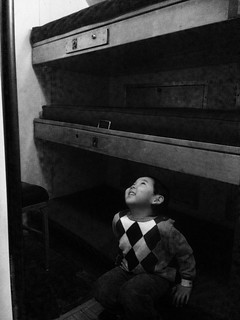
USS REQUIN at the Carnegie Science Center - Pittsburgh
Turning the wheel of the USS Requin (SS-481)

USS REQUIN at the Carnegie Science Center - Pittsburgh
These beds are small
.

Tuesday, November 25, 2014

Using blogs and news articles as class mini-cases - How discrete-event simulation can help project prison populations

How discrete-event simulation can help project prison populations (SAS Subconscious Musings)

My experiment this semester is more intensive use of news articles as subjects for in-class discussion of examples of applications of what we are learning.  While I have done this in the past, this semester I made it a deliberate plan to discuss one article a week in each class.  So far this semester in my simulation and decision models classes, I have covered reactions to the W. Africa Ebola outbreak, Game 7 of the 2014 World Series, Gamergate, flu vaccinations, commercial manned space transport, pulling a goalie in hockey, cargo shipping, business expansion, business divestiture, automation of manufacturing, health care system operations, among other things.

I identify articles through the use of RSS feed aggregators. My news feed includes a number of feeds from a range of business school professors focusing on supply chain and operations management issues.  I follow the CDC MMWR as well as the journal Health Affairs to get health care related articles.  And the New York Times front page and Google News are good for a lot of different stories.  The key is finding an article where the reporter was good enough to discuss the various options that were available and enough details that you can figure out the values of various actors involved.

The key a good class case article is that there are potentially reasonable alternatives to discuss.  In the decision models course, the discussion revolves around identifying the courses of action available, the sequence in which decisions need to be made and information becomes available, assessing the attributes (values) of the people involved, then assessing how they may assess probabilities of various events.

For the simulation course, the focus on case discussions is on understanding how a decision maker in the article may use the simulation, then we do a whiteboard exercise where we draw out an event graph diagram to model that system, focusing on what needs to be included (states, events) based on the decision maker needs. The goal is to discuss modeling in a specific context, so we can talk about what needs to be included, and what does NOT need to be included in the model to fit the particular purpose.  The contrast is to the textbook homework problems, which generally provide a very specific context and set of details which have be included in the model to answer the homework problems.  Textbook problems generally do not include thinking about modeling in such a way to determine what is the right question and how to simplify the model to address the question.

Last week we looked at the decisions made by the North Carolina Sentencing commission.  Unlike most cases, in this case we happen to know for a fact that a simulation was used in the decision making process.

Our discussion began with purpose: why would the North Carolina Sentencing Commission be interested in a simulation of prison population. We came up with the need to plan prison space, make arrangements with neighboring states to house NC prisoners, and to allocate resources to monitor parolees.

Next, a discussion of what would the simulation need to track to fulfill the purpose of the NCSC. This would include the number of prisoners and the number of parolees. And the time remaining for each prisoners sentences. Then, we have the state of the system being the prisoners and parolees, and the terms of sentencing. (we decided not to discuss the size of the prison, since that is something that was being determined).

The last part of the discussion was where the typical homework or exam problem started, diagramming the events tracked by the system, how each events changes the system state, and then how to generate delays in the simulation.

The purpose of the exercise was to discuss modeling. Not in terms of how you build a model from a system description, but to think through how to model and make modeling trade-offs given the decision that needs to be made about a specific system.  The cost of this discussion is time, doing this results in us not completing a semester syllabus of a class that is quite analytical. But, as textbooks usually begin modeling examples with a system description and a purpose, I think it adds to the course and I think the compromise is worth it.

Thanks to Natalia, Jeff, and Leo from SAS for our conversations about this particular SAS case at the INFORMS conference. It enriched the class discussion to know what was happening behind the scenes of the Subconscious musings blog article.

Sunday, November 16, 2014

Testing in pairs: The Global Day of Coderetreat

Global day of Coderetreat: a day to celebrate passion and software craftsmanship

A Coderetreat is like a master class for computer programmers. It is a chance to view programming as a craft that can be practiced and honed.  And like other crafts, the way you develop skill and creativity is to create limits, then use your creativity to accomplish the goal while working around the limits.

As an engineer, I am not primarily a programmer, although I have some level of skill, so this is not the typical view of programming, which is viewed more as a tool and a necessary evil. The effect is that improved competency is not valued, which leads to  inability to deal with dirty data, models that cannot be implemented, and results that cannot be reproduced.

Code retreat is build around the four principles of simple design, due to Kent Beck: 


  1. Runs all the tests
  2. Expresses every idea that we need to express
  3. Says everything once and only once
  4. Has no superfluous parts
The structure of the Coderetreat is six sessions where we work with Conway's Game of Life. For each session, we pair with a different partner. In addition, in each session we are to begin from scratch, and there is a twist to the rules.  The goal was never to actually implement the Game of Life (although in two cases we actually had all of the parts working and tested), but to spend time working with someone else on code.

Observations

1.  Pair programming.  This was my favorite aspect of the Coderetreat, pairing with six different people.  I figure there were two where I was generally more skilled, two where I was generally less skilled, and two where we were pretty much even. In every case our end solutions had very different designs as it was a combination of our different ways of looking at things and our experiences of having tried different designs in previous sessions, and the skill levels of the people involved.  When I worked with students, we would occasionally have a session where we worked together to solve a problem, and some of my students have commented that they found those sessions to be invaluable because they had a chance to watch how I worked and saw how I dealt with different types of problems.  But this time I did pair programming on people on a much more even footing and I get to experience it as well.  It showed in how we used different tools (although I was experimenting with a new IDE), how we solved problems in code and how we solved logic problems. 

2.  Test driven development (TDD). I've heard of the concept before, and I have even contributed to a unit test framework, but I've never really done it.  What TDD did was to encourage more modular code. It also forced us to put more thought into our design, as we had to consider what information was required an in what format to do what we needed.  In one session, one member of the pair would write tests and the other would write the code, and the two were not allowed to communicate. As the one writing the tests, since we could not otherwise communicate, I realized that in writing the tests I was forcing a set of data structures and a design in my tests.

3.  Throwing away dsigns.  We started each session with a clean code base. What it meant was that we did each session using the lessons from what went before.  The first two sessions we did not get much progress, but the third was the one where we made the most progress, as we basically learned from the combined mistakes made over the first two sessions and designed the tests with the past problems faced in mind, and the solution was fairly easy after that.  That was good because the next three sessions were the ones with the wierder twists.

4.  New languages.  Python is by far my strongest language, but I did one session in Clojure and one session with Java.  In both cases I learned a lot about how people set up their tools and the idioms they used, which were different than what you see in standard texts.

5.  Dealing with constraints. There were three weird twists. One was mute pairs, one was limitations on the size of methods, one was no use of conditional statements.  Mute pairs forced the design to be simple and clear (especially difficult because we did it in Clojure, which I barely can say I know without the aid of a book in front of me), the size of methods led us to generate very ugly method/class hierarchy to deal with the extreme restrictions, no conditionals lead to a range of creative hacks.  This has an effect similar to a lot of exercises done in the creative arts, adding constraints is one way of encouraging more creativity.

This was a valuable experience. Most of the people there had computer science backgrounds, and pairing with them taught me a lot.  And I was somewhat glad to know I could add to people's knowledge base as well.


Thanks to Code & Supply (@codeandsupply) and Think Through Math (@ThinkThroughMath) for making this event possible and for helping to keep it free, and to IBM for hosting.


Pittsburgh Code & Supply Logo

Think Through Math logo

Saturday, November 01, 2014

Parenting month 48: Now that we are four

Before T was born, we thought that the first few years did not really matter, that we would not really start trying to teach T anything before he was four. Because we did not think we had any strong opinions on what needed to be done before that.


(I'll pause and wait for everyone to stop laughing. But the real reason for this was that we promised not to stress over any differences in parenting style between us and both pairs of grandparents by deciding ahead of time that it really did not matter, and I think we did pull that off.)


And now, surprise, he is four. So time to take stock of where we are.


1.  Our engaged with parents but not with others has turned into a talker. He plays with many of the other kids now (and he does like being one of the older ones in his room). While he would not be considered an extrovert by preschooler standards, he is a long way from the one who took three months before he would get comfortable with daycare/preschool staff.


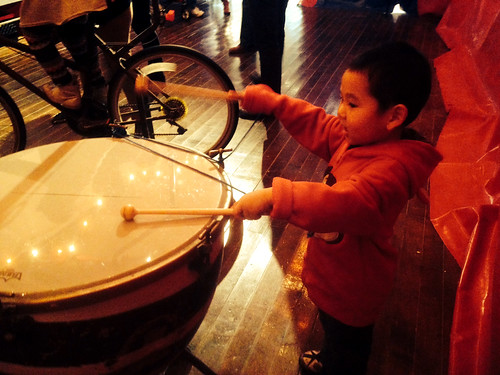
I am playing the drums
Drums at the Mattress Factory


2.  He likes being competent. Today's trick was building a LEGO set for his birthday reading the instructions himself (I only helped when the issue was finger strength). Granted, it was a set that was designed so young children could make it, (aimed at 4-7 years), but he was happy to say he did it. We've been consciously trying to get him to feel good about being competent and accomplishing things, whether it is building something, playing music, working with the garden, building things with tools, or anything else that preschoolers can do.
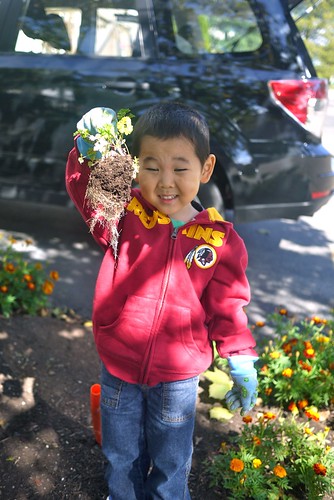
These are parsley roots from my garden


3.  He can read simple books. For a while we thought he was  just memorizing books, but we have caught him figuring out new words through phonics.


The American Academy of Pediatrics says you should read to newborns.
Reading for my little sister
4.  He has always had empathy in the sense of responding to our feelings, but now it expresses itself in a new way as he is the big brother who cares for his little sister.


But now that he is four, and we obviously did not let things ride for the first few years of life, what does it mean to be thinking deliberately about his growth?  We are watching the progression to kindergarden, as the cutoff point for school has been moving earlier over the years (parents have been holding their children back for fear that they were not developmentally ready), and now T is on the other side of it, so we are worried that based on the public school cutoff points, he will have to wait and double up a year in preschool at some point before he is eligible for kindergarden/first grade, and that will be boring.  So we are thinking of ways for him to get into the school system despite the cutoff date.

Some favorites from the year:

Song: Let it go from Frozen, like the majority of preschoolers around the world. And he gets it in both english and mandarin.

Books: The Scholastic, DK, and Random House Readers series.

Museum: Carnegie Museum of Natural History

Playground: The yellow and gold playground by the swimming pool in North Park

Toy:  LEGO  (actually, I think parents are the true favorite toy)

Movie:  The LEGO Movie

On the other end, A is a full on babbler. She can play with things put into her crib, and she likes putting things in her mouth (T always tested things before putting them in). Latest trick is turning over. She can kick and swing enough to go from back to front. Of course she does not know what to do after that so the sense of accomplishment quickly gets replaced by frustration.