I got a new computer via a project. It is a Windows machine which is heavily administered, but they let me put Virtualbox on it, and naturally I have Ubuntu running on it so I can actually build the tools that let me do work. Times like this I am very glad I've been putting my installation notes for various packages on the blog since it saves me time searching all over the place (e.g. some gotchas on Eclipse and StatET (R-project))
For JAGS (Just Another Gibbs Sampler), there is an Ubuntu package of 1.0.2, but JAGS is at 2.0+. And the CRAN packages of rjags and R2jags are similarly behind. So I downloaded the source and installed them.
JAGS was simple. The usual combination of:
./configure
make
sudo make install
make installcheck
works as expected.
For rjags and R2jags I had to try a number of different configurations. I ended up with
sudo R --with-jags-modules=/usr/local/lib/JAGS/modules-2.1.0 CMD INSTALL rjags_2.1.0-10.tar.gz
sudo R --with-jags-modules=/usr/local/lib/JAGS/modules-2.1.0 CMD INSTALL R2jags_0.02-09.tar.gz
While I'm not entirely sure that sudo was necessary, prior to this I was getting in trouble with
Error in dyn.load(file, DLLpath = DLLpath, ...) :
unable to load shared library '/home/louis/R/i486-pc-linux-gnu-library/2.10/rjags/libs/rjags.so':
libjags.so.2: cannot open shared object file: No such file or directory
So this did work. Source is Installing jags on 64-bit Debian by Roger Levy
Friday, September 24, 2010

Wednesday, September 22, 2010
Why I am a Red Cross Volunteer
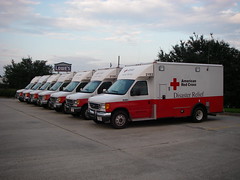
At my University there has been a Red Cross Club for a few years. And our local American Red Cross chapter finally discovered them. So I was there today at their second meeting of the year to talk about the Red Cross and the VA and volunteering off campus. I spoke about the things we do as emergency services volunteers, responding to fires, floods, hurricanes, storms, and so forth. Of Health & Safety, teaching classes. Of Service to the Armed Forces, of having others in my unit who were deployed who got the calls that they should come home while there was time. I suppose that this audience probably were more interested in this talk then my students in class are.
I started volunteering for the Red Cross when I was in college. I was a volunteer EMT, and since I was learning CPR, I also became an instructor. Our EMS organization taught classes on campus to university staff and to students (it was how the organization raised funds). And I taught classes in the community as an instructor for the Red Cross chapter.
I left that behind when I graduated and started work. Work and grad school just squeezed that out of my life for a while. Then when I went back to grad school for a PhD I started volunteering again, this time in emergency services. My degree was in modeling operations. The Red Cross gave me the opportunity to take part in operations.
It is not just that the Red Cross conducts operations. It conducts them under some of the most difficult constraints for operations. In disaster response, we do not choose the time, place or scale, and we do not get to choose who responds. Those who plan and run the operation work with the resources and personnel available at the time and place. The current classical situation is a hurricane. And to work in that setting competently, with the chaos of an unknown and uncertain situation where the pressure of people whose lives are at stake is a stress and challenge only matched by combat against a willful and capable opponent.
What to tell these college undergraduates that perhaps volunteering with the Red Cross or with Veterans Affairs is worthy of their time? I had three areas for them.
1. This was good and meaningful tasks. Granted, there were other opportunities for good and meaningful things that they will be provided on a college campus. With the Red Cross and VA staff and volunteers where people who have done things. At both, everyone there has had the experience of being in high stress situations and having to act and make decisions. Whether it is a Red Cross volunteer who is the team lead at a house fire where the family has no where to go, no food and only the clothes on their back, or the nurse who has had a patient crash, they would be with people who have experienced life and can get things done.
2. The Red Cross and the VA trains their volunteers. For those who volunteer over years, they will be trained to do their tasks, but also about dealing with people and dealing with life in all its aspects, both the good and bad. To recognize what is important and what is not.
3. I also told them that I was a professor. And that this semester, there is a group in my department whose senior design project is with the local Red Cross Chapter. Because the Red Cross and the VA are not just another charity or hospital, but they are organizations that reach out into their communities and interact with them in complex ways. And because of this someone with a little curiosity will quickly see there are many questions to be asked, ways of handling difficult issues to develop, and resource limitations that need to be dealt with. So I told them that I would like to see members of this club who volunteer with the Red Cross and the VA over the course of their college years to be doing senior projects, senior thesis and class papers based what they observed and did with the Red Cross and VA. So they can take what they are learning and put it in context with real problems effecting real people.
This fall, the first Pitt students have started volunteering at the VA under the Red Cross Veterans Affairs Voluntary Services partnership, after going through orientations in spring. This year, they are being introduced to the Red Cross and VA at the beginning of the year before they have settled into their routines. And these students will see a part of life greater then what they would get if they did not leave their campus.
Monday, September 20, 2010
Renee Fleming: The Inner Voice
This post was originally posted at the Pittsburgh Symphony Orchestra Blogs
The day before the opening Gala, Renee Fleming and Ann Pratchett had a book discussion at the O’Reilly Theater. It was an enjoyable conversation with two artists. They spoke of limits, of family, of talent. But what stood out, was they spoke that creating art is work.
Fleming commented that one thing that she dislikes is the belief that music is a gift, that one day someone opens her mouth and sings, then she is discovered, and then she goes to the Met. (Metropolitan Opera). Ann also has instances where people ask if she works. Because they are faced with the belief that talent is innate, it only needs to be found. But for both of them, this is not true. And it is not true in general.
Peter Orszag recently wrote two pieces in the New York Times about talent and effort. His observation that is shared by many others who have examined this (Michael Syed “Bounce”, Carol Dwed “mindset”, and others is that innate talent only gets so far, that to reach world class levels in a complex field takes practice. 10,000 hours of practice. It holds in music, mathematics, many sports, and chess. It shows in the dedication of young men and women in their teens who get up with the rising sun to practice, whether it is on the athletic field the weight room or in the studio. The students working their way through problems and proofs. My friends in martial arts working on their kata. Soldiers and FBI agents working through battle drills in the desert.
Fleming said at one point that when learning a part, it is not enough to know the words and the music, then you need to learn the meaning. And then, when you know what it means and you know it well, you are able to do more then follow the score and you are able to interpret or try new techniques to make it your own. The same is in other fields. Through practice the athlete learns the limits of her body and strength. The chess or go player can recognize patterns on the board and see the progression of the game. The soldier knows his role on his team and the overall intent of his commander even when he is unable to communicate with them. The mathematician or scientist or engineer can look at a problem and recognize what the form of the solutions or results will be even before she begins the work. Authors and writers can see how a turn of phrase can change the tone of a work. All this comes not from some gift of birth, but time and effort in practice and study, purposeful and directed effort.
The thing is, somehow one has to be convinced this is worth the effort. If you are good, you will be around people who are even better. And you will be working on things beyond your ability. And here you have a choice. You can decide you are good enough and stop. You can give up because it is too hard. Or you can look ahead and decide that it is worth the effort and pain of work to master your art. And the rewards? While Renee Fleming stated that her goal when growing up was to be good at something and it did not have to be music, I am glad that it was.
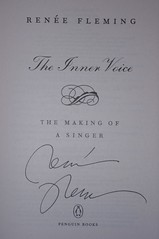
The day before the opening Gala, Renee Fleming and Ann Pratchett had a book discussion at the O’Reilly Theater. It was an enjoyable conversation with two artists. They spoke of limits, of family, of talent. But what stood out, was they spoke that creating art is work.
Fleming commented that one thing that she dislikes is the belief that music is a gift, that one day someone opens her mouth and sings, then she is discovered, and then she goes to the Met. (Metropolitan Opera). Ann also has instances where people ask if she works. Because they are faced with the belief that talent is innate, it only needs to be found. But for both of them, this is not true. And it is not true in general.
Peter Orszag recently wrote two pieces in the New York Times about talent and effort. His observation that is shared by many others who have examined this (Michael Syed “Bounce”, Carol Dwed “mindset”, and others is that innate talent only gets so far, that to reach world class levels in a complex field takes practice. 10,000 hours of practice. It holds in music, mathematics, many sports, and chess. It shows in the dedication of young men and women in their teens who get up with the rising sun to practice, whether it is on the athletic field the weight room or in the studio. The students working their way through problems and proofs. My friends in martial arts working on their kata. Soldiers and FBI agents working through battle drills in the desert.
Fleming said at one point that when learning a part, it is not enough to know the words and the music, then you need to learn the meaning. And then, when you know what it means and you know it well, you are able to do more then follow the score and you are able to interpret or try new techniques to make it your own. The same is in other fields. Through practice the athlete learns the limits of her body and strength. The chess or go player can recognize patterns on the board and see the progression of the game. The soldier knows his role on his team and the overall intent of his commander even when he is unable to communicate with them. The mathematician or scientist or engineer can look at a problem and recognize what the form of the solutions or results will be even before she begins the work. Authors and writers can see how a turn of phrase can change the tone of a work. All this comes not from some gift of birth, but time and effort in practice and study, purposeful and directed effort.
The thing is, somehow one has to be convinced this is worth the effort. If you are good, you will be around people who are even better. And you will be working on things beyond your ability. And here you have a choice. You can decide you are good enough and stop. You can give up because it is too hard. Or you can look ahead and decide that it is worth the effort and pain of work to master your art. And the rewards? While Renee Fleming stated that her goal when growing up was to be good at something and it did not have to be music, I am glad that it was.
Sunday, September 19, 2010
Why I enjoy classical/concert music
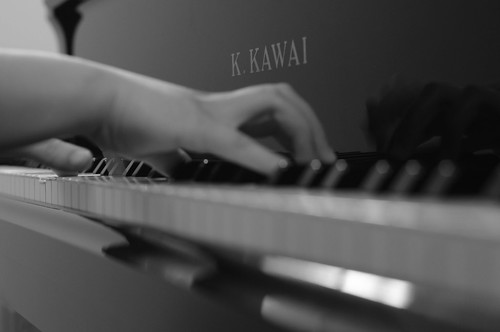
This is, obviously, a badly titled post. Because 'enjoy' is not the proper word. Not that there is anything wrong with merely enjoying something. I believe that there is a place in life for things that can be enjoyed as they are. But I don't think that 'enjoy' or 'appreciate' conveys how I experience concert music. There is a cliche that those with mathematical backgrounds should enjoy classical music because music, like math, deals with patterns. But that does not get you very far. By the end of chapter 2 of his Critical and Historical Essays (lectures on music at Columbia University), Edward MacDowell shows examples of what happens when you take mathematics as the means of analysis of music, and each historical case of cultures that try it leads to dead ends.
When I was in high school, the smart kids, the ones in the honors program, took Art Appreciation. I was not one of those kids. To this day, I say I know almost nothing about art/music history or theory. My experience with music was playing in the high school marching and symphonic bands. While I was good enough to be first chair my senior year, and being part of the Chicago All-Catholic Band, our ambitions were suitably limited (the bandmaster considered part of his job to be dissuading students from the profession.) The goal there was an appreciation of music, and perhaps a life-long hobby (e.g. community ensembles or playing in private). This is where I was when I lived around Washington DC, where I took advantage of a wealth of performances in public spaces (museums, parks, public buildings, university) and the occasional concert. And I continued my practice from when I was an undergraduate of going to performances of friends who were in music programs at the local universities.
In graduate school this began to transform. I had friends in the music program, but now I was at a school with a decent music program, where students there had aspirations of professional careers in classical music. I was going to recitals, concerts, and programs where my friends were performing on a regular basis. And, since I was taking my time in a Ph.D. program, I could follow them throughout their time in school, and I could watch how they developed both in performances and sitting in on practice time. (I had one friend comment that having me in the room while she was practicing was like a studio session. My wife thanks everyone for the training as she is the current beneficiary of all of those sessions.) Over time I stopped merely hearing the music to listening for the interpretation. Instead of appreciating the music being played, I could observe how an ensemble interact with each other and it became a conversation between people, not only the genius of the composer putting notes on a page.
What do I gain? Like all of the other fine arts, classical music is an abstract way of asking what it means to experience being human. At times composers use it to respond to a historical context. Most composers chose to create a tension by using a format to constrain themselves as they desired to emote or to present a story. (I tend to not get many of the more free form moderns). And I take it as a privilege to observe the result.
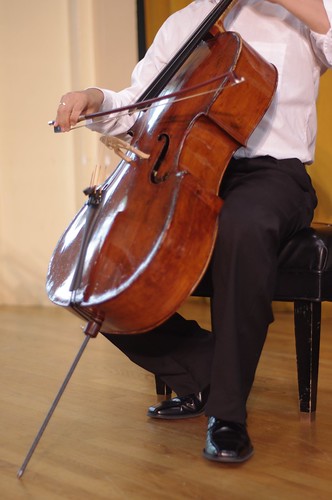
I am looking forward to another season of blogging for the Pittsburgh Symphony Orchestra. I have always maintained that my blog is not a concert review. The Post-Gazette has someone who does that as well as people associated with the schools of music and conservatories. Many with backgrounds in the humanities can discuss what a piece means. And I know little about the mechanics or history or philosophy of music. What I can do is pay attention to the concert and react to it. At a book discussion prior to last weeks opening gala, Renee Fleming stated that her performances where a collaboration between the creator (composer) and the performer. But she is missing an actor. Aaron Copeland stated that art is a collaboration between the composer, the interpreter, and the listener. Copeland tells the listener his job is to be aware of the personalities and functions of the composer and interpreter, to distinguish between them. And it is not sufficient (or maybe not even necessary) to be educated and trained, but the listener must love music. And not just particular styles or forms or schools of music, but across a wide range. And then react to it. Otherwise the efforts of composer and interpreter do not have meaning. I do my part.
Tuesday, September 14, 2010
Creating spatial data files
At my school, there is a class on Geographic Information Systems (GIS). When you complete the class, you now know how to analyze data using ArcGIS. But you do not know how to create the data files you used. And you do not know how to do anything that ESRI did not include in ArcGIS. As a researcher, I find that unacceptable. This year, there is a senior project team including someone who has taken this class doing a project with the local chapter of the Red Cross that will involve using spatial data. But since they cannot create a spatial file, I will create the data sets that they will use to populate their models. If I am going to do something, I may as well learn something along the way. Those somethings are Spatialite and Google Maps API for geocoding.
# get api_key from http://code.google.com/apis/maps/signup.html
Step 1. Given a list of addresses, find their latitude and longitude. The official way to do this is to get the TIGER line files of street maps. These encode each block by name and the end points of addresses for each block along with their geospatial coordinates. Then you can interpolate. The more pragmatic way of doing this is to find someone who has already processed the TIGER line files and created an API or other interface to work with them. There are many that will then create Keyhole Markup Language (KML) files as output, and I have used one before.
The way I will do it is to use the Google Maps API. There is a Python package called googlemaps that will find lat/long given a properly formulated address. (note: long is a keyword in Python, so we use lng for longitude)
from googlemaps import GoogleMaps
def getlatlong(gmaps, streetaddress, city, state, zipcode):
address = streetaddress + " "+ city + ", "+ state +" "+ zipcode
lat, lng = gmaps.address_to_latlng(address)
return lat, lng
api_key = "APIKEY"
gmaps = GoogleMaps(api_key)
. . .
lat, lng = getlatlong(gmaps, streetaddress, city, state, zipcode)
Step 2. Create an Spatialite database. Spatialite is the SQLite database with extensions for Simple Features for SQL, i.e. a relational database that allows for queries on geometric objects. The other options are Oracle Spatial, DB2 Spatial, PostGIS and MS Server with spatial extensions. There are also spatial extensions to MySQL, but they do not meet the SFSQL standard, and they are simplistically implemented (which would lead to many errors if you actually needed correct answers instead of approximations.) Of these, Spatialite does not require an administrator and contains its data in a single file, both of which simplify their use. To use Spatialite, the PROJ and GEOS libraries should already be on your machine. (see Spatialite installation instructions)
To create a database, use spatialite the same way as you would have used sqlite. But after creating the database, load init_spatialite.sql This SQL file loads some required tables. Sometimes, Spatialite will create the tables on its own, but sometimes not (especially if the database was originally an SQLite database).
Next, load the data (using any of a variety of different methods for SQLite databases.) Given address data, determine lat/long and enter each of them into their own fields. (you probably have to create these fields after importing the address data.
Step 3. Create the geometric representation of the data. What makes data spatial is the connection of a geometric representation of the data and the information about the spatial object. Before you do this, it would help to look at other datasets you are using. Spatial data is usually distributed as ESRI Shapefiles. Each Shapefile is actually a collection of files that include the polygons of the geographic objects, the data associated with those polygons, and a projection that describes how to make a representation of a surface of a sphere into the two dimensions of the computer screen (or piece of paper). The projection of a shapefile is usually found in a *.prj file in the same directory as the *.shp file. Most GIS viewers allow you to look at the shapefile properties from within the GIS viewer. The value needed is an SRID, usually a 4-digit number (sometimes 5). From here, a set of spatial queries are run from within Spatialite to add the geometry to the database. See prior post on loading lat/long data in Spatialite. When these spatial functions/queries are run, Spatialite will perform a series of operations that use the information in tables loaded by the init_spatialite.sql to generate the geometry representation or convert representations between projections. At this point, the data is now spatially enabled.
Step 4. View/Export. At this point, only a few GIS viewers can use Spatialite databased directly. One is QGIS. So after performing any wanted spatial queries or other operations you should export the data to another format, such as Shapefiles. The OGR/GDAL tools of the Geospatial Data Abstraction Library are able to do this. Within Spatialite you can use the .dumpshp function to create a shapefile.
The format of .dumpshp is
.dumpshp table Geometry sitelocations CP1252 POINT
table is the TABLE to be exported. I think this could have been a VIEW as well. Geometry is the name of the field within the table that has the geometric representation. Note that Spatialite stores this as a BLOB object. sitelocations is the name of the shapefile to be created. CP1252 is the name of a character set. Presumably there are others, but I have been using CP1252 for now. POINT is the spatial data type. Other types include LINESTRING, POLYGON, and MULTIPOINT.
What would be very useful right now is if I could automate steps 3 and 4 so I could run them from within Python instead of doing them inside Spatialite. However, this only works if SQLite was compiled with the ability to load extensions. Most distributers do not do so. One workaround is to install the pysqlite2 extension and compile it so that it can load extensions (as opposed to using the sqlite3 extension that is included in Python).
Sunday, September 12, 2010
Why I run
(and hike and camp and . . .)
"Short cut this way" - spectator sign at 2004 Chicago Marathon
"No short cuts" - 2004 Chicago Marathoners cry on seeing the sign
There are lots of reasons to promote running. Fitness. Competition. Glory. Euphoria. Myself, after 20 years of running I'm not going to turn heads by my fitness. The only races where I've gotten prizes are races where noone serious shows up (don't laugh, it has happened. The funny thing, I was teasing the eventual winner about it before the race). And I don't get euphoria from just running any more (ok, maybe if there is a real good hill. Note: my idea of a real good hill is one that a car cannot drive up.)
But what I do get is connect to reality. My profession is one of abstraction. How to make an abstraction of our world so we can understand it better. But, as I had to explain to one of my students, when you are faced with an actual instance, there is no need for abstraction. In running, hiking, camping the road, trail, hill, stream, field is present with you, and you have to deal with it as it is. Heat, water, cold, ice, rain, snow, hazards, obstacles, are things you face. The constraints of fuel, food, water and the limits of your body, skill, knowledge and training have to be considered before you start, and their effects have to be dealt with. Preparation matters, and you pay a price if you skimp. There are real hazards. I've written journal entries for the purpose of informing whoever discovered them. I've given reports that a trail was hazardous and should have been closed.
But what I do get is connect to reality. My profession is one of abstraction. How to make an abstraction of our world so we can understand it better. But, as I had to explain to one of my students, when you are faced with an actual instance, there is no need for abstraction. In running, hiking, camping the road, trail, hill, stream, field is present with you, and you have to deal with it as it is. Heat, water, cold, ice, rain, snow, hazards, obstacles, are things you face. The constraints of fuel, food, water and the limits of your body, skill, knowledge and training have to be considered before you start, and their effects have to be dealt with. Preparation matters, and you pay a price if you skimp. There are real hazards. I've written journal entries for the purpose of informing whoever discovered them. I've given reports that a trail was hazardous and should have been closed.
I think we live in a society that likes to ignore reality, preferring to view perception as more important. And they can use power derived from fait, moral righteousness or power to enforce their views. But that does not count when it is you, your fitness, skill, training and nature. And I like having one part of my life where that is unambiguously true.
Monday, September 06, 2010
Loading Lat/Long data into Spatialite
The task: Load spreadsheets with Longitude and Latitude data into a spatial format. Preferably in a way that can be done by people who are not good programmers but can follow directions to use command line tools.
Initial data: Spreadsheets with addresses and Longitude and Latitude. Note: this can be created using the Google Maps API accessed through various programming interfaces.
Tools: Spatialite and SQLite Manager (Firefox plug-in)
Steps:
- Save spreadsheet as a comma separated format
- Import into SQLite using SQLite Manager plug in
- Open Spatialite using command line interface.
- Add the geometry to the table using: SELECT AddGeometryColumn('addresstable', 'the_geom', 4326, 'POINT', 2);
- Note that 'addresstable' is the table within the database that contains the long/lat data. 'the_geom' will be the new field that contains the spatial data. 4326 represents the SRID for the projection to be used (in this case WGS 84). 'POINT' is the spatial data type. 2 indicates this is in a 2-D space.
- Calculate and insert the spatial data using: UPDATE 'addresstable' SET the_geom = GeomFromText('POINT('||Longitude||' '||Latitude||')', 4326);
- Longitude and Latitude are the field names containing the longitude and latitude data in the table. The names do not matter. But they order does. And they are separated by a single space.
- Method is taken from PostGIS in Action by Obe and Hsu. Spatialite function names are similar to PostGIS function names. In many (but not all) cases, the 'ST_' is removed from the beginning of the function name. Note that for the exceptions, the Spatialite documentation references two function names, one without 'ST_' and one with.
Sunday, September 05, 2010
Why I am a photographer
I have had a wide range of hobbies, as does most people over the course of their lives. And like most, many have gone by the wayside. I think one aspect of maturity in a hobby or an activity is that you are no longer merely an actor performing techniques, but you either guide others (through teaching or through organizing a community) or you are pushing yourself in the practice of the art. In photography, this observation comes through in the form of commentary on digital cameras, especially digital SLRs. One big criticism is that the advertising around cameras fosters a view that being a good photographer was only a matter of a big (and expensive) camera and big (and expensive) lenses, completely neglecting the elements of skill and practice and understanding of light.
I started photography with a manual SLR. Center-weighted meter, manual focus, manual aperture, manual shutter speed. After that was a point and shoot. An Olympus Epic known for its good 35mm f/2.8 lens and being a hockey puck (indestructible). It was a few years before I even bought my first auto focus/auto exposure camera. Continuing my ways, my favorite camera was a manual focus, manual exposure rangefinder (i.e. what cameras were like before SLR was invented). This was characterized by fast (wide aperture) prime (non-zoom) lenses and frequent use of black & white film. Also known as "this is how Cartier-Breeson and Capa did it"
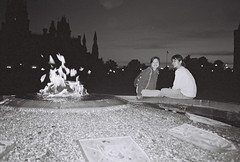
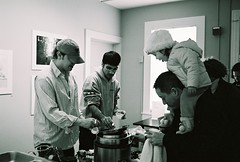
Part of being good is taking time to learn the fundamentals. Learning the ways of light and shadow. The limits of the sensor (film or digital). How to see relationships in a scene. How to see a relationship unfold so you can be ready at the decisive moment.
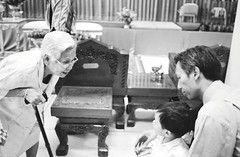
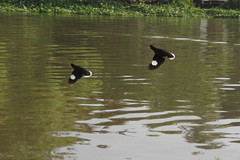
My investment in equipment pales in comparison to the investment in study and practice, and I like to think that it shows.
For my involvement in the arts, photography is my only practice of it. So to improve means to find ways of improving your skill. And one of the classical ways of developing creativity is to put in place boundaries that force creativity in other ways. Thus my preference for using prime lenses and black & white. It becomes the frame in which I develop. And the expectation is that when I do use color and zoom lenses, the skills and ability to see that is developed carry over.
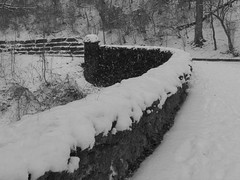

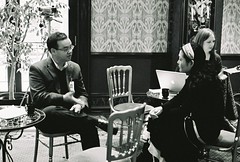
Like many things, I have adapted as the technology behind photography has changed. My rangefinder is now rarely used, since the chromonegative film I had always used is no longer available. I now have a digital SLR and a set of zooms. But the manual focus primes are still what I take most of the time and that goes well with one of the smallest APS digital SLRs on the market. Most of my photography is not intended to push my abilities, but to record the events of life.

I started photography with a manual SLR. Center-weighted meter, manual focus, manual aperture, manual shutter speed. After that was a point and shoot. An Olympus Epic known for its good 35mm f/2.8 lens and being a hockey puck (indestructible). It was a few years before I even bought my first auto focus/auto exposure camera. Continuing my ways, my favorite camera was a manual focus, manual exposure rangefinder (i.e. what cameras were like before SLR was invented). This was characterized by fast (wide aperture) prime (non-zoom) lenses and frequent use of black & white film. Also known as "this is how Cartier-Breeson and Capa did it"
Part of being good is taking time to learn the fundamentals. Learning the ways of light and shadow. The limits of the sensor (film or digital). How to see relationships in a scene. How to see a relationship unfold so you can be ready at the decisive moment.
My investment in equipment pales in comparison to the investment in study and practice, and I like to think that it shows.
For my involvement in the arts, photography is my only practice of it. So to improve means to find ways of improving your skill. And one of the classical ways of developing creativity is to put in place boundaries that force creativity in other ways. Thus my preference for using prime lenses and black & white. It becomes the frame in which I develop. And the expectation is that when I do use color and zoom lenses, the skills and ability to see that is developed carry over.
Like many things, I have adapted as the technology behind photography has changed. My rangefinder is now rarely used, since the chromonegative film I had always used is no longer available. I now have a digital SLR and a set of zooms. But the manual focus primes are still what I take most of the time and that goes well with one of the smallest APS digital SLRs on the market. Most of my photography is not intended to push my abilities, but to record the events of life.
Thursday, September 02, 2010
Why I read
 Ruined by Reading: A Life in Books by Lynne Sharon Schwartz
My rating: 2 of 5 stars
View all my reviews
I recently went to my first meeting of a book club. The last one I was with slowly faded away, as such enterprises do. For the new one, this was its second meeting of its existence. Which is a milestone. If nothing else it means that one group of strangers did not repulse each other away and they thought it was worth meeting again. It does seem odd that less than two months before a baby arrives I am meeting new people. But I was not alone, as one guy there is a new father as well. The book we read this month was fairly unremarkable. But its subject is the place reading has played in the life of the author. Most of the book focuses on the author as a young girl. And for an author to examine the place of reading in her life is a bit of navel gazing.
So, why read? There are many arguments not to. I know many people who state that they do not read fiction, only non-fiction, viewing all fiction as fantasy and a waste of time. Various books get branded as out of bounds or satanic. Of course, many of these same people invest time in video games, shopping, and other arguably non-productive hobbies and pursuits which I do not. I also can say, as my wife would put it, I have actually done a lot of these things in real life, so living vicariously through reading is not strictly necessary.
What reading provides is a way of making my world larger. I joke that the reason I listen to people telling stories and lessons learned is that I want to hear others talk about how things went wrong. Because I am a very creative person and I want to make mistakes that are unique. Mark Twain in "Taming the bicycle" discusses learning through one's experiences only as misleading, since you don't know if what aspect of your experience provided the right lesson.
Fiction does the same. What good fiction should do (and I hold movies to the same standard) is develop a world, and provide situations for its characters to engage in the three major conflicts: man against nature, man against man and man against self. Given the setting (I always give authors and writers great leeway in how they make their setting, since real life is pretty varied as well), do the choices and consequences of the characters make sense. (again, realizing the wide range of responses people in the real world use, there is a certain amount of range available here too.) Every (good) book adds to my world, and provides a base that I take with me in engaging my world, in all of its messiness and occasional perversity. And ways of describing my experiences to others (I write a lot of after action reports and meeting notes)
Is it worth reading and talking about it with other people? Like many things, reading is a skill. There is a benefit to testing your ability to observe and synthesize with other people who also had the same experience (reading the same book). It is a given that everyone will take away different things from a book (which is not to say that the takeaway needs to be anything profound or deep), but you should at least recognize each others observations of action, character, and motivations.
But the main reason I read is that it makes my world larger. And richer. And we look forward to our son doing the same.
Monday, August 30, 2010
Why I am a researcher
I was asked yesterday about the value of a Ph.D. It is a fair question. When I was in graduate school, occasionally a first year student would say something to the effect that he was in grad school because he wanted to make money. We all informed him that he assuredly had the skills to do very well, with an MBA (equivalent) from the excellent business school down the block at our university. And that he would make more money for considerably effort then the road that he was starting on. I did not start my professional life as an academic, so this is a question that in a sense has an answer.
After I finished college I went to D.C. to a policy school for a professional master's degree and to work. (because all Master's in policy students usually work while in school). Over the next four years I worked for a legislature, a non-profit, a government agency and at a government contractor. I did this as a quantitative analyst and as a logistician. And it was fun. I worked on environmental studies and projects that were at the cutting edge of applied economics and modeling. There is work I did that I could see in the news over a decade later as they came to fruition or the issues they addressed began to be considered by commercial enterprises. I had few projects that were routine. There was always the sense that you were developing something new, and while there may be ways to do that, what you would find along the way was not always obvious in foresight.
But I also realized that the only reason I was working on these projects was because of my boss(es) along the way. And this is not what work would always be like. Looking ahead, I realize that there were really two ways to have a career doing new things like this. One was to work for twenty years and establish yourself at the top of your field (like my last boss). The other was to get a Ph.D.
And this was the value of the Ph.D. Not the knowledge gained along the way, but the opportunities to work on things that were new and hard. At one meeting with non-researchers I've explained I do not want to be working on problems unless someone else has examined it and failed to find a resolution. And at this time, I can say I have this. Will this continue? As a non-tenure track academic I have a good place working on difficult applied problems, where there are both technical and social issues that need to be solved (as I've commented to one doctor, if the social issue is what is preventing the situation from being resolved, it is an issue that needs to be solved.) Is there a place long term for this? One of the criticism of academia is that it focuses on problems that are theoretically hard rather then hard in practice, even when the reason it is hard in practice is because of the lack of development in theory. In Operations Research, there is pride in working on hard problems, but the definition of hard is based on the technical difficulty of the math, while I tend to use the definition that smart and talented people have tried and failed as my benchmark. Whether there is a place for that remains to be seen.
Monday, August 23, 2010
Why I ____
I remember an article and conversations some time ago asking the question which is harder: Marriage or Motherhood? Replacing 'Motherhood' with 'Parenting', I think both of us have the conclusion that given how easy Marriage has been, we are going to come on the 'Parenting is harder' side of the argument. Even though we are not among those people who knew each other for many years, joining lives was not a big adjustment, partly because our lives were (and are) in the midst of ongoing changes so it was more of merging of two moving highways then big changes. And we both have well exercised sharp elbows. At least neither of us ever picked up the habit of hiding sharp elbows until the worst possible time. (or hiding them at all)
People who rhapsodize over marriage or parenting have tended to make both sound very unattractive. Both criticize those who have not yet joined them as selfish (I sometimes wonder if my friends who criticize their unmarried peers as selfish but do not have kids hear the criticism that those who are married without kids are being selfish.) Both describe the life post-marriage/parenthood as a dying of self and life and the parts of life that are interesting. And the wonderful alternative presented is often something unappetizing. A life without flavor. We've been glad that this has not come to pass in marriage, but parenting looks a little more problematic. To use vocabulary one mother used, working with the things that come in marriage involved skills and attitudes that were already part of our operating systems. We're not sure that Parenting is. One person who was ready to provide wisdom asked us the question "Are you ready? Most people are not sure they know how to raise a child before their first" Our answer was "Of course not! We're pretty sure that after our first child we still won't know how to raise a child."
The other problematic side is the reality that some aspects of our lives will fall away or change markedly. We are fortunate that we have many examples of people who did not disappear off the face of the earth when they had children, and so we think there is hope.
But, as I tell my graduate students and the post-docs I work with, the reason I write such detailed messages is because I have no memory. And while I still have a nice record of photographs, I do not live life through a viewfinder (and I never will). So to remember, I have to write it down. And so I won't loose it, I am putting my faith in Google (and maybe a printout) as a place of record. So begins a series of notes on the various aspects of my life now. And in a few years, I may look back on it fondly (or not) as we bring a child into this world and all that is before us.
Friday, August 20, 2010
WinBUGS and JAGS differences
One of my graduate students and I have been working on input modeling in a setting where the amount of historical data can range from a lot to almost no (i.e. 0, 1, 2) occurrences. So both of us have been learning Bayesian methods and developing means to work with our setting. Part of this involves working with the standard tools and building blocks for Bayesian methods, in particular Monte Carlo Markov Chains (MCMC). To implement these methods, you can program your own, or use some standard modeling frameworks. Some of these frameworks are essentially programming libraries. But the primary ones are Bayesian inference Using Gibbs Sampling (BUGS) derivatives. There are two families: WinBUGS/OpenBUGS and JAGS.
WinBUGS is the direct successor to BUGS, with OpenBUGS being the open source next generation. BUGS is both a software package as well as a model specification language for MCMC models. One issue with WinBUGS/OpenBUGS is that it is written in Component Pascal. WinBUGS depended on the BlackBox component builder, which is only available in MS Windows (as does OpenBUGS, but OpenBUGS is essentially the open source next generation of WinBUGS once it is done). JAGS is an opensource implementation of the BUGS model specification and command language and is written in C++ on top of some open source libraries. JAGS exists specifically because of the inability to port WinBUGS. A review of the literature shows that WinBUGS/JAGS/various other libraries, all have areas of strength and weakness. Research groups working extensively with Bayesian methods use all of the them at various times.
But, this is our first project. So one thing we did was to examine three frameworks while we were learning Bayesian methods. I primarily used JAGS, one graduate student worked with WinBUGS, a third graduate student (the strongest programmer) used MCMCpack (an R package).
Our intent was to use either WinBUGS or JAGS when we actually implemented our methods on real data, so the question was which to use. Some obvious differences that came up.
- When running using R, the RWinBUGS interface opens the WinBUGS application to run BUGS model. We anticipate having to run this on ~50 separate data sets a day as part of our methodologies. This time of interface is unstable (both theoretically, and practically as my student's computer ends up hanging a lot)
- WinBUGS is a lot more particular about the BUGS model specification. Or, since the WinBUGS people are the ones who developed the BUGS model specification, it is probably better to say that JAGS is much more forgiving. Some gotchas that came up included:
- When specifying distributions, parameters in WinBUGS could not be expressions. Only single variables. I.e. something like (num1*num2) is not allowed. So we have to perform all computations, then specify the distribution separately. JAGS allows passing an expression as a parameter.
- WinBUGS does not have an exponent operator (either '^' or '**') JAGS does. Since one parameter that is important and common is 1/variance, this is very useful when the data is expressed in terms of standard deviation. We have to use expressions like (num1*num1) all over the place.
- JAGS from R is seamless (R2jags, rjags). You call JAGS, and it returns without opening any IDEs. You can see the JAGS output in the terminal, but JAGS runs in command line, then is done. No IDE left to close. (R2jags was designed to work the same way as RWinBUGS, but I think it is much more elegant)
- The JAGS documentation includes some more differences, but we have not hit those yet.
Thursday, August 05, 2010
Book review: The Visual Display of Quantitative Information by Edward Tufte
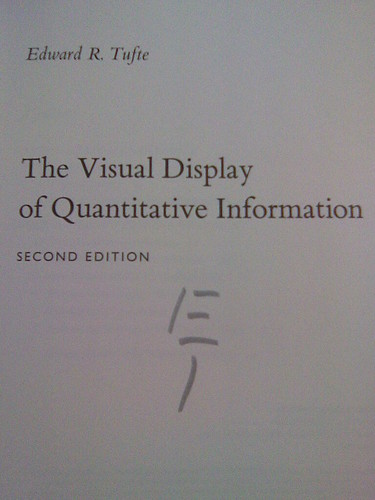 by Edward R. Tufte
My rating: 4 of 5 stars
The book goes through many examples of displaying information visually. And it does so through a historical context, reminding us that the issues that are faced and the many ways to (mis)-represent them have been around for centuries.
What I'm reminded of is that statistics and data analysis is not just about methods, but they are means of communication. And like all methods of communication, they can be made less clear whenever you have something other than clear communication as the goal.
Many of the techniques discussed in the creation of various plots and charts are artifacts of when printing graphics was done by ink and pen, and difficult to reproduce. But the book's focus is not on the techniques of making these visual displays, but on the principles in designing efficient displays.
I use a number of data analysis packages and packages, Excel, R, Python, etc. After reading this it makes me look at these other packages and their options differently, wanting to evaluate the choices there designers made. It also makes me look at charts and graphs on internet sites, newspapers and magazines differently. I imagine the author would consider that to be a success.
View all my reviews >>
Friday, July 30, 2010
Five factors that make a job dangerous
From a recent presentation by K. Emmerling to Southwest PA (Pittsburgh) Red Cross Disaster Volunteers on dealing with difficult people
- You work with the public
- You work after midnight
- You handle money
- You work alone (or are the ranking person present)
- There are weapons present
The presenter then worked through a quick narrative that explained that in the course of regular duties as Red Cross Disaster Volunteers, all five are present. Those present had numerous examples of social situations that occurred on duty that had potential to escalate.
Stay safe everyone.
Thursday, July 22, 2010
Looking at source code version control: Comments wanted
I've been investigating version control systems for use by a team. Is there anyone who uses these who can have some comments? I'm leaning towards Mercurial, but I am open to change (our best programmer likes Git). What follows are my notes on some version control systems. Note: While I personally like/use Linux, as a team we are being provided with Windows machines for this project. Based on my review, I'm only looking at Subversion, Mercurial and Git. Comments and experience would be helpful.
=====
Version control systems (VCS) are used to track historical changes to source code (text) files as well as a means to enable collaboration between team members working on a single project. Note that this can be for any text based project, both programming or LaTeX writing. There are 2 major advantages:
- Rollback: It is possible to retrieve the version of a file at any point in time. This is especially useful when one is exploring a new idea that ends up not working (or has introduced a bug or error into a program/file) (Note: Apple Computing advertises this feature in recent versions of Mac OS X as the "Time Machine", which is essentially version control built into an operating system).
- Collaboration: In the case of multiple people working on a different parts of a single project, changes that are made by one person can be committed to a shared repository, then distributed to all other team members. This results in a definitive version of a system, even as multiple team members are involved in ongoing work on their own parts of the system. Is it does so, version control can keep track of the changes, so that if a change is determined to cause problems and needs to be removed, it can be removed for everyone (or only on an individual's local version as needed)
There are two major categories of modern version control system: Centralized and Distributed
Centralized version control requires the use of a server, and all team members can update or branch using the centralized repository. For distributedversion control, all team members have a local version of source code repository, that can be synchronized to a definitive repository as needed. Distributedversion control is a relatively recent development (
- Native availability under MS Windows (availability under UNIX/LINUX is true for almost all Version Control systems). Preferably without use of Cygwin or MSYS.
- Can be used through GUI - through the operating system file explorer or a stand alone GUI (all open source VCS enable command line use)
- Integration with IDE - Visual Studio, Eclipse etc (EMACS/VIM integration can be assumed for open source VCS)
- Documentation - Tutorials available for those learning the system with the expectation of infrequent use
- Existing support within ___
- Available for MS Windows, Linux, Mac
- Standard plugins for Visual Studio (http://www.visualsvn.com/visualsvn/) and Eclipse (http://subclipse.tigris.org/).
- TortoiseSVN (http://tortoisesvn.net/) is a standard gui that integrates into Windows Explorer (MS Windows) as a context sensitive menu (usually right-click on a file to see options)
- Requires server
- The O'Reilly Press Subversion book is available as a freely available ebook (http://svnbook.red-bean.com/)
- Many tutorials available
- Built on UNIX shell and Perl. For Windows, this seems to require that CYGWIN or MSYS be installed to provide UNIX shell services on Windows.
- Available for MS Windows, Linux, Mac
- Multiple plugins for Visual Studio (http://visualhg.codeplex.com/) and Eclipse (http://javaforge.com/project/HGE).
- TortoiseHg (http://mercurial.selenic.com/wiki/TortoiseHg) is a standard gui that integrates into Windows Explorer (MS Windows) or Nautilus (Linux file explorer) as a context sensitive menu (usually right-click on a file to see options)
- The O'Reilly Press Mercurial book is available as a freely available ebook
- Some tutorials available. http://hginit.com has an introduction to version control tutorial.
- Also http://mercurial.selenic.com/wiki/UnderstandingMercurial and a tutorial (http://mercurial.selenic.com/wiki/Tutorial) and a Quick Start guide (http://mercurial.selenic.com/wiki/QuickStart)
Evaluation
For evaluation purposes we will compare three systems Subversion, Git and Mercurial, each of which are open source (license allows for free distribution) and in widespread use including a number of high profile large projects.
Subversion - Centralized version control system http://subversion.apache.org/
Git - Decentralized version control system
Mercurial - Decentralized version control system
http://mercurial.selenic.com/
MS Visual Source Safe / MS Team Foundation Server / IBM Clear Case are commercial Centralized VCS systems that are often used. In corporate environments they are often mandated by upper management because of their connections with Microsoft and IBM. Comments from working programmers are near-universally derogatory. The complaints include too tight integration with other vendor tools (so if an environment is not in MS Visual Studio, it is very difficult to get it into VSS/TFS (e.g. LaTeX files) ) In addition, there are numerous complaints that the repositories are difficult to manage, to the extent that it seems to be very easy to corrupt a repository, (making it useless)
There are other open source and commercial VCS systems (e.g. CVS, Perforce, AccuRev, Bazaar). Subversion, Git and Mercurial were chosen as the comparison set because as a set they are consistently are viewed as superior to others in comparisons among VCS. Note that because distributed VCS is so new (2005), comparisons more then 2 years old should be considered obsolete.
Some references:
Overview of Version Control tools by Martin Fowler (writer and consultant on organizing programming teams)
IBM DeveloperWorks article on Introduction to Distributed Version Control Systems
Monday, July 05, 2010
How can you bring a life into this world?
I remember conversations about this when I was in Grad school (note: not with other grad students). While some of this may be just usual 20 something angst, at the time the local pastor was also proclaiming that our entire social circle were a group of social freaks. When God declares this view of you, a certain allowance of cynicism towards life and the world could be understandable.
Are there things to be depressed about? The candidate list is fairly long. Among the list of actions that I have engaged in that have been described as evil and/or warranting eternal damnation at one time or another include working in academics, deploying and working in a combat zone, work with the Red Cross, catching a falling hiker, organizing social activities (both with undesirables as well as including people I should not), associating with doctors, lawyers, police, diplomats, responding to calls for help, (list goes on. Note that no one person would hold the entire list against me, just their own selected parts as their moral authority deems fit.)
My wife and I have the fortune of knowing and counting as friends people with a wide range of history, interest and backgrounds. We know both the wealthy as well as those who have chosen to be simple. Those who are world class in their chosen pursuits, and others who may or may not have a college education. Doctors, lawyers, engineers, tradesmen and craftsmen who take pride in the attributes and high callings of their professions. Christian, Buddhist, Jew, agnostic and atheists. And for each of these, those who view those as moral inferiors.
As we have gotten older, we recognize that our group of friends, relations and acquaintances has been narrowing over the years. And we've been told that would be the case. But we have also hoped that we would maintain a range of friends. Because someday, we would be starting a family.
We get asked sometimes if we hope that our son will be just like us. Both of us say absolutely not. Because as much as we enjoy life, neither of us think you can ask someone to take the paths we've taken. While it is entirely possible that he may choose to take life in a similar direction, that may not happen. And we want people we know and trust to be companions along the way.
What do we hope that he learns? We hope that he learns that people are interesting and have stories that are worth getting to know. Deeply.
We hope that he learns that there is value in learning and understanding something deeply. To learn to recognize what good looks like in any field of endeavor, and that it is worth striving to meet that standard.
We hope that he learns to value the creative, the ones who find ways to do the difficult tasks that have never been done. We hope that he decides that difficult things are worth doing. And, if he is good enough, that difficult things are the things that are worth his time, energy and creativity.
Is this guaranteed? No. As much as we hold certain values, we are fully aware that we are around people who scorn those values. And our son will be exposed to them. And along the way he will choose. But we can ensure he knows the choice he makes.
In the end, the goal of life is not the avoidance of things that are bad, but the striving for the things that are good. Our child may not achieve all of his dreams and will experience pain, suffering and hurt along the way. But he can also make choices, that we hope are those that lead to things beautiful and useful. And the stories he will create along the way, and the stories we build with him are something worth looking forward to.
Friday, July 02, 2010
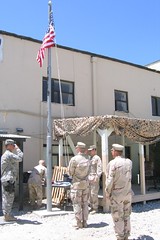
Flag raising July 4, 2007
So I reject the notion that the American moment has passed. I dismiss the cynics who say that this new century cannot be another when, in the words of President Franklin Roosevelt, we lead the world in battling immediate evils and promoting the ultimate good.
I still believe that America is the last, best hope of Earth. We just have to show the world why this is so.
- Barack Obama, September 2007
I still believe that America is the last, best hope of Earth. We just have to show the world why this is so.
- Barack Obama, September 2007
Monday, June 28, 2010
June 28, 2008
 |
| From Wedding Dancing |
I think that if we thought about it in a purely abstract way, neither my wife nor I would be inclined toward marriage. Most of what we have heard about marriage from those who claim it as wonderful did not have all that much appeal. Well meaning friends assured us that it would be the end of all the things that made life interesting. My wife was assured that I would settle down and become normal. And the idea that marriage would make either of us complete or whole or mean settling down was frankly horrifying. Because neither of us was done growing or exploring our world or changing.
But marriage, and relationships, is not something that is meant to be discussed in the abstract. I have held that discussions on relationships are only interesting when there are names involved. And when asked about how I knew that this is the person I want to marry, my response has been that it was not about who I was getting married to, it was what we would become and how we would get there. And that is what I was getting.
Married life has been surprisingly easy. One other person who had commented on married life being easy likened married life to moving furniture around in the house. There are changes in life, but they are minor compared to the steadiness of the foundation. In our case, it was like moving furniture around, but each of us would have been moving the furniture around anyway, and had considerable flexibility on different furniture arrangements. Marriage did not mean we had to stop growing, changing, or even reinventing ourselves along the way. Neither of us is the same person as when we started dating, or even when we go married. And we have not gotten bored.
Will it stay that way? The same person who described marriage as like moving furniture also described being a parent as tearing down and rebuilding a house while living inside it. Of course, I've done that before :-)
Strange how you know inside me
I measure the time and I stand amazed
Strange how I know inside you
My hand is outstretched toward the damp of the haze
And of course I forgive
I've seen how you live
Like a phoenix you rise from the ashes
You pick up the pieces
And the ghosts in the attic
They never quite leave
And of course I forgive
You've seen how I live
I've got darkness and fears to appease
My voices and analogies
Ambitions like ribbons
Worn bright on my sleeve
Strange how we know each other
Strange how I fit into you
There's a distance erased with the greatest of ease
Strange how you fit into me
A gentle warmth filling the deepest of needs
And with each passing day
The stories we say
Draw us tighter into our addiction
Confirm our conviction
That some kind of miracle
Passed on our heads
And how I am sure
Like never before
Of my reasons for defying reason
Embracing the seasons
We dance through the colors
Both followed and led
Strange how we fit each other
Strange how certain the journey
Time unfolds the petals
For our eyes to see
Strange how this journey's hurting
In ways we accept as part of fate's decree
So we just hold on fast
Acknowledge the past
As lessons exquisitely crafted
Painstakingly drafted
To carve us as instruments
That play the music of life
For we don't realize
Our faith in the prize
Unless it's been somehow elusive
How swiftly we choose it
The sacred simplicity
Of you at my side
- Eric's Song, Vienna Teng
Sunday, June 20, 2010
Rachel Carson Challenge 2010
Saturday was the 2010 Rachel Carson Challenge (notes from previous Rachel Carson Challenges are here). My partner in crime this time was SS, who decided this past winter when things were rather boring that she needed a hobby, and this need of a hobby led her to the Rachel Carson challenge. As usual, we did the series of training hikes (Hi Donna! Hi Bob!) that included wet days and hot days. (I missed the really hot sunny day, figures)
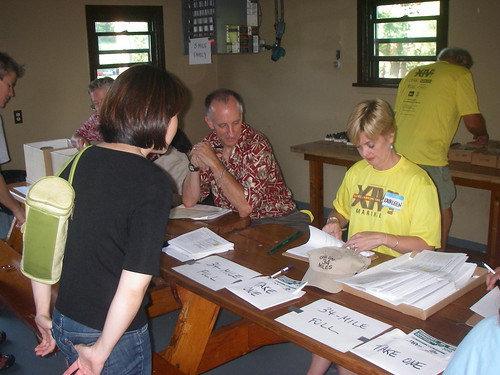
The challenge began with waking up at ~3 AM in the morning so we could catch the bus to Harrison Hills Park. And we did with time to spare before sunrise.
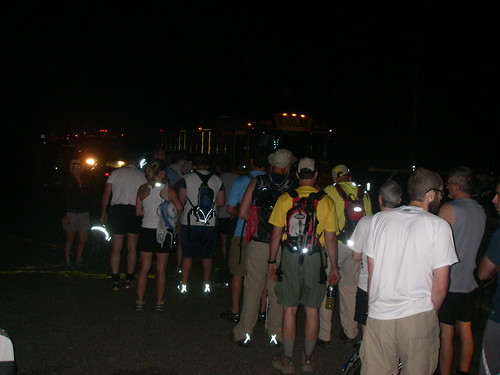
We raced through the first section, keenly aware that we wanted to cover miles before it got sunny. By the first checkpoint, everything was still sunny and good.
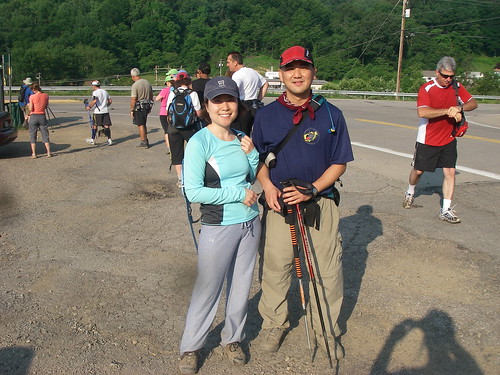
By the second checkpoint I was running into trouble. I had run out of water along the way, and the second checkpoint had run out of gatorade. (and forgotten my extra bottles of water in the kitchen on the way out the door) So by checkpoint 3 I was starting to dehydrate. Checkpoint 3 was a definite rehydration stop. I filled up my camelbak with gatorade with the goal of finishing it before I left while I was essentially eating lunch. In addition to the usual PB&J sandwiches, oranges, bananas, pretzels and chips there were salted potatoes. But I realized that I was not going to speed up anytime soon so SS found a group and went on ahead. I started from Checkpoint 3 and things got better for me as electrolytes were absorbed into my body.
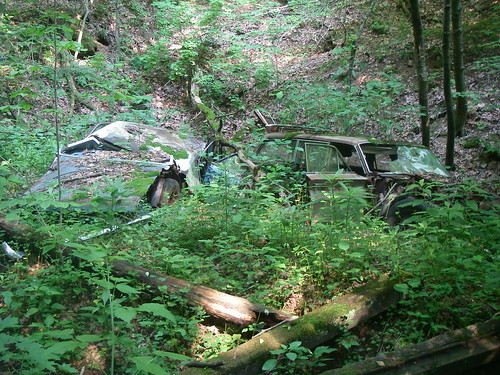
The Rachel Carson Trail is a connector trail. It connects a number of county and municipal parks in Allegheny County, starting in Harrison Hills Park and going through Agan Park, Emmerling Park, Hampton Community Park, and ending in North Park. (MapMyHike link). Allegheny County is an urban county (includes Pittsburgh, PA) so to connect all these parks means that there is substantial private property and hiking along roads along the way. There are numerous hills (i.e. too steep for building roads or houses) and streams without bridges on the trail.
By checkpoint four, I was feeling pretty good. And I had four hours to go the last 8.2 miles. No problem. But the clouds were rolling in. And about an hour after I left checkpoint four it started raining. And heavily. And thunder. I found a group that was working through Hampton Community Park together and we made it across Route 8 together. Then the trail started to follow Pine Creek. And by follow I mean we had to cross it. Five times.
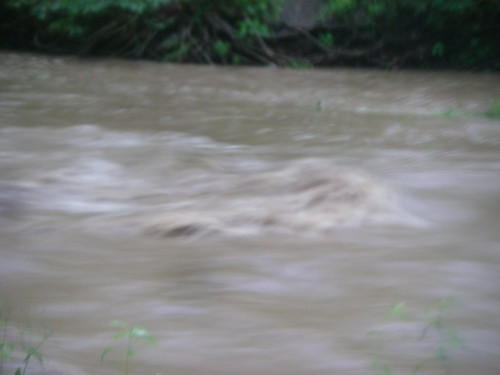
The creek in the areas we had to cross it ranged from 20 to 30 feet across. While normally it is a shallow gravel stream bed with water about an inch above the gravel, that day after the thunderstorm it was a raging stream thigh deep. I hooked up with J and J from our little group and we crossed the streams together, holding arms to keep each other from being knocked down and dragged by the current.
After this major adventure, we reached North Park. There were four relatively easy stream crossing (much higher than normal, but by this point they were easy), and then the trail went up and into the park proper. A couple miles here and on to one last stream crossing and to the finish at Beaver Shelter.
Why do something like this? Like a t-shirt says, it is called the Rachel Carson Challenge, not the Rachel Carson Walk. It is a challenge. And like anything worthy of the name, it is hard. I tend not to be a competitive person by nature, but I am drawn to things that are hard.
There is also the inherent honesty and reality to such things. You are dealing with nature in a raw and unforgiving form. Heat, sun, dehydration, nutrition, physical limits, water, streams, hills are real. There is no recourse to decisions made by authority that is granted by God or Man. There are people who believe that perception is reality. And on a trail such as this, even in the urban area of Pittsburgh, that is wrong. Perception is not reality and believing otherwise can get you killed. Reality is reality, and there are enough people who believe otherwise that a challenge like this with people who recognize this is a wonderful experience.
Many thanks to SS, for being a wonderful training and hiking companion. Donna, Bob, Mark and many other volunteers for your work (including washing everything today [Sunday]) J, J, E and KB3OGS for being companions along the way. And looking forward to the next challenge. As a volunteer.
The challenge began with waking up at ~3 AM in the morning so we could catch the bus to Harrison Hills Park. And we did with time to spare before sunrise.
We raced through the first section, keenly aware that we wanted to cover miles before it got sunny. By the first checkpoint, everything was still sunny and good.
By the second checkpoint I was running into trouble. I had run out of water along the way, and the second checkpoint had run out of gatorade. (and forgotten my extra bottles of water in the kitchen on the way out the door) So by checkpoint 3 I was starting to dehydrate. Checkpoint 3 was a definite rehydration stop. I filled up my camelbak with gatorade with the goal of finishing it before I left while I was essentially eating lunch. In addition to the usual PB&J sandwiches, oranges, bananas, pretzels and chips there were salted potatoes. But I realized that I was not going to speed up anytime soon so SS found a group and went on ahead. I started from Checkpoint 3 and things got better for me as electrolytes were absorbed into my body.
The Rachel Carson Trail is a connector trail. It connects a number of county and municipal parks in Allegheny County, starting in Harrison Hills Park and going through Agan Park, Emmerling Park, Hampton Community Park, and ending in North Park. (MapMyHike link). Allegheny County is an urban county (includes Pittsburgh, PA) so to connect all these parks means that there is substantial private property and hiking along roads along the way. There are numerous hills (i.e. too steep for building roads or houses) and streams without bridges on the trail.
By checkpoint four, I was feeling pretty good. And I had four hours to go the last 8.2 miles. No problem. But the clouds were rolling in. And about an hour after I left checkpoint four it started raining. And heavily. And thunder. I found a group that was working through Hampton Community Park together and we made it across Route 8 together. Then the trail started to follow Pine Creek. And by follow I mean we had to cross it. Five times.
The creek in the areas we had to cross it ranged from 20 to 30 feet across. While normally it is a shallow gravel stream bed with water about an inch above the gravel, that day after the thunderstorm it was a raging stream thigh deep. I hooked up with J and J from our little group and we crossed the streams together, holding arms to keep each other from being knocked down and dragged by the current.
After this major adventure, we reached North Park. There were four relatively easy stream crossing (much higher than normal, but by this point they were easy), and then the trail went up and into the park proper. A couple miles here and on to one last stream crossing and to the finish at Beaver Shelter.
Why do something like this? Like a t-shirt says, it is called the Rachel Carson Challenge, not the Rachel Carson Walk. It is a challenge. And like anything worthy of the name, it is hard. I tend not to be a competitive person by nature, but I am drawn to things that are hard.
There is also the inherent honesty and reality to such things. You are dealing with nature in a raw and unforgiving form. Heat, sun, dehydration, nutrition, physical limits, water, streams, hills are real. There is no recourse to decisions made by authority that is granted by God or Man. There are people who believe that perception is reality. And on a trail such as this, even in the urban area of Pittsburgh, that is wrong. Perception is not reality and believing otherwise can get you killed. Reality is reality, and there are enough people who believe otherwise that a challenge like this with people who recognize this is a wonderful experience.
Many thanks to SS, for being a wonderful training and hiking companion. Donna, Bob, Mark and many other volunteers for your work (including washing everything today [Sunday]) J, J, E and KB3OGS for being companions along the way. And looking forward to the next challenge. As a volunteer.
Friday, May 28, 2010

Wednesday, May 12, 2010
Why is the Silk Screen Asian Film Festival valuable?
At last Friday's Silk Screen Film Festival Gala, I was one of many who were interviewed by a local TV crew. One of the questions asked was what makes Silk Screen valuable to Pittsburgh. Now, I hardly claim to represent Pittsburgh, but I can think about what makes Silk Screen, and film festivals in general, valuable to me.
Now, for sheer variety of selection, we have things like Netflix that have an overwhelming selection of films. And what makes Netflix special is not that it mails these movies to my home, but that it has a selection of everything under the sun, including the most obscure (my wife and I imagine that the Netflix computers that analyze movie selections must have a real fun time working with us) and foreign films. But while Netflix computers can recommend movies similar to what you have seen before, what it would not do is expose you to something completely different.
Those who watch media have noted that over the last few years it has become increasingly fragmented. It is very easy now to see only what reinforces your current beliefs, views, opinions and way of life.
But, for me, life has not yet become a routine of the same. And given my age, I'm starting to wonder (and hope!) that it does not (since I think for most people have settled into a set routine by now). There is not a week that goes by that I don't have to deal with something that, if not completely new, is something I do not expect to deal with often. While it makes for an interesting life, I only get one of these, so do not have the benefit of experience (to be fair, I'm often in situations where noone involved has this benefit.) What film (and works of fiction in general) do is provide a window into different ways of seeing a situation, working out alternatives, and providing a mirror that asks what is it that you value. While it cannot be expected that the movie or book describe any real situation exactly (after all, it becomes a sample of 1), it can teach you to see things from several viewpoints. And if not teach you what to do, at least show you what you do not want to happen.
And Silk Screen. The festival takes on the role of an editor or reviewer. Of the myriad of choices out there, where to find the gems. And Silk Screen identifies films worthy of my time and attention, and brings them here to Pittsburgh. Showing me the world through a set of eyes I may not have found on my own here. And for that I am thankful.
See you at the movies of the Silk Screen Asian Film Festival in Pittsburgh.
Monday, May 10, 2010
PSO: Thinking about talent
[Originally posted at Pittsburgh Symphony Orchestra: PSO Blogs]
Listening to Hilary Hahn starting off Sibelius Concerto I had to think about what constitutes talent. I have to recognize the reality that most of the performers (and just about all of our wonderful guest) are at a technical proficiency well beyond my ability to judge. The sheer volume of performers that come out of the world’s music schools and conservancy’s will ensure that only those that are the most skilled make their way into our notice. But there is more to talent than skill. And you realize this when listening to Ms. Hahn, who commands your attention without flash.
In my profession, computers are the instrument of use. Because for all the work we do, at some point our work interacts with the world through data, and through a computer program that takes our understanding and uses it to interpret the data. The risk is to forget that the value of the work lies in the understanding that went into the program and the interpretation of the results, not in the program itself. But this is easy to forget, especially if only viewing it from the outside. From a surface understanding, one can only see a computer and an operator. And in the shallowness of the moment, believe that the talent is the talent of the operator. But this is a trap. The point where you need to make the investment and have the best people is with the person who designs the analysis and interprets the results. Not the person to implements it and operates the computer. To implement the procedures and run a program is (comparatively) easy. Understanding is hard.
Similarly in arts, at the level under consideration, the technical capability of the performers is not a consideration. Everyone who graces the stage at Heinz Hall has demonstrated mastery of the instrument throughout its range. But we can ask for considerably more. We can ask from our interpreters (conductor and musicians) for not just the ability to recreate the written record of composers past, but to imagine what if some things were different, to use the creativity of the composer as a point of departure and develop an interpretation that includes the aspects that cannot be expressed in ink on paper. Then present that interpretation.
After that, Aaron Copeland said that art (music) is a collaboration between composer, interpreter and audience. Once the composer and interpreter have done their part, it is our turn to do ours.
Wednesday, May 05, 2010
Allegheny County Public Service Net - 9:00 PM 5 May 2010
This is KB3OGQ representing the American Red Cross as net control station for the Allegheny County Public Service Net. This Net meets every Wednesday night at 9:00 PM local time on the North Hills Amateur Radio Club Repeater, the W3EXW repeater on 147.09 MHz. The back up repeater is the Gateway FM Association repeater, the WA3PBD repeater on 146.73 MHz. In the event this repeater should fail, wait 2 minutes. If this repeater does not return to operation, switch to the back up. Is there any emergency or priority traffic - if so call KB3OGQ.
(pause)
Hearing None. This is a directed net, alerted for the purpose of a training drill. When I call the roll please give your call and state if you have any comments for the net.
(roll call)
I will now take additional check ins. You do not have to be a member of ARES or RACES, or be from Allegheny County to check in. Please give your call, name and location.
(take check ins)
Are there any additional check ins.
(pause)
I would like to thank the North Hills Amateur Radio Club for use of the repeater. I will now close the net and return the repeater to general amateur radio use.
And so went my first experience as net control. Thanks to everyone for being nice :-)
(pause)
Hearing None. This is a directed net, alerted for the purpose of a training drill. When I call the roll please give your call and state if you have any comments for the net.
(roll call)
I will now take additional check ins. You do not have to be a member of ARES or RACES, or be from Allegheny County to check in. Please give your call, name and location.
(take check ins)
Are there any additional check ins.
(pause)
I would like to thank the North Hills Amateur Radio Club for use of the repeater. I will now close the net and return the repeater to general amateur radio use.
And so went my first experience as net control. Thanks to everyone for being nice :-)
A Taste of Art: the student run restaurant at the Art Institute of Pittsburgh

A Taste of Art
420 Boulevard of the Allies
Pittsburgh, PA 15219-1301
412-291-6532
http://www.artinstitutes.edu/pittsburgh/StudentLife/resturaunt.aspx
(Note: check website and make reservations as menu and times change over the course of the year)
A Taste of Art is a student operated restaurant at the Art Institute of Pittsburgh. It is operated by the A la Carte class in the Culinary Arts program. They are supervised by their instructor, who informed us that the students spend the first two weeks of the semester developing a menu, costing it, and deciding on dishes from those created by them that fit the theme chosen by the instructors (this semester is Mexican). By week three, the restaurant opens and students rotate through the positions both in the kitchen and hospitality staff. (the instructor told us that when they first open, the students in hospitality are terrified at dealing with actual customers).
We enjoyed talking with the instructor, who was modeling the practice of hospitality like good owners do.
For the food, we had appetizer, main dishes and dessert. The appetizer was interesting, the dessert wonderful in creativity and flavor (we had Blueberry Bird's nest and Banana cheesecake and something else I don't remember).
However, the main dishes left something to be desired. We had steak salad and beer braised turkey tacos. Both of them were lacking in flavor. Disappointing. We wish the students would be more aggressive in trying something creative.
A fun place for a different lunch in downtown Pittsburgh. Definitely go for an inexpensive meal (entrees $6.50 - $8)
Tuesday, May 04, 2010
Lessons Observed: Teaching Design of Experiments
This past semester I taught Design of Experiments. The primary reason I was teaching this was that this is the point of departure from one of my research areas. In particular my PhD student's thesis builds on this field, and he had never taken design of experiments. The course had not been taught in this department for years, so I offered to teach it. I ended up getting my students, and a MBA who was working at a local manufacturing company.
1. Textbook - I used Dean and Voss Design and Analysis of Experiments. This is a very comprehensive text. For this purpose, it was overkill. It covers methods in depth. So much so that it went into areas that showed the weakness in the use of software packages. So the SAS code they have to give for examples is quite sophisticated. Minitab, as far as we could tell, was completely outclassed by the end of the course. I was doing everything in R. But I believe what my students decided that I was a better programmer then they were. For statistics majors, this is probably the right book. And I picked it because it gave perfect lead ins into some topics I wanted to learn. But it was too ambitious (and I was not even trying to cover the whole book. I was using a slightly modified version of their sample curricula) But the next time I teach this I would use Box and Hunter. Which has the advantage of having an associated R package for examples. One real good aspect of Dean and Voss are the datasets. They made a point of having real data sets in the examples and in the homework sets. So we were forced to deal with messy data.
2. Material - I was actually learning some of the material myself along the way, since I had not taken a true DoE course (only one focused on applications in simulation). So some of the lectures took me a long time to prepare. On the other hand, I found that I was developing a deeper understanding of statistical methods. In particular, I now think if multiple comparisons is an issue whenever using statistical inferences. When Tom Siegfried wrote his Science News editorial Odds Are, It's Wrong: Science fails to face the shortcomings of statistics, I was able to identify just what the misuse of statistics was for all of his points (except for the Bayesian, because I have not had much exposure to Bayesian methods.) So I learned alot about the underlying assumptions of a many statistical methods. And one of my students is actually a statistics Ph.D. student, so someone was around to keep me honest.
3. Software. The book uses SAS. I used R. My own graduate students started in Minitab and switched to R as the material in the book reached the limits of what Minitab could be made to do. The MBA stuck with Minitab and we had to live with its limits. I ended up getting much better at R and Sweave (because I forced myself to use it for everything, even when no package was found for a method). Even redoing Dean and Voss examples. I am now a big fan of list comprehensions and I think I can almost program in a functional style (as opposed to procedural and object style). I won't say I like R better then Python, but I am almost as fluent now.
4. Summary. This course took a lot of time. Partly because I was learning much of it as I went along. And I was also learning the tools as well (R and Sweave). It is gratifying to know that I actually taught something useful. The MBA student has started using the material at work (and can now go toe-to-toe with the Six Sigma Black Belts in his company when talking statistics). My PhD student incorporated some of the material into his proposal. He also keeps saying that he wish he took this class years ago (he said this after the last class I taught, which was basically created for him). And my statistics student seems to have learned a lot about working with real data. (Dean and Voss have a lot of real, and messy, data sets.) But in the future, I think I'm going to find textbooks where I can also get some solved problems, because this was a lot of work for a single class.
Wednesday, April 21, 2010
PSO: What makes a classic?
[Originally posted at Pittsburgh Symphony Orchestra: Outside Perspectives]
Two pieces. One was first performed even before it was fully written, with the composer partly filling in the parts as he played. The other solid in style, but had the misfortune of opening alongside a piece that incited great and vigorous argument, and therefore went into obscurity. Clearly the outcomes are not related to the work and effort that went into them, but somewhere there is something else.
I have two students who are presenting their plans for their ongoing efforts this week. Both are engaged in a creative work, building on what has been done before, moving in directions that are unknown. Along the way they will be questioned, their beliefs and assumptions challenged, their thinking sharpened. And both do so with hopes that they are building something of enduring value (in addition to completing a project!)
But realistically, not everything is of such value. Looking at concert music, it is almost unfair comparing pieces from centuries past to music from the past century. But it is not because of the composer, but the mere fact that pieces are still played means they survived and were found worthy of remaining a part of the repertoire, while younger pieces have not finished this winnowing process. And with my students (and myself for that matter), it is not just the effort that goes into the work, but the many decisions and choices of those who come next, when they consider what is worth commenting on, and worth building upon, that will ultimately determine any enduring value in what we create.
But does that mean that the work is only of value because it is known or because others build upon it? In a sense, because what we are doing is a creative work, its value will be in part how it effects conversation in our field (measured by people choosing to react to it and build up on it or take it in new directions.) But there is more. Henri Poincare wrote about what scientists study. It is not just that the study of our world is useful (although it is), but what we study is beautiful, and in that captures our attention, and rewards us for efforts beyond the remuneration we receive. And I'm looking forward to the years to come, that they may be devoted to efforts that I can say that I delight in them, and uncover both the beautiful and useful, whether enduring or obscure.
Sunday, April 11, 2010
PSO: Avalanches and pebbles
[Originally posted at the Pittsburgh Symphony: Outside Perspectives]
Listening to Prokofiev Symphony No. 5 made me think of the tides of history. The movements started with transparent motifs that made one think of someone exploring life and his world. But each movement soon descended into a deep foreboding mass of power and force, making the initial moments of carefree joy meaningless.
When I was younger, it was easy to think that the world moved on its own, and there was nothing you could do to influence events, or even your own fate. It was easy to think that everything was chance. In the TV show "Babylon 5", a significant quote is "The avalanche has started, it is too late for the pebbles to vote."And now? Between me and my wife's family we have direct experience in three wars. Our stories sound like history books and newspaper stories. We have no illusions about personal impact on the course of history, but neither are we merely swept along with the tides. We see and notice how people are swayed, pulled by their fears, or resigned to insignificance by those who would scream the loudest. And for Prokofiev in Stalin's Soviet Union, where work done with the approval of one set of leaders would suddenly be denounced in another time, it would seem that way, a powerless man swept by the tides of history, subject to its whims and caprices.
But, as statistician/political scientist/artist Edward Tufte remarked just yesterday here in Pittsburgh, we do not live in that kind of place or that kind of time. We live in a place and time that allows us to make choices, take risks and adapt to our changing world instead of only following the herd. And as we do so we can bear the cost, reap the rewards. And live other then as sheep who follow where those play on our fears would lead us. For all its cost, we recognise there is no other place like that on this earth, and we rejoice in it.Thursday, April 08, 2010
Edward Tufte: An Academic and Otherwise Life An n=1
The Carnegie Mellon University has a lecture series "Journeys" where the speaker (usually a CMU professor) talks about what is important in life. A famous example of this was Randy Pausch's talk that was played in various forms (and also presented on Oprah) as well as turned into a book. Edward Tufte is best known for work on presenting data. He gave a talk yesterday about data presentation. Today's talk was on life. n=1 is an acknowledgement that these are observations based on a sample of 1, himself. With the statistician's view of how well you can generalize from that (not at all.)
His story is one of a polymath. His was an academic track. But while his degree is in statistics, his first academic job was political economy, and he has had positions in Political Science, statistics and computer science. And he is a "B-rate" artist (meaning he can get his work shown in B-rate galleries.) But this talk is advertised about being about academics.
One of his learning moments was the encouragement to do work of lasting value. He started out as a political economy, working on things very up to date, like results of the last (or next) election. Just like untold multitude's of junior political science professors. And the parallel in any field is to look for 'hot' topics. Which change like the wind. He says the reason he was able to jump from field to field was his ability to look at a field and identify what the key issues of the field were, and spend his time working on those. His point is that much of the academic world becomes focused on itself, on its own controversies and issues of the profession. So that he was always able to enter a field and distinguish himself by ignoring that and focusing on the knowledge of the subject itself.
There is a researcher working with us that I've been trying to give some advice. And one was telling him that one of the primary skills that should have been developed when he was getting his Ph.D. was the ability to identify what was important and what was trivial detail. Does this work? My grad students and the post-docs I work with have noticed that when I turn my attention to something, I learn and pick out the important details of papers and texts (in new areas) faster then they can. And I am reasonably good about telling them a few weeks in advance what they will need to know and be able to do down the line in our projects.
I think Tufte touches one of the reasons I was not that interested in academia. I was more interested in actual problems and issues, not so much in what an academic profession thought of as an issue. And in my exploration of academia, that is one thing that I bring to my host department, I probably deal with the messiness of the real data better then anyone else there. Tufte made the comment that it is instructive to observe how the data that you are using is collected, because they give you insight. In my case, some of the data sets I use have my name in the recorder block. Because I was the one writing the report at 2:00 in the morning. And I have to agree, that is useful knowledge. I hope that it is an advantage that I can make useful.
Sunday, March 28, 2010
Eclipse setup notes: R (StatEt) and Python (Sage)
My standard Eclipse setup consists of the following extensions:
The trick with getting RJava to work is set the configuration in the JRE tab in eclipse. In the VM Arguments, there should be an option included that points to rJava (which you have installed and run
-Drjava.path=/path.to/rJava
(where the /path.to/ is your path to the location you installed your rJava library in the R directory. On my system it is /home/my_account/R/i486-pc-linux-gnu-library/2.9/ )
This provides a stable interactive R console and allows Sweave.
For Python, in addition to the standard interpreters (python, jython, ipy), you can run Sage. This would be through using the Python interpreter that is in the Sage package.
So add another Python interprester pointing to /sage-4.x.x/bin/python
With $SAGE_ROOT = /path/to/sage-4.x.x
and LD_LIBRARY_PATH = $SAGE_ROOT/local/lib
Next steps, figure out how to add R libraries to the R included in Sage, so R packages can be called from within Sage (note that R can be called using the rpy2 package, but this is only the currently installed packages.)
- Texclipse
- StatEt (for R and Sweave)
- Pydev
- Data Tools
- BIRT
- CDT (C/C++ Developers tools)
- Java (since it comes with)
- Subversion
The trick with getting RJava to work is set the configuration in the JRE tab in eclipse. In the VM Arguments, there should be an option included that points to rJava (which you have installed and run
sudo R CMD javareconfto enable)
-Drjava.path=/path.to/rJava
(where the /path.to/ is your path to the location you installed your rJava library in the R directory. On my system it is /home/my_account/R/i486-pc-linux-gnu-library/2.9/ )
This provides a stable interactive R console and allows Sweave.
For Python, in addition to the standard interpreters (python, jython, ipy), you can run Sage. This would be through using the Python interpreter that is in the Sage package.
So add another Python interprester pointing to /sage-4.x.x/bin/python
With $SAGE_ROOT = /path/to/sage-4.x.x
and LD_LIBRARY_PATH = $SAGE_ROOT/local/lib
Next steps, figure out how to add R libraries to the R included in Sage, so R packages can be called from within Sage (note that R can be called using the rpy2 package, but this is only the currently installed packages.)
Wednesday, March 24, 2010
PSO: A conversation with strings that are different
[Originally posted at the Pittsburgh Symphony Orchestra: Outside Perspectives]
Having a viola as soloist was a change from the usual piano or violin guest artist. I was laughing reading the program notes saying that Berlioz Harold in Italy was written for Paganini, who complained that it did not allow him to play enough. Because Berlioz wrote a different kind of piece.
While it may not have satisfied a violin virtuoso, what Berlioz gave us was a conversation. Instead of the violin soaring exuberantly, we were treated to viola, harp, and flutes passing their lines to one another. Each different, yet fitting together like old friends engaged in conversation.
My wife and I have not been married long, but we sometimes get to enjoy the moments where we can talk about subjects ending with the wonder "you think about that too!?", the times when we can finish each other's thoughts (which is real useful when one has trouble coming up with the next word), and "magic" around the house. But, in our unsentimental times, we have some understanding of how the "magic" happens, it is the paying attention to each other and around us, and it almost seems natural. So it is with the first movements of Harold. The principals are not the type to overwhelm with brilliance, instead we hear them play with each other, bow, pluck and wind. Appreciative both of the differences and their ability to be together. And hoping life will be like that as well.
Sunday, March 07, 2010
Is it [being married] all that you expected?
Somehow, we (the married for ~20 months couple) got asked if "being married was all we expected?" We did not really answer the question. And I'm not sure we had expectations all things considered. Marriage was more something we got into thinking we could make work more then something we had dreams and aspirations for. Of course, a relationship seemed the same, it was something that could work, more then something of dreams.
There are lots of examples of things to be afraid of. We both know people whose lives lost much in richness, became uninteresting, and definition when they became involved in romantic relationships, and replaced what we knew with a life completely defined only by their relationship, viewing the world only through the lens of romantic relationships, and viewing those who did not share this with disdain. I know of others who viewed their romantic relationships as prizes and possesions, that they would rather have the partner dead then with others, with all the righteousness of their God to justify them. And we have known people who were the possession or prize.
Did this happen with us? Some old interests faded away. Although living it, it feels like this is the natural progressions of interests, in the course of events our interests change, some fade away, others are added, and hopefully some get deeper. But having someone else there changes the direction. It is not that we share all the same interests (or that is ever going to happen, as anyone who knows us will no doubt affirm), but others are shared, and sharpened. Because there is little that sharpens more then someone else who can challenge, affirm, question, and support in ones endeavours and goals.
But this was not something that would lead to marriage. In the end the question was about living life. To take in the joys and the challenges, life's uncertainties and the rewards that may or may not be there. To recognise there are no guarantees in life, not even what is in life right now.
When we were dating, someone told me that the time we were apart when I was deployed overseas did not count when considering the time in relationship. I disagree. One of the results is that our relationship was stressed. It would not be the first such stress. My wife has joked that she thinks she found herself in a movie plot. And no doubt there will be more stresses and changes to come. And we will both change along the way as these stresses come, so it was good to learn how this happens. And probably even more important to learn how we undergo change then what the changes actually were. Neither of us is the same as the person we were when we met, when we got engaged, or when we got married. And it is better that way.
Subscribe to:
Posts (Atom)