Tuesday, September 16, 2008
QOTD: If you are not pissing everybody off

Friday, September 12, 2008
Hunkering down for Hurricane Ike
At one point one of the other Red Cross guys with me took a moment to step back to watch the room. He figured there were thirty phones going off at the time. Let's see, what kind of things to I work on. . .
- Calls from mobile kitchens that are running out of fuel
- Shelters that needed supplies, showers, generators
- Requests for data on feeding activities for planners
- Requests for information on state emergency and disaster declarations
State agencies asking 'Can Red Cross do . . .?'
Governor's representatives coming to ask 'How does Red Cross . . .?'
- Big, unsolicited, unexpected donation of food that we had to figure out how to use (or if we could use it)
Lots of big issues. Very different from being one of the people on the ground, talking to people, feeding people, setting up cots, surveying damage, all the other things I've done in Red Cross. But it is not too hard to see how it fits into everything else. Especially when some of the resources that get coordinated here keep other operations from shutting down. Like feeding people who do not have another source of food because the power is out.
But now, Ike is making landfall overnight. Everyone is hunkering down. The place I'm staying has had its power on and off today. And waiting out the storm. So we can go back to work tomorrow.
Saturday, September 06, 2008
Greeting Hurricane Gustav in Texas
"Please update your availability to deploy for Hurricane Gustav"
Thursday:
"Can you deploy for Hurricane Gustav? I'll get back to you with an assignment."
Friday 1430:
"Book the first available flight to Tyler, TX. You will be a government liaison. Call me when you have flight information."
I've been spending the past week in Tyler, TX volunteering for the Red Cross responding to Hurricane Gustav. It has been a hectic week, almost all of it spent inside a state operations center here starting from morning until late at night. I joke it is my first Red Cross deployment, it is for a hurricane, and I never got wet.
Tyler, TX is in northeast Texas, and while it did not get hit by Hurricane Gustav, its partner city, Beaumont, did. And in the first test of the Texas evacuation plan, all evacuees from Beaumont were sent to Tyler. The center I was in was responsible for state of Texas resources in 20 counties in northeast Texas, who were housing evacuees from various parts of the Texas coast around Beaumont and Galveston. It is a massive burden, as the receiving counties are not nearly as densely populated as their coastal partners. Red Cross and locally sponsored shelters had 5000+ evacuees, and every hotel and motel room in the region was booked, mostly with evacuees. And they have to be fed, medical needs met, and issues of all sorts that happen when you have this large a population over any period of time. And then, when the all clear comes, everyone that evacuated with help from the state, needs to get back.
Does it work? Like all concepts that are implemented for the first time there are kinks, but everyone here looks pleased by the end result, and much better then last time around (2005). Evacuees were around people from the same place as them, and it was easier to organize the transporation back, as people in one shelter were going to the same destination point along the coast. Still, I submitted a 5 page report with some issues, and everyone has been told to do the same, quickly, because there is another hurricane on the way.
It was a good place to work. Incident Command System (ICS) works, I had my role, and I fit into the team here pretty much seamlessly. Like all operations, there is a lot that is learned everytime you go on one in a different place. It gets hectic. Problems arise at the local level that were not anticipated (after all, this is a disaster). There are the information requests from higher up that are overly burdensome. And there are long hours trying to plan the next stage of the disaster response, which has to happen the same time you are working on issues in the here and now. And you have been doing this for N hours that day, with another M hours to go before you even think of sleep. Along with everyone else in the room who have been doing the same thing.
Deep thinking will have to wait. The last couple days were spent getting buses to people, people on buses, and buses moving south. And people arriving back home. And now, I head east, to Louisiana, where it seems like it was not so easy. Because, even though I've noticed that Hurricane Gustav is not on the news anymore (pushed off by Hurricane Hannah. We heard a reporter say "it may make a moderate category 1" and we all started laughing. A moderate category 1 can be experienced by driving on the highway with the windows open during a thunderstorm), Red Cross, police, medical, and military personnel are still helping those evacuees, feeding those who have returned to homes without electricity and gas, and helping hospitals who have their populations back, but are not operating at full themselves.
Wednesday, August 27, 2008
On Patriotism "the world as it should be"
- G. K. Chesterton - A Defense of Patriotism
All of us driven by the simple belief that the world as it is just won't do, that we have an obligation to fight for the world as it should be.
And that is the thread that connects our hearts. That is the thread that runs through my journey and Barack's journey and so many other improbable journeys that have brought us here tonight, where the current of history meets this new tide of hope.
And, you see, that is why I love this country.
-- Michelle Obama - 2008 Democratic National Convention
I was listening to the Monday evening keynote address by Michelle Obama. And the lines that I remember, is when she talks about love of country, and of what she, and others strive for, that we committed ourselves to building the world as it should be.
This is the best form of patriotism can hope for. G.K. Chesterson has a illustration of Pimlico,
It is not enough for a man to disapprove of Pimlico: in that case he will merely cut his throat or move to Chelsea. Nor, certainly, is it enough for a man to approve of Pimlico: for then it will remain Pimlico, which would be awful. The only way out of it seems to be for somebody to love Pimlico: to love it with a transcendental tie and without any earthly reason. If there arose a man who loved Pimlico, then Pimlico would rise into ivory towers and golden pinnacles; Pimlico would attire herself as a woman does when she is loved. . . . If men loved Pimlico as mothers love children, arbitrarily, because it is THEIRS, Pimlico in a year or two might be fairer than Florence. Some readers will say that this is a mere fantasy. I answer that this is the actual history of mankind. This, as a fact, is how cities did grow great.
Patriotism, like love in its best forms, should not be blind. It had a loyalty, not because its object is perfect, or even that its object is great. But because of what the object of that loyalty can be. And the expression of that patriotism is the desire for what could be, to become true. And for Michelle Obama to speak of working for "the world as it should be" is to talk of patriotism and love of this nation in its finest form. I remember, back in April, Barack Obama's speach after his former pastor, Jeremiah Wright, USMC (Ret.) refused to repudiate his talk of racial hate. Barack Obama then spoke of "a more perfect union." A desire to see his country become greater than it is, because that is the way it should be, not what it is now.
The contrast is discussed by C.S. Lewis. The opposite of patriotism and love is not hate, it is cynicism. The view that things will never be great, that patriotism and love are tools of manipulation to protect a history of lies and iniquity.
To listen to a Michelle Obama or a Barack Obama, or to read an essay by G.K. Chesterton or C.S. Lewis, you have options on the kind of world you want to live in. One that can think of a world or nation or city that can be, or one that prefers to remember the lies, deceits, hatreds and destruction that has created the wrongs one sees.
Friday, August 22, 2008
Importing spreadsheet data into Derby/JavaDB
Adding spreadsheet data to Apache Derby
I have a number of Spreadsheets with data in them, and the trick is to get them into a database so I can make some sense out of them (or be able to tell that they do not make sense, as the case may be). And I figured this would be a decent time to work on a new database. I could have used SQLite that I've used in the past. But I decided to use a server-class database, just because I've never used one. So I choose Derby (because I can still use it as if it were a single-site database). Also, there is some sensitive data, so I needed to password protect it.
Import CSV files
Creating CSV filesThe first trick is always getting the data into the database. I opened up the spreadsheet in OpenOffice.org, then copied the row names to text file. That text file turned into a CREATE TABLE statement. The first problem was some of the names were reserved words, in particular 'Case'.
Next, I removed extra rows from the top of the database, i
 ncluding some instructions and the column headers. To make the comma-separated-values text work, I checked the formatting for all the columns. In particular, I formated the dollar figures to remove currency symbols, and insured that fields intended to be numbers were explicitely formated as numbers.
Then I exported the data to text (CSV) with double-quotes (") to delimit text, and semi-colons (;) to delimit fields.
From the CSV file, I removed empty rows and some extraneous text. The big one was where a space " " was in a cell that should have been empty. I got rid of those by searching for [;" ";] where there should have been a [ ;; ] that represented an empty field.
Import CSV files using ij
Finally, was the actual import. I had earlier added the Derby scripting tool, ij, into my path by putting
# add DERBY environmental variables
export DERBY_HOME=/usr/share/javadb
export PATH="$DERBY_HOME/bin:$PATH"
into my .bashrc file. In my script file, I had added the following above the CREATE TABLE SQL text:
connect 'jdbc:derby:Sample;create=true';
DROP TABLE Sampletable;
Then at the bottom, I entered the data into the newly created table by adding the following after the CREATE TABLE statement
CALL SYSCS_UTIL.SYSCS_IMPORT_TABLE (null,'Sampletable','Sampledata.csv',';',null,null,0);
At this point, I ran
Select * from Sampletable;
in ij just to make sure it got in.
Setting a password
Next question was could I put a password on this. From within ij I created a database user with password, then set the database to require a password.
call syscs_util.syscs_set_database_property ('derby.user.testuser', 'test');
call syscs_util.syscs_set_database_property ('derby.authentication.provider', 'BUILTIN');
call syscs_util.syscs_set_database_property ('derby.connection.requireAuthentication', 'true');
Exiting from ij, then reconnecting using
connect 'jdbc:derby:Sample' user 'testuser' password 'test';
confirmed that the connection worked.
Connecting through Eclipse
The next task was to ensure that I could use the data through other tools, specifically Eclipse and OpenOffice.org. In Eclipse, I had BIRT installed. It gives a few choices for perspectives and I chose the Choose Report Design perspective. The perspective then gives the choice of 'Databases' or 'ODA Data Sources'. I right-clicked on 'Databases' and then chose 'Derby Embedded Database.' The next screen asked for a connection profile name and description. Next was the driver details. I clicked on the option box with the three dots, and looked at available drivers. These were not set properly, so I set the embedded driver to /usr/share/javadb/lib/derby.jar and a client driver to /usr/share/javadb/lib/derbyclient.jar. Filling in the Username 'testuser' and password 'test', then clicking on 'Test Connection' showed that this succedded.
In Eclipse, under 'Databases', the 'Sample' database shows up. Under 'Sample' was 'Schemas'. Under the 'APP' schema, undert 'Tables' was my 'SampleTable', waiting to be found.
Connecting using OpenOffice.org
Before starting, I opened OpenOffice.org and selected Tools -> Options. In the window that comes up, in the right I opened up the OpenOffice.org tree (click on '+' if it does not show) then selected 'Java'. On the right, there is a button for 'Class Path' Click on that button, and I added the derby.jar and derbyclient.jar archives to the Classpath. These were at /usr/share/javadb/lib/derby.jar and /usr/share/javadb/lib/derbyclient.jar respectively.
Using OpenOffice.org, I selected File -> New -> Database. In the Database Wizard that comes up, I picked 'Connect to an existing database', with 'JDBC' as the chosen option.

In the 'Set up a connection to a JDBC database' screen I entered
Datasource URL: jdbc:derby:/path/to/Sample
JDBC driver class: org.apache.derby.jdbc.EmbeddedDriver
Clicking on 'Test Class' confirmed the driver was in the Classpath as set earlier. The next screen is 'Set up the user authentication' I leave the 'User name' blank, but check the box labeled 'Password required'
On the next screen, 'Decide how to proceed after saving the database', click 'Yes, register the database for me' which allows OpenOffice.org to access the database (or you just have an odb file that includes database connection parameters) and 'Open the database for editing' ('Create tables using the table wizard' is not useful now since there already are datatables).
OpenOffice.org then asks for a name for the .odb file it will create to maintain the connection to the database (as well as any queries created in OpenOffice.org). The database can be accessed by clicking on any icon ('Tables', 'Queries', 'Forms', 'Reports'). OpenOffice.org will then connect to the database (asking for the database username and password along the way. Entering 'testuser' for username and 'test' for password does it). Then the database can be used from the GUI, which includes a graphical Query Design view or the usual SQL.
Sunday, August 17, 2008
The Clover at 21st Street Coffee
What is the big deal? Well, the Clover fixes the quantity of beans, the water temperature, and the time steeped for a single cup serving of coffee. That means the coffee is fresh (ground just before being added to the Clover) and the barista and coffee place can experiment with those three settings to get the best coffee given the bean and the roast.
S, C (who we conned into coming) and I had three cups of coffee: Kenya, Costa Rica, and Honduras (all roasted at Chicago's very own Intelligencia). My Kenya was a bit mild for my taste. We liked the Costa Rica. Honduras was not bad. But at the end of the day, we bought a bag of the Costa Rica.
The benefit of the Clover? The taste that is there comes through more then normal and the coffee is smooth, more than drip or the french press, or even vacuum press. S and I were tasting the coffees like they were wines. Now, I'm not going to pay wine prices for this, but it is quite good.
Saturday, August 16, 2008
On the labeling of ideas (or, how to identify a liberal or conservative)
But there persists those who would rather turn a distinguished idea such as this as an insult, and seek to make words mean whatever they want it to at the time, instead of using words for what they really mean. And sometimes the purpose is the creation of hate and dissention, which is not useful, especially to those who believe that the United States experiment in a democratic republic is a useful one.
So, how to identify a "liberal" or a "conservative" (or a "progressive" or an "idealist", "realist", you get the idea)? The principal tthat is useful is to look to those who actually claim the label as their own, and see who they agree with. So ask liberals who are the liberals, conservatives to find out who are the conservatives, etc.
The current U.S. presidential campaign is remarkable in that both the liberals and the conservatives appear to have lost their respective nomination campaign, which is causing much wringing of hand and gnashing of teeth. The Democratic Party is furiously trying to keep the liberals in the fold, trying to appease the Clinton supporters and the disappointes supporters of universal health care, and hoping the demonstrations of the progressives do not get out of hand. The Republicans, well, have the spector of John McCain, who conservatives used to ask "Is McCain a Republican?"
Why It's Important to Note that Obama is NOT Liberal or Progressive at Open Left
Taylor Marsh at The Huffington Post, Barack Obama's Progressive CannibalismOscar Howard at The Conservative Voice, John McCain is Not a Conservative
Babbin at Human Events.com, John McCain: The Anti-Conservative
What to make of it? Numerous newspaper columnists have had a chance to amuse themselves at liberals who have realized that Obama is not one of them by in effect observing some progressives seem to be intent on fooling themselves that he is only seeming centrist but a hidden progressive "In effect, they convinced themselves that he was a transformational figure behind a centrist facade. They may have had it backward." (Paul Krugman, New York Times, The Obama Agenda) Or, it could be that maybe that there are other labels besides 'liberal' or 'conservative' that properly identify the candidates positions (which is the Obama position on this labeling). There are plenty to choose from ('idealist/realist', 'progressive/reactionary'). Or maybe it would pay to pay attention to what the candidates actually say.
Tuesday, August 12, 2008
Book Review: The Immortals by Tracy Hickman
 The Immortals by Tracy Hickman
My review
rating: 4 of 5 starsThe book describes a dystopia with a plague, where everyone who is infected is put into concentration camps. And unknown to the general population of the U.S., they are cremated en masse. The book describes a country where the country's passions where inflamed so that this was possible by a media whose purpose became, not to inform, but to reinforce their audience's beliefs.
It is a story of a father and son, who were separated because of prejudices inflamed by the media. There is a story about how the prejudices that were grown on the outside the camp they were in came with the infected on the inside.
The big question Tracy addresses is the purpose of arts. The protagonist created a media empire that only existed to inflame people's prejudices. The end of the book has the arts enabling the the prisoners of the camp to express who they are, almost the ideal of the arts as expressing what it means to be human, especially coming from the residents of the camp who have been given up for dead before they arrived in the camp.
The ending is disappointing, as you get the idea that the administration and party that inflamed the prejudices and created the camps was overthrown as society rebelled against the practices, but Hickman spent the last chapters discussing the maintenance of the records of the artistic creation of the camp. While there is action, the new characters do not deal with the knowledge of the prejudices that lead to the camps. I would have removed the action, which is almost besides the point.
The book does not seem to be in print any longer. I got it as a free audiobook from Podiobook.com (http://www.podiobooks.com/titl.... The music that introduces each chapter gets annoying, but I liked the delivery otherwise.
View all my reviews.
As Swimming Records Fall, Technology Muddies the Water in The New York Times
Every Olympics, there are a number of World Records broken, sometimes by small margins, some by large. This year the main culprit seems to be swimming, with World Records being dropped by large margins. The Italian National team coach in particular is complaining that the new swimsuits developed by Speedo give an unfair advantage, especially to his team which uses a competing swimware company. Some have compared the conversation of swimsuits to the conversation about doping, describing them as equivalent.
But these sudden gains in performance have occurred before. The 4:00 minute mile was at one time considered unbreakable, even as times creeped slowly down towards the 4:01. But once it was broken, it was broken dozens of time in the course of a couple years. Cycling has also seen technological advances, such as the aero bars that are used to provide lower air resistance. So what is the difference? It is not a secret technology, Speedo Razor is used by many teams, in fact Razor suits are available off the shelf (which is why Speedo created them, for sale to the public). And there is no secret to the fact that it is being used, or anything preventing any athlete from using it (other then the fact that the Italians are using a commercial sponsor who is paying for the privilege). And finally, the suit does not move the person, the athlete still does all the work. Is it much different from when swimmers learned to shave their legs? In that way, it is qualitatively different then doping, where the athlete adds to their bodies instead of the work of practice and training. Just as training at altitude is qualititively different then doping, even if they both have the effect of more blood cells. Because training at altitude still requires the body to do the work of building those cells on its own, in response to training.
Where are the limits? First there is safety. Here lies the prohibitions to steroids, most drugs, the age limits barring the very young. Here is why aerobars are prohibited from the peloton (as opposed to triathalons or time trials), why racing bikes have minimum weights. Next, the goal is that athletics is intended to be physical competition in defined events. The general mechanics of running are the same on the roads of Pittsburgh, Athens, Colorado Springs or Beijing, and the club runner or cyclist can appreciate the effort and training involved at the highest levels. The short-cuts of drugs instead of training short circuits that, and removes the athletic performance from the idea of athletes who come from the masses of humanity.
So, why are there so many records being broken? Part of it is the Olympics are the premier event for swimmers, and when you have 10-15 years in a career (as western swimmers now do, as long as they stay off drugs) you can train to peak on the Olympic year. Similarly, companies like Speedo can focus their R&D on the timing of the Olympics, helping sponsored swimmers at their biggest events. And in this Olympics, something special was done. The Chinese actually paid attention to the design of the pool. And so you have buffer lanes, pool sides and lane dividers designed to absorb wake. All so that the Beijing Olympics would be something special. All that was needed was for the athletes to do their part.
Friday, August 08, 2008
Vienna Teng, Club Cafe LIve, Pittsburgh, PA August 8 2008
Whatever You Want - A shoutout to the TV show Office Space
Blue Caravan - Vienna said this was inspired by mountains driving around Pittsburgh after giving Pittsburgh props as an untalked about wonder. Then she talked about getting lost in Pittsburgh, going through the Liberty Tunnels after missing the turn on Carson St. And after someone in the car has announced the need to go to the bathroom.
Gravity - Vienna plays this one using her thighs as percussion while rubbing her hands to be
In Another Life - Talks about two people who think they knew each other in a former life. Includes West Virginia miners, Chinese Red Guards, and a teenage bride of an ancient warrior. The Red Guards reference also got my wife's attention, as she was part of that (or something like that) as a wee one in China.
1BR/1BA - The lead in was joking how 'sexy' Alex was in playing the melodica. This featured an bridge off of Simon and Garfunkal 'Cecilia' that everyone clapped along to. One thing about the lead in story, I've always only had this as a fun background piece. Hearing it live after the lead-in story, I heard details I never noticed before. That is probably one of the good aspects of live performances.
Antebellum - I believe this is the collaboration with Alex Wong
Brooklyn Blurs (An Alex Wong song) - Alex has a story about bicycling in New York. He was talking about using bicycling at 4 AM or listening to an iPod on the subway as a way of finding solitude while living amongst the mass of humanity that is New York City. Vienna attempted to accompany, and was promptly informed that 'the other mallet is softer.'
Homecoming - after talking about the Manchester, MI, Riverfolk Festival and the famous Chicken Broil. And cole slaw with 13 secret ingredients, one for each member of the city council. Vienna commented on how friendly everyone in Manchester was and then led into 'Homecoming'
I Don't Feel So Well - The lead into story was about Vienna and Alex taking the Lake Michigan Express (ferry), in between the Manchester Riverfolk Festival and a concert in Wisconsin. And getting sea sick along the way, which was not helped by eating a reuben sandwich while on the ferry.
City Hall - Vienna says this was a story she wanted to tell and finally decided it needed a country feel to it. So she bought and listened to two Dolly Parton albums straight before going in the studio to write this. The last chorus turned into a sing-a-long. I don't know if this was planned, or because so many of us were singing the chorus anyway that Vienna just invited us to join in openly.
Idioteque (Radiohead cover)
Grandmother's Song - The song recounts advice given by a grandmother to her as of yet unmarried grand-daughter who is a musician. Vienna said she just had a conversation with her grandmother that seemed to touch many of the things that were in this song. My wife laughed so many times during this song as 1. she has a grandmother, 2. She is a musician by profession. 3. She has gone to grad school 4. She is chinese. Just the right demographic.
Encore - Hope on Fire
After the encore Vienna signed CD covers while Alex chatted with people about the various instruments. I told her that we used "Eric's Song" as our first dance song. At which she promptly asked "Did you waltz?" Our reply was, of course, "yes."
There is a lot to say for going to live concerts instead of just listening to recordings. Vienna always shares fun stories. And hearing her play, even with songs I've known for years, different parts of the songs stand out. Much of it is from listening to her stories to frame the songs. The songs deal with real life, and even when the stories are new, the situations in the songs are not unique to her. 1BR/1BA has aspects familiar to anyone starting out in a big city. The story of City Hall is one that has made headlines again not too long ago. Grandmother's song has so many pieces of 'advice' I've heard so many times, usually when I was thinking about very different issues.
What makes Vienna's concert special? Just the humanity of it all. The stories, not just the songs themselves, but the stories that she tells that are more recent, the stories of people that she meets on tour or stories from family. And being able to chat afterwards, and share our own stories and how her songs speak to them, that was a treat as well.
Wednesday, August 06, 2008
Ham Radio at Pittsburgh Vintage Grand Prix 2008
The Pittsburgh Vintage Grand Prix ("Grand Prix") is a road race using vintage cars on the roads of Schenley Park, Pittsburgh. They are in classes defined in a variety of ways. Some by age ("Pre-war (WWII)"), some by engine size ("under 1 litre") others by some other, more complex definition ("Sport racers"). The Grand Prix has the distinction of being one of only a few such motor races that are held on actual city streets (as opposed to a course made for the purpose). It is in its 25th year, put on by volunteers, supplemented by volunteers from the Sports Car Club of America (SCCA) and the Vintage Sport Car Club of America. From the beginning it has also been associated with Myron Cole (sports caster of "Terrible Towel" fame), the Autism Society of Pittsburgh and the Allegheny Valley School. As Cole passed away this year, this year's Grand Prix was in his honor and the volunteer/staff shirts took on a Terrible Towel theme (more on this later).
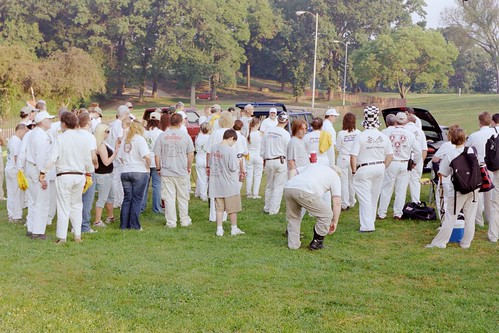
My association with the Grand Prix was through the Amateur Radio Emergency Service (ARES). ARES groups have a practice of providing radio support to major events as practice for their real purpose, providing backup communications support for public service emergencies and disasters. As such, the organization of event support and public service support are the same. Mobilization of volunteers, establishment of net control, check-ins of operators on site, assignments of radio operators to either stations or as shadows of key officials, and operation over time. It provides practice for the operators, test assumptions on how to manage large events, verify operating procedures, and gives operators a chance to test their equipment when operating in field conditions over the course of a day. And it provides practice in supporting another organization as well as other public service agencies who are also working the event. In my case, as a relatively young operator (< 2 years), training in procedures and actual use of my equipment (and some suggestions on what will help me work better). My assignment at the Grand Prix was to work a corner station, consisting of a corner captain with associated flaggers and course crew. Since this was the first time I've worked this event, I was with two other operators who happened to be two Elmers of mine, Mike and Cathy, (An 'Elmer' is an experienced operator who assists new hams as they learn the practices of ham radio.) Mike and Cathy are a married couple who help with the Red Cross radio operations. They have a wonderful story, of how one of their first dates was when Mike worked the Grand Prix some 18 years ago. And Cathy enjoyed it so much she got her radio license, so she could work the Grand Prix without Mike in case they broke up. Apparently, this has not been an issue.
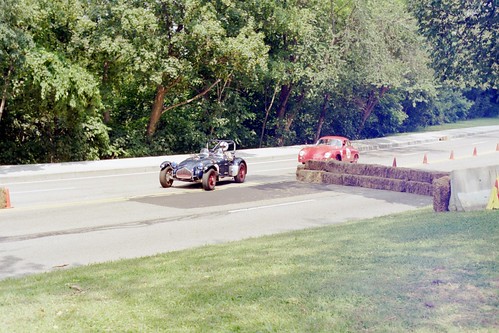
I was told that this particular corner was worked by two families (including Mike and Cathy) who have a long history of working the same corner for the Grand Prix year after year. We had "Sarge" and "Mom" who were the corner captain and the main flagger for the corner. Two sons and a daughter working the corner. A few others (including a couple) working to maintain that stretch of the course. And a few grandkids, including one (teenage) grandson helping with the course maintenance, and another grandson who dressed properly to help as able and needed, and other grandkids playing with the sound of the cars in the background. So in addition to carrying out their tasks, there was the passing down of traditions and practice down the generations. The tasks such as what the various flags were for. The use of hand and flag signals and whistles to communicate to the other workers and the drivers. Why all race workers dressed in white shirt and white pants. The complaints about the yellow t-shirts (because not only were they not the traditional road race white, they were yellow. Yellow and Red are forbidden colors on the race course because they are used on warning flags.) Having one grandson help with the flagging (holding a signal flag) and telling him he gets to brag at school of working on a race course. Hearing all the stories of how people got involved in racing, and everyone sharing of their lives and each other lives as the natural progression of years goes on. (birth, marriage, kids, deaths)
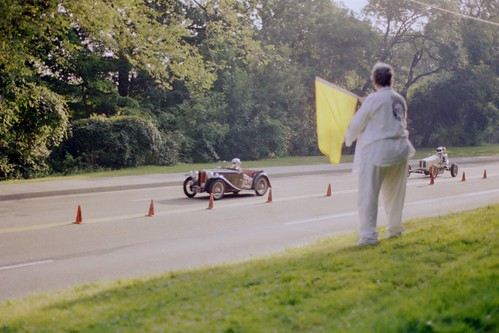
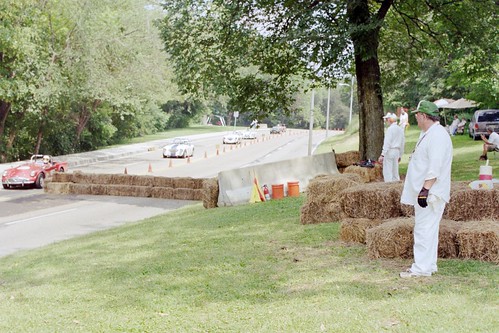
We learned of radio operation as well. Mike and Cathy showed me their setups, both their car, and a rig they set up to transmit television signals of the corner. We discussed equipment, such as the use of gun muffs over headphones to block out the roar of the cars. There was a conversation with Sarge and Mike about the sound blocking qualities of various types of muffs, down to the frequency response due to the different intended purposes of various type of ear protection. It was the first time I've worked for extended periods on simplex (not using a repeater) so I got an education on the qualities of different antenna as I compared reception of others from various places in the hills and valleys of Schenley Park. And Mike and Cathy provided commentary on the proper practice, from listening to others. They let me handle some routine communication. In addition, we took messages from the corner captain to send to race officials about the condition of cars, and reports on the condition of the corner. The most exciting thing was when one car sustained sudden damage, sending debris over the course. Which required that the course be closed and cars stopped. Because of the hills and valleys of the course, it is not possible to see the entire course, and having to make individual calls to the corners would be so inefficient, the use of a radio net is ideal for this, as several corners passed on information and requests to the net control and to the race stewards, letting the race officials make proper decisions on the running of the race and ensuring the safety of drivers, workers, and spectators. Which is what would happen in a real public service event.

And more education. Of how events are organized and how radio volunteers are recruited. The history of ARES is SW Pennsylvania. The personalities, mistakes, goals, expectations of radio operators and those who want them. All of which I actually need to know. Because it is a community that is hoping I take my place among them.
Tuesday, August 05, 2008
Book Review: Academ's Fury by Jim Butcher
 Academ's Fury by Jim Butcher
My review
rating: 3 of 5 starsAcadem's Fury is the second book in Codex Alera. The main character is Tavi, a quite ordinary boy who has been admitted to the Academy, where the top agents of Alera are trained. The problem is he is ordinary, in a world where almost everyone has talents caused by tapping into their personal Fury, elementals of earth, air, fire, water, wood or metal. These Furies are what gives humans the ability to survive a world full of more powerful dangers, and Tavi has none of this.
The book focuses on Tavi, his Marat (barbarian) friend Kitai, and his aunt Isana amidst the intrigues of the capital. What makes them special is how ordinary they are. They are surrounded by characters who wield power, political, personal, and through their Fury. Tavi and Kitai have only thier own wits and physical skills.
And their motivations are banal. In a setting where the others talk of status, the rise and fall of empires and rulers, Tavi, Kitai and Isana talk of caring for family, an unbothered future, and living a life without worrying of the doings of the great. They become human, even ordinary people in an extrodinary circumstance.
View all my reviews.
Wedding music
Excerpt from Sonata for Violin and Piano, Op. 78 - Johannes Brahms
“Nessun Dorma” from Turandot Giacomo Puccini
Excerpt from Symphony No. 4 “Italian Symphony” - Felix Mendelssohn
First Dance, Final Dance: Eric's Song by Vienna Teng
Second Dance: Anna Rose by Vienna Teng
Removal of Garter: The Raiders March (A.K.A.The Indiana Jones Theme) by John Williams
Clinking of glasses:
Yodeling by D. Green and J. Ott
Twinkle, Twinkle Little Star by The Shaws
You are my Sunshine by The Fishers, Lee and Chan

Monday, August 04, 2008
Book Review: Small Favor (The Dresden Files, Book 10)
 Small Favor by Jim Butcher
My review
rating: 4 of 5 stars
The Tenth book of the Dresden Files. And the principal, Harry Dresden, is a wizard, and a Warden, one of the principle enforcement agents of the wizard world. And he is held in suspicion by his fellow Wardens, his allies the Knights of the Cross. And he is being called in on a favor he owes. To someone who does not wish him well.
As the books have gone on, Harry matures. He is no longer protecting everyone by his silence on approaching danger. The dangers are greater, but now the interaction with his friends and allies has grown richer. The allies begin making significant choices and their personalities, attitudes, and values come into play throughout the plot.
The strength of the characters other than Harry takes away the unreality of the situation. With all the strong powerful beings, it would have been easy to make this a story focusing on a fight between powerful beings. But it becomes a story of people deciding where their loyalties, principles and their duties lie. And these choices had costs, to themselves and to those they were loyal to. And sometimes their loyalties and principals hurt each other. What makes this interesting is seeing the characters struggle with this. And watch them make their choices, some accepting the price, some rejected the great benefits and power offered. Some of these we do not know well, some we have been following for almost the entire series. And this makes this a book I was glad to read.
View all my reviews.
Sunday, August 03, 2008
Book Review: An Army at Dawn by Rick Atkinson
The U.S. introduction to the land war in europe in WWII against Germany was in North Africa. The generals there, Eisenhower, Bradley, Patton, first were tested here, along with an un-tried American army. History and us remember them as the leaders who breached the Atlantic Wall and liberated Europe, but it is easy to forget that they did not spring full grown as an Athena out of the head of Zeus. They had to learn to walk before they could run. And this book documents those first steps.
As you read Atkinson's account, you get a sense of the confusion, unknown and uncertainty. Both at the level of the normal foot soldier as well as the highest commanders. Atkinson shows, that even with the very best and most meticulous of preparation, war is messy, confused, unpredictable. And that the enemy always has a vote, even when it seems they are out.
What history tells us is in North Africa, a young United States Army as part of the Allies completed its first campaign having evicted the Axis from a continent and removing two German Field Armies from the war. Atkinson tells us of the lessons and pains along the way. The stories of an army learning the art of war are something to remember, especially as new stories of another American Army learning the ways of war are being recorded (with Rick Atkinson being one of the recorders.)
Saturday, August 02, 2008
Movie Review: The Jane Austen Book Club
During the course of the movie, the movie follows the characters romantic lives. Prudie's troubled marriage, Allegra and her lesbian relationships, Sylvia and her ex-husband, and Jocelyn, whose attempts to get Grigg and Sylvia together misfire as Grigg has more of an attraction or Jocelyn. And the book discussions focus not on plot or facts (after all, this is not high school english) but on characters, goals, motivations, desires, the themes of order vs. desire. And the discussions also becomes a subtext to the characters speaking and thinking about their personal lives (one of the funny quotes in the movie is Bernadette saying "I'm glad that this is the last book, there is too much plot going on."
Obviously, there is a certain amount of dramatic license that goes on, and romanticism of what book clubs are, after all, this is a romantic drama. But the goal is probably right, the books provide a focal point of thinking about life, and the clubs provide a means to do so amongst others. Whether friends, like the movie, or among strangers who have nothing in common but the fact they like to read. Some are narrowly defined. The club I am in (well, I have been truant recently, I hope for an excusable reason) reads all sorts of things (well, fiction, and not science fiction) and was assembled slightly randomly (two different book clubs were started by people making a general announcement and taking all comers, and eventually one folded and a few survivors (well, two) joined the other). So what you get are a slightly random group of people who like to read, and are at least non-introverted enough to meet a bunch of strangers and talk about what they think. And reality is, they also like to eat and randomly chat and have conversation. Which is how it usually works, even though the group has very little a priori in common, other then some attitudes.
Does the outside world come into this? Yes, members do have lives. They move, buy houses, have babies, get married, all the normal ebs and flows of life. And the book club becomes a place of semi-normalicy. People who know you enough to talk to, but not so close that it is threatening. And there is a place for that.
It was a fun movie. I missed it when people from my book club went to see it last year. My wife and I found it amusing, and I assure everyone that it was my idea to rent it.
Thursday, July 17, 2008
A wedding

And apparently this was noticeable. Several vendors we worked with remarked about how calm we were about things. S's mother (who does not speak english) observed over the month before the wedding that everyone around us were nervous and stressed and rushed, but not us.
And looking back on it, we were so amused about the many little details that just happened to fit nicely, better than we could have planned it:
- Both mothers shoes matched.
- Both fathers had the same color tie.
- The tool frame around the cross and alter was just right. (yes, I now know there are multiple meanings of the word 'tool')
- Sisters wearing dresses close to the correct color (obviously, they were paying attention

- The Pittsburgh Opera tenor wore a vest that blended with the wedding colors. (Chambourcin for those interested)
- Flower girl just happened to have a proper dress.

- Bouquets and boutonnieres were larger then expected, because the florist was able to get less expensive flowers (because we let them pick the flowers, we [meaning bride] picked the concept, the professionals handled the details and could pick something that was priced low for the day)

- Tables seemed to match for good conversations (the first cut at table assignments was done alphabetically)
- Bangkok Balcony and Silk Elephant were able to properly show off with the appetizers and rehearsal dinner.

- Amy Marshall tuning the piano the day of the wedding on one day notice, juggling her Saturday schedule to make it happen, because that was one detail we thought was important for us to fuss over.
- Everyone waiting for the bride to come in. And waiting. And waiting. (one of the groomsmen had the assignment to get the groom to church. Noone seemed to have had the assignment to make sure the bride could get into the church.)

- Waiting to take pictures at Marshall Island, North Park, and looking at the clouds coming in.
- Boy coming out in hotel lobby, running to the eagerly waiting bride and groom, and swerving away from a hug at the last minute.

- The bouquet toss into the light

- The groom removed the garter in a proper manner

- Homemade wine

- Playing the piano, after ___ ___ of wine

- Bride and groom stranded at the hotel, trying to bum a ride.
- "You can dance!?"

- Large group of girls on the dance floor, with one, obviously very worthy, little boy.
- "Are you going to church tomorrow (Sunday)?" "No!"
- The rainbow after the thunderstorm

Many thanks to Linli and Jim for pictures. More pictures are here:
Louis and Sha pictures by Linli
Sunday, July 13, 2008
A Week in the Valley - New Market, VA
Our home for the week was the Crossroads Inn in New Market, a Bed & Breakfast, where we stayed in the Blue Room.
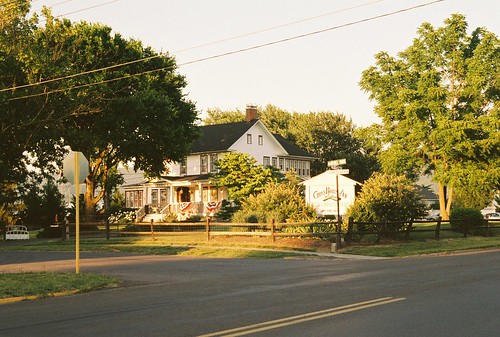
Properly named, it is at the crossroads US 11 and US 211. Or to give it a more geographical location, the old Valley Pike off the New Market Gap. The New Market Gap is the historical reason for the town's existance, as it provides an entryway into the valley through the Blue Ridge Mountains on the east. We picked it because we wanted a home base in the Valley, and we wanted to stay in a small town. And it turned out the New Market Gap/US 211 led to the most convenient entryway into the Shenandoah National Park for us (see earlier posting).
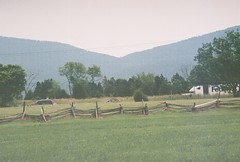
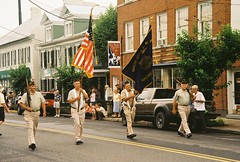
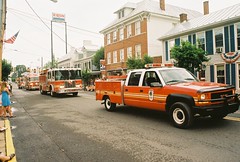
We did spend considerable time going up and down the Valley going to Vineyards. But we also spent much time in the New Market area as well. This included whitewater canoeing on the Shenandoah River near Luray, and the town Fourth of July Parade and fireworks.
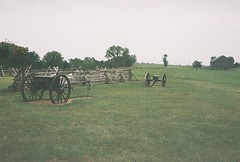
The Civil War New Market Battlefield was right next to town, complete with museum staffed with very enthusiastic Virginia Military Institute cadets.
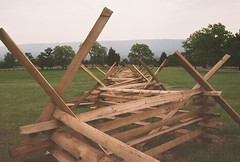
Disclaimer: I did not pick the town of New Market. I merely provided a list of several suitable towns in the Shenandoah Valley to my now wife, and she picked the town. And she did a very good job.
We also sampled several of the town restaurants, including Southern Kitchen (where we played Kenny Chesney "How Forever Feels" on the Jukebox. The steak was a bit too well done), The Congress Publik House (the tamarind pork was real good) and Jalesco (a surprisingly good mexican restaurant).
But the fun part about going to a honeymoon in a small town was the hospitality and attention we got. The B&B provided many good conversations over both breakfast and afternoon wine and cheese (especially when people figured out we were a honeymooning couple). Several coaches from the local college summer baseball league team were staying there as well as parents of the boys, which provided good conversation on the development of young men. People got used to seeing a young asian couple strolling down the street. The lady at the local chamber of commerce gushed over us when we stopped by. During the parade and the picnic we were regularly congratulated and wished best of luck for our marriage. Strangers said 'hello' and 'good morning' on the sidewalks. Very hospitable place. And a lot of this is probably the fact, they don't have very many pure tourists staying at the town, so they don't get so jaded. And we got a lot of attention wherever we went, more so then any high-end resort or hotel or cruise could have given. And it was a more enjoyable, less pressured time than any other we could have imagined.
During our time in the Valley, we frequently were asked by townspeople or winery owners where were we staying. And when we told them the Crossroads Inn, they immediately knew where we were staying, and who the owners were. Because, it turns out, the owner, and the person who was cooking and serving our breakfast, changing our sheets, lover of wines, had another identity. How many other newlyweds were served breakfast by the town mayor?
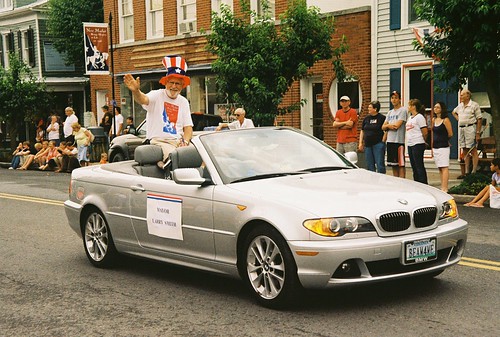
On July 5, all of us at breakfast expressed our delight at learning this during the parade the day before. One of life's little pleasures. And another memory for our honeymoon.
Wednesday, July 09, 2008
Vineyards in the Valley - Shenandoah
During the first breakfast at the Bed & Breakfast we stayed in, we commented to the owner about the ceramic skillets that he used for the omlettes. He said that he got them from a nearby pottery studio, the Art Studio Pottery, on the outskirts of town. So that was our first stop. When we arrived, Joan was working on her garden, and she showed us around. We got two skillets, then went on a tour of her studio downstairs. We talked about the making of glazes, the difficulty of marking the pieces (she was using a rubber stamp to stamp 'Shenendoah Valley' on her pieces, which would get filled in along the way), and making a chop, which Louis mentioned (and Joan was rather impressed by).
Vineyard #1 was the North Mountain Vineyard in Mauertown, VA. We were greated by their 14-year old dog, then went up for the tasting. We and another couple were the first ones in for the day. We figured the owner was of german descent based on the accent, and had a wonderful time telling us the stories behind the different wines they had. And among the wines was chambourcin, so now when asked what the color was for our wedding, we can point to a bottle instead of describing it as 'burgandy, but with more purple.' We got two bottles here, including a Chambourcin.
A few days later, we went back to the North Mountain Vineyard for their picnic lunch, because we felt like taking a day to just enjoy some wine and sit back and relax. We debated on the way up if they would remember us from our visit their Thursday, Sha declared that we are cute and interesting enough. Louis figured they saw plenty of people. When we got there someone else was minding the counter, but as we set up, the owner who helped us Thursday came and informed her that we were a newlywed couple here on their honeymoon. Seriously impressing the lady at the counter with her powers of observation, until the owner let her know we were there earlier to taste the red wines. This time, we tasted some white wines and a couple of sweet wines, settling on a bottle of white and a bottle of sweet table wine. The other owner also came by to chat as he overheard we were on our honeymoon. He was prior service in Germany and had gone through jump school, although he was communications, not airborne. The picnic lunch was fried chicken, potato salad, potato chips, pickle and beans, along with their Oktoberfest wine. We at, read, relaxed, and just took in the sights and sounds of the country home. Then we were invited on a cellar tour, which was normally something that had to be paid for (or you have to buy the really good wines). We learned about the bringing in of the grapes, the three vineyards they have (including one outside New Market), the three sources of oak for the barrels, the toasting of the barrels, and how North Mountain distributes wines. Alas, they do not ship outside Virginia because of the difficulty, so the only way to get it is either to visit the vineyard, or ship it to someone in Virginia in advance of a visit. We are already coming up with such people.
Vineyard #2 was the Shenandoah Vineyard. This was probably the most marketed of the vineyards in the valley. And it was the busiest as well. Wines were so so. We did get one bottle though.
Vineyard #3 was the Wolf Gap Vineyard. The vineyard was deep into the back roads of the valley. When we arrived, we met the owner, Will, also known as 'Wolf Gap Willie.' He is retired Air Force, and we joked that when he killed a fly 'air-to-air'. He told us that he actually was not planning on opening that day until we called about coming. We got a blend that he created as well as a Chambourcin (notable as the wine that our wedding color was named after). We stayed a while on his porch eating a ham and cheese plate and admiring the scenery, which included the Wolf Gap which the vineyard was named after.
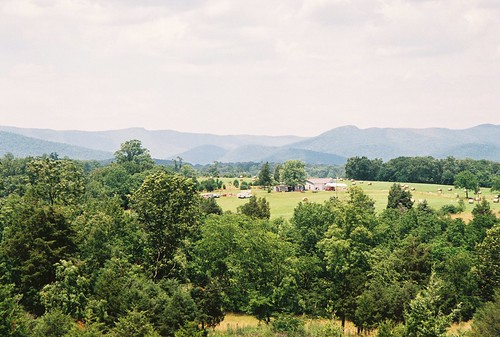
Vineyard #4 was Cave Ridge. The girl was the daughter of the owners, and had returned to the Valley after being in Ohio for a while. The winery looked nice, but wine was only soso. We did get couple bottles.
We went to Vineyard #5, Misty Ray Vineyard in Harrisonburg. This was a place in someone's house who was also only open by appointment (i.e. I called Wednesday about coming.) It was a house at the end of a cul-de-saq. Phil had a small selection of table wines. We got two bottles, and he gave us a couple of house wine glasses as wedding present (he had asked us how long we were married because he guessed it was not very long)
What impressed us the most about the Shenandoah Valley was the accessibility of the people. In all but one winery, we were served by the owners. In three of the wineries, our visit included much friendly conversation and interaction (which included them learning we were on our honeymoon). Two of them were open on the day of our visit only because we had called ahead to let them know we were coming.
Tuesday, July 08, 2008
Camping in the Shenandoah National Park
We arrived at the Big Meadows campground Monday afternoon, watching the clouds come in. We had decided to skip backpacking and just do camping Sunday night, when we realized that we would not leave home until around 11. So the whole way, S and I were joking about how happy I would be if he would have to put up the tent in the rain. We picked a site along the Appalachian Trail and set up the tent and rainfly. The tent was set up in a hurry, and it started raining while they were putting up the fly. And, while it was still lightly raining, we juggled the meal schedule and cooked tricolor pasta with pesto sauce, which did not care much if it got wet. And on finishing cooking the meal we ducked under the fly to eat to dine under the rainfly. And we enjoyed our dinner of pasta and wine. S informed me that I was not allowed to be not happy the rest of the honeymoon.
Tuesday was for hiking. Breakfast was scrambled eggs with onion and a bit of pesto sauce along with pita and green tea. The hike was in four parts, three waterfalls and the finish. First stage was to Rose River falls. We started from the campsite along the Appalachian Trail. We took some pictures at Fishers Gap, and took off our jackets as we started to warm up.
On the Rose River Trail L and S confirmed the directions for a family that was not sure which trail to take. After checking his maps and compass, the family declared that L and S were professionals while they were amateurs.
We made it to the Rose River Falls. This was in an area designated as wilderness within Shenandoah National Park. Very much enjoyed taking pictures. Someone else there took pictures of us. And we also used the Gorillapod (Thanks Guy!) to take pictures of us by the falls. Next, to the Dark Hollow Falls. The stone table bug in a supposedly wilderness area. And it started raining. And Sha experienced having rain when hiking with Louis, which apparently she had never experienced before.
When we reached Dark Hollow Falls, we were initially very disappointed. Then looking at a map, we realized we did not reach the falls. A lady with baby and toddler came down and informed us the falls were actually further up and their was a steep part to the trail. At least it was steep for someone holding a baby and with a toddler in tow. So we went up the trail to the actual Dark Hollow Falls. And that was more impressive. We had lunch on the trail, marinated salmon and pita bread. The part that did not fall on the ground.
The last falls were the Lewis Falls, which were on the Lewis Trail around Big Meadows. We got near the falls, which was not very impressive because we could not get to close to the falls. On the way back, we went up a very rocky trail, that included some scrambling. We also saw a couple that we had met taking pictures near the Dark Hallow Falls. We figured they were driving, so they got there just a little before we did.
Dinner was pad thai with egg. While getting the stuff from Sha's car, Louis picked up her luggage and dropped all her clothes on the ground. While Louis was picking up her clothes and apologizing profusely, Sha decided to dump all her toiletries on the ground too. But then we decided that dumping things on the ground was not so fun so we went back to getting dinner ready. We soaked the noodle, but we were running out of cooking alcohol, so we ended up putting in a lot of water in the pad thai to get the noodle soft. But it was still good.
Since it looked like it was not going to rain on dinner, we took down the fly, and put up a tarp to dry it out overnight. And we went to an earlynight.
Breakfast Wednesday was bagel and tea. While enjoying our tea, a ranger came by and asked if we had reserved our spot. When we told him that we came and picked it he was surprised. Because we had the best campsite in the campground because of the great view of the mountains from the site. Which we had been appreciating the whole time. We packed everything up, and it turned out just about everything was dry after being out overnight and through the morning. The drive back was along Skyline drive. We made two stops, one on the east and one viewing west. The west viewing stop was where we could see Stony Man Mountain as well as the New Market Gap. The rest of the trip to the B&B was uneventful, after all, we passed by this way on the way here. And we looked forward to what our honeymoon had in store for us next.