Another fall, and I again went to my professional society conference. As usual, the meeting of old friends, and making some new ones in the same circles. I'm slowly becoming more comfortable in the idea of academia, so my circle is growing beyond connections from graduate school. Although it is including my friends students over time.
1. The big news I could tell everyone was that my first PhD student is defending this month. My advisors are very happy with news of their impending grandchild. (and yes, they do refer to him in all seriousness as a 'grandchild'. Any professor who mentors PhD students understands the sentiment.)
2. Despite my being a very junior faculty person, I've been informed that I have been around enough so that I cannot avoid various community service opportunities by hiding in the corner much longer.
3. I had a number of 'what am I going to do when I grow up' conversations. Although, it is nice when some of those conversations include comments like 'you check a lot of boxes.'
4. I've continued my tradition of eating Saturday dinner with someone random I meet at registration. Although I really should start trying harder to actually schedule something.
5. I've also continued the practice giving a friend's PhD student feedback. Although this time I was not really expecting to do so since her advisor was at her talk. I figure it is good training for when I have my own students giving talks.
6. It is a good feeling to say 'My talk is for fun. My (student/post-docs) are giving the serious talks.'
Sunday, November 20, 2011

Wednesday, November 09, 2011
Ten Photo Assignments (Rocky Nook) by Amanda Quintenz-Fiedler
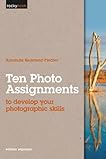 Ten Photo Assignments by Amanda Quintenz-Fiedler
My rating: 3 of 5 stars
Before you attain mastery of a craft, you must first learn the fundamental skills. I know a world class violinist whose teacher spent months having him practice picking up and properly holding his violin. Pianists spending hours on hours starting with scales and octaves. Chefs in their first jobs develop knife skills by cutting food. This book is trying to be the tutor for knife skills for digital photography. It may start out slow, but the goal is to master the tools of the photographer's craft, then you can create what you see in your mind.
For all the sophistication of some modern cameras, there are only a limited number of things that can be adjusted on a camera. Traditionally, it was shutter speed and aperture, and film speed (sensor) to a limited extent. And in digital SLR you also include white balance (instead of using filters). All the fancy features in cameras exist to do this, or help the photographer decide how to make these settings. But for the photographer to make these decisions instead of letting the camera do so, the photographer needs to know the consequences of these decisions. And the way to do that is to experience the difference. And this exercise comprises the majority of the assignments in this book.
The assignments here are very different then most lists of photographic assignments. Usually, when I think of photographic assignments it deals with shooting a specific subject under certain conditions. Here it is the learning of how to use a particular aspect of the camera. So one assignment is a test of how your camera light meter measures exposure, so you can see what your camera considers to be proper exposure, over exposed and underexposed. And when you come across a scene, you can determine what you should set the exposure as (i.e. above or below what the camera reads). The second assignment deals with lenses, so you spend time shooting with each lens you own, so you learn its characteristics at different apertures and have a visceral sense of what each focal length looks like. And so on with the many white balance modes, and different combinations of shutter speed and aperture with equivalent exposures. Not until you get to assignment seven do you start two assignments on composition and two assignments on lighting.
Key to appreciating this book is recognizing it for what it is. The first six assignments of the ten are learning the tools of the photographer's craft. It makes you learn what your instrument can do and how it responds to your changes in controlled conditions, and asks questions so that you can reflect on the outcomes so that you develop an intuition on how the camera works, and you can make decisions when you get to the field. I don't think there is a readily available resource outside of a teacher that would lead you on this path. The last four are more pedestrian and generic. For learning composition and lighting there are many sources of exercises and photo assignments that can teach you more with more scenarios and challenges.
At its base level, photography is a craft and skill. And to learn it well you need to practice it deliberately until the fundamentals are sound and intuitive. This book will take you there. But its title is somewhat deceptive (and maybe there is no title that would work in a book like that) because it is not a standard set of assignments (and I dock a star just for that). Perhaps this book is the Études of digital photography, focusing on getting the technical aspects of photography right. But the artistry is something to be developed elsewhere.
View all my reviews
Note: I received a free electronic copy of this book as part of the O'Reilly Media Blogger program. More information on this book can be found at the 10 Photo Assignments web page
Thursday, November 03, 2011
Parenting: One year
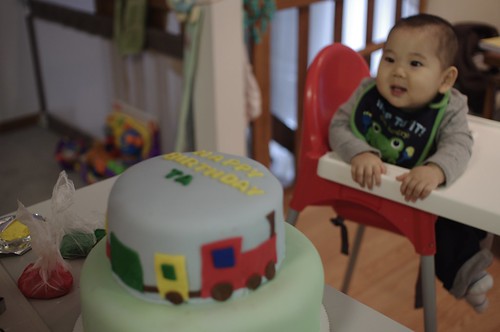
Oh wow, how did we manage to pull that off? Before T was born, someone was commenting on the fact that parents to be never felt ready, so he was wondering how we felt. My response back then was I was pretty sure after we have had a child, we still won't say we are ready. But some thoughts on the first year.
1. Parenting is an experiment of one. We used to say we would ignore all developmental milestones before T turned 4, in recognition that babies are highly variable. I can't say we have achieved that, but I think that the more we strayed from that ideal, the more the stress, and I don't think there was any benefit.
2. Attachment Parenting. To the extent we followed any philosophy (other than Chinese mother/auntie advice), we ended up closer to the attachment parenting school. He is what the AP folks call a 'high-need' baby, so he wants contact. But when he get it, T thrives. He is highly responsive to contact whether being carried around, having someone in the room in sight when he sleeps. The result has been what was promised, a baby who is very responsive to people (well, at least people he knows). For all he likes various toys, we like to think that we are his favorite toys.
3. Sleeping. All the books and magazines talk about babies sleeping through the night and when that happens. T is in that set of babies that does not sleep through the night. And apparently he has considerable amounts of company. This counts as another source of stress that did not seem to do any good. But his sleep (or non-sleep) schedule now drives the rhythm of our lives.
4. Learning. We are somewhat surprised that we actually do care about how well he learns, even now. Although we are not so sure about his peers who are doing flash cards and such. It is not facts or things we want him to learn (although we expect him to learn numbers and letters in due time), we want him to learn how not to give up, that things that are hard are worth trying to do, and when you can accomplish them, they are fun. He actually is just getting some of the things we have been playing with him, and it is a lot of fun watching him pai-pai shou (clap hands) when he accomplishes something
5. Alert. Ever since he made it past his colic period, this is one of the most frequent comments we get. That he is alert and intently examining his surroundings (this is another one of the rewards advertised of attachement parenting). He wants to look at everything, we joke he inspects everything he can reach and tastes his food before he decides it is acceptable.
6. Sick. Standard baby is sick with the condition of the month. Always changing.
7. Priorities. Probably the most frustrating part of parenting is that you are always have two or three top priorities at any point in time.
8. Toys. Well, besides us, we have him enjoying reading (at least he turns the page when he is ready to go to the next page, which is usually when we finish reading). Then there are the screens. We are raising a child who thinks it is perfectly normal to have a video call on something that is portable. As well as watch a video or play a keyboard or draw. We're not too sure about that, although I am hoping we can steer him to things that involve him making something.
.
Sunday, October 09, 2011
Ethics and role playing games
 One of the few hobbies that I've kept is playing role-playing games. Alas, it has been a while since I've played with real people, so I tend to play over the internet, with people I don't actually know in real life. For those who only know of games such as Dungeons & Dragons by reputation or only know of electronic versions such as video games, the important thing about role-playing games done right is that they are shared storytelling. The story can be dark, flashy, primarily physical, primarily social, gritty, hopeful, serious, silly or anything else that the participants require. While the organizer sets the environment and milieu, it is the job of the other players to decide how the story goes within the setting.
There are plenty of motivations for doing this. People just enjoying each other's company, wit and humor; those who want to try out what the world looks like from another point of view; writers who want some practice (or who are still working on getting their 1 million words of bad prose out of the way). But one thing I get is the opportunity to think through how to deal with moral issues that do occur in real life.
My wife jokes that I have a habit of playing characters that are like myself. Or more precisely, I take one aspect of me, and make a character that is built on that. Like what beginning writers are told to do, write about something you know. It could be thought of as exploring what ifs. Of course, currently, I am trying to break this by playing a modern day Buddhist monk, Jesuit priest, and paramedic along with a technician in an early industrial setting. (well, I think my wife will call me out on one of these, but I was not trying too hard building that character). But the games I get into tend to be on the grittier side. And one of the effects is that they go into moral issues. Over the past couple years the games I have been in have dealt with racism, class divisions, prejudice, counter-insurgency, and the application of torture. To play well, it means you have to think about the motivations of your character, and the consequences of traits and decisions made along the way.
The groups respond in various ways. For some, it becomes repulsive and they want no part in it. Which is frankly how a large part of the real world is like, where moral guardians declare their righteousness and destroy the possibility of intelligent discussion. Others play things out, and let their characters respond to see how things lead (of course, there are often characters who are moral guardians in play, but this still means that things play out).
And that is probably one thing that I get in gaming that I don't get in real life anymore. I am no longer active in communities that have learned that a lack of transparency, honesty, and openness leads to failure and death. It has been a few years since the last time I was part of a conversation that included a discussion on how a decision would be made to accept the death of some of those present. In its place is a world where moral outrage is a practiced art form, and moral guardians reserve for themselves the right to have these discussions, and shout down others who may want a say.
Not knowing most of my playing companions in person, I have no way of knowing if these are questions they think deeply about, or if these are things that only come up in their lives in the context of games. But I do know that when we are talking about life and death, generally I find that the time to think about it is before you are faced with it for real. Then things tend to work out better. And this is one place to do it.
One of the few hobbies that I've kept is playing role-playing games. Alas, it has been a while since I've played with real people, so I tend to play over the internet, with people I don't actually know in real life. For those who only know of games such as Dungeons & Dragons by reputation or only know of electronic versions such as video games, the important thing about role-playing games done right is that they are shared storytelling. The story can be dark, flashy, primarily physical, primarily social, gritty, hopeful, serious, silly or anything else that the participants require. While the organizer sets the environment and milieu, it is the job of the other players to decide how the story goes within the setting.
There are plenty of motivations for doing this. People just enjoying each other's company, wit and humor; those who want to try out what the world looks like from another point of view; writers who want some practice (or who are still working on getting their 1 million words of bad prose out of the way). But one thing I get is the opportunity to think through how to deal with moral issues that do occur in real life.
My wife jokes that I have a habit of playing characters that are like myself. Or more precisely, I take one aspect of me, and make a character that is built on that. Like what beginning writers are told to do, write about something you know. It could be thought of as exploring what ifs. Of course, currently, I am trying to break this by playing a modern day Buddhist monk, Jesuit priest, and paramedic along with a technician in an early industrial setting. (well, I think my wife will call me out on one of these, but I was not trying too hard building that character). But the games I get into tend to be on the grittier side. And one of the effects is that they go into moral issues. Over the past couple years the games I have been in have dealt with racism, class divisions, prejudice, counter-insurgency, and the application of torture. To play well, it means you have to think about the motivations of your character, and the consequences of traits and decisions made along the way.
The groups respond in various ways. For some, it becomes repulsive and they want no part in it. Which is frankly how a large part of the real world is like, where moral guardians declare their righteousness and destroy the possibility of intelligent discussion. Others play things out, and let their characters respond to see how things lead (of course, there are often characters who are moral guardians in play, but this still means that things play out).
And that is probably one thing that I get in gaming that I don't get in real life anymore. I am no longer active in communities that have learned that a lack of transparency, honesty, and openness leads to failure and death. It has been a few years since the last time I was part of a conversation that included a discussion on how a decision would be made to accept the death of some of those present. In its place is a world where moral outrage is a practiced art form, and moral guardians reserve for themselves the right to have these discussions, and shout down others who may want a say.
Not knowing most of my playing companions in person, I have no way of knowing if these are questions they think deeply about, or if these are things that only come up in their lives in the context of games. But I do know that when we are talking about life and death, generally I find that the time to think about it is before you are faced with it for real. Then things tend to work out better. And this is one place to do it.
Wednesday, October 05, 2011
PSO Blog: Mommy and daddy need to go to a PSO concert
[Originally posted at the Pittsburgh Symphony Orchestra blogs]
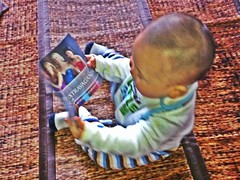 We achieved one of those major milestones in parenting this weekend. Leaving baby with a caregiver not related to us. ( Yes, we did check in during the course of the afternoon). The occasion, a PSO concert of pieces by Beethoven featuring the Eroica Trio playing the Triple concerto, as we were reminded by a mailer a couple weeks before.
I have a recording of the Triple Concerto at home. And I've been asked why I would go to a concert when I have a recording of some of the greats. And there is something to be said about the fact that every performance is unique. But there is also the fact that there is more to a piece than the notes written by the composer. There is the interpretation of the work. And when you have a group like the Eroica Trio who have been playing together for decade you get the collective interpretation of the work.
With in the first minute of the first movement I was hearing aspects of the piece I have never heard before. A good part of this can be attributed to Honeck balancing out the orchestra so that the right part has focus at any point in time. But another part of it is probably due to the fact that the Eroica Trio has played together for so long. The recording I have is by three acclaimed musicians with another world class orchestra. But the three soloists are known as soloists, not as an ensemble. And there is a difference between musicians playing together and musicians who know each other playing a single piece. It shows in the way the Eroica Trio could play off each other, more a conversation of old friends rather then a few technicians working together. And it felt more that we were privileged to bear witness to it more than just being in an audience.
When I was in graduate school I had remarked to a pianist friend that I thought a duet she was performing probably could only be mastered by pianists who were family members, because there was so much potential in how the parts worked with each other that could not be expressed by performers who knew each other in passing. This weekend's performance is the reward of having artists playing together who not only know their craft, but each other.
We achieved one of those major milestones in parenting this weekend. Leaving baby with a caregiver not related to us. ( Yes, we did check in during the course of the afternoon). The occasion, a PSO concert of pieces by Beethoven featuring the Eroica Trio playing the Triple concerto, as we were reminded by a mailer a couple weeks before.
I have a recording of the Triple Concerto at home. And I've been asked why I would go to a concert when I have a recording of some of the greats. And there is something to be said about the fact that every performance is unique. But there is also the fact that there is more to a piece than the notes written by the composer. There is the interpretation of the work. And when you have a group like the Eroica Trio who have been playing together for decade you get the collective interpretation of the work.
With in the first minute of the first movement I was hearing aspects of the piece I have never heard before. A good part of this can be attributed to Honeck balancing out the orchestra so that the right part has focus at any point in time. But another part of it is probably due to the fact that the Eroica Trio has played together for so long. The recording I have is by three acclaimed musicians with another world class orchestra. But the three soloists are known as soloists, not as an ensemble. And there is a difference between musicians playing together and musicians who know each other playing a single piece. It shows in the way the Eroica Trio could play off each other, more a conversation of old friends rather then a few technicians working together. And it felt more that we were privileged to bear witness to it more than just being in an audience.
When I was in graduate school I had remarked to a pianist friend that I thought a duet she was performing probably could only be mastered by pianists who were family members, because there was so much potential in how the parts worked with each other that could not be expressed by performers who knew each other in passing. This weekend's performance is the reward of having artists playing together who not only know their craft, but each other.
Sunday, October 02, 2011
Parenting Month 11: Let's play a game - feed mommy and daddy
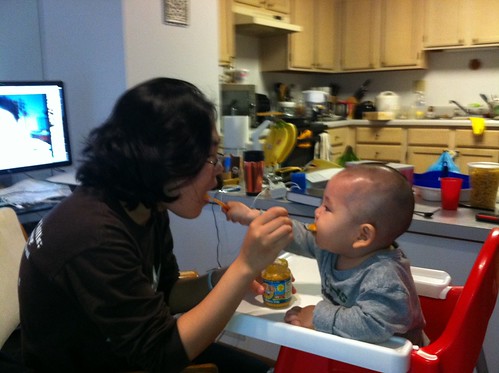
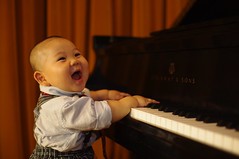
This past week we have been having lots of fun playing feed mommy and daddy. Because T knows that he likes being fed and he wants to do the same for us (we think). We also play give mommy/daddy ___ alot now.
On the not so nice front, we are declaring defeat on the ear infection that has been with us since early August. So this month tubes will go in. It seems to be widespread in this region, and by all accounts the tubes seem to work (a four year old gave us a full description of what it was like to get them, but it seems he was sleeping for most of it. Obviously it was not too traumatic.), but he does seem young for this sort of thing. But he has been bothered by it, especially at night since he wants to relieve the discomfort, but he cannot reach inside his head to get at it. On the other hand, for a sick child, he is remarkably good natured and happy when awake. It fools all the doctors who think it cannot be too bad, But we're hoping it gets even better once the fluid drains from his ears.
Thursday, September 29, 2011
Book Review: The Perfect Photo by Rantakrans and Hagberg
 The Perfect Photo: 71 Tips from the Top by Elin Rantakrans
My rating: 2 of 5 stars
Obviously, The Perfect Photo is mis-named. At a mere 128 pages, this is a pocket book and it is not attempting to be the modern day counterpart of Ansel Adams series on photography or Photography by London and Upton. But what is it? It purports to be a set of simple tips for any photographer, regardless of equipment. However, while the tips are indeed the classic ones that every photographer needs to learn, this book is harder to use for the beginner than it needed to be. It tries to be all things to all people, but it is not enough for a knowledgable photographer, and it skips information that a novice would need to be able to use the good advice effectively. So it fails to deliver to anyone.
The format of The Perfect Photo is similar to what other photographers who are also columnist have used, a set of short articles each on a single subject organized topically. The problem is that while the book is probably best for novices who have not learned these methods, the articles are aimed at photographers with a particular type of equipment, Full Framed system cameras, which are the high end of photography equipment. For example, many of the chapters discuss the use of features that would not exist on point and shoots or compact cameras such as white balancing or the manual controls for aperature and shutter speed. And it does not discuss the work arounds that those who have gotten good at working with these types of cameras have developed to compensate.
More egregarious are the issues with sensor size. While everything they discuss is in terms of Full Frame sensors (24 x 35 mm), they acknowledge something called a half-frame camera. But there is nothing marketed as 'half-frame camera'. There are the digital cameras with APS-C sensors (ranging from 13.8 x 20.7 mm to 19.1 x 28.8 mm depending on manufacturer), there is the four-thirds system, (17.3 x 13 mm) and a few other proprietary formats that are used by a single manufacturer. But none of those is 17.5 x 24 mm , which is presumably what half-frame would be. And while it does mention a few equivalent focal lengths (e.g. that a 50 mm lens will cover the same area on a 'half-frame sensor' as a 75 mm lens on a full-frame camera), they don't go the obvious next step of saying that you can multiply by a factor of approximately 1.5. Even this discussion is not until Tip 22. So in multiple discussions of lens focal length, the novice would not have noticed that there was an issue and they needed to mentally adjust the discussions of what wide-angle, normal or tele-photo are.
And this is my complaint about this. Each tip is oriented towards the novice photographer who is just getting serious and needs to start somewhere. But the individual essays almost require a base of knowledge of photography and the workings of the equipment to understand it fill in the missing details. And worse, the novice would not have realized there was a problem until she tried to use the tip.
Rocky Nook (publisher) offerings seem to be finding replacements for the teaching of photography technique that are useful for the digital age. And this book seems like it was to meant to be the slim fieldbook for the novice who is just starting the road to being serious. But while each tip is good in itself, it needed an editor's hand to pick its audience and focus on it to properly fill this niche.
Disclaimer: I received a free electronic copy of The Perfect Photo as part of the O'Reilly Bloggers program.
View all my reviews
Tuesday, September 20, 2011
Book Review: Think Stats by Allen Downey
 Think Stats by Allen B. Downey
My rating: 4 of 5 stars
Statistics gets a little respect in Operations research, in part because it gets taught as a bunch of formulas and computer procedures. And the problem with the way that it is taught is that the formulas don't mean anything, and the student may know her way around menus, but that does not mean that she knows under what circumstances to use what method. And everything is learned in isolation, often without practice in getting her hands dirty. Think Stats gives students the chance to get their hands dirty.
Because it uses a programming language (Python) it covers data analysis from beginning to end: viewing data, calculating descriptive statistics, identifying outliers, describing data using the distributions (and explaining what the distributions really mean!). Going through this small book, the goal is understanding and using statistics, not just learning statistics. I have a number of college undergraduate students working on projects. I have started giving them this to work on when they first start with me, both for the programming in Python and to learn statistics and data analysis so they can be useful.
I received a free electronic copy of Think Stats from the O'Reilly Blogger review program.
View all my reviews
Wednesday, September 14, 2011
Remembering 9/11 in music
[Originally posted at the Pittsburgh Symphony Blog site]
I was listening to the Pittsburgh Symphony concert from September 11, 2011 in Berlin on YouTube. As the 10th anniversary of the September 11, 2001 attacks in New York City, Washington DC and Shanksville PA, this was billed as a dedicated to the victims of the attacks. But I started to wonder, what does it mean to have a concert dedicated to an event? In particular, there was nothing different about this concert then any other concert on the tour, so it is not in the program. And it is not likely that anyone present was directly related to the attacks. So what does it mean to use music as a means of remembrance, particularly if the music was written with no specific meaning?
At the Chatham University concert commemorating the 10th anniversary of the attacks, Pauline Rovkah commented that the reason we have these concerts is that we have no other way to express what we feel. It is not just that the opportunities do not present themselves, but what we feel is beyond our ability to express them in words.
And the music is not just how we express how we feel, but also how remember later what we feel now. When I was listening to Yo-Yo Ma playing Bach Cello Suite No. 1 - Sarabande in New York for the ceremony at the 9/11 WTC memorial, I remember listening him playing another piece. On July 1, 2007, I was deployed in Afghanistan. That day, the news told us that Tuzla Air Base, Bosnia, had been turned over by the American military to the Bosnia-Croatians. Many people in my unit had deployed to serve in the Balkans during those years, and the turnover of Tuzla Air Base represented the success of that effort. And that day I listened to a recording of Yo-Yo Ma playing The Cellist of Sarejevo by David Wilde. Which was in remembrance of darker days of that conflict, of a cellist who remembered his friends by playing his cello during the Siege of Sarejevo. Music as a reminder of sorrow in the past, and the joy of the day that signified that sorrow was past.
We don't always have words to express how we feel. And the reality is that we sometimes forget what we were feeling in the past as time goes by. But when we want to remember, we can remember the music we used. Yo-Yo Ma playing the Sarabande from Bach Cello Suite #1 in 2011, or Cello Suite #5 from 2002 for the World Trade Center attacks. The Cellist of Sarejevo for those who remember the Balkan war of the 1990s. Or even the trumpet or horn solos from Mahler #5.
At the Chatham University concert commemorating the 10th anniversary of the attacks, Pauline Rovkah commented that the reason we have these concerts is that we have no other way to express what we feel. It is not just that the opportunities do not present themselves, but what we feel is beyond our ability to express them in words.
And the music is not just how we express how we feel, but also how remember later what we feel now. When I was listening to Yo-Yo Ma playing Bach Cello Suite No. 1 - Sarabande in New York for the ceremony at the 9/11 WTC memorial, I remember listening him playing another piece. On July 1, 2007, I was deployed in Afghanistan. That day, the news told us that Tuzla Air Base, Bosnia, had been turned over by the American military to the Bosnia-Croatians. Many people in my unit had deployed to serve in the Balkans during those years, and the turnover of Tuzla Air Base represented the success of that effort. And that day I listened to a recording of Yo-Yo Ma playing The Cellist of Sarejevo by David Wilde. Which was in remembrance of darker days of that conflict, of a cellist who remembered his friends by playing his cello during the Siege of Sarejevo. Music as a reminder of sorrow in the past, and the joy of the day that signified that sorrow was past.
We don't always have words to express how we feel. And the reality is that we sometimes forget what we were feeling in the past as time goes by. But when we want to remember, we can remember the music we used. Yo-Yo Ma playing the Sarabande from Bach Cello Suite #1 in 2011, or Cello Suite #5 from 2002 for the World Trade Center attacks. The Cellist of Sarejevo for those who remember the Balkan war of the 1990s. Or even the trumpet or horn solos from Mahler #5.
Wednesday, August 31, 2011
Parenting Month 10: Socializing
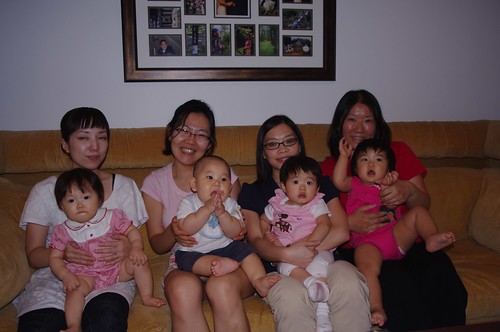
After last month's Thailand trip, our hope for this month is that all that contact with other people would make things easier at daycare and such. And it has. T no longer cries the entire time he is at day care or with other caregivers. He even interacts with the other kids there. We were confident enough to host a little party of babies at our house and he did well.
And he even learned to share. Unfortunately, his friends taught him to share whatever they got sick with while we were gone, so he would not miss out. And he came back and shared with mommy and daddy. So our house has been a house of coughing and sneezing for much of the past month. And it has morphed over time so what we all have now is probably different than one we had at the beginning of this mess.
Now that school is starting for both of us, we finally are into the full swing of life with a baby. Two adults with full time jobs and baby at full time day care with no grandparents around. So far, he is handling it well, except that he does not sleep much while at day care. Hopefully that will also improve.
Friday, August 12, 2011
Alternatives to the scientific method
I've been taking some time over the past two weeks having lunch with some students who were working with me for the summer. As part of this, I ask them what they thought about the experience of working with researchers and their own roles. I also discuss the project and where what they did fit into the overall goals.
One thing that surprised them all was that there was an alternative to decision-making through the use of models and analysis. And that using models and rigorous analysis was not always accepted or desired as a way of understanding our world and making decisions. Even important and complex ones.
1. Analysis by argument/logic - There is a reason that study of the natural world (what is now science) used to be called natural philosophy. This is analysis through reasoning and providing explanations for observed phenomena.
2. Perception as truth - The belief that what is perceived is what is true. This was argued by a number of friends of mine in graduate school who were members of a faith based group. It also is the justification of truth being arbitrated by those with societal power.
The contrast is the scientific method, which involves
i. Propose a hypothesis
ii. Identify a consequence from the hypothesis
iii. Develop and conduct an experiment that can test the consequence and potentially disprove the hypothesis
iv. Revise the hypothesis
Why would someone use (1) or (2) in making decisions instead of the scientific method?
a. Easier. (1) or (2) can be done much faster.
b. Lack of capability. Utilizing the scientific method required personel who are trained in developing hypothesis, identifying consequences, and designing experiments to test the hypothesis in the domain in question.
c. Power. (1) and (2) can be used by those who have built up power in a domain. Related to (a)
d. Disbelief. A large segment of society does not believe in the scientific method and prefers other sources for establishing truth.
(a) and (b) tend to be the basis of outreach by analytical groups within companies and academics. They often run into (c), which is subverted when top leadership has experience with having analytical groups assist decision makers in the past (one common example is if an executive served in the U.S. military) (d) tends to be the target of groups such as the American Association for the Advancement of Science (AAAS), the National Academy of Sciences (NAS) or more politically oriented groups such as the Ben Franklin's List (see New York Times, August 8, 2011, Groups Call for Scientists to Engage the Body Politic)
In large part those of us who are trained and teach and use the scientific method forget that there are alternatives, and people choose to follow those alternatives for reasons. I think that working with the high school students who don't worry about sounding ignorant (after all, they are going to go on with their lives, and there is never any shame for a high school student to tell a college professor in private that they don't understand something)
One thing that surprised them all was that there was an alternative to decision-making through the use of models and analysis. And that using models and rigorous analysis was not always accepted or desired as a way of understanding our world and making decisions. Even important and complex ones.
1. Analysis by argument/logic - There is a reason that study of the natural world (what is now science) used to be called natural philosophy. This is analysis through reasoning and providing explanations for observed phenomena.
2. Perception as truth - The belief that what is perceived is what is true. This was argued by a number of friends of mine in graduate school who were members of a faith based group. It also is the justification of truth being arbitrated by those with societal power.
The contrast is the scientific method, which involves
i. Propose a hypothesis
ii. Identify a consequence from the hypothesis
iii. Develop and conduct an experiment that can test the consequence and potentially disprove the hypothesis
iv. Revise the hypothesis
Why would someone use (1) or (2) in making decisions instead of the scientific method?
a. Easier. (1) or (2) can be done much faster.
b. Lack of capability. Utilizing the scientific method required personel who are trained in developing hypothesis, identifying consequences, and designing experiments to test the hypothesis in the domain in question.
c. Power. (1) and (2) can be used by those who have built up power in a domain. Related to (a)
d. Disbelief. A large segment of society does not believe in the scientific method and prefers other sources for establishing truth.
(a) and (b) tend to be the basis of outreach by analytical groups within companies and academics. They often run into (c), which is subverted when top leadership has experience with having analytical groups assist decision makers in the past (one common example is if an executive served in the U.S. military) (d) tends to be the target of groups such as the American Association for the Advancement of Science (AAAS), the National Academy of Sciences (NAS) or more politically oriented groups such as the Ben Franklin's List (see New York Times, August 8, 2011, Groups Call for Scientists to Engage the Body Politic)
In large part those of us who are trained and teach and use the scientific method forget that there are alternatives, and people choose to follow those alternatives for reasons. I think that working with the high school students who don't worry about sounding ignorant (after all, they are going to go on with their lives, and there is never any shame for a high school student to tell a college professor in private that they don't understand something)
Sunday, August 07, 2011
Lessons learned: working with high school students
In the New York Times Education section there was an article on how high school students are looking for experiences over their summers beyond the usual summer job (For a Standout College Essay, Applicants Fill Their Summers). This summer I had three high school students working for me on various projects. They had come through my department chair, who was aware that I had more project ideas then money and suggested them to me.
Over the course of the summer I had them working on a mix of grunt tasks and substantive ones. I think a lot of times high school interns end up doing data entry or manual labor tasks. And I had them doing such things.
Some thoughts
This was a good experience. I don't have much experience working with kids (to me, everyone before college), so this was a good one. From talking with each of them over lunch, it was for them too.
Over the course of the summer I had them working on a mix of grunt tasks and substantive ones. I think a lot of times high school interns end up doing data entry or manual labor tasks. And I had them doing such things.
- Entering data from forms written by teams that were in the field (i.e. on foot when they collected the data)
- Entering data into a spreadsheet model from multiple sources (census, address lists, etc.)
- Developing process maps from a process description
- Running a simulation and performing sensitivity analysis
- Debugging and running linear programming models and analysis
Some thoughts
- Clearly the high school students (juniors and seniors) I am seeing are taken from the top. I was impressed by their desire to carry out the tasks. I had to gently remind one of them that I wanted to know about difficulties as well as progress, because I actually did want the tasks done. (or there were alternatives if something was impossible. The difference between a school assignment and a research project is that research projects do not come with guarantees that they will succeed.) I have a hard time with graduate students who give up too easily.
- I could have pushed harder. While high school students typically do grunt work, I had them running models. Talking to them at the end of the summer, each of them said they may have been able to do more technical work. One of them had started learning R in the middle of the summer (for someone else). I think that if I started teaching them programming Python or R at the beginning of the summer, we would have found reason to use it at some point, and do it better then trying to learn programming when a specific task came up.
- They were very eager and inquisitive. Lots of good questions. Which came in useful since I wanted to have better documentation of the models and they would ask about what they did not know (because it was not in the current documentation)
This was a good experience. I don't have much experience working with kids (to me, everyone before college), so this was a good one. From talking with each of them over lunch, it was for them too.
Saturday, July 30, 2011
Parenting Month 9 - We're going to Thailand and we're so happy we just want to sing
The big event of the month. The family trip to Thailand so that T could meet his grandfather and his great-grandmother for the first time. It was deft scheduled to thread the narrow window between the end of colic (because there is no point bringing a baby who is screaming around the clock anywhere) and when T starts crawling. Some notes:
One of the big questions about traveling with a baby is if it is worth it compared to the difficulty. Some thoughts:
We are very glad we did this trip. In the few days we have been back, T has started crawling in earnest (he started while in Thailand). Everyone tells us that traveling becomes much harder from now until he learns how to read, so it may be a while before we do something this involved again.
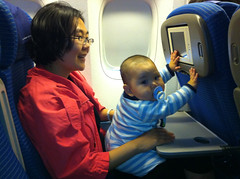 T was a good flyer.
 He did not fuss beyond what is normal for going to bed at night. Actually, he spent a lot of the flights smiling at our neighbors and the flight attendants. One of the flight attendants wanted to hold him while we were on the ORD-NRT leg of the trip. (no, we did not let her try) 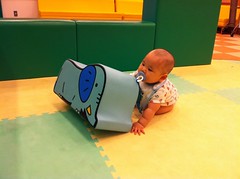 We loved Narita Airport (Tokyo). They have great family bathrooms with very large changing tables and a seat for a baby in the bathrooms. They also have these fun play areas everywhere.
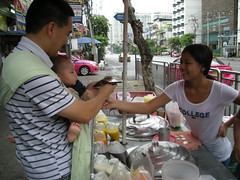 Every day I took T to the market to get breakfast. Sometimes with someone, sometimes not. By the end of the trip, lots of people on the street in the morning were used to seeing him. Many regularly said hello. I think that one of the biggest things from this trip was exposing T to a new environment, new people, new sights, new sounds, new smells.
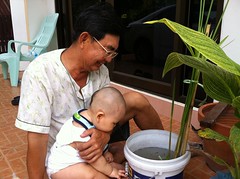 One comment we got everywhere we went was how big his eyes were. Because everywhere I took him, he would be looking around at things and looking at people. Highly attentive.
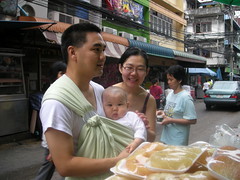 I carried him everywhere in a baby carrier, specifically a Maya Wrap Ring Sling. I could not imagine using a stroller on Thai streets with the pollution and various bugs and animals on the ground. We also noticed that in the sling, T could look at what he choose, which could mean looking ahead or behind. And he could choose to look at people (or not). Those he rewarded with his attention were obvious because of their happy smiles (and his too). It made it real easy to just talk to people who T spotted first.
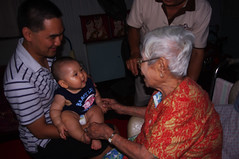 Of course, the other major reason was so he could see great-grandma. And we were not the only ones. There was another cousin coming in from Chicago whose daughter had never been to Thailand either. And another family from Singapore with two more children. A big family reunion.
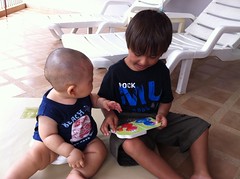
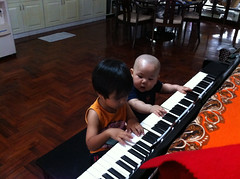
- Oh yeah, lots of cousins to play with. This is actually pretty important because T does not get much exposure to playing with other kids. So this was a good way of doing it.
One of the big questions about traveling with a baby is if it is worth it compared to the difficulty. Some thoughts:
- Traveling with children is easier in Asia than in the U.S., because the U.S. culturally makes it unnecessarily difficult. One writer describes it as "not socially acceptible to be human." There are a number of practices in the U.S. that are a based on a desire NOT to make it easier on parents (because the attitude is that conveniences and services must be paid for) that have the effect of making things worse for everyone. In Asia, babies and small children are pretty much welcomed everywhere we went. Granted, I also never saw out of control children in Asia, but part of that is because there is space for them that is not as controlled as in the U.S.
- While the purpose was for the benefit of the grandparents/great-grandparents, I think that T benefited from the trip (even if he does not remember it). He was exposed to many new people, new sights, new sounds, and new experiences. Before he had significant stranger anxiety and was easily scared. So being exposed to so many new things while in the safety of us (parents) holding him may help in this respect.
- T does not get many opportunities for playing with other kids. So being in repeated contact with his cousins in Thailand was a growing experience.
- T really likes being with mom and dad. Dr. Sears describes this as a characteristic of high-need babies (see www.askdrsears.com for what this means). This trip means he had pretty much 24/7 contact with us for the two weeks. So he was a very happy baby pretty much all the time. And development is supposedly faster when a baby is not wasting effort fussing.
We are very glad we did this trip. In the few days we have been back, T has started crawling in earnest (he started while in Thailand). Everyone tells us that traveling becomes much harder from now until he learns how to read, so it may be a while before we do something this involved again.
Tuesday, July 19, 2011
Things guaranteed to make my son laugh
1. Playing peek a boo with mommy, while daddy is holding him
2. Singing Bad Romance by Lady Gaga (we're trying to figure this one out. Of course, if anything describes him, Little Monster is pretty good).
3. Mommy and daddy kissing
4. Rum-tum-riddle-rum-tum-tum (from Winnie-the-Pooh)
2. Singing Bad Romance by Lady Gaga (we're trying to figure this one out. Of course, if anything describes him, Little Monster is pretty good).
3. Mommy and daddy kissing
4. Rum-tum-riddle-rum-tum-tum (from Winnie-the-Pooh)
Sunday, July 17, 2011
A back of the envelope modeling of daycare operations
We have what Dr. Sears refers to as a high-needs child. They define high-need as a contrast to fussy or colicky in that fussy babies quickly outgrow their fussiness and colicky babies tend to be incolable and in pain. Dr. Sears describes high-needs children as "supersensitive, intense, craving physical contact, have difficulty self-soothing . . . however, generally happy when their needs, as they see them, are met" Which is a good description of our son. Dr. Sears also describes this as something that continues for a while. While there are future benefits, such as good attachment to responsive parents, there are some problems. One of which is difficulty with alternate care-givers, such as day care. In our case, we have started T with half day at day care, and he pretty much cries the entire time, only taking a break to eat. So we have to consider the possibility of a mis-match of child and day care center.
We investigated an alternative of a family day care, meaning a day care that is run within a home. So it is smaller, as there are limits to the number of unrelated children that can be in a daycare (ratio of 1:4 staff to infants, 1:6 for older children).
The one thing that does seem to work is for the day care worker to spend individual time with T, such as when eating, but also one-on-one play time. Dr. Sears also consols that high-need babies are carried for some length of time per day. So, as we do not think by observation that the skills of care givers in either the current day care or the family day care are much different (although we think that the senior staff at the current day care have a broader breadth of experience in terms of how different the kids are), we decided to work out the numbers. Our day care center reports seem to indicate that they spend time with him either carrying him or taking him for a walk in a stroller. While there is no statement to that effect, that seems to mean that he gets regular individual time. So our question is if this can possibly be true.
Current large day care center summer months is a little slow, so let's say two care givers and 8 infants over a day (justified as they seem to have a number of part-timers on call that allow them to flex staff based on daily demands. If > 8, they bring in more staff. For < 8, the numbers only get better, especially since they have some staff dedicated to lunch/feeding). For an 8 hour day, that gives 16 staff hours split across 8 infants. Figure 2 hours per staff for feeding time (1/2 hour per child), that leaves 12 hours of care time. So do we believe that they can use these 12 hours to provide one-on-one time for each child (with the other staff worker essentially keeping an eye on all the others) If you count feeding time, you can state that the limit is 8 hours of one-on-one time to avoid having both staff engaged in one-on-one time simultaneously, so that allows for each child to get 1/2 hour feeding time and 1/2 hour of individual play time. Note that I did not allow for staggered child schedules, which actually would lead to increased potential individual time.
Then we thought about the family day care center we looked at. There is one worker for 6 children (some are older, so she is working under that ratio.) While older kids can somewhat entertain themselves, we realized that she cannot afford to provide individualized attention, because that would leave the other children with no supervision.
Conclusion: we think that we are doing the best we could given that we have a high-need baby and we are staying with the current daycaree center (there are other reasons then presented here)
We investigated an alternative of a family day care, meaning a day care that is run within a home. So it is smaller, as there are limits to the number of unrelated children that can be in a daycare (ratio of 1:4 staff to infants, 1:6 for older children).
The one thing that does seem to work is for the day care worker to spend individual time with T, such as when eating, but also one-on-one play time. Dr. Sears also consols that high-need babies are carried for some length of time per day. So, as we do not think by observation that the skills of care givers in either the current day care or the family day care are much different (although we think that the senior staff at the current day care have a broader breadth of experience in terms of how different the kids are), we decided to work out the numbers. Our day care center reports seem to indicate that they spend time with him either carrying him or taking him for a walk in a stroller. While there is no statement to that effect, that seems to mean that he gets regular individual time. So our question is if this can possibly be true.
Current large day care center summer months is a little slow, so let's say two care givers and 8 infants over a day (justified as they seem to have a number of part-timers on call that allow them to flex staff based on daily demands. If > 8, they bring in more staff. For < 8, the numbers only get better, especially since they have some staff dedicated to lunch/feeding). For an 8 hour day, that gives 16 staff hours split across 8 infants. Figure 2 hours per staff for feeding time (1/2 hour per child), that leaves 12 hours of care time. So do we believe that they can use these 12 hours to provide one-on-one time for each child (with the other staff worker essentially keeping an eye on all the others) If you count feeding time, you can state that the limit is 8 hours of one-on-one time to avoid having both staff engaged in one-on-one time simultaneously, so that allows for each child to get 1/2 hour feeding time and 1/2 hour of individual play time. Note that I did not allow for staggered child schedules, which actually would lead to increased potential individual time.
Then we thought about the family day care center we looked at. There is one worker for 6 children (some are older, so she is working under that ratio.) While older kids can somewhat entertain themselves, we realized that she cannot afford to provide individualized attention, because that would leave the other children with no supervision.
Conclusion: we think that we are doing the best we could given that we have a high-need baby and we are staying with the current daycaree center (there are other reasons then presented here)
Sunday, July 03, 2011
Review: Sage: Beginner's Guide by Craig Finch
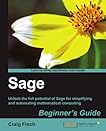 Sage Beginner's Guide by Craig Finch
My rating: 4 of 5 stars
I like to use Python for modeling and data analysis, and I tell my students that I consider Matlab, R and Python moral equivalents, made in kind by their wrapping of various numerical Fortran libraries, data structures for matrices and vectors, and numerous specialized libraries. But while there are Matlab books for every combination of field and level, and R books for every branch of statistics under the sun, Python books for data analysis are rare. Most introduction books are aimed at computer administrators or web programmers. Material on the web for scientists tended to be reference material that explained the functions available. The few in depth books seemed to assume that you were already a competent scientific programmer who was adding a new language to the toolkit. Sage: Beginner's Guide is meant for the person who is learning scientific programming, and doing so using Sage. As such it is highly useful for those who are being introduced to scientific computing in Python world.
While I use Sage and Python in technical programming myself, I have not been able to successfully teach someone else to do the same. What Finch does is to introduce someone not only to tools available for Python programmers, but instructions on setting up the environment, the practice of technical programming, but also the idea that each of these steps sets up something else.
Sage is a large and highly capable program, so any book has to focus somewhere. So the chapters can be thought of as covering the following (Note: this is NOT a chapter listing):
- Introduction and installation of Sage
- Use of Sage as an interactive environment
- Python programming: Introductory and advanced programming
- Numerical methods: Linear algebra, solving equations, numeric integration, ODE
- Symbolic math: algebra and calculus
- Plotting: 2D and 3D
In each substantive chapter, topics are covered in a standard pattern. A brief narrative description, a short sample program that uses the concept, a description of what program does and why the output looks like it does, then sometimes there are exercises that you can use to confirm you understand the concept or build your intuitive understanding.
What is missing? These are probably additional topics for "Where do we go from here" chapter. First, they do not take advantage of the Python ecosystem. Because of the basics of Numpy, Scipy and Matplotlib, numerous other scientific libraries exist that are not in Sage. I would include some notes on installing packages for use in Sage (which requires some modifications to the standard procedures). Also, an explicit mention of Scipy, since it is the basis for a number of other scientific packages in Python.
Sage: Beginner's Guide is a great addition to the library. It fills the role of the introduction to technical programming in Python that for Matlab is filled by professors who teach computational science/engineering courses. I envision that my copy of the book will be loaned out to one student after another for some time to come.
View all my reviews
Note: I received a free copy of Sage Beginner's Guide for review from Packt Publishing.
Thursday, June 30, 2011
Parenting Month 8 - Attachment
 |
| From Baby at Exercise Hurricane Earl |
But that is only as long as one of us is present. The other major happening of the past month is we have started sending T to day care. And he definitely does not like it. We suspect that the majority of his time there is spent crying. We also have noticed this at the local YMCA (which has child care) and at a church nursery. While the Y and the day care don't think this is bad enough to merit calling us, we notice that after leaving him with others for a while he is sobbing for a while. One web site describes stranger anxiety at this age to be a sign that we are successful in developing attachments with the parents. By this measure, we must be wildly successful.
The other fun thing that we did was have him take part in his first Red Cross exercise. It was a shelter exercise and his job was to take the role of a baby staying at the shelter without his mom. A role that he played admirably according to all concerned.
 |
| From Discussion about lunch |
Tuesday, June 28, 2011
June 28, 2008: Three years
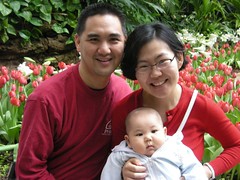 Every now and then in some parenting/marriage forums the discussion topic "which is easier/harder, marriage or parenting." And well before we had our first son, we were convinced that the answer would be parenting, if nothing else because we found the transition into marriage to be a very pleasant one and could not imagine the transition to parenting to be as good. And while there are not major dramas involved, I think that I would still consider being a new parent is harder than a new marriage was.
Neither of us had ever been much for the propaganda that surrounds both marriage and parenting. Neither the comments about how wonderful both would be, or the assumptions that either are signs of maturity or social skills. For both of us, it was a part of life, and it happens that it is a part of life that most people took part in, but no more.
What makes parenting difficult? Not to talk about the day to day issues (that is for my monthly updates), but more of what is intrinsically different about a family of two adults compared to having a third person who is completely dependent. For all talk about two becoming one, for us, marriage was still two people who were living life alongside each other, but we were still growing and had room to explore life while alongside each other. Each of us was making personal decisions that was separate from our marriage. While marriage provided the color and background scent of our lives, both of us had more. We can make decisions that affect the other, but both of us had resilience, and could disagree and influence the other.
With a baby it is different. We can make decisions, and the baby is dependent on our judgment. And that has changed the dynamic of decisions. Because we cannot get good feedback from a baby, we are reduced to guesses and feelings about what the root problem is, or even what constitutes a problem. And this is heavily influenced by what babies we have been exposed to, how intensely, the tendencies of parents to trumpet good things widely, but hide problems, books we read, and who we happen to talk to. And for most of us, the number of babies we actually have is small (certainly not enough to form a valid sample).
So we have the things that have gone well (baby is thriving, he is generally very happy, well attached to both parents, teething was fairly painless) and not so well (was colicky for many months, doesn't sleep well or self-sooth, does not take alternate care-givers well, does not socialize with others well, not really as active as we would like). And with the realization that all of our parenting desires are not all achievable (especially the sleeping part), the question is turning to what are we willing to sacrifice to achieve the desires we have not met. Because in the past it was enough to talk about things and know that our opinion is part of the eventual decision making. Now both of us are fully engaged in this thing called parenting, and we are interpreting the same information differently we do not make the same decisions with the same goals. And that is what the electrical people call impedance mismatch. ('friction' does not quite get the sense right)
One of the things that is nice about the fact that we are both on academic calendars is that our slower pace makes working through this easier then it will be when we are on our full job responsibilities. But still not easy. But we have years to work this out.
Sunday, June 26, 2011
Review: The Manga Guide to the Universe by Kenji Ishikawa
 The Manga Guide to the Universe by Kenji Ishikawa
My rating: 3 of 5 stars
The Manga Guide to the Universe is another offering in The Manga Guide to . . ., this time focusing on modern astronomy. And this is not astronomy as in star watching, this is astronomy as in modern physics. It tries to get across the fact that science is about answering questions through reason and data. But with cosmology as the subject, the plot is more obviously contrived than others in this series, and in this case may be too distracting to achieve its purpose.
Reading The Manga Guide reminded me of an astronomy course I took back in college. Like the others in the series, it presents the material in the context of an anime storyline set in a japanese high school, with a plot that involves some schoolgirls in a situation that requires some knowledge about astronomy to solve. In this case, they need to put on a play, and they require expert assistance in updating a traditional story for a play for modern audiences. But because too much of traditional folklore is not believable due to scientific advances, they re-write it so that the principle characters are from other places, consulting with a local university astronomy student and an astrophysics professor to join them along the way.
The plot takes us to the moon, solar system, the Milky way and beyond. Each step has the characters identify a logical flaw in the current understanding, and then they reason through a solution, with the professor giving expositions as needed to fill in the facts or to demonstrate why the reasoned out solution is in fact correct (or not). While it can be fun, the writers clearly had more trouble on this one than in others, as the exposition often has to go on for pages, unlike other Manga Guide to the ... which usually only gives exposition to present a more concise and complete explanation of the principle that was just illustrated in the story. Because of this, while it is mostly entertaining, I think that The Manga Guide to the Universe may have been a stretch too far covering too much ground for the format.
Note: I received a free electronic copy of The Manga Guide to the Universe from O'Reilly Press from their blogger program.
View all my reviews

Friday, June 03, 2011
How I use a Kindle (e-book reader)
I got the Kindle in September 2010. The timing was based on the fact that I had a baby on the way (more on that later). Because one of my hobbies is reading, and I realized that I was going to soon have considerable amount of time that I would be stationary, with only one hand available.
I already had a fairly large collection of e-books, mostly Adobe Acrobat files that are the daily nourishment of an academic. But I was also exposed to ebooks on my mobile phone and my long dead Palm Pilot. So I was used to the concept.
So what have I found? Like other data devices, the Kindle is an adjunct to my computer, not a replacement. Where it shines is in it's ability to sync with my computer, in particular I probably use the Kindle to read news as much as to read books (through pulling in news feeds in Calibre).
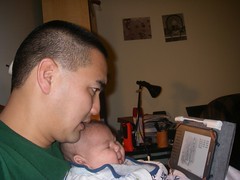 For books, I like the fact that there are lots of inexpensive books. One of the first books I bought for the Kindle was Sears' The Baby Book, which was a $5 special right around the time my son was born. I regularly check Amazon's discount section for similar gems. But the shining jewels are the free book depositories. Project Gutenberg with it's vast collection of older works, with the better offering conveniently arranged into topical bookshelves and the Baen Books Free Library and their many CDs of books available.
I am a particular fan of Project Gutenberg Children's Picture Books which have provided a fine introduction to the tales of Peter Rabbit and many friends.
The place I really appreciate the Kindle is when I'm holding my son, when he is sleeping Because my son likes to be held when sleeping. And reading is a good way to use the time.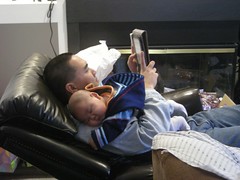 The Kindle is light enough and small enough to hold in one hand, or prop it up on my son without waking him up. And I can work its controls while doing so.
The other way to get something on the Kindle is email. Every Kindle has a name@free.kindle.com email address and you can send a file to yourself (after setting up your account so that it will accept the email). I do this to send notes (e.g. shopping lists) or documents to myself so I can look at them online.
Some issues:
PDF is awful. Because PDF is a fixed size, and the Kindle has no easy way of moving around the page or zooming arbitrarily.
Wifi works, but it is slow. Use sites that are optimized for mobile use is available. When the page is loaded, use the Kindle menu to switch to 'Article mode', which strips it down to the article itself (i.e. takes out all the navigation and advertising columns)
Final verdict: Very handy. I would recommend it to any parent who reads, because this will help keep you sane when you are trying to do anything else when with a baby. Also very handy for carrying around documents without carrying lots of paper.
Resources for Kindle
Calibre - Library manager for your ebooks. Manage all your ebooks that you do not buy from Amazon here , it has a RSS feeds and it will automatically load to the Kindle when you sync. That means you can automatically download stories from news sites, blogs about any topic of interest.
Send to Kindle - Chrome plugin that automatically takes any web page and emails it to your Kindle (assuming you have set it up with your email address)
ReKindleit - Plugin for Firefox. Same idea, when you are looking at a web page, email it directly to the Kindle.
I already had a fairly large collection of e-books, mostly Adobe Acrobat files that are the daily nourishment of an academic. But I was also exposed to ebooks on my mobile phone and my long dead Palm Pilot. So I was used to the concept.
So what have I found? Like other data devices, the Kindle is an adjunct to my computer, not a replacement. Where it shines is in it's ability to sync with my computer, in particular I probably use the Kindle to read news as much as to read books (through pulling in news feeds in Calibre).
For books, I like the fact that there are lots of inexpensive books. One of the first books I bought for the Kindle was Sears' The Baby Book, which was a $5 special right around the time my son was born. I regularly check Amazon's discount section for similar gems. But the shining jewels are the free book depositories. Project Gutenberg with it's vast collection of older works, with the better offering conveniently arranged into topical bookshelves and the Baen Books Free Library and their many CDs of books available.I am a particular fan of Project Gutenberg Children's Picture Books which have provided a fine introduction to the tales of Peter Rabbit and many friends.
The place I really appreciate the Kindle is when I'm holding my son, when he is sleeping Because my son likes to be held when sleeping. And reading is a good way to use the time.
The Kindle is light enough and small enough to hold in one hand, or prop it up on my son without waking him up. And I can work its controls while doing so. The other way to get something on the Kindle is email. Every Kindle has a name@free.kindle.com email address and you can send a file to yourself (after setting up your account so that it will accept the email). I do this to send notes (e.g. shopping lists) or documents to myself so I can look at them online.
Some issues:
PDF is awful. Because PDF is a fixed size, and the Kindle has no easy way of moving around the page or zooming arbitrarily.
Wifi works, but it is slow. Use sites that are optimized for mobile use is available. When the page is loaded, use the Kindle menu to switch to 'Article mode', which strips it down to the article itself (i.e. takes out all the navigation and advertising columns)
Final verdict: Very handy. I would recommend it to any parent who reads, because this will help keep you sane when you are trying to do anything else when with a baby. Also very handy for carrying around documents without carrying lots of paper.
Resources for Kindle
Calibre - Library manager for your ebooks. Manage all your ebooks that you do not buy from Amazon here , it has a RSS feeds and it will automatically load to the Kindle when you sync. That means you can automatically download stories from news sites, blogs about any topic of interest.
Send to Kindle - Chrome plugin that automatically takes any web page and emails it to your Kindle (assuming you have set it up with your email address)
ReKindleit - Plugin for Firefox. Same idea, when you are looking at a web page, email it directly to the Kindle.
Subscribe to:
Posts (Atom)