Sunday, February 14, 2021
Theatre during COVID-19: The Catastrophist by Lauren Gunderson and the Marin Theatre
Saturday, February 06, 2021
The home gym in January 2021: An ode to StreetParking
The Basement Gym Equipment
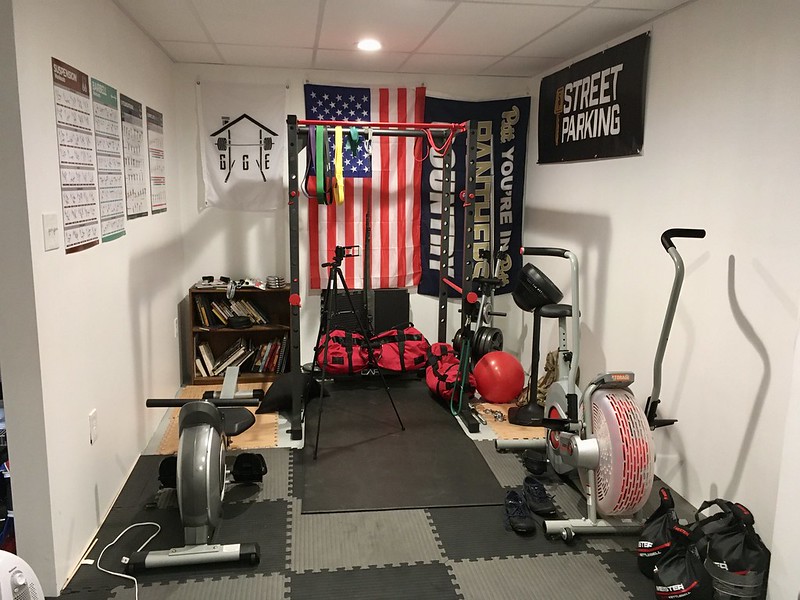
Here is the current state of the basement gym. When we bought this house, we decided to make the basement a gym (the previous owner basically used it as a messy closet), so we had ordered mats that would arrive just after we moved (and before the movers moved our stuff). So the main part of the basement was immediately covered in 3/4" mats suitable for exercise.


What we do
Streetparking
Monday, January 04, 2021
Fitness in 2020
![]() |
| Heart rate zones and training benefit |
Bassically, I continued to do about 5 workouts a week. But a lot more endurance (run, row, cycle), in part because of doing the endurance program (many of which did not get counted here). I increased Buts and Guts. This is generally bodybuilding type workouts, but focused on core and unilateral lower body, which helps in preventing injury. After I went to physical therapy for IT band syndrome in summer 2019, I did Butts and Guts on a regular basis. And less use of the sandbag, since I had other things to concentrate on. (Program A is a kettlebell/dumbbell focused, Program B is a barbell version, Program C is a sandbag version of the same workout)
Thursday, December 31, 2020
Book review: Weapons of Math Destruction: How Big Data Increases Inequality and Threatens Democracy by Cathy O'Neil
Weapons of Math Destruction: How Big Data Increases Inequality and Threatens Democracy by Cathy O'NeilMy rating: 5 of 5 stars
There is a popular diagram that describes data science as a combination of math and statistics, computer programming skills, and subject domain expertise; and describes the dangers of what happens when one of those three are not available. But among academics, there is an opposed line of thought that says that math and statistics methods are pure and subject independent. This book is firmly against the idea that algorithms are a defense against bias. The reason may be that while the mathematician/machine learning modeler may be naive, the setting of the implementation is not, and the questions that are being asked as well as the data being used to train models are both affirmative choices where the analyst and customer have agency. And pretending to be a naive analyst leads to errors in the result that have real consequences.
O'Neil goes through a number of cases. But while many accounts will go into the "evils" of big data and machine learning, she does suggest good practices that can prevent the dangers. First evaluation of the model. The model should be tested by actually looking at its predictions and seeing if they are true. In statistics this is done through control groups. In data science this is done through holdout test sets. And in her case studies, she points out this is not done. Next, compare the model input data set to the population that will be applied. Again, she regularly points out where this is not done. A third one is the well known make sure that you are not using machine learning to perpetuate an undesirable status quo. (but this argument is too easy)
Read this at a book club at work. It spurred a great discussion, that has carried over into other conversations. Definitely recommended to those involved in data science/analytics where people are impacted, and in areas where data analysis is becoming a bigger part of life, so as someone who works with the results of analysis you can ask good question, both while the analysis is planned and performed, and in understanding and questioning the results.
View all my reviews
Thursday, August 06, 2020
A data point on the efficacy of fitness trackers
You may not realize this, but if you own a smartphone, it comes with a step counter. Because it tries to count steps while in your pocket. (my son can explain to you how step counters work). But the magic in step counting is not being able to count steps, it is mental, it gets you to be more active based on the "if it gets measured it gets done" principle. Meaning you actually have to look at the numbers every now and then to get the motivation to do something about it.
So, I'm a lapsed runner, but I run a decent amount. I got my iphone 5 somewhere in 2017 (I think) and that is when I now got Apple Health, which lets me see the iPhone step counter. So this is what it shows me for those first few months.
Saturday, June 06, 2020
Teaching kids micro:bit and makecode during COVID-19 quarantine
For classmates, our first community that we reached out to were the other kids from his LEGO robotics group. I already had a number of email addresses from organizing an outing, and these were all kids who knew blockly style programming (or Scratch like) and programming in the physical world. The next source was a local chinese parent WeChat group. And we were looking for kids roughly the same age as DS9. And we found one more from a camp that DS9 was in last year.
The goal was teaching programming, and for this, I choose block style programming, specifically on the BBC Micro:bit. The micro:bit was created for teaching introduction to computer science in Britain. They goal was a microprocessor that had on-board physical inputs and outputs, the ability to connect to other components, and could by taught by middle school teachers, who had a wide range of comfort level in teaching technology, and likely no comfort in teaching programming. Blockly style programming (using makecode) is particularly suited as it had enough range to allow the application of computer science basic concepts, but without issues such as syntax, which in normal text based programming often dominate an introductory computer science course. (in computer science, the concepts are the important part, syntax is merely the implementation. The focus in time and energy on syntax is considered a distraction)
For materials, my mainstays of Adafruit and SparkFun were both unavailable. Adafruit was designated an essential business, but was focusing on medical suppliers. SparkFun was closed. So we had to source kits from Amazon.com, who was working from stock. The micro:bit itself was available, but kits tended to be from one of the multitude of unknown suppliers.
For curriculum, I used the book micro:bit in Wonderland from Tech will save us. The target audience was people who could not program, and it was craft based, where the projects all had a programming component and a craft component (that interfaced with the micro:bit board through alligator clips and the touch pads. As an added bonus, there was a motivating reading, from Alice in Wonderland (which many people already owned, but was also free as it was in the public domain on Project Gutenberg.)
- Impacts of shutdown. The micro:bit was generally available on Amazon.com, but the kits of basic supplies were not. There were two sources that were left, the https://www.techwillsaveus.com/site and various no-name kits on Amazon.com The no-name kits tended to be breadboard based kits as opposed to alligator clip based kits. For elementary and middle school classes, the alligator based kits would have been much better
- Block coding on micro:bit was something the kids took to easily. Even the one who had no programming experience (meaning not even having background in Scratch). Using makecode was easy. By the second week everyone had a microbit (not necessarily a kit) and getting working makecode onto the micro:bit was not hard.
- First hard lesson was the control of the LED light, which was the first lesson that got off the micro:bit board. As this was really the first experience in physical computing, I believe that this is also considered a first milestone in electrical engineering. It took a lot of one-on-one attention to get everyone through this. But all of the other physical computing lessons (touch pads, connecting to sound speaker, other LED light projects) went much easier.
- If-else was not a problem
- Kids enjoyed the sound projects. Both the buzzer, then the music box.
- They also had no problem working through complicated if-else trees
- The big assignment here was to use the microbit as a musical instrument, which meant making lots of sounds (kids like noise)
Monday, May 25, 2020
Parenting month 111: Online school during COVID-19
So our kids have both moved to online learning. Just as both of us academic parents moved to online teaching. They have gone through many rounds as everyone; kids, parents, teachers, administrators; have been figuring things out as we go, trying new things, discarding things that were too hard, trying for what works while minimizing the pain over the perfect.
We do have the advantage that our kids generally like being around us. So the first few weeks they were very happy to have both of us around all of the time. Of course, DS9 eventually started to realize that mommy and daddy school is considerably more demanding than regular school (the cost of having picked two academics to be parents. From the day he was born we joked that he clearly was not thinking things through when he picked his parents, probably was thinking about food)
Our schedules have settled into a pattern. In the morning both kids have to check their schools communication channels. Both schools at one point had several information channels to check, which definitely caused problems, but they have settled into one location for DD6, and two places for DS9. Both kids generally finish their school work before lunch (with minimum help from parents). Then comes mommy and daddy school, which generally includes piano, chinese, math, and extra curriculars.
Most enrichment programs closed down due to COVID-19 at the same times the schools did. Although a large number of asian parents in the area were talking about pulling kids out of school for a couple weeks before PA schools actually closed down (we were only one day ahead of the PA announcement). Eventually, many enrichment activities went online, using Zoom (just like all of our work places). TKD started up online fairly quickly, and our kids joined in once a whole cycle started as online. Ballet started online with the Pittsburgh Ballet using online kids classes as an outreach to maintain contact, and now the closer in schools are starting up online classes starting with the summer camps. The LEGO robotics school DS9 is in is going online for camps, they have procedures of how to do in person (limited numbers, distancing) but we'll see if they actually carry them out (if WPA remains in yellow, I expect that they would definitely do so if WPA goes to green status).
For math, we are somewhat putting it on hold while they still go through school. It is a little easier now that our university work is done, but as their school winds down we will add that back in. DS9 will go back to Beast Academy to finish off level 5 (which will reach the end of the Art of Problem Solving Beast Academy series for the younger students). We will be exploring the main AoPS at some point. DD6 is still not ready for Beast Academy, so she will do a couple of books from the Life of Fred series. Like Beast Academy, it is a math series that promotes learning to think about math instead of drill and kill (the way most American learn math, and learn to hate it). She is doing it online with a friend, which seems to be cause for much laughter in the room.
My contribution to teaching kids during COVID-19 has been teaching a programming with micro:bit to kids we have met from a few sources, mostly the LEGO robotics (their online program had not started yet) and chinese families. In addition to the materials at microbit.org and micromag, we used a book "microbit in Wonderland", which had a craft feel to it for relating computing to the physical world. Most (but not all) of the kids had exposure to Scratch (scratch.mit.edu), but generally the act of connecting physical items like lights, speakers, and conductive surfaces (aluminum foil) was new (outside of packages systems like LEGO robotics). I suspect most electrical engineering professors would tell me that my experience of everything getting much smoother after we go to the point of controlling light bulbs is a known fact of life. The whole "teaching pre-teens programming online" experience has gone off much better than expected, with the parents telling me that the kids show off the weekly homework projects. And having 7 out of 9 effectively make it to the end is probably a good record :-)
So, the end of the online school year is in sight, and I sense that teachers and kids are going for survival to the finish line (my university reminded faculty from the beginning of the online teaching period that the goal was survival, not perfection) So the next phase will be replacing the usual summer camps with either online versions or us working at home (or parent run groups, coop style)
Monday, May 04, 2020
Senior capstone during COVID-19
For looking ahead, I had told our senior capstone course during their midterm presentations on March 6 that COVID-19 was coming, and that they should expect it to be here before they returned from spring break. Chatter among the Chinese community in the north hills of Pittsburgh was about when to pull the kids out of school, first in dread of the return of college students from spring break, then after that watching COVID-19 march toward us when it reached Cleveland. And we pulled our kids Friday March 13. That day, our school district announced that everyone should be prepared to not come back to school from the weekend, somewhat jumping the gun on the Commonwealth's announcement, but basically being correct.
All the schools (universities and kids schools) went on a one week pause while all of the teachers figured out how to convert their classes to online for the foreseeable future. For me, this first affected the Pitt Industrial Engineering Senior Capstone course, which had corporate sponsors. Once Pitt announced the delay of school, I sent a message to all of the students:
As you have heard, the University of Pittsburgh is postponing the start of classes until Monday March 23. The extra week is to give faculty a chance to make a plan to move to online delivery of classes. While the university and school of engineering are working on setting policies and plans, I can offer the following:
Reminder to all groups.
1. Please send me and your faculty mentor the report specified in 2 by the end of today. Also, let me know as much as you know about (3), (4), (6).
2. You should have your next meeting with your mentor scheduled. As per recommendations, this should be a virtual meeting. Make sure that you have a videoconference method that you have complete access to (i.e. no time limits) (Note: as Pitt provides you with an account MS Teams is such a method. The faculty should be getting enterprise Zoom accounts soon, but that requires the faculty be present in the meeting.)
3. Professional Note: What we are doing is called a Continuity of Operations Plan (COOP). While not always done, there are many management recommendations that any organization have one that covers loss of key personnel, loss of access to facilities, and potential disasters. Ideally (but not always done) this is exercised on occasion. E.g. I volunteer with Red Cross for disaster response operations in western PA. Every now and then, we have an exercise where the staff are hands off, to confirm that the volunteers can manage a regional disaster response in it entirety without staff participation.
----
The Capstone program coordinators had a meeting this afternoon.
- The Design EXPO is cancelled.
- Please inform your sponsors.
- I need a report from each of the teams by Monday to understand your status and resource needs.
- What is your plan on remote collaboration (again, I am recommending Microsoft Teams as a collaboration platform if you have not chosen one). Have you tested the collaboration platform?
- What is the status of team members (i.e. where are they geographically)
- For teams that are not substantially done (substantially done means you are running models and analyzing results), what needs are remaining? What is your plan on meeting those needs?
- If your needs are data related, you should anticipate the possibility of not being able to collect data. Do you have the expertise to work with minimal available data and generate appropriate probability distributions (Note: these are topics from probability and from simulation) Is your faculty mentor able to help you? If not, I (Luangkesorn) am the faculty with the most research and practical experience with knowing what can be done with limited to no data.
- Discuss with your sponsors your plan for ongoing collaboration. In particular, how the final presentation will be done. Note: Pitt has Microsoft Teams accounts for all of you (see previous message) and I recommend that as a presentation platform if they do not have one.
- As the EXPO is cancelled, your company presentation (if recorded) will be your final presentation. You should have the presentation recorded and have your faculty mentor(s) and myself invited. Check with your sponsor if there are any security considerations. If you are not able to make a recording or invite the faculty to your company presentation (or if there is not a company presentation before finals week), we will have to make another arrangement (i.e. a presentation over Microsoft Teams)
- For all teams, check with your faculty on if there are any limitations on your reaching out to other faculty and getting assistance. You must do this. In the past, there are faculty who have gotten very angry about their team consulting with other faculty, even at the point where the team was fearful of project failure. You need to have an affirmative response that consulting other faculty is acceptable with no reservations. Do not wait until you need help to get this taken care of. My instructions from the department are to ask for permission to respond to your request from help, and to allow the team to fail if the answer is no.
- As I mentioned on the first day of class, during senior design, life happens. Back then, I was thinking of individual events, but this is clearly something much larger. Just as I said on the first day, be flexible and take care of each other. While I asked about geographic locations earlier, also check on everyone's physical and mental states. We are all human, and everyone's situation, especially those at home, is different.
- If you have questions or concerns, or even if you need a human contact, contact me.
Wednesday, January 01, 2020
Home gym in December 2019
![]() |
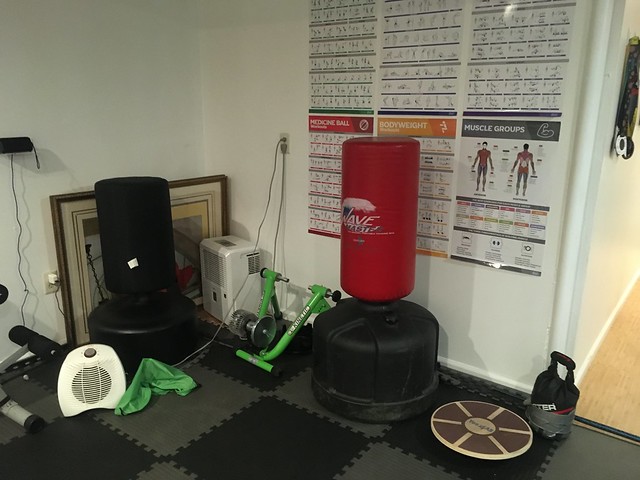
| Floor and taekwondo equipment |
![]() |
| Power rack and cardio |
I also have two RepFitness sandbags that I've had for about 1 1/2 years. One is 50 lbs and is my normal use. The other is 65 lbs that I use for heavier olympic lifts., and as my fitness improves, I will add weight to it. In the lower right corner are sand kettlebells, 10, 15, 20, 25 lbs. I like these because they are safe around the kids, so DS9 and DD5 are cleared for sand kettlebell use and can do deadlifts, goblet squats, upright rows. DS9 can also do presses and KB swings. They are also good for a warmup, 20/25 lbs is a good warmup weight to get loose. The sandbags and sand kettlebells are what I use if I want to take a workout outside, as they won't break on the driveway. The CamelBak HAWG (in DCU) is used for rucking, I load it with a 25 lb plate.
For cardio equipment, I got the Schwinn AirDyne and the Sunny magnetic rower off of Facebook Marketplace. I probably like the rower more, but DS9 is cleared to use it and he tends to use it when we are working out together. I can get more intense faster on the AirDyne, but I can probably go for longer on the rower. I had first bought a hydraulic rower off of Facebook Marketplace, but when I figured out that I would actually use cardio equipment, I bought the magnetic rower and eventually sold off the hydraulic rower, for more than I paid for it.
![]() |
| Boxes and odds and ends |
Last corner is the DIY pylo box (16" x 20" x 24") and the steppers (church sale) The kids use the stepper when I use the box for stepups or jumpovers. Also in this corner are physical therapy equipment. The balance board, stability disc, and foam roller. I started using these when I was in PT for IT band syndrome. The medicine balls (6, 10, 14 lb) in the corner are also approved for use by DS9 and DD5. Also are the various electronics. The Amazon Fire stick connected to a monitor and bluetooth speaker provides background music. A kitchen timer and Gymboss timer provides timing. Then I have a Polar H7 chest strap HRM, a ScoreIt band for counting rounds, and the obligatory whiteboard. I have recently gotten the Polar M200 heart rate monitor, and I have started using it to record all of my workouts.
At this point, with various equipment collected over a decade, this gym looks pretty complete. I cover strength and cardio, power and olympic weightlifting, along with a pretty complete set for martial arts. The need to keep space around the power rack clear and the desire to have a large open floor space fights any urge to collect anything else. And behind all of this is a belief that it is better to spend effort on skill development over equipment (which is why this gym is focused on free weights)
For programming, I use StreetParking https://www.streetparking.com, which is an online CrossFit style programming at $19/mo. This setup with free weights and lots of floor space works out just right for it. They have several versions of the same workout (same stimulus) each day, A is dumbbell/kettlebell based and can include running and the pylo box, B is barbell based, C has other equipment such as sandbags or the rower/air bike. Then there is shift which is a simplified version of A. When the kids are with me or I have also done something else (TKD), I do shift. Otherwise I do A or C (kettlebell or sandbag) depending on if I am feeling particularly badass (sandbag!). Weekly, they also have a range of accessory programs. I usually do endurance (run, row, or bike). They have two strength based programs, power (lifting) and olympic. Over the summer when I started physical therapy I started doing Buts and Guts regularly, because these exercises tended to match the PT exercises hitting my legs in different directions unilaterally. There is also a program called Suns out-guns out, which is semi-jokingly the bro-sessions you may find in most commercial gyms or fitness magazines focusing on arms and chest. They also have special programs for specific goals. I did a 20 back squat progression last year. This summer I was doing a pull-up progression where there were three sessions a week with added exercises built around building up to pull-ups.
So, my standard workout is to take one of the Streetparking workouts. A second workout is focused on taekwondo (but this or physical therapy often becomes the warmup) where we (with kids) do a warmup/stretch routine, a few body weight exercises, forms (poomsae/kata), and bag work. A third type of workout are bodyweight workouts. There are two forms. One is the kids work off the posters and pick one upper body, one lower body, and one trunk/core exercise and we do rounds and reps. A second form is to take the Stack 52 exercise cards and draw 10 random cards. The last type of workout is cardio. This is either the rower or airdyne (my son likes to claim the rower) and I pick one of the Streetparking endurance program workouts on hand depending on what type of interval we want to do.
Tuesday, December 31, 2019
Parenting Month 106: A rounded life
- Taekwondo mid-term testing as a 2nd degree black belt
- Chinese final exam
- University music prep department piano recital
- Elementary school choral concert (Small Ensemble)
When we talk to other parents, we are dizzy trying to keep track of everything they do. Even DS9 feels busy to us, but then there are kids who can double up on every dimension (DS9 activities are roughly orthogonal to each other)
Even though DS9 did not cover many of the standard enrichment activities that are meant to lead to a selection, DS9 has been passing most selection stages he encounters (accelerated math, advanced programs, teams, music auditions). Fortunately, he does not have an appreciation for what this means, so he has not been participating in the posturing that is already observable in his peer group.
![]() |
| DS9 is in lower right |
For her part, DD5 is in the early stages of the same. She does drawing (with a chinese teacher), piano, and taekwondo, enjoys all three pretty much all of the time. And is noticeably happy, almost all of the time. Almost the ideal of what you want out of a 5 year old.
Just as with DS9 at this age, the kids in her peer group are all more heavily involved in activities than she is. And just like him, we will see how this turns out.