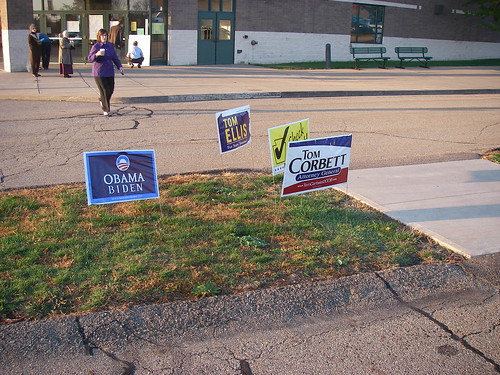
After voting (an hour wait at 7AM) I spent the day all over the North Hills of Pittsburgh, knocking on doors, reminding people to vote. Somewhat incongruous, because "everyone knows" the North Hills is overwhelmingly Republican. Or, it is supposed to be. Many people said thanks. A few were surprised to find that their polling location had changed from what they knew of it. And a few who proudly informed me that they had voted for McCain. Depending on my mood, I informed them I served my country in a combat zone so they could vote. And many people for Obama wondering "can he (Obama) win?"
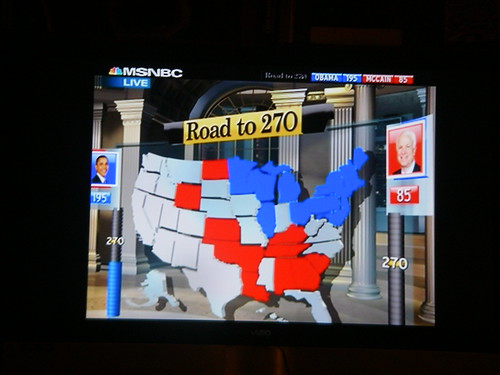
We spent the evening in a small house party at the local volunteer organizer's house. One of the shockers was seeing the networks declaring Pennsylvania so quickly. Because we remember back in summer that Pennsylvania was almost even, so the reports of ~10-15% advantage to Obama/Biden was "crazy talk".
Throughout the night as the results rolled in, and once it was apparent that the only thing that everyone was waiting for was the Pacific Time Zone states to report in, the phone calls were coming in. At our little party we got calls from friends in California, Virginia, Florida. The campaign staff at the local congressman campaign headquarters and those at the Pittsburgh headquarters, all sharing their joy, and asking if any of us wanted to go. But we stayed. Happy to be with our little band, basking in months of hard work, making calls and pounding pavement. And a President-elect who promises hard work ahead for this country.
One of those dark open secrets of American democracy is the embarrassingly low voter turnout rates. The U.S. is a country that considers 50% participation to be high. Dictatorships around the world point to this number and tell their populations that American democracy is a myth and not for their people. And they point to their 100% turnout in their elections, with 99% of the votes for the winning (and only) candidate. After all, 100% turnout is much more representative then the <50% the U.S. gets, even for a presidential election. It is a hard argument to refute.
This is one of the things that makes voter suppression efforts in the U.S. to be so insulting. The right to vote is the foundation for all the other rights. When an interest is shut out of the political process, the only means left to being heard is through violence. The right to vote brings groups that would otherwise resort to extremes and violence into the political process. And in the U.S. and around the world, moderates them. The modern classical example is the Basque region of Spain, where Basque separationist have operated for generations. Then the Basques were given semi-autonomy, and the responsibility of governance. Even with many issues still open, the violence went down.
To attempt the wholesale rejection of people's right to vote is to refute representative government as created by principles enshrined in the U.S. Constitution. It is cynicism in the extreme. One of the perverse effects has been the wholesale challenges to a large number of voter registrations in Ohio, where one of the challenged names was Samuel Joseph Wurzelbacher, also known as "Joe the Plumber." But Joe will be glad to know that the Democratic Party is fighting for his right to vote.
It is an altruism that you can be judged by the quality of your enemies. When the subject is political discourse, it is hoped that the saying can be rephrased to "opponents" oe "those who disagree." This U.S. Presidential Race is remarkable that there happens to be an issue that is considered a major flashpoint in American politics, and both major party candidates agree. Both Obama and McCain oppose same-sex marriage and both Obama and McCain oppose amending the U.S. Constitution to ban same-sex marriage. But the difference lies in the way this opposition is presented.
Gay rights activists have reported many interactions with Obama on the issue of same-sex marriage. The New York Times article and other reports are the same, Sen. Barack Obama will not back same-sex marriage due to his Christian beliefs. And there is no expectation that Obama will be changing his understanding of Christian tradition that "marriage is something sanctified between a man and woman" , nor change his acceptance of this aspect of Christian beliefs and teaching. But they support him despite his opposition to this dearly held goal. Because his Christian beliefs also include a belief in his own sinfulness and fallibility. And a Christian faith that recognizes the fallibility of the holder is something they can live with.
McCain's opposition to same-sex marriage is due to acceptance of culturally accepted norms, according to his advisors. But when this is communicated to those of the gay community, it comes out, wrong. Whereas Sen. Obama always openly communicates to the gay community that he will not support same-sex marriage due to his Christian beliefs, Sen. McCain is less straight-forward. In his interview with Ellen DeGeneres, they had the following exchange.
The California Supreme Court had just cleared the way for same-sex marriage, and Ms. DeGeneres had announced on her program that she planned to marry her longtime girlfriend. “We are all the same people, all of us — you’re no different than I am,” Ms. DeGeneres told Mr. McCain as they sat next to each other in plush chairs. “Our love is the same.”
Mr. McCain called her comments “very eloquent” and added: “We just have a disagreement. And I, along with many, many others, wish you every happiness.”
Ms. DeGeneres said: “So, you’ll walk me down the aisle? Is that what you’re saying?”
Mr. McCain replied, “Touché.”
It is not that their views are different, but Sen. Obama is capable of communicating differences with people, even on issues that they hold dear, even when the differences are irreconcilable due to an immutable value on Sen. Obama's part. While Ms. DeGeneres catches Sen. McCain offering patronizing platitudes without being willing to follow through in action. So Sen. Obama can disagree and leave his opposition's dignity intact, and with the belief that they are also viewed as human, with the greatness and fallibility this implies.
It is not only with the gay community that Sen. Obama does this. The Palestinians Sen. Obama deals with knows this, that they will never change Sen. Obama's staunch support for Israel's right to exist with secure borders ([Rashid] Khalidi added that he strongly disagrees with Obama's current views on Israel, and often disagreed with him during their talks over the years - LATimes). Yet the Palestinians who desire peace also view Sen. Obama as someone who can consider the interests of the Palestinian people in the context of a secure Israel. (Those that do not desire peace dislike Sen. Obama without reservation) He has spoken openly to African-American audiences about the requirement for personal accountability and individual work ethic. Messages that have been reacted to badly when delivered by others such as Bill Crosby.
In his book Audacity of Hope Sen. Obama talks about the interaction of political candidates with special interest groups. He talks about how political advisors recommend not answering questionnaires from groups that oppose them, because it only gives them more reasons to hate you. But somehow, Sen. Obama has figured out how to confront audiences with his beliefs that are in opposition to their's, and leave them thinking that he is still the person they want in office. And I believe it is because he has this understanding of his own fallibility, that he knows there are no silver bullets, that the tasks and issues are not black and white and easy, but that the path ahead is hard. And he asks that along this hard road, his audiences follow him and work with him. And that this hard road ahead is something they can find believable, more then the many false platitudes they have heard before.
[Obviously, this is my own views, not vetted or approaved by any other person or organization or company]
Democracy is the worst form of government except for all those other forms that have been tried from time to time.
- Winston Churchill, speech in the House of Commons, 11 November 1947
I've had the opportunity over the past few weeks to have a number of conversations with individuals about the U.S. Presidential election. And the fact that I was in Afghanistan does come up. With the proportionately small portion of the population associated with the military it is a different background. One of the most rewarding conversations was with one woman in the North Hills whose son has enlisted, and is going to start after high school graduation.
I first started paying attention to Obama after his "More Perfect Union" speech, given when he was being attacked because of the views held by his former Pastor. It was striking because instead of attacking back, or complaining about the unfairness of being attacked for the beliefs and views of another (beliefs that he disagrees with), he instead talked about what America was and could be. That America could be more like the 'City on a Hill' for the world to see and aspire too. And it is the 'last best hope for the world.' It was so different then the reflexive flag waiving or the criticize America that one usually hears that it is striking in its difference. And certainly to be dispised by the extremes on both right and left.
The areas I write about are National Security and ability to handle crisis.
1. National Security. The framework is the four elements of National Power: diplomatic, information, military, economic, referred to as DIME (Strategypage.com).
Diplomatic: A nations ability to rally allies, engage opponents, and persuade neutral governments. Obama has repeated stated that a forefront of his national security policy is to work with U.S. partners to further our shared interests and that he will engage potential opponents. McCain states as a virtue that he will ignore certain allies (will not commit to meeting with Spain??!!) and views engaging potential opponents as venal. McCain will instead form new groupings such as a 'League of Democracies' to deal with international issues as opposed to existing institutions such as NATO. The obvious question, what makes McCain think that NATO allies and the usual other allies (Japan, Australia, New Zealand, South Korea) are not an appropriate start (because NATO includes countries like Spain and France???)
Information: The ability to gather information, and communicate with foreign audiences. Obama would engage foreign populations directly to pursuade them and to undercut anti-U.S. propaganda. To amplify this point, look at a Obama-Biden rally vs. a McCain-Palin rally, and look at it from a point of someone in Asia or Africa or South America or the Middle East. Especially when Palin talks about representing 'Real Americans'. (Many in New York City think when hearing this 'We were American enough for Al-Queda, why are we not American enough for Republicans?') Obama's ability to do this is exemplified by Rashid Khalidi, a Palistinian advocate. Khalidi added that he strongly disagrees with Obama's current views on Israel, and often disagreed with him during their talks over the years. But he added that Obama, because of his unusual background, with family ties to Kenya and Indonesia, would be more understanding of the Palestinian experience than typical American politicians.
Military: Ability to apply military power. This goes beyond any shooting, as the U.S. military response to the tsunamis in Southeast Asia, the Philippines and disasters in Pakistan show. Both candidates will strengthen the military. Obama speaks also to bringing in the rest of the government (i.e. diplomacy and foreign aid) engaged on the ground in major areas instead of just the military. McCain does not speak to non-military elements.
Economic: Understanding how economic issues bear on foreign policy. Neither candidate speaks to this directly, as discussion of economic issues in the campaign focuses on domestic issues, but Obama speaks to applying the entire tools of the U.S. government to national security/foreign relations. McCain does not.
2. Crisis Management. The second area is the ability to handle crisis. When the U.S. has a new President and strong opponents, the new President will be tested. To say otherwise is naivete. The only question is how this crisis will be handled. This campaign had the added highlight of a major economic crisis, the potential fall of the U.S. financial system during the campaign.
From reports, we know of the following actions by Sen. Obama i. Discussed the strategy with House Democratic leaders for finance and economics. ii. As Democratic leaders determined their goals (that the rescue plan provide the opportunity for taxpayers to recoup their investments), Sen. Obama began speaking in public on the need for a rescue and the Democratic desire that the rescue be made as investments so the investment can be recovered. iii. Liberal democrats in congress who initially stated their willingness to let the U.S. financial system collapse report receiving calls from Sen Obama persuading them that the modified rescue plan was worth voting for. iv. The use of government purchase of equity was used by European governments as the cornerstone of their rescue, based on past experience by some European countries. As provision had been made in the U.S. rescue plan for potential purchase of equity in financial institutions, the U.S. Treasury took part in the plan.
From reports, we know the following actions by Sen. McCain i. Suspended campaign and went to Washington DC to work on the House negotiations, which collapsed that day. There are no reports of significant inputs to the debate, nor Sen. McCain's understanding or support.
Obama had made the comment that a "President will have to deal with more than one crisis at a time. His steadiness, taking the time to understand the issues, and ability to communicate the issues to other lawmakers and to the public are the mark of a leader. There is no evidence for results for McCain.
Colin Powell stated in his endorsement of Obama And he displayed a steadiness, an intellectual curiosity, a depth of knowledge and an approach to looking at problems like this and picking a vice president that, I think, is ready to be president on day one. And also, in not just jumping in and changing every day, but showing intellectual vigor. I think that he has a, a definitive way of doing business that would serve us well.
And these are the traits that I would look for in handling crisis.
There are other reasons for choosing Sen. Obama over Sen. McCain. Colin Powell discusses a number of them in his endorsement ((Transcript)). Christopher Buckley, onetime columnist with the conservative National Review does the same.One could go to the two candidate websites for information on what they believe. http://www.barackobama.com http://www.johnmccain.com
========== Colin Powell Endorsement (Transcript) (12:28)
Obama Closing Arguments, Norfolk, VA October 28, 2008 (35:47)
“I guarantee you that two weeks from now, you will see this has been a very close race, and I believe that I'm going to win it,” McCain told interim "Meet" moderator Tom Brokaw. “We're going to do well in this campaign, my friend. We're going to win it, and it's going to be tight, and we're going to be up late.”
This weekend my wife and I went to the Sunday concert and decided to have lunch before the concert on the Strip. And the most obvious thing about a Sunday afternoon on the Strip, is there is a Steelers home game! All around there was Black and Gold. On the sidewalks, in the stores, in the coffeehouse and in the restaurants, waiting for the late afternoon game against the Giants. It was a lot of fun to see the Strip alive on a weekend.
We wanted to try something new so we went to the Chicken Latino (ok, our first four choices were packed with hungry Steeler fans.) And something completely different, we had their Peruvian rotisserie style chicken while getting Clover-brewed coffee from 21st Street Coffee across the street. We knew we were in for a treat when we were looking at the selection of tabasco sauces on the counter and the guy there asked "do you like things spicy" as he reached back for "This is our hot sauce. You'll like it." And we did! A different variety of seasonings in the chicken, and the sauce was wonderful to our jaded taste buds (I'm Thai. We have standards before admiting something is spicy.) And I've long learned to appreciate Clover brewed coffee at 21st Street, even the new ones as they have switched their selection of beans (I liked the Ethiopean coffee I had.)
The soloist for the concert was Arabella Steinbacher. Unlike many of the soloists, she was not from an American school, but from Europe, and I was curious if it made a difference.
The piece was Scottish Fantasy by Max Bruch. During the concert pre-talk, we learned that Bruch never actually went to Scotland, the piece was composed after researching Scottish folk songs in the library. Being a researcher by trade who values on the ground fact checking, I had to groan at that.
The piece lended itself to very different interaction between soloist and orchestra then the soloists we have had before. While we have gotten used to virtuosi impressing us with their talent and emotion in cadenza, Ms. Steinbacher's strength was the balance with the orchestra. Sometimes the soloist was a secondary theme, weaving with the piece, sometimes the solo rose above the rest of the orchestra holding the audience at attention with the melodies. While I appreciate the raw talent that the soloists who play with the PSO have, I love listening to artists work together. As conductor, Janowski did a wonderful job working with that.
A different soloist, and a day for discovery in the Strip and at the Symphony.
rating: 5 of 5 stars This is a book I wish I had read at the beginning of grad school. How to Solve It is not as much about methods of solving mathematical problems as it is about various approaches to solving problems in general. The method he uses to teach problem solving is to apply the approaches to problems of geometry. This is actually in line with the ancient greek (Aristotle) opinion that the young should learn geometry first, then when they have learned logic and how to prove things with physical reality, then they can go on to things such as philosophy or politics.
The first part of How to Solve It are essays on how to teach and how to approach problems in general. His view on teaching is leading a student to think. Giving the student problems where the answer is not the goal, but the experience in seeing a new type of problem. This is contrasted with viewing teaching as a series of cookbook or algorithms to be taught. It also means the role of the teacher is to provide the problem, then give only what is necessary to nudge the student in the direction needed for the student to discover the method of solution. And presumably, to be able to develop methods for other problems the student has not seen before. Very much like what graduate school is supposed to be.
The bulk of How to Solve It describes a wide range of approaches to problem solving. Some are familiar to a variety of disciplines such as business, crisis management, or general analysis. Some are more familiar to those in sciences or mathematics. But the illustrations are understandable to anyone past a first or second year of high school mathematics, making them much more understandable then, say, a graduate course in real analysis.
If I was in the position of working with first year graduate students in anything, I would recommend this book as something to read before they arrive on campus. It provides a good first exposure to many problem-solving approaches and an exhortation on how to think logically and analytically, that will suit them well when they are faced with the complicated subject matter that is ahead of them.
Colin Powell in his endorsement of Senator Barack Obama for President
"Well, the correct answer is, he is not a Muslim. He's a Christian, has always been a Christian. But the really right answer is, 'What if he is? Is there something wrong with being a Muslim in this country?' The answer's 'No, that's not America.'"
[Original is at the Pittsburgh Symphony Blogs] Yeeha Chiu, Piano *Dennis O'Boyle, Violin *Michael Lipman, Cello Daphne Alderson, Contralto *Paul Silver, Viola *Laura Motchalov, Violin Pauline Rovkah, Piano
* PSO Musician
When I lived in Shadyside, one of the benefits of living there was the close proximity of Chatham College for chamber concerts and talks. Smaller then Pitt and CMU, it made for a more intimate setting. In particular, I like chamber music there. I like the interplay between the players that you don't get as much in a symphony, and everytime I go to Chatham, I engage in conversation with others in the audience during intermission and afterwards.
Last Sunday, several members of the PSO along with notable local pianists and a contralto, had a chamber concert as part of Chatham's Chamber Music series. Among the seven artists, there were five distinct groupings with music by Haydn, Brahms and Schumann.
Why do I enjoy chamber music? It is the interaction between the players. There is the stimulation of trying to follow the motif passed among the parts And in the larger groupings, hearing the various parts weave amongst each other. In Haydn Trio in C Major for Violin, Cello and Piano (Hob XV No. 21) it is between the piano and the strings. For Schumann Piano Quintet in E flat major, Op. 44, at times four distinct lines are weaving in and out of each other simultaneously, in addition to each of the five parts taking their turns with the motif in different styles.
And in the end, as we broke for the reception, Pauline (Director, Piano program Chatham) made a special announcement. It was her father-in-law's birthday! And 200+ music lovers sang Happy Birthday along with Piano and Violin. A picture of a community enjoying each other.
No one man can terrorize a whole nation unless we are all his accomplices. (1954)
We must not confuse dissent with disloyalty. We must remember always that accusation is not proof and that conviction depends upon evidence and due process of law. We will not walk in fear, one of another. We will not be driven by fear into an age of unreason, if we dig deep in our history and our doctrine, and remember that we are not descended from fearful men — not from men who feared to write, to speak, to associate and to defend causes that were, for the moment, unpopular. (1954 on See it Now)
Good Night and Good Luck was about Ed Murrow, a broadcast journalist with CBS in the 1940s and 1950s. His fame was based on his broadcasts from England during the London Blitz, which is where his catch phrases "This . . . is London" and "Good night, and Good luck" originated. This movie describes his conflict with Senator Eugene McCarthy during the Red Scare.
What we see is a newsroom as you would hope for it, in the early days of broadcast television. Producers getting stories, and trying to determine what is known and not known, and to pitch a story, as hard as the facts may warrant it, but no more.
And you see the pressure that was put on the journalists for doing this. Senator McCarthy used intimidation, secret evidence, guilt by association, and near blackmail to further his cause. And in it all, there was almost no proof.
Ed Murrow also pushes the point, that Senator McCarthy's primary tactic was to paint people as guilty by association. The mere association with people who were communists was enough to be a target of McCarthy. But unless you live a sheltered life, outside the streams of human suffering and existence, and outside the stream of history, you cannot avoid associating with people with unsavory pasts. Murrow responds to McCarthy's accusation that a socialist author dedicated a book to Murrow by stating that author belonged to a time and tradition that allowed people to be friends with people they disagreed with. And the book dedication that McCarthy gave as evidence of communist leanings acknowledged that Murrow disagreed with the author on principles. McCarthy's argument was pure innuendo, with no substance beneath the surface.
The movie does have a 'just the facts' aura to it. Events and decisions are made bluntly, purely business. There is rejoicing after the job is done, but the actual work is deliberate. The many subplots makes the whole thing almost inhuman. Except for the McCarthy emphasis on character assassination. As the CBS crew reports it, and is a target of it, you see the cost of character assassination in careers ruined, lives ruined, people driven to suicide. All of which steels the CBS crew in their determination to resist the pressure and present the news in an manner beyond reproach.
A very good movie. The antagonist use of character assassination by association is something that has been used many times throughout history, and Good Night and Good Luck does a good job of showing the cost, foreshadowing what kind of world would result if it left unchecked, and showing what resistance to that kind of world looks like.
Saturday night's concert had a treat. Two modern pieces, including a world premier written by Theofanidis with the performer the piece was written for as the soloist. And the Rachmaninoff symphony to provide more traditional meat in the second half of the program.
One of the things I like about going to the Pittsburgh Symphony is the composer in residence program. As much as I enjoy concert music, I am not versed enough to be looking for new music myself. And frankly, the sheer volume of new material is daunting to wade through and separate the wheat from the chaff. Classics are called "classics" for a reason, they have been filtered through the ages and on several different generations of review, they have a certain level of quality. The newer concert works do not have that, and for someone like me who sometimes enjoys the modern works, it is nice to have a filter. In the literary arts this is an editor. But for concert music, I take advantage of having the Pittsburgh Symphony bringing in composers and giving them space to work.
I've never seen (or heard) Nixon in China. But listening to John Adams The Chairman Dances I could almost see a plot. The first part with the buzz of activity growing as various parts are preparing for the historic occasion. The switch to a more melodic middle during the event itself (and maybe a flashback scene along the way?). And the event ends with slowly diminishing activity, until all goes quiet. Now, granted, I just made all that up, but the story in the music was so strong, the composer and orchestra almost seemed to deserve listener imagination of a story.
Hearing Theofanidis give a pre-performance talk before his Concerto for Violin and Orchestra was performed. (I was trying to arrive in time for the pre-concert talk, but traffic was a bear.) I remember a talk of his when he was the PSO composer-in-residence and it was a treat to hear it again. There are not that many opportunities to have an artist talk about the creative process, especially when those that would perform the piece (orchestra and soloist) were providing feedback while the piece was being composed. The whole process is that much more alive then the idea of a composer writing the work, then passing on to an orchestra, conductor and soloist to do what they will. Last year, we had the pleasure of John Corigliano and Joshua Bell being present for the Red Violin Concerto and having both of them talk about how they worked together and what the piece was meant for made the experience richer.
There are many reasons to go to symphonic concerts in person. Part of it is to hear the music in a richer form than would be possible off of recordings in the comfort of home, both because of the acoustics and the uniqueness of the interpretation that always happens with a different combination of performer, conductor, setting and audience. There is the beauty and elegance of the setting (ok, I'm not an expert here). And there is the witnessing of the culmination of a creative process that starts with a spark or theme in a composers head, then gets marinated, developed and refined over time and contact. And the composer-in-residence program at the PSO gives us a window into this.
Watching the two candidates respond to the ongoing U.S. financial crisis has been instructive. While the media spin has been that these are a continuing series of "bailouts" it is hard to think who has been bailed out, instead the owners (stockowners) of the institutions in questions have taken a bath, while their customers, clients and counterparties are merely protected from loss (to the extent that their individual dealings were of good quality).
The two candidates (McCain and Obama) do show their different ideas of leadership. McCain opted for publicly jumping into the fray with his physical presence. Senator McCain openly stated he would jump into the negotiations of the U.S. House of Representatives (which he is not a member) and inject his leadership. Nevermind if the House leadership was interested in this (polite statements afterwards aside). Senator Obama spoke to his colleagues in the House so he could understand the issues, then spoke to the American people to explain what the issues were (see LaCross, WI speech below).
The McCain is the in-your-face Great Man view of how things work. He promises that his vast experience will enable him to survive and be successful in the backroom face-to-face negotiations. Can this occur? Every freshman political science student has seen pictures or descriptions of President Lynden Johnson giving "the Treatment" from when he was Majority Leader of the Senate.
But there are actually facts and realities that lie behind these issues, and it is more then just personalities and "special interests" (are "interests" "special" when you are talking something so broad as the U.S. banking and financial market? Who does not have a bank account, work for someone with a line of credit, or have investments in stocks for retirement?) And this is where Obama shines in comparison to McCain. McCain derides as elitist Obama's tendency to explain the issues in their complexity as opposed to giving out soundbytes. But the historical parallel here is Franklin D Roosevelt, in the 1930s during the Great Depression with his fireside chats. Talking directly to a population scared of the future, he acted as if normal people were capable of understanding issues, or at least listening to them. But he also convinced the people that he had taken the time to understand something that was unfathemable to them, and because of that, he could guide them through the fearful unknown.
And that is what Obama is doing. Instead of riding the popular "hang them all" opinion that was seen by the House Republicans, he works behind the scenes in Washington and takes part in the building of a plan that he can understand and then go to the American people, and let them know what the issues are, not just the soundbyte "this is a bailout of fat pigs" rhetoric. He takes risks, as the conservative Republicans threaten they will use any vote that preserves the financial system to cruxify their opponents. And he does this, not in sophisticated audiences like those found in big cities, in university towns, or in a financial audience, but LaCross, WI. In a rural corner of a state that is bordering another rural corner of another state.
As for myself, I'll take intelligent analysis that can be presented to the people over backroom deals, soundbytes, and trying to fly in front of the wind any day.
Reno, NV
"if your neighbor's house is on fire, you can say that he is irresponsible . . . but first you help put out the fire, because it can spread to your house."
First concert of the season. Actually, I think I've only been to opening weekend once, two years ago. But I remember the start. The assembled audience openly singing 'The Star Spangled Banner' to the best of their ability accompanied by the Pittsburgh Symphony Orchestra. A performance I find better then any celebrity with their own interpretation of the piece at a Super Bowl or World Series.
The Star Spangled Banner has changed its meaning to me over the past two works, which is proper as an artistic work (which it is, among other things). In the past two years, I have been attached to military forces to Afghanistan, and I have responded to fires and worked in Hurricane response as a Red Cross volunteer. I've been alongside those in the military, fire, police, all levels of public service and volunteers doing their jobs in non-standard conditions. To use some allusions to literature, classic man vs. man and man vs. nature scenarios. Some of the people I worked with were tuned personally to working in crisis and emergency conditions. Some were not. But even those who were not, generally strove to do their duty even when in situations much larger then themselves. And I was glad to be in their company.
With this frame of mind, I listened to the PSO play 'Short Ride in a Fast Machine.' I've listened to versions on the internet, but somehow, the hearing it live, in the concert environment, with all the variables of the concert setting such as an audience, the orchestra and conductor, and its place on the program, changes its meaning. I spent much of the past month in Texas and Louisiana volunteering for the Red Cross, serving in government operations centers. In these centers, there were representatives from a wide variety of state government agencies, working to provide support for citizens being impacted by the hurricane or in the early stages of recovery. Many of the workers there were used to working in emergencies, like those from law enforcement or fire. Many were not, and these were new stresses for them.
The time in these centers were marked by constant activity, rising and falling in tempo. And there was much repetition, as similar issues would recur in different places. Similar enough to be familiar, but just different enough that they had to be engaged differently. Very much like the orchestral parts in 'Short Ride' with it many repetitions in the parts that were close enough to be familiar, but different enough to sound different with every reprise of a theme.
The underlying unity of 'Short Ride in a Fast Machine' is provided by the wood blocks, with their constant marking of a pulse, even as their tenor changes. And the constant where I was working was in the steadiness of the work, the ongoing response to situations by those doing the work, whether steady, calm, frustrated, or overwhelmed, which was the constant tenor amidst the constant activity and sometimes chaos of a hurricane.
My life is a varied one, with many aspects. Among them is this place to absorb and respond to performances of the fine arts. While in Texas and Louisiana I dealt with a wide variety of people. People whose lives have been turned inside out and upside down. People who worked in recovery, to whom hurricane response and recovery was a challenge worthy of applying their talents and skills. People who were responsible for citizens of their towns, counties and parishes, doing their duty. People who heard a calling to help their fellow people, using the talents and abilities they may have. Some of them would view themselves as simple people, far away from the lights of the big city and the great ideas of the world. And many of them would be greatly surprised at being thought of in the context of one of the country's great fine arts institutions. But it is for them that such works were created. And I was proud to know them and glad for the opportunity to serve with them.
[Also posted at the Pittsburgh Symphony Orchestra PSO Blogs]
Doves: Disaster Operations Volunteer Escapees. retired couple that for their vacations travel to disasters in their RVs to work as Red Cross volunteers.
I've been here for a week now. Mostly working in the Louisiana State Operations Center. Very busy, lots of phones going off with all the state agencies here. Lots of different groups in the room. Numerous state agencies including State Police, Environmental Quality, National Weather service, Dept. of Agriculture, Department of Transporation and Development. Department of Social Services, Department of Health and Hospitals. Voluntary Organizations Active in Disaster. Red Cross. Corps of Engineers. And many that you may not expect. All with a job. Some jobs are obvious, some are not. Because there is a disaster. It is a surprise that everyone can be thrown in a room and work together. Well, ok, there is a learning curve for everyone to work together, but still, 50+ people in a room who have never been in the same room before working together is pretty impressive.
At one point one of the other Red Cross guys with me took a moment to step back to watch the room. He figured there were thirty phones going off at the time. Let's see, what kind of things to I work on. . .
- Calls from mobile kitchens that are running out of fuel
- Shelters that needed supplies, showers, generators
- Requests for data on feeding activities for planners
- Requests for information on state emergency and disaster declarations
State agencies asking 'Can Red Cross do . . .?'
Governor's representatives coming to ask 'How does Red Cross . . .?' - Big, unsolicited, unexpected donation of food that we had to figure out how to use (or if we could use it)
Lots of big issues. Very different from being one of the people on the ground, talking to people, feeding people, setting up cots, surveying damage, all the other things I've done in Red Cross. But it is not too hard to see how it fits into everything else. Especially when some of the resources that get coordinated here keep other operations from shutting down. Like feeding people who do not have another source of food because the power is out.
But now, Ike is making landfall overnight. Everyone is hunkering down. The place I'm staying has had its power on and off today. And waiting out the storm. So we can go back to work tomorrow.
Last week Wednesday "Please update your availability to deploy for Hurricane Gustav"
Thursday: "Can you deploy for Hurricane Gustav? I'll get back to you with an assignment."
Friday 1430: "Book the first available flight to Tyler, TX. You will be a government liaison. Call me when you have flight information."
I've been spending the past week in Tyler, TX volunteering for the Red Cross responding to Hurricane Gustav. It has been a hectic week, almost all of it spent inside a state operations center here starting from morning until late at night. I joke it is my first Red Cross deployment, it is for a hurricane, and I never got wet.
Tyler, TX is in northeast Texas, and while it did not get hit by Hurricane Gustav, its partner city, Beaumont, did. And in the first test of the Texas evacuation plan, all evacuees from Beaumont were sent to Tyler. The center I was in was responsible for state of Texas resources in 20 counties in northeast Texas, who were housing evacuees from various parts of the Texas coast around Beaumont and Galveston. It is a massive burden, as the receiving counties are not nearly as densely populated as their coastal partners. Red Cross and locally sponsored shelters had 5000+ evacuees, and every hotel and motel room in the region was booked, mostly with evacuees. And they have to be fed, medical needs met, and issues of all sorts that happen when you have this large a population over any period of time. And then, when the all clear comes, everyone that evacuated with help from the state, needs to get back.
Does it work? Like all concepts that are implemented for the first time there are kinks, but everyone here looks pleased by the end result, and much better then last time around (2005). Evacuees were around people from the same place as them, and it was easier to organize the transporation back, as people in one shelter were going to the same destination point along the coast. Still, I submitted a 5 page report with some issues, and everyone has been told to do the same, quickly, because there is another hurricane on the way.
It was a good place to work. Incident Command System (ICS) works, I had my role, and I fit into the team here pretty much seamlessly. Like all operations, there is a lot that is learned everytime you go on one in a different place. It gets hectic. Problems arise at the local level that were not anticipated (after all, this is a disaster). There are the information requests from higher up that are overly burdensome. And there are long hours trying to plan the next stage of the disaster response, which has to happen the same time you are working on issues in the here and now. And you have been doing this for N hours that day, with another M hours to go before you even think of sleep. Along with everyone else in the room who have been doing the same thing.
Deep thinking will have to wait. The last couple days were spent getting buses to people, people on buses, and buses moving south. And people arriving back home. And now, I head east, to Louisiana, where it seems like it was not so easy. Because, even though I've noticed that Hurricane Gustav is not on the news anymore (pushed off by Hurricane Hannah. We heard a reporter say "it may make a moderate category 1" and we all started laughing. A moderate category 1 can be experienced by driving on the highway with the windows open during a thunderstorm), Red Cross, police, medical, and military personnel are still helping those evacuees, feeding those who have returned to homes without electricity and gas, and helping hospitals who have their populations back, but are not operating at full themselves.
'My country, right or wrong' is a thing that no patriot would think of saying, except in a desperate case. It is like saying, 'My mother, drunk or sober'.
- G. K. Chesterton - A Defense of Patriotism
All of us driven by the simple belief that the world as it is just won't do, that we have an obligation to fight for the world as it should be.
And that is the thread that connects our hearts. That is the thread that runs through my journey and Barack's journey and so many other improbable journeys that have brought us here tonight, where the current of history meets this new tide of hope.
And, you see, that is why I love this country.
-- Michelle Obama - 2008 Democratic National Convention
I was listening to the Monday evening keynote address by Michelle Obama. And the lines that I remember, is when she talks about love of country, and of what she, and others strive for, that we committed ourselves to building the world as it should be.
This is the best form of patriotism can hope for. G.K. Chesterson has a illustration of Pimlico,
It is not enough for a man to disapprove of Pimlico: in that case he will merely cut his throat or move to Chelsea. Nor, certainly, is it enough for a man to approve of Pimlico: for then it will remain Pimlico, which would be awful. The only way out of it seems to be for somebody to love Pimlico: to love it with a transcendental tie and without any earthly reason. If there arose a man who loved Pimlico, then Pimlico would rise into ivory towers and golden pinnacles; Pimlico would attire herself as a woman does when she is loved. . . . If men loved Pimlico as mothers love children, arbitrarily, because it is THEIRS, Pimlico in a year or two might be fairer than Florence. Some readers will say that this is a mere fantasy. I answer that this is the actual history of mankind. This, as a fact, is how cities did grow great.
Patriotism, like love in its best forms, should not be blind. It had a loyalty, not because its object is perfect, or even that its object is great. But because of what the object of that loyalty can be. And the expression of that patriotism is the desire for what could be, to become true. And for Michelle Obama to speak of working for "the world as it should be" is to talk of patriotism and love of this nation in its finest form. I remember, back in April, Barack Obama's speach after his former pastor, Jeremiah Wright, USMC (Ret.) refused to repudiate his talk of racial hate. Barack Obama then spoke of "a more perfect union." A desire to see his country become greater than it is, because that is the way it should be, not what it is now.
The contrast is discussed by C.S. Lewis. The opposite of patriotism and love is not hate, it is cynicism. The view that things will never be great, that patriotism and love are tools of manipulation to protect a history of lies and iniquity.
To listen to a Michelle Obama or a Barack Obama, or to read an essay by G.K. Chesterton or C.S. Lewis, you have options on the kind of world you want to live in. One that can think of a world or nation or city that can be, or one that prefers to remember the lies, deceits, hatreds and destruction that has created the wrongs one sees.
I have a number of Spreadsheets with data in them, and the trick is to get them into a database so I can make some sense out of them (or be able to tell that they do not make sense, as the case may be). And I figured this would be a decent time to work on a new database. I could have used SQLite that I've used in the past. But I decided to use a server-class database, just because I've never used one. So I choose Derby (because I can still use it as if it were a single-site database). Also, there is some sensitive data, so I needed to password protect it.
Import CSV files
Creating CSV files The first trick is always getting the data into the database. I opened up the spreadsheet in OpenOffice.org, then copied the row names to text file. That text file turned into a CREATE TABLE statement. The first problem was some of the names were reserved words, in particular 'Case'.
Next, I removed extra rows from the top of the database, including some instructions and the column headers. To make the comma-separated-values text work, I checked the formatting for all the columns. In particular, I formated the dollar figures to remove currency symbols, and insured that fields intended to be numbers were explicitely formated as numbers.
Then I exported the data to text (CSV) with double-quotes (") to delimit text, and semi-colons (;) to delimit fields.
From the CSV file, I removed empty rows and some extraneous text. The big one was where a space " " was in a cell that should have been empty. I got rid of those by searching for [;" ";] where there should have been a [ ;; ] that represented an empty field.
Import CSV files using ij
Finally, was the actual import. I had earlier added the Derby scripting tool, ij, into my path by putting
connect 'jdbc:derby:Sample' user 'testuser' password 'test';
confirmed that the connection worked.
Connecting through Eclipse
The next task was to ensure that I could use the data through other tools, specifically Eclipse and OpenOffice.org. In Eclipse, I had BIRT installed. It gives a few choices for perspectives and I chose the Choose Report Design perspective. The perspective then gives the choice of 'Databases' or 'ODA Data Sources'. I right-clicked on 'Databases' and then chose 'Derby Embedded Database.' The next screen asked for a connection profile name and description. Next was the driver details. I clicked on the option box with the three dots, and looked at available drivers. These were not set properly, so I set the embedded driver to /usr/share/javadb/lib/derby.jar and a client driver to /usr/share/javadb/lib/derbyclient.jar. Filling in the Username 'testuser' and password 'test', then clicking on 'Test Connection' showed that this succedded.
In Eclipse, under 'Databases', the 'Sample' database shows up. Under 'Sample' was 'Schemas'. Under the 'APP' schema, undert 'Tables' was my 'SampleTable', waiting to be found.
Connecting using OpenOffice.org
Before starting, I opened OpenOffice.org and selected Tools -> Options. In the window that comes up, in the right I opened up the OpenOffice.org tree (click on '+' if it does not show) then selected 'Java'. On the right, there is a button for 'Class Path' Click on that button, and I added the derby.jar and derbyclient.jar archives to the Classpath. These were at /usr/share/javadb/lib/derby.jar and /usr/share/javadb/lib/derbyclient.jar respectively.
Using OpenOffice.org, I selected File -> New -> Database. In the Database Wizard that comes up, I picked 'Connect to an existing database', with 'JDBC' as the chosen option.
In the 'Set up a connection to a JDBC database' screen I entered
Clicking on 'Test Class' confirmed the driver was in the Classpath as set earlier. The next screen is 'Set up the user authentication' I leave the 'User name' blank, but check the box labeled 'Password required'
On the next screen, 'Decide how to proceed after saving the database', click 'Yes, register the database for me' which allows OpenOffice.org to access the database (or you just have an odb file that includes database connection parameters) and 'Open the database for editing' ('Create tables using the table wizard' is not useful now since there already are datatables).
OpenOffice.org then asks for a name for the .odb file it will create to maintain the connection to the database (as well as any queries created in OpenOffice.org). The database can be accessed by clicking on any icon ('Tables', 'Queries', 'Forms', 'Reports'). OpenOffice.org will then connect to the database (asking for the database username and password along the way. Entering 'testuser' for username and 'test' for password does it). Then the database can be used from the GUI, which includes a graphical Query Design view or the usual SQL.
I've been wanting to try coffee made on The Clover ever since I first heard of this. Of course, there is only one in Pittsburgh, 21st Street Coffee in the Strip. Which I don't go to all that often. So a few weeks ago, my wife and I made the decision, we will go to 21st Street Coffee sometime. And today was sometime.
What is the big deal? Well, the Clover fixes the quantity of beans, the water temperature, and the time steeped for a single cup serving of coffee. That means the coffee is fresh (ground just before being added to the Clover) and the barista and coffee place can experiment with those three settings to get the best coffee given the bean and the roast.
S, C (who we conned into coming) and I had three cups of coffee: Kenya, Costa Rica, and Honduras (all roasted at Chicago's very own Intelligencia). My Kenya was a bit mild for my taste. We liked the Costa Rica. Honduras was not bad. But at the end of the day, we bought a bag of the Costa Rica.
The benefit of the Clover? The taste that is there comes through more then normal and the coffee is smooth, more than drip or the french press, or even vacuum press. S and I were tasting the coffees like they were wines. Now, I'm not going to pay wine prices for this, but it is quite good.
I have been entertained by someone who has been trying to use the word "Liberal" as an epitath. Like in the way 3rd grade boys shout insults to each other, and not nearly as sophisticated as the trash talk that can be found on any inner city basketball court. But words should have meaning, and to use it as a meaningless insult is, well, meaningless. And why would I not want to be considered a liberal? The classical meaning is a doctrine stressing individual freedom, limited government, stressing the importance of human rationality, individual property rights, natural rights, protection of civil liberties, constitutional limitations of government, free markets and individual freedom from restraints (taken from Wikipedia). Its foundation is on the writings of Adam Smith, David Hume, and Thomas Paine.
But there persists those who would rather turn a distinguished idea such as this as an insult, and seek to make words mean whatever they want it to at the time, instead of using words for what they really mean. And sometimes the purpose is the creation of hate and dissention, which is not useful, especially to those who believe that the United States experiment in a democratic republic is a useful one.
So, how to identify a "liberal" or a "conservative" (or a "progressive" or an "idealist", "realist", you get the idea)? The principal tthat is useful is to look to those who actually claim the label as their own, and see who they agree with. So ask liberals who are the liberals, conservatives to find out who are the conservatives, etc.
The current U.S. presidential campaign is remarkable in that both the liberals and the conservatives appear to have lost their respective nomination campaign, which is causing much wringing of hand and gnashing of teeth. The Democratic Party is furiously trying to keep the liberals in the fold, trying to appease the Clinton supporters and the disappointes supporters of universal health care, and hoping the demonstrations of the progressives do not get out of hand. The Republicans, well, have the spector of John McCain, who conservatives used to ask "Is McCain a Republican?"
What to make of it? Numerous newspaper columnists have had a chance to amuse themselves at liberals who have realized that Obama is not one of them by in effect observing some progressives seem to be intent on fooling themselves that he is only seeming centrist but a hidden progressive "In effect, they convinced themselves that he was a transformational figure behind a centrist facade. They may have had it backward." (Paul Krugman, New York Times, The Obama Agenda) Or, it could be that maybe that there are other labels besides 'liberal' or 'conservative' that properly identify the candidates positions (which is the Obama position on this labeling). There are plenty to choose from ('idealist/realist', 'progressive/reactionary'). Or maybe it would pay to pay attention to what the candidates actually say.
rating: 4 of 5 stars The book describes a dystopia with a plague, where everyone who is infected is put into concentration camps. And unknown to the general population of the U.S., they are cremated en masse. The book describes a country where the country's passions where inflamed so that this was possible by a media whose purpose became, not to inform, but to reinforce their audience's beliefs.
It is a story of a father and son, who were separated because of prejudices inflamed by the media. There is a story about how the prejudices that were grown on the outside the camp they were in came with the infected on the inside.
The big question Tracy addresses is the purpose of arts. The protagonist created a media empire that only existed to inflame people's prejudices. The end of the book has the arts enabling the the prisoners of the camp to express who they are, almost the ideal of the arts as expressing what it means to be human, especially coming from the residents of the camp who have been given up for dead before they arrived in the camp.
The ending is disappointing, as you get the idea that the administration and party that inflamed the prejudices and created the camps was overthrown as society rebelled against the practices, but Hickman spent the last chapters discussing the maintenance of the records of the artistic creation of the camp. While there is action, the new characters do not deal with the knowledge of the prejudices that lead to the camps. I would have removed the action, which is almost besides the point.
The book does not seem to be in print any longer. I got it as a free audiobook from Podiobook.com (http://www.podiobooks.com/titl.... The music that introduces each chapter gets annoying, but I liked the delivery otherwise.
Every Olympics, there are a number of World Records broken, sometimes by small margins, some by large. This year the main culprit seems to be swimming, with World Records being dropped by large margins. The Italian National team coach in particular is complaining that the new swimsuits developed by Speedo give an unfair advantage, especially to his team which uses a competing swimware company. Some have compared the conversation of swimsuits to the conversation about doping, describing them as equivalent.
But these sudden gains in performance have occurred before. The 4:00 minute mile was at one time considered unbreakable, even as times creeped slowly down towards the 4:01. But once it was broken, it was broken dozens of time in the course of a couple years. Cycling has also seen technological advances, such as the aero bars that are used to provide lower air resistance. So what is the difference? It is not a secret technology, Speedo Razor is used by many teams, in fact Razor suits are available off the shelf (which is why Speedo created them, for sale to the public). And there is no secret to the fact that it is being used, or anything preventing any athlete from using it (other then the fact that the Italians are using a commercial sponsor who is paying for the privilege). And finally, the suit does not move the person, the athlete still does all the work. Is it much different from when swimmers learned to shave their legs? In that way, it is qualitatively different then doping, where the athlete adds to their bodies instead of the work of practice and training. Just as training at altitude is qualititively different then doping, even if they both have the effect of more blood cells. Because training at altitude still requires the body to do the work of building those cells on its own, in response to training.
Where are the limits? First there is safety. Here lies the prohibitions to steroids, most drugs, the age limits barring the very young. Here is why aerobars are prohibited from the peloton (as opposed to triathalons or time trials), why racing bikes have minimum weights. Next, the goal is that athletics is intended to be physical competition in defined events. The general mechanics of running are the same on the roads of Pittsburgh, Athens, Colorado Springs or Beijing, and the club runner or cyclist can appreciate the effort and training involved at the highest levels. The short-cuts of drugs instead of training short circuits that, and removes the athletic performance from the idea of athletes who come from the masses of humanity.
So, why are there so many records being broken? Part of it is the Olympics are the premier event for swimmers, and when you have 10-15 years in a career (as western swimmers now do, as long as they stay off drugs) you can train to peak on the Olympic year. Similarly, companies like Speedo can focus their R&D on the timing of the Olympics, helping sponsored swimmers at their biggest events. And in this Olympics, something special was done. The Chinese actually paid attention to the design of the pool. And so you have buffer lanes, pool sides and lane dividers designed to absorb wake. All so that the Beijing Olympics would be something special. All that was needed was for the athletes to do their part.
Vienna's concert was opposite the Olympic Opening Ceremonies and a Pittsburgh Steelers Pre-season game at home. Going opposite a Steelers Game in Pittsburgh is death for pretty much any event of any demographic. So turn out was not all that bad, even if lighter then when I've seen her here in the past. The playlist follows, along with some stories Vienna and Alex shared to go with the songs.
Whatever You Want - A shoutout to the TV show Office Space
Blue Caravan - Vienna said this was inspired by mountains driving around Pittsburgh after giving Pittsburgh props as an untalked about wonder. Then she talked about getting lost in Pittsburgh, going through the Liberty Tunnels after missing the turn on Carson St. And after someone in the car has announced the need to go to the bathroom.
Gravity - Vienna plays this one using her thighs as percussion while rubbing her hands to be
In Another Life - Talks about two people who think they knew each other in a former life. Includes West Virginia miners, Chinese Red Guards, and a teenage bride of an ancient warrior. The Red Guards reference also got my wife's attention, as she was part of that (or something like that) as a wee one in China. 1BR/1BA - The lead in was joking how 'sexy' Alex was in playing the melodica. This featured an bridge off of Simon and Garfunkal 'Cecilia' that everyone clapped along to. One thing about the lead in story, I've always only had this as a fun background piece. Hearing it live after the lead-in story, I heard details I never noticed before. That is probably one of the good aspects of live performances.
Antebellum - I believe this is the collaboration with Alex Wong Brooklyn Blurs (An Alex Wong song) - Alex has a story about bicycling in New York. He was talking about using bicycling at 4 AM or listening to an iPod on the subway as a way of finding solitude while living amongst the mass of humanity that is New York City. Vienna attempted to accompany, and was promptly informed that 'the other mallet is softer.'
Homecoming - after talking about the Manchester, MI, Riverfolk Festival and the famous Chicken Broil. And cole slaw with 13 secret ingredients, one for each member of the city council. Vienna commented on how friendly everyone in Manchester was and then led into 'Homecoming' I Don't Feel So Well - The lead into story was about Vienna and Alex taking the Lake Michigan Express (ferry), in between the Manchester Riverfolk Festival and a concert in Wisconsin. And getting sea sick along the way, which was not helped by eating a reuben sandwich while on the ferry.
City Hall - Vienna says this was a story she wanted to tell and finally decided it needed a country feel to it. So she bought and listened to two Dolly Parton albums straight before going in the studio to write this. The last chorus turned into a sing-a-long. I don't know if this was planned, or because so many of us were singing the chorus anyway that Vienna just invited us to join in openly.
Idioteque (Radiohead cover) Grandmother's Song - The song recounts advice given by a grandmother to her as of yet unmarried grand-daughter who is a musician. Vienna said she just had a conversation with her grandmother that seemed to touch many of the things that were in this song. My wife laughed so many times during this song as 1. she has a grandmother, 2. She is a musician by profession. 3. She has gone to grad school 4. She is chinese. Just the right demographic.
Encore - Hope on Fire
After the encore Vienna signed CD covers while Alex chatted with people about the various instruments. I told her that we used "Eric's Song" as our first dance song. At which she promptly asked "Did you waltz?" Our reply was, of course, "yes."
There is a lot to say for going to live concerts instead of just listening to recordings. Vienna always shares fun stories. And hearing her play, even with songs I've known for years, different parts of the songs stand out. Much of it is from listening to her stories to frame the songs. The songs deal with real life, and even when the stories are new, the situations in the songs are not unique to her. 1BR/1BA has aspects familiar to anyone starting out in a big city. The story of City Hall is one that has made headlines again not too long ago. Grandmother's song has so many pieces of 'advice' I've heard so many times, usually when I was thinking about very different issues.
What makes Vienna's concert special? Just the humanity of it all. The stories, not just the songs themselves, but the stories that she tells that are more recent, the stories of people that she meets on tour or stories from family. And being able to chat afterwards, and share our own stories and how her songs speak to them, that was a treat as well.
I've been in Pittsburgh for four years now. And it is a source of unending wonder to see how various large scale events are actually done. Big, major, high-profile events are done, not by promotional and event companies that would do things like this in Chicago, but instead well defined networks centered on a number of families. This past weekend I was working the Pittsburgh Vintage Grand Prix, and had the privilege of working it in the company of one of these families.
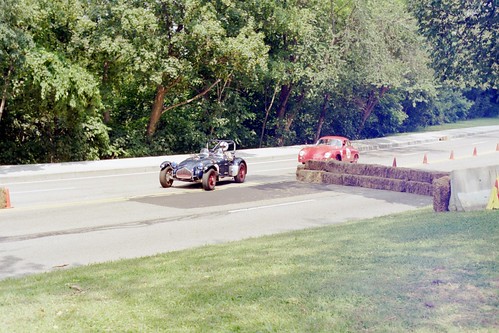
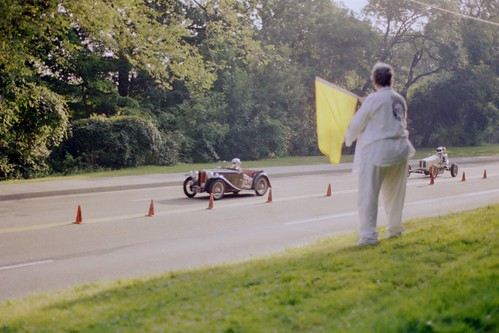
The Pittsburgh Vintage Grand Prix ("Grand Prix") is a road race using vintage cars on the roads of Schenley Park, Pittsburgh. They are in classes defined in a variety of ways. Some by age ("Pre-war (WWII)"), some by engine size ("under 1 litre") others by some other, more complex definition ("Sport racers"). The Grand Prix has the distinction of being one of only a few such motor races that are held on actual city streets (as opposed to a course made for the purpose). It is in its 25th year, put on by volunteers, supplemented by volunteers from the Sports Car Club of America (SCCA) and the Vintage Sport Car Club of America. From the beginning it has also been associated with Myron Cole (sports caster of "Terrible Towel" fame), the Autism Society of Pittsburgh and the Allegheny Valley School. As Cole passed away this year, this year's Grand Prix was in his honor and the volunteer/staff shirts took on a Terrible Towel theme (more on this later).
My association with the Grand Prix was through the Amateur Radio Emergency Service (ARES). ARES groups have a practice of providing radio support to major events as practice for their real purpose, providing backup communications support for public service emergencies and disasters. As such, the organization of event support and public service support are the same. Mobilization of volunteers, establishment of net control, check-ins of operators on site, assignments of radio operators to either stations or as shadows of key officials, and operation over time. It provides practice for the operators, test assumptions on how to manage large events, verify operating procedures, and gives operators a chance to test their equipment when operating in field conditions over the course of a day. And it provides practice in supporting another organization as well as other public service agencies who are also working the event. In my case, as a relatively young operator (< 2 years), training in procedures and actual use of my equipment (and some suggestions on what will help me work better). My assignment at the Grand Prix was to work a corner station, consisting of a corner captain with associated flaggers and course crew. Since this was the first time I've worked this event, I was with two other operators who happened to be two Elmers of mine, Mike and Cathy, (An 'Elmer' is an experienced operator who assists new hams as they learn the practices of ham radio.) Mike and Cathy are a married couple who help with the Red Cross radio operations. They have a wonderful story, of how one of their first dates was when Mike worked the Grand Prix some 18 years ago. And Cathy enjoyed it so much she got her radio license, so she could work the Grand Prix without Mike in case they broke up. Apparently, this has not been an issue.
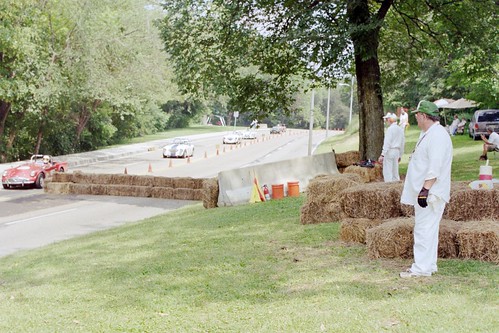
I was told that this particular corner was worked by two families (including Mike and Cathy) who have a long history of working the same corner for the Grand Prix year after year. We had "Sarge" and "Mom" who were the corner captain and the main flagger for the corner. Two sons and a daughter working the corner. A few others (including a couple) working to maintain that stretch of the course. And a few grandkids, including one (teenage) grandson helping with the course maintenance, and another grandson who dressed properly to help as able and needed, and other grandkids playing with the sound of the cars in the background. So in addition to carrying out their tasks, there was the passing down of traditions and practice down the generations. The tasks such as what the various flags were for. The use of hand and flag signals and whistles to communicate to the other workers and the drivers. Why all race workers dressed in white shirt and white pants. The complaints about the yellow t-shirts (because not only were they not the traditional road race white, they were yellow. Yellow and Red are forbidden colors on the race course because they are used on warning flags.) Having one grandson help with the flagging (holding a signal flag) and telling him he gets to brag at school of working on a race course. Hearing all the stories of how people got involved in racing, and everyone sharing of their lives and each other lives as the natural progression of years goes on. (birth, marriage, kids, deaths)
We learned of radio operation as well. Mike and Cathy showed me their setups, both their car, and a rig they set up to transmit television signals of the corner. We discussed equipment, such as the use of gun muffs over headphones to block out the roar of the cars. There was a conversation with Sarge and Mike about the sound blocking qualities of various types of muffs, down to the frequency response due to the different intended purposes of various type of ear protection. It was the first time I've worked for extended periods on simplex (not using a repeater) so I got an education on the qualities of different antenna as I compared reception of others from various places in the hills and valleys of Schenley Park. And Mike and Cathy provided commentary on the proper practice, from listening to others. They let me handle some routine communication. In addition, we took messages from the corner captain to send to race officials about the condition of cars, and reports on the condition of the corner. The most exciting thing was when one car sustained sudden damage, sending debris over the course. Which required that the course be closed and cars stopped. Because of the hills and valleys of the course, it is not possible to see the entire course, and having to make individual calls to the corners would be so inefficient, the use of a radio net is ideal for this, as several corners passed on information and requests to the net control and to the race stewards, letting the race officials make proper decisions on the running of the race and ensuring the safety of drivers, workers, and spectators. Which is what would happen in a real public service event.
And more education. Of how events are organized and how radio volunteers are recruited. The history of ARES is SW Pennsylvania. The personalities, mistakes, goals, expectations of radio operators and those who want them. All of which I actually need to know. Because it is a community that is hoping I take my place among them.
Academ's Fury is the second book in Codex Alera. The main character is Tavi, a quite ordinary boy who has been admitted to the Academy, where the top agents of Alera are trained. The problem is he is ordinary, in a world where almost everyone has talents caused by tapping into their personal Fury, elementals of earth, air, fire, water, wood or metal. These Furies are what gives humans the ability to survive a world full of more powerful dangers, and Tavi has none of this.
The book focuses on Tavi, his Marat (barbarian) friend Kitai, and his aunt Isana amidst the intrigues of the capital. What makes them special is how ordinary they are. They are surrounded by characters who wield power, political, personal, and through their Fury. Tavi and Kitai have only thier own wits and physical skills.
And their motivations are banal. In a setting where the others talk of status, the rise and fall of empires and rulers, Tavi, Kitai and Isana talk of caring for family, an unbothered future, and living a life without worrying of the doings of the great. They become human, even ordinary people in an extrodinary circumstance.
Sonata for Violin and Piano, Op. 24 “Spring Sonata” - Ludwig van Beethoven Excerpt from Sonata for Violin and Piano, Op. 78 - Johannes Brahms “Nessun Dorma” from Turandot Giacomo Puccini Excerpt from Symphony No. 4 “Italian Symphony” - Felix Mendelssohn
First Dance, Final Dance: Eric's Song by Vienna Teng Second Dance: Anna Rose by Vienna Teng Removal of Garter: The Raiders March (A.K.A.The Indiana Jones Theme) by John Williams
Clinking of glasses: Yodeling by D. Green and J. Ott Twinkle, Twinkle Little Star by The Shaws You are my Sunshine by The Fishers, Lee and Chan
rating: 4 of 5 stars The Tenth book of the Dresden Files. And the principal, Harry Dresden, is a wizard, and a Warden, one of the principle enforcement agents of the wizard world. And he is held in suspicion by his fellow Wardens, his allies the Knights of the Cross. And he is being called in on a favor he owes. To someone who does not wish him well.
As the books have gone on, Harry matures. He is no longer protecting everyone by his silence on approaching danger. The dangers are greater, but now the interaction with his friends and allies has grown richer. The allies begin making significant choices and their personalities, attitudes, and values come into play throughout the plot.
The strength of the characters other than Harry takes away the unreality of the situation. With all the strong powerful beings, it would have been easy to make this a story focusing on a fight between powerful beings. But it becomes a story of people deciding where their loyalties, principles and their duties lie. And these choices had costs, to themselves and to those they were loyal to. And sometimes their loyalties and principals hurt each other. What makes this interesting is seeing the characters struggle with this. And watch them make their choices, some accepting the price, some rejected the great benefits and power offered. Some of these we do not know well, some we have been following for almost the entire series. And this makes this a book I was glad to read.
The U.S. introduction to the land war in europe in WWII against Germany was in North Africa. The generals there, Eisenhower, Bradley, Patton, first were tested here, along with an un-tried American army. History and us remember them as the leaders who breached the Atlantic Wall and liberated Europe, but it is easy to forget that they did not spring full grown as an Athena out of the head of Zeus. They had to learn to walk before they could run. And this book documents those first steps.
As you read Atkinson's account, you get a sense of the confusion, unknown and uncertainty. Both at the level of the normal foot soldier as well as the highest commanders. Atkinson shows, that even with the very best and most meticulous of preparation, war is messy, confused, unpredictable. And that the enemy always has a vote, even when it seems they are out.
What history tells us is in North Africa, a young United States Army as part of the Allies completed its first campaign having evicted the Axis from a continent and removing two German Field Armies from the war. Atkinson tells us of the lessons and pains along the way. The stories of an army learning the art of war are something to remember, especially as new stories of another American Army learning the ways of war are being recorded (with Rick Atkinson being one of the recorders.)
The movie "The Jane Austen Book Club (2007) (IMDB) (Wikipedia)" revolves around a book club in California. Two friends, Bernadette and Jocelyn, come up with the idea of starting a book club reading Jane Austen books to help cheer up their friend Sylvia, whose husband leaves her during the opening scenes of the movie. They get Sylvia's daughter, Allegra to join in. Along with Prudie, a teacher who they meet while standing in line for a Jane Austen film festival. Jocelyn gets into the act by picking up Grigg, a science fiction fan at a hotel where there is both a science fiction convention and a dog breeders convention (Jocelyn breeds dogs) happening at the same time, as a potential romantic interest for Sylvia. The plan is for each of the members to lead the discussion of one Jane Austen book each month. And, of course, each of the main characters picks the book that includes the Jane Austen character each is modeled after.
During the course of the movie, the movie follows the characters romantic lives. Prudie's troubled marriage, Allegra and her lesbian relationships, Sylvia and her ex-husband, and Jocelyn, whose attempts to get Grigg and Sylvia together misfire as Grigg has more of an attraction or Jocelyn. And the book discussions focus not on plot or facts (after all, this is not high school english) but on characters, goals, motivations, desires, the themes of order vs. desire. And the discussions also becomes a subtext to the characters speaking and thinking about their personal lives (one of the funny quotes in the movie is Bernadette saying "I'm glad that this is the last book, there is too much plot going on."
Obviously, there is a certain amount of dramatic license that goes on, and romanticism of what book clubs are, after all, this is a romantic drama. But the goal is probably right, the books provide a focal point of thinking about life, and the clubs provide a means to do so amongst others. Whether friends, like the movie, or among strangers who have nothing in common but the fact they like to read. Some are narrowly defined. The club I am in (well, I have been truant recently, I hope for an excusable reason) reads all sorts of things (well, fiction, and not science fiction) and was assembled slightly randomly (two different book clubs were started by people making a general announcement and taking all comers, and eventually one folded and a few survivors (well, two) joined the other). So what you get are a slightly random group of people who like to read, and are at least non-introverted enough to meet a bunch of strangers and talk about what they think. And reality is, they also like to eat and randomly chat and have conversation. Which is how it usually works, even though the group has very little a priori in common, other then some attitudes.
Does the outside world come into this? Yes, members do have lives. They move, buy houses, have babies, get married, all the normal ebs and flows of life. And the book club becomes a place of semi-normalicy. People who know you enough to talk to, but not so close that it is threatening. And there is a place for that.
It was a fun movie. I missed it when people from my book club went to see it last year. My wife and I found it amusing, and I assure everyone that it was my idea to rent it.