Thursday, December 31, 2020

Book review: Weapons of Math Destruction: How Big Data Increases Inequality and Threatens Democracy by Cathy O'Neil

Weapons of Math Destruction: How Big Data Increases Inequality and Threatens DemocracyWeapons of Math Destruction: How Big Data Increases Inequality and Threatens Democracy by Cathy O'Neil
My rating: 5 of 5 stars

There is a popular diagram that describes data science as a combination of math and statistics, computer programming skills, and subject domain expertise; and describes the dangers of what happens when one of those three are not available. But among academics, there is an opposed line of thought that says that math and statistics methods are pure and subject independent. This book is firmly against the idea that algorithms are a defense against bias. The reason may be that while the mathematician/machine learning modeler may be naive, the setting of the implementation is not, and the questions that are being asked as well as the data being used to train models are both affirmative choices where the analyst and customer have agency. And pretending to be a naive analyst leads to errors in the result that have real consequences.

O'Neil goes through a number of cases. But while many accounts will go into the "evils" of big data and machine learning, she does suggest good practices that can prevent the dangers. First evaluation of the model. The model should be tested by actually looking at its predictions and seeing if they are true. In statistics this is done through control groups. In data science this is done through holdout test sets. And in her case studies, she points out this is not done. Next, compare the model input data set to the population that will be applied. Again, she regularly points out where this is not done. A third one is the well known make sure that you are not using machine learning to perpetuate an undesirable status quo. (but this argument is too easy)

Read this at a book club at work. It spurred a great discussion, that has carried over into other conversations. Definitely recommended to those involved in data science/analytics where people are impacted, and in areas where data analysis is becoming a bigger part of life, so as someone who works with the results of analysis you can ask good question, both while the analysis is planned and performed, and in understanding and questioning the results.

View all my reviews

Thursday, August 06, 2020

A data point on the efficacy of fitness trackers

 You may not realize this, but if you own a smartphone, it comes with a step counter.  Because it tries to count steps while in your pocket.  (my son can explain to you how step counters work).  But the magic in step counting is not being able to count steps, it is mental, it gets you to be more active based on the "if it gets measured it gets done" principle. Meaning you actually have to look at the numbers every now and then to get the motivation to do something about it.

So, I'm a lapsed runner, but I run a decent amount.  I got my iphone 5 somewhere in 2017 (I think) and that is when I now got Apple Health, which lets me see the iPhone step counter.  So this is what it shows me for those first few months.


Increasing steps as I get better fitness watches

So, I'm hovering around 5,000 steps per day.  But I'm not paying that close attention.  In early 2018, I get a fitness tracker.  A Huawei Fit, because I want it to double as a watch.  And it has an immediate effect.  I start actually looking at my step count.  And realize that the only thing between me and a consistent 5,000 steps a day is taking the stairs 10 flights to my office.  And I start doing that every day, at least once. Because when I do that, 5,000 steps in a day is easy.


Increasing steps as I get better fitness watches

Now, 5,000 steps per day is easy.  But I actually do real stuff.  Like CrossFit, taekwondo, and I occasionally run.  And I realize I am actually getting use out the fitness tracker, so I figure it is worth getting a real sports heart rate monitor.  Being a former runner (and I already have a Polar H7 chest strap), I stay in the Polar ecosystem (because Polar's definining trait is that it caters to athletes and does not have anything that an athlete does not need) and get a Polar M200.  Because it is already generations out of date and I can pick it up for pretty cheap.  And then this is what happens around December 2019 (early Christmas present)


Increasing steps as I get better fitness watches

Another jump.  Actually, Polar does not actually reports steps, it reports activity, which is much more useful.  So, instead of thinking about whether or not I am walking up and down 10 flights of stairs, I'm more interested in making sure I take activity breaks (to avoid movement alarms), and getting my activity(ies) in every day.

So, I am a poster child for how having a gadget gets someone to be more active.  And in the era of COVID-19, you can see that April was when we all went into stay at home, and by the next month I had my routine set (10 minute exercise sessions in the morning and around lunch to replace walking up and down the office stairs, and I get my main activity in the evening).  And yes, I think I am making my heart rate monitor worth it.

Saturday, June 06, 2020

Teaching kids micro:bit and makecode during COVID-19 quarantine

A couple of weeks into social distancing, as the kids various activities had shut down with no plan on how to open, we were faced with the question of how to keep our kids occupied.  We have generally followed the principle of having one artistic, one physical, and one STEM activity ongoing per child (plus chinese), and for the older one we were trying to fill in the space opened as his robotics (First LEGO League) activity had closed down.  And we wanted to have it be somewhat social, as we also wanted him to maintain his connections, as well as make sure there was a community of friends and relationships that may endure.

For classmates, our first community that we reached out to were the other kids from his LEGO robotics group.  I already had a number of email addresses from organizing an outing, and these were all kids who knew blockly style programming (or Scratch like) and programming in the physical world.  The next source was a local chinese parent WeChat group.  And we were looking for kids roughly the same age as DS9.  And we found one more from a camp that DS9 was in last year.

The goal was teaching programming, and for this, I choose block style programming, specifically on the BBC Micro:bit.  The micro:bit was created for teaching introduction to computer science in Britain.  They goal was a microprocessor that had on-board physical inputs and outputs, the ability to connect to other components, and could by taught by middle school teachers, who had a wide range of comfort level in teaching technology, and likely no comfort in teaching programming. Blockly style programming (using makecode) is particularly suited as it had enough range to allow the application of computer science basic concepts, but without issues such as syntax, which in normal text based programming often dominate an introductory computer science course.  (in computer science, the concepts are the important part, syntax is merely the implementation.  The focus in time and energy on syntax is considered a distraction)

For materials, my mainstays of Adafruit and SparkFun were both unavailable.  Adafruit was designated an essential business, but was focusing on medical suppliers. SparkFun was closed. So we had to source kits from Amazon.com, who was working from stock.  The micro:bit itself was available, but kits tended to be from one of the multitude of unknown suppliers.

For curriculum, I used the book micro:bit in Wonderland from Tech will save us.  The target audience was people who could not program, and it was craft based, where the projects all had a programming component and a craft component (that interfaced with the micro:bit board through alligator clips and the touch pads. As an added bonus, there was a motivating reading, from Alice in Wonderland (which many people already owned, but was also free as it was in the public domain on Project Gutenberg.)

Some unit notes:

  • Impacts of shutdown. The micro:bit was generally available on Amazon.com, but the kits of basic supplies were not.  There were two sources that were left, the https://www.techwillsaveus.com/site and various no-name kits on Amazon.com  The no-name kits tended to be breadboard based kits as opposed to alligator clip based kits.  For elementary and middle school classes, the alligator based kits would have been much better
  • Block coding on micro:bit was something the kids took to easily. Even the one who had no programming experience (meaning not even having background in Scratch).  Using makecode was easy. By the second week everyone had a microbit (not necessarily a kit) and getting working makecode onto the micro:bit was not hard.
  • First hard lesson was the control of the LED light, which was the first lesson that got off the micro:bit board. As this was really the first experience in physical computing, I believe that this is also considered a first milestone in electrical engineering.  It took a lot of one-on-one attention to get everyone through this.  But all of the other physical computing lessons (touch pads, connecting to sound speaker, other LED light projects) went much easier.
  • If-else was not a problem
  • Kids enjoyed the sound projects. Both the buzzer, then the music box.
  • They also had no problem working through complicated if-else trees 
  • The big assignment here was to use the microbit as a musical instrument, which meant making lots of sounds (kids like noise)

Really, the only difficult week was the first experience with lighting a light bulb.  While many students had experience with LEGO robotics and things like SPHERO, those kits deliberately hide the difficulties in connecting a controller to something off the controller. So after that, it becomes easier.

One thing I would do differently if I had to do this again, I would use the Sparkfun gator:circuit kit.  It breaks out many comment electrical components and packages them along with resistors (needed to make sure that low resistance components like LED lights do not get burnt out) to make a alligator clip friendly board, which is much easier than trying to connect components on a bread board (I think Adafruit has components that do this to, but not packaged in a named kit).  Leave the breadboard work for high school or later.


As this whole teaching kids programming experience was not nearly as traumatic as I thought it could be  :-)   there is going to be a follow-on.  But instead of having the focus be technology and computing, the goal will be to actually use these skills to do something, so we are going to take the Sparkfun gator:science kit, which has electronic sensors that can be used with the microbit to create data collection lab instruments, as the basis for an investigative science course. And in true co-op style, there will be a team of parents who will be trying to teach the kids science.  :-)


Monday, May 25, 2020

Parenting month 111: Online school during COVID-19

So, everyone in the world is dealing with COVID-19. One universal experience are the kids experiencing shelter in place.  Schools around the world closed or moved to remote learning.

So our kids have both moved to online learning.  Just as both of us academic parents moved to online teaching.  They have gone through many rounds as everyone; kids, parents, teachers, administrators; have been figuring things out as we go, trying new things, discarding things that were too hard, trying for what works while minimizing the pain over the perfect.

We do have the advantage that our kids generally like being around us.  So the first few weeks they were very happy to have both of us around all of the time.  Of course, DS9 eventually started to realize that mommy and daddy school is considerably more demanding than regular school (the cost of having picked two academics to be parents.  From the day he was born we joked that he clearly was not thinking things through when he picked his parents, probably was thinking about food)

Our schedules have settled into a pattern.  In the morning both kids have to check their schools communication channels.  Both schools at one point had several information channels to check, which definitely caused problems, but they have settled into one location for DD6, and two places for DS9.    Both kids generally finish their school work before lunch (with minimum help from parents).  Then comes mommy and daddy school, which generally includes piano, chinese, math, and extra curriculars.

Most enrichment programs closed down due to COVID-19 at the same times the schools did.  Although a large number of asian parents in the area were talking about pulling kids out of school for a couple weeks before PA schools actually closed down (we were only one day ahead of the PA announcement).  Eventually, many enrichment activities went online, using Zoom (just like all of our work places).  TKD started up online fairly quickly, and our kids joined in once a whole cycle started as online.  Ballet started online with the Pittsburgh Ballet using online kids classes as an outreach to maintain contact, and now the closer in schools are starting up online classes starting with the summer camps.  The LEGO robotics school DS9 is in is going online for camps, they have procedures of how to do in person (limited numbers, distancing) but we'll see if they actually carry them out (if WPA remains in yellow, I expect that they would definitely do so if WPA goes to green status).

For math, we are somewhat putting it on hold while they still go through school.  It is a little easier now that our university work is done, but as their school winds down we will add that back in.  DS9 will go back to Beast Academy to finish off level 5 (which will reach the end of the Art of Problem Solving Beast Academy series for the younger students).  We will be exploring the main AoPS at some point. DD6 is still not ready for Beast Academy, so she will do a couple of books from the Life of Fred series.  Like Beast Academy, it is a math series that promotes learning to think about math instead of drill and kill (the way most American learn math, and learn to hate it).  She is doing it online with a friend, which seems to be cause for much laughter in the room.

My contribution to teaching kids during COVID-19 has been teaching a programming with micro:bit to kids we have met from a few sources, mostly the LEGO robotics (their online program had not started yet) and chinese families.  In addition to the materials at microbit.org and micromag, we used a book "microbit in Wonderland", which had a craft feel to it for relating computing to the physical world.  Most (but not all) of the kids had exposure to Scratch (scratch.mit.edu), but generally the act of connecting physical items like lights, speakers, and conductive surfaces (aluminum foil) was new (outside of packages systems like LEGO robotics).  I suspect most electrical engineering professors would tell me that my experience of everything getting much smoother after we go to the point of controlling light bulbs is a known fact of life.  The whole "teaching pre-teens programming online" experience has gone off much better than expected, with the parents telling me that the kids show off the weekly homework projects.  And having 7 out of 9 effectively make it to the end is probably a good record :-)

So, the end of the online school year is in sight, and I sense that teachers and kids are going for survival to the finish line (my university reminded faculty from the beginning of the online teaching period that the goal was survival, not perfection) So the next phase will be replacing the usual summer camps with either online versions or us working at home (or parent run groups, coop style)

Monday, May 04, 2020

Senior capstone during COVID-19

This is the month of COVID-19.  Both University of Pittsburgh and Geneva College (our employers) announced that they would be delayed the week after spring break on March 11 (pushing back opening until March 20. The Commonwealth of Pennsylvania declared that all educational institutions be closed on March 17.  Which also meant that our kids were not returning to school.

For looking ahead, I had told our senior capstone course during their midterm presentations on March 6 that COVID-19 was coming, and that they should expect it to be here before they returned from spring break.  Chatter among the Chinese community in the north hills of Pittsburgh was about when to pull the kids out of school, first in dread of the return of college students from spring break, then after that watching COVID-19 march toward us when it reached Cleveland. And we pulled our kids Friday March 13. That day, our school district announced that everyone should be prepared to not come back to school from the weekend, somewhat jumping the gun on the Commonwealth's announcement, but basically being correct.

All the schools (universities and kids schools) went on a one week pause while all of the teachers figured out how to convert their classes to online for the foreseeable future. For me, this first affected the Pitt Industrial Engineering Senior Capstone course, which had corporate sponsors.  Once Pitt announced the delay of school, I sent a message to all of the students:

As you have heard, the University of Pittsburgh is postponing the start of classes until Monday March 23.  The extra week is to give faculty a chance to make a plan to move to online delivery of classes.  While the university and school of engineering are working on setting policies and plans, I can offer the following:


1. Note that while the classes are suspended, society as a whole, including your clients, is moving forward. Please contact your sponsors and discuss working arrangements.
2. For team meetings, have a discussion on how to hold these as many students may not be on campus.  I recommend the use of collaboration software. For my own work, I am planning on using Microsoft Teams and I recommend it as one alternative. For those who do not know, MS Teams is a collaboration suite that comes with Microsoft 365 Online (those of you who use Outlook online or MS Office online with Box are using 365 Online)  Information is located at https://www.technology.pitt.edu/services/microsoft-teams It includes text chat as well as video chat, screen sharing, and whiteboard sharing.
3. After you have determined how your group will work, please contact your faculty mentor and discuss how you will continue to work with your mentor.  Note that faculty are still available to assist.
4. One major issue that was highlighted in the methodology presentation was how to work with the lack of data.  You are encouraged to discuss this with faculty (subject to your mentor).  In particular, the field of input modeling within simulation includes methods for working with limited data (I have discussed this with many projects, and the long term feedback from the clients is that the resulting models have been useful). In addition, many subject areas have standard methods of soliciting expert opinion.
5. For end of term activities, there will be meetings at the school of engineering this week and next to discuss how these will be modified.  I will inform you as they get made.

Specifically, was the need for a continuity of operations plan On March 16 I sent out:

 Reminder to all groups. 
 1. Please send me and your faculty mentor the report specified in 2 by the end of today. Also, let me know as much as you know about (3), (4), (6). 
 2. You should have your next meeting with your mentor scheduled. As per recommendations, this should be a virtual meeting. Make sure that you have a videoconference method that you have complete access to (i.e. no time limits) (Note: as Pitt provides you with an account MS Teams is such a method. The faculty should be getting enterprise Zoom accounts soon, but that requires the faculty be present in the meeting.) 
 3. Professional Note: What we are doing is called a Continuity of Operations Plan (COOP). While not always done, there are many management recommendations that any organization have one that covers loss of key personnel, loss of access to facilities, and potential disasters. Ideally (but not always done) this is exercised on occasion. E.g. I volunteer with Red Cross for disaster response operations in western PA. Every now and then, we have an exercise where the staff are hands off, to confirm that the volunteers can manage a regional disaster response in it entirety without staff participation. 
 ---- 
 The Capstone program coordinators had a meeting this afternoon. 

  1.  The Design EXPO is cancelled. 
  2. Please inform your sponsors. 
  3. I need a report from each of the teams by Monday to understand your status and resource needs. 
    1. What is your plan on remote collaboration (again, I am recommending Microsoft Teams as a collaboration platform if you have not chosen one). Have you tested the collaboration platform? 
    2. What is the status of team members (i.e. where are they geographically) 
    3. For teams that are not substantially done (substantially done means you are running models and analyzing results), what needs are remaining? What is your plan on meeting those needs? 
      1. If your needs are data related, you should anticipate the possibility of not being able to collect data. Do you have the expertise to work with minimal available data and generate appropriate probability distributions (Note: these are topics from probability and from simulation) Is your faculty mentor able to help you? If not, I (Luangkesorn) am the faculty with the most research and practical experience with knowing what can be done with limited to no data.
  4.  Discuss with your sponsors your plan for ongoing collaboration. In particular, how the final presentation will be done. Note: Pitt has Microsoft Teams accounts for all of you (see previous message) and I recommend that as a presentation platform if they do not have one. 
  5.  As the EXPO is cancelled, your company presentation (if recorded) will be your final presentation. You should have the presentation recorded and have your faculty mentor(s) and myself invited. Check with your sponsor if there are any security considerations. If you are not able to make a recording or invite the faculty to your company presentation (or if there is not a company presentation before finals week), we will have to make another arrangement (i.e. a presentation over Microsoft Teams) 
  6. For all teams, check with your faculty on if there are any limitations on your reaching out to other faculty and getting assistance. You must do this. In the past, there are faculty who have gotten very angry about their team consulting with other faculty, even at the point where the team was fearful of project failure. You need to have an affirmative response that consulting other faculty is acceptable with no reservations. Do not wait until you need help to get this taken care of. My instructions from the department are to ask for permission to respond to your request from help, and to allow the team to fail if the answer is no. 
  7. As I mentioned on the first day of class, during senior design, life happens. Back then, I was thinking of individual events, but this is clearly something much larger. Just as I said on the first day, be flexible and take care of each other. While I asked about geographic locations earlier, also check on everyone's physical and mental states. We are all human, and everyone's situation, especially those at home, is different. 
  8. If you have questions or concerns, or even if you need a human contact, contact me.
Over the next few weeks, as classes were in turmoil from uncertainty, a number of students were sending me notes of thanks for providing structure for how to work with all the turmoil.  Many noted the slight irony that one of the most unstructured courses they had (capstones are supposed to be about the students taking on management roles and providing their own direction) suddenly became one of the most structured courses they had (my directives were to create a Continuity of Operations Plan, so they had a well defined task that gave the rest of their semester structure) while all of their other faculty were still figuring out what the rest of the semester was going to look like.

Wednesday, January 01, 2020

Home gym in December 2019

Here is the current state of my basement gym.  The basement is used by myself and my two kids for exercise of various types (we are trying to get my wife to use it too :-) )  Nothing here is too impressive, since if I ever wanted to use higher end stuff, the YMCA is available, but I think that everything here is good enough for our needs and they way we train (taekwondo, bodyweight, CrossFit)

Basement gym Taekwondo corner
Floor and taekwondo equipment
The most important part of the gym is the floor.  When we moved into the house we bought 3/4" thik squares and covered the basement floor with it with the intention of using it for taekwondo practice and bodyweight exercises.  The floor is big enough that one of us can do our taekwondo form.  It gets used for bodyweight exercises and as a workout area for CrossFit (Streetparking.com) workouts.  The second most important part of the gym are the instructional materials. We have several decks of Stack 52 exercise cards and more recently the posters illustrating various exercises for bodyweight, kettlebell, dumbbell, suspension band, stretching, etc. As my kids get older, they get cleared to use more of the posters, card decks, and equipment. This corner shows our taekwondo training equipment.  Two Century (ATA branded) Wavemaster standing bags loaded with sand (50 lbs on the small one, 100 lbs on the regular sized one).  We have a large kick pad, a pair of focus mitts, a target pad, and two kick pads.  Not pictured are our practice weapons and some agility equipment (agility ladder and cones).
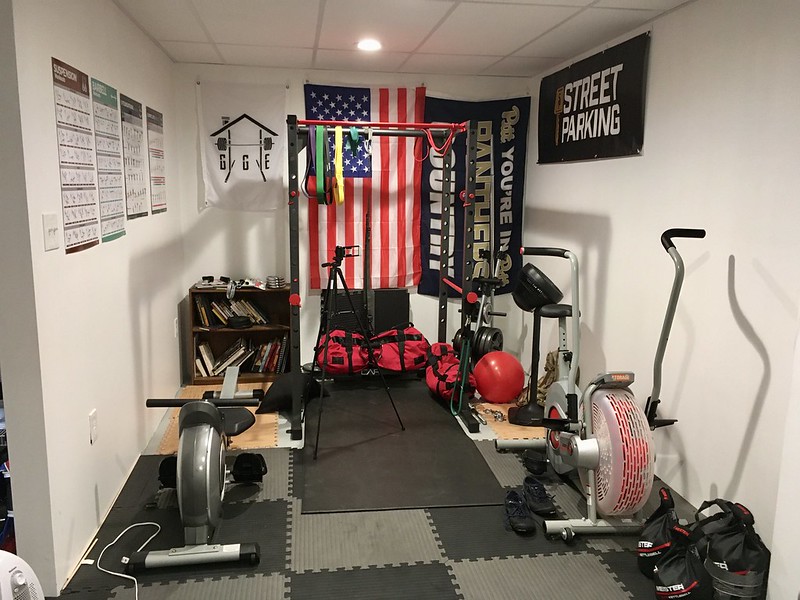

Basement gym strength and cardio
Power rack and cardio
The previous owner of the house did not know what to do with this nook and used it to store junk.  In the beginning (i.e. from just after I finished grad school), I had a 40 lb dumbbell set with handles and plates along with a bench.  Over the past two years I bought a short CAP Barbell power rack, a standard barbell, and an adjustable kettlebell from Fitness Gear (Dick's Sporting Goods) that uses standard plates.  I also have been buying additional plates as my deadlifts used up all of my plates and I have around 250+ lbs of plates now.   Generally, I use the barbell for only power type lifts (deadlift, squats, presses).  For olympic type lifts (clean, jerk, snatch) I will use sandbags or kettlebell. The adjustable kettlebell is so much better for dynamic movements compared to the dumbbell handles that I don't use the dumbbells so much any more.  The power rack is used for power lifts with the barbell (and bench for bench presses).  It is also used for pullups.  And it is a mount for the suspension trainer and the resistance bands.  The rack is not bolted to the grounds, so I use the sandbags and plates on the support legs to weigh the power rack down and add stability.

I also have two RepFitness sandbags that I've had for about 1 1/2 years.  One is 50 lbs and is my normal use. The other is 65 lbs that I use for heavier olympic lifts., and as my fitness improves, I will add weight to it. In the lower right corner are sand kettlebells, 10, 15, 20, 25 lbs.  I like these because they are safe around the kids, so DS9 and DD5 are cleared for sand kettlebell use and can do deadlifts, goblet squats, upright rows. DS9 can also do presses and KB swings.  They are also good for a warmup, 20/25 lbs is a good warmup weight to get loose.  The sandbags and sand kettlebells are what I use if I want to take a workout outside, as they won't break on the driveway.  The CamelBak HAWG (in DCU) is used for rucking, I load it with a 25 lb plate.

For cardio equipment, I got the Schwinn AirDyne and the Sunny magnetic rower off of Facebook Marketplace.  I probably like the rower more, but DS9 is cleared to use it and he tends to use it when we are working out together.  I can get more intense faster on the AirDyne, but I can probably go for longer on the rower.  I had first bought a hydraulic rower off of Facebook Marketplace, but when I figured out that I would actually use cardio equipment, I bought the magnetic rower and eventually sold off the hydraulic rower, for more than I paid for it.


Basement gym Mobility and pylo
Boxes and odds and ends

Last corner is the DIY pylo box (16" x 20" x 24") and the steppers (church sale)  The kids use the stepper when I use the box for stepups or jumpovers.  Also in this corner are physical therapy equipment. The balance board, stability disc, and foam roller.  I started using these when I was in PT for IT band syndrome.  The medicine balls (6, 10, 14 lb) in the corner are also approved for use by DS9 and DD5. Also are the various electronics. The Amazon Fire stick connected to a monitor and bluetooth speaker provides background music.  A kitchen timer and Gymboss timer provides timing. Then I have a Polar H7 chest strap HRM, a ScoreIt band for counting rounds, and the obligatory whiteboard.  I have recently gotten the Polar M200 heart rate monitor, and I have started using it to record all of my workouts.

The two biggest benefits of the home gym are the convenience and that the kids can us it.  I am down here at all sorts of hours and I really don't have a regular daily schedule. So this flexibility is great.  For CrossFit, I can arrange the equipment as needed, and I pretty much have everything (at a low level). The kids often join me for the CrossFit workouts, and we have a wonderful time warming up together, and then figuring out the appropriate scaling options for each workout.  Then we have the space for TKD. We would never get this at any gym or fitness facility, where kids are quite unwelcome (for safety reasons).  It is probably my favorite room in the house, and our go-to when we need to get the kids out of a funk. (or me for that matter)

At this point, with various equipment collected over a decade, this gym looks pretty complete. I cover strength and cardio, power and olympic weightlifting, along with a pretty complete set for martial arts.  The need to keep space around the power rack clear and the desire to have a large open floor space fights any urge to collect anything else.  And behind all of this is a belief that it is better to spend effort on skill development over equipment (which is why this gym is focused on free weights)

For programming, I use StreetParking https://www.streetparking.com, which is an online CrossFit style programming at $19/mo.  This setup with free weights and lots of floor space works out just right for it.  They have several versions of the same workout (same stimulus) each day, A is dumbbell/kettlebell based and can include running and the pylo box,  B is barbell based, C has other equipment such as sandbags or the rower/air bike.  Then there is shift which is a simplified version of A.  When the kids are with me or I have also done something else (TKD), I do shift. Otherwise I do A or C (kettlebell or sandbag) depending on if I am feeling particularly badass (sandbag!).  Weekly, they also have a range of accessory programs.  I usually do endurance (run, row, or bike). They have two strength based programs, power (lifting) and olympic.  Over the summer when I started physical therapy I started doing Buts and Guts regularly, because these exercises tended to match the PT exercises hitting my legs in different directions unilaterally.  There is also a program called Suns out-guns out, which is semi-jokingly the bro-sessions you may find in most commercial gyms or fitness magazines focusing on arms and chest.  They also have special programs for specific goals.  I did a 20 back squat progression last year. This summer I was doing a pull-up progression where there were three sessions a week with added exercises built around building up to pull-ups.

So, my standard workout is to take one of the Streetparking workouts.  A second workout is focused on taekwondo (but this or physical therapy often becomes the warmup) where we (with kids) do a warmup/stretch routine, a few body weight exercises, forms (poomsae/kata), and bag work.  A third type of workout are bodyweight workouts. There are two forms.  One is the kids work off the posters and pick one upper body, one lower body, and one trunk/core exercise and we do rounds and reps.  A second form is to take the Stack 52 exercise cards and draw 10 random cards.  The last type of workout is cardio.  This is either the rower or airdyne (my son likes to claim the rower) and I pick one of the Streetparking endurance program workouts on hand depending on what type of interval we want to do.

Tuesday, December 31, 2019

Parenting Month 106: A rounded life

In one weekend in December, DS9 had the following:

  • Taekwondo mid-term testing as a 2nd degree black belt
  • Chinese final exam
  • University music prep department piano recital
  • Elementary school choral concert (Small Ensemble)
This covers sports, language, and a double dose of arts. The only thing he was missing was something in math and sciences (next year, if he continues robotics with First LEGO League, there will be something around this time of year).


One of the hazards of parenting in upper middle class suburban America is the parenting arms race, which is magnified among asians.  All of the children we are in contact with are actively participating in a range of enrichment activities, many with a goal of an admissions package to get into a college of the parent's dreams (we do not always know the children well enough to know about their dreams).  And looking down the road, from the complaints of parents whose children do not get into the desired schools despite these efforts, it does not seem to be consistently successful.


When we talk to other parents, we are dizzy trying to keep track of everything they do.  Even DS9 feels busy to us, but then there are kids who can double up on every dimension (DS9 activities are roughly orthogonal to each other)

Even though DS9 did not cover many of the standard enrichment activities that are meant to lead to a selection, DS9 has been passing most selection stages he encounters (accelerated math, advanced programs, teams, music auditions). Fortunately, he does not have an appreciation for what this means, so he has not been participating in the posturing that is already observable in his peer group.


Marshall Elementary chiral concert - Small Ensemble December 2019
DS9 is in lower right
At this point,  DS9 is happy with the activities he is in. He enjoys the competence. He enjoys the experience (most of the time) and he alternates between enjoying and despising the activities that lead to that competence (like most adults).  And at this age, there is too much between now and college admission time to know what path the kids will take as they mature and develop other interests, and there are too many kids at his level to know if his trajectory will continue.

For her part, DD5 is in the early stages of the same. She does drawing (with a chinese teacher), piano, and taekwondo, enjoys all three pretty much all of the time. And is noticeably happy, almost all of the time. Almost the ideal of what you want out of a 5 year old.


Just as with DS9 at this age, the kids in her peer group are all more heavily involved in activities than she is.  And just like him, we will see how this turns out.


Saturday, September 28, 2019

Parenting Month 103: Competition

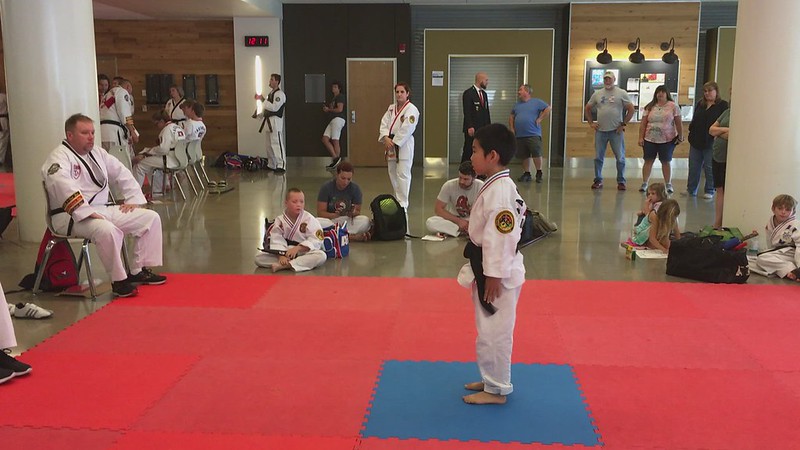
We have been of the opinion that competition is good for the kids.  They are placed in a safe environment where they are under stress, but only after preparation.  We also believe that the benefit of the competition is not the end placement, but the preparation for the competition and the act of competing.


Mentally rehearsing his forms
Visualization prior to competition
DS8 is exposed to competition in a few forms.  The most obvious are Taekwondo and piano.  And the pattern are the same:  maintaining focus through the performance, attention to multiple details during practice, a transition from individual skills practice to sequences, an intensive ramp up to the actual competition focus on ever tinier points of performance, which closes with a focus on principles, calming techniques at the beginning of a performance.


Saang jae baang form in competition
Saang jae baang at Kaminski's ATA Steel City Songham Classic
And so far, he has done well.  In TKD DS8 competes in the competitive division, and regularly goes up against kids who sport state and district champion badges (earned through a competitive points system across tournaments over a year).  And he is competitive in forms (non-contact sequences of moves that are designed to imitate facing two opponents).  But not in sparring (he does not have the aggressiveness needed to be good at sparring).


Shim jun in Tournament competition
Shim jun at Kaminski's ATA Steel City Songham Classic
But we notice the other kids and adults.  While the ATA is pretty good about reigning in the worst of the in the moment actions of sport parents that are sometimes noticed in American culture, you still see some of the signs.  Parents keeping detailed notes on scoring and other competitors.  Kids who clearly are not used to not winning.  Kids who have clearly traveled for the purpose of tournament competition.  The types of conversations that go on the sidelines and the kids reactions.

But here in suburban America, competition exists in other venues even without tournament dates.  My son has gone through several rounds of selection within the school system. And while the intent of the selection is a good one, identifying students who can move ahead of the main group and give them the opportunity to grow a year with every year, the attitude taken by the students and families may not be so healthy.  One selection that my son went through is fairly rare, but well known among ambitious families, is placed as a goal for kids to aspire to, years before the time comes for selection.
And the kids know the stakes and what it means to be one of those selected. So much that it becomes more than just parents pride in being selected, but there is a danger of elitism among the kids, and a letdown when they are not among the selected.

9-10 yr old boys receiving their pre-competition instructions
Pre-competition pep talk

What makes competition good is that it is always good to be in the company of those who are good. There is a saying in many domains of expertise, if you are the best in the room, you are in the wrong room.  So, for those who are who are in the ballpark, this is an opportunity to see what good really looks like and it provides something to aspire too, or to recognize there are others just as good and you can spur each other on to be better.

But, when the goal of competition is the winning, eventually, one will reach the point where the competition is better than you.  And you will no longer win. Sometimes it is because you were never exposed to that level of competition before (something we see alot of in university freshmen). Sometimes it is because you have a view of your capabilities that is not based on a sober assessment.  So a culture or attitude that you will always win runs into the hard reality provided by the outside world.


Post competition bowing out
Post-competition bowing out

Our goals in competing are to provide the experience in preparing for something hard where details matter, learning how to deal with pressure in the moment and being able to perform with no opportunity for correction, being exposed to quality competition, and knowing you have done your best and are continually getting better.  Whether that is taekwondo, piano, math, or any other aspect of life.  And experience the joy in being capable and competent.

Showing off his medals
Two third place medals

Monday, September 09, 2019

Film review: Meru (2015)

Jimmy Chin leading on an ice path on the 2008 Meru attempt

Meru is a documentary about three elite climbers; Conrad AnkerJimmy Chin, and Renan Ozturk; and their two attempts to take the "Shark's Fin" route on Meru, a 4,000 near vertical wall of rock that is the last part of a 21,000 climb up rock and ice. It is styled as more technically challenging than Everest, because it combines a difficult ice climb and a difficult rock climb.  Anker and Chin are represented as climbers who have been on many expeditions before, Ozturk, while an elite climber, was the new person on the team.

The movie's focus is on the two attempts at this route, one that has never been completed before. And in between there is much discussion of risk.  The movie interviews the climbers, other elite climbers, and family members and they discuss a lot about risk. Family members talked about thinking of a sibling or spouse who could very well die on a mountain.  The climbers spoke about other elite climbers they knew who had died on climbs, and some of those climbs were relatively normal.

There was a period of my life where I was regularly doing some activities that were inherently dangerous. And the possibility of dying was not something I cared about. I think at the time my view was that I was in the moment, and when life ended, it ended.  I like a line from Conrad Anker, these activities are dangerous, but we approach them with skill and knowledge, and when we take risks, with do so knowingly and deliberately. And if we should have an accident, our thought is one of profound embarrassment, because it meant that we did not know that we had crossed the line of too much risk.  Jimmy Chin had a line about the excitement of it all, the rush comes because we are doing something that is in fact dangerous.  So it is different than say an amusement park, which has speed but is under control.The thrill comes from mastery, that danger is faced, examined, and confronted, and overcome, while always under control.  And the glory (to the extent there is any) is from knowing that you could go up to that line, but always recognize it and back away before crossing.

The documentary is about two attempts 2008, and 2011.  The first attempt failed after they lost three days in a snowstorm, and their limited amounts of food led them to turn back a mere 150 m from the summit.  And this is almost an example of their skill, to have the judgment to turn back even when they were so close.

The film then talks about risk in another way.  Chin and Ozturk suffered a pair of accidents while on a commercial shoot on a ski slope. Ozturk was severely injured, Chin was caught in an avalanche. So the lead into the 2011 climb was both of them recovering from this, both physically (Ozturk was nearly paralyzed in several different ways) and mentally.

What sold this was the discussion about risk. Climbers and other sports are often viewed as crazy daredevils looking for thrills. There is a thrill, but it is not from the excitement. The thrill comes from bring to bear knowledge, skill, and judgment in an environment were all three are needed, and surviving in the face of real danger.


Conrad Anker on the "House of Cards" pitch

Sunday, September 08, 2019

Parenting month 102: 5 year olds know everything

As we start the new school year, we have a new milestone.  DD5 is starting Kindergarten!  Our school district does only half day so just like big brother she is going to a nearby catholic school, which has full day kindergarten and two working parents can figure out how to make schedules work.

So, at this point, DD5:

  • Taekwondo:  following daddy and big brother, she does TKD.  And she now goes into testing with a go-to show-off move, (something she can do that the other tigers (age 4-6) do not). Last time it was repeated round kicks.  This time they are kicks that are as high as her head.  The other thing of note is that some of the teachers figured out that she can actually learn the forms (standard for 4-6 yr olds is that they follow the teachers in forms)  Of course, that means that they make her do this in class.  In one sense, special attention is a good thing. But DD5 has figured out that means they are extra demanding.
  • Ballet:  At this point, she just does her own thing.  Thing is, she actually does know the standard positions, and she could do these dance if she wanted to.
So, at this point, she has figured out many ways of earning praise, and there is certainly a show off element here, as well as showing the adults in the room she is a good girl when big brother (or someone else) is being bad.

For kindergarten she
  • Figured out  that having another chinese girl in the school means that they have a secret language (chinese) they can use.
  • Tells the reading teachers that the books they are finding for her are not at her level.
  • Is pretty sure she knows everything.
So, DD5 is very entertaining (always has many things to say), but is potentially trouble (in a good way for a 5 year old)


View this post on Instagram

A post shared by Louis L 🔑 (@lluang70) on