Showing posts with label CAP. Show all posts

Tuesday, May 22, 2018

My home gym circa May 2018: martial arts and free weights

One of the first things we did when we moved to a house with a semi-finished basement was to declare that the basement would be a workout room.  And our primary exercise that time was taekwondo along with bodyweight exercises for DS5 (then) and I.  In addition, I had some lightly used exercise equipment (dumbbells, a weight bench, and a Total Gym exercise machine) and this became the start of the workout room.

First, we got 1" thick tatami foam puzzle type mats from IncStores that we laid on the floor.  The thickness was for normal martial arts (i.e. some impact, but we are not wrestlers or judoki.)  This was used to cover the larger portion of the basement floor in a checkerboard pattern (gray and black squares)  These mats were not difficult to cut with box cutters, so we cut them to fit the basement and the way the walls were laid out.  This was a good way of covering a concrete floor.  The way the basement is laid out, it is big enough for me to cover half a Songham (ATA style taekwondo) square for forms.  So as long as I start in an appropriate place, I can do a form with full extensions. (which I could not do at the old house).  So this floor gets used for TKD practice, forms, and drills, along with bodyweight exercises.
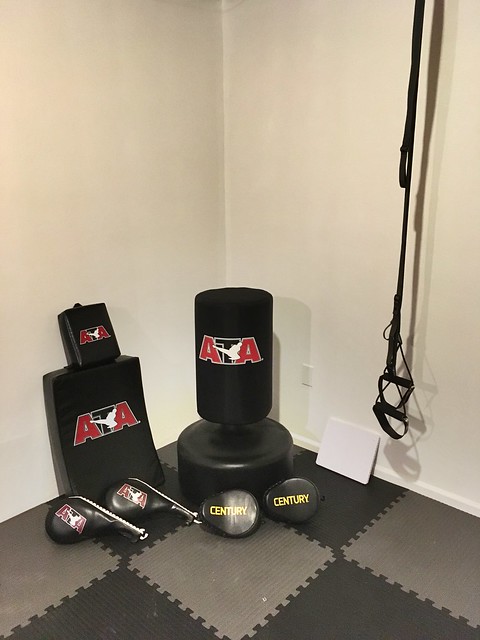

TKD gear in the workout room
Taekwondo training gear
For Taekwondo we have a assembled a fairly extensive list of practice gear.  For my son and I, we both have our gear bags with uniforms, bag gloves, sparring gloves, foot pads, chest pads, and head gear.  We also have sang jae baang (nunchucks), ba maang ee (escrima sticks), and jaang baang (bo stick).  (we have declared that jaang baang is not for indoor use because of the ceiling).  But we also have a junior standing bag (Wavemaster weighted with 80 lb of sand in the base), a double kick pad (claps when struck correctly, now we have 2), a small target, large kick pad, and a pair of focus mitts.  The matted area is good enough for pretty much any standard or sparring drill.

For bodyweight exercises, we are used to this from taekwondo, but our real use is based on a fitness cards based on Stack 52 Strength decks. (review)  So (now) DS 7 and I will draw 7-10 cards (he uses both beginner and intermediate cards) and we will do them.  DD 4 also joins in and does her analogue of the exercises as well.
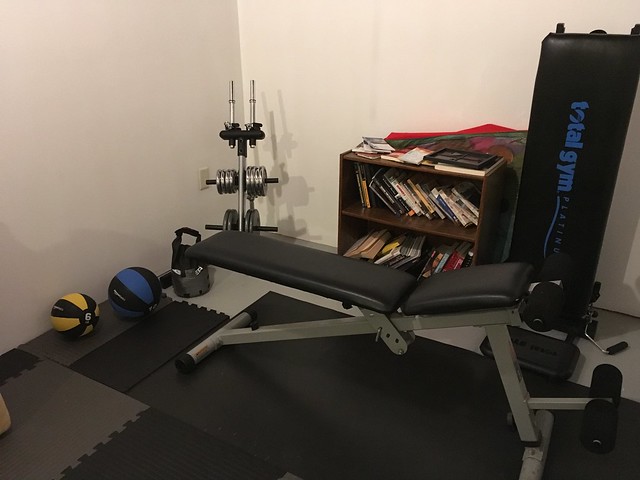
Workout room freeweight corner
Weights and Total Gym
For weights, from my pre-grad school days I had a cheap dumbbell set (the standard 4x5lb weights, 4x3lb weights, 2 handles with spin locks for a total of 40lb of dumbbells).  I had added the bench when I moved to my apartment when first started working after grad school.  Again, back then running was my primary workout, then the Total Gym for cardio.  I was not trying too hard with the dumbbells, but I knew a few exercises from when I did a few sessions with a trainer back in grad school.  And while I was not so concerned about strength, I pretty much maxed these out on the stronger exercises (e.g. bench press) soon after getting these.  Combined with not having a good place for this in my old house, I did not use this much.

After moving to the new house, I added a pair of medicine balls (6 lb and 10 lb) to the mix.  These were good complements to the bodyweight exercise, as they could be used with pretty much any bodyweight exercise to add more of a challenge. In fall, I decided that I would use the winter to add strength to my conditioning and I purchased 4x10lb weights and additional handles, which more than doubled the weight I had and allowed for switching between heavy, medium, and low weight exercises much easier.  More recently, I got the weight tree for the plates (which used to live on the mat underneath the weight bench) and a lot more weight plates (taking advantage of coupons and a sale from Dick's sporting goods), improving both the maximum weight and the range of different exercises I could be set up for in a workout.  Another use of the weight plates is for conditioning.  I have a military grade Camelbak HAWK backpack that I will load with 20 lbs of plates for rucking when going on walks with my family (so what is good exercise for the kids is also good exercise for me).  One big thing, weight training has gotten much more interesting and enjoyable once I got enough weights for it to be a challenge.  Working with the 40lb dumbbell set was essentially a messed up conditioning workout.  I could not go fast enough for a proper conditioning workout, but there was not enough resistance to actually get stronger.

For exercise equipment, I had a Total Gym from many years ago.  It was an incline based equipment that I have had from my apartment days.  It was always lightly used, generally it got the most use during winter when I ran outside less than before.  And after kids it got a little problematic because the track that the pad rolls on is an obvious pinch hazard.  And I probably had it on its steepest (hardest) setting from basically the time I bought it, so it really only was good for making my muscles move, not really for building strength or endurance.  To give me conditioning equipment to go along with the strength equipment, I got a suspension trainer (no longer available when the dominant company, which will remain nameless, used to court system to push them out of the market).  Since we have a semi-finished basement, the beams in the ceiling were exposed and I used one of these to mount the suspension trainer.  Similarly to the bodyweight exercises, I have a set of suspension exercise cards from Stack 52 to provide variety in my routine. This takes over from the Total Gym as it is easier to set up the exercise to be more difficult even as I am getting cardio in from lots of reps (at the end of the day, these are slightly harder versions of bodyweight exercises, but not as hard as using my dumbbells, so I use this for cardio as I am doing a large number of reps.  With the Stack 52 cards I have a range of exercises for upper body, core, and lower body.  And I can generate a fairly long circuit for conditioning.
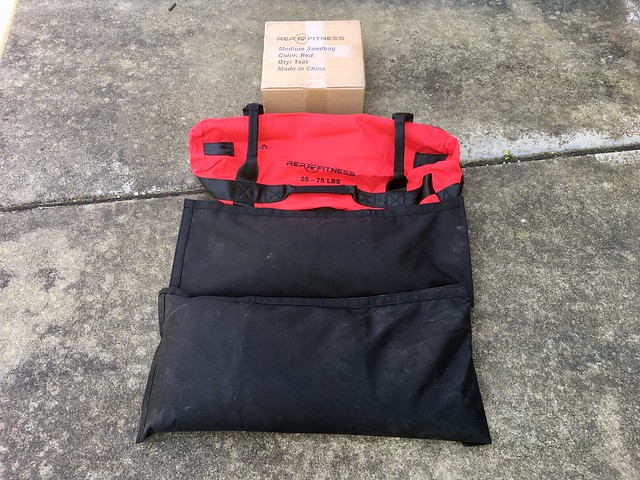

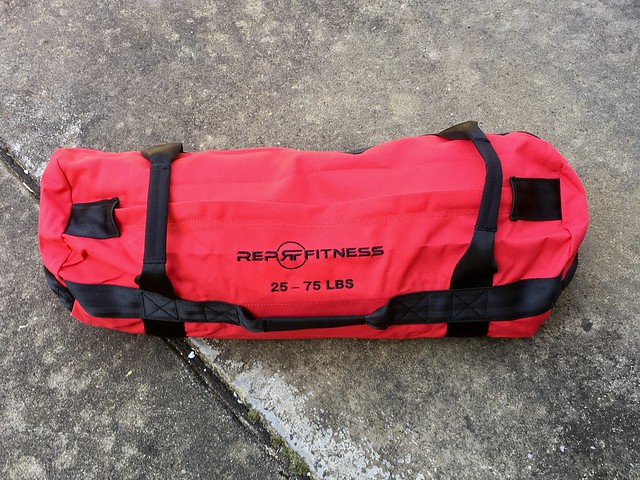
Rep fitness medium sandbag filling
Rep Fitness Sandbag with 15lb and 35lbs in filler bags
To the TKD, bodyweight, and cardio equipment, I recently added a sand kettlebell (20 lb) and sandbags (currently set at 15 and 35 lbs).  These are in the category of freeweights and along with dumbbells, were the featured equipment in the book Push, Pull, Swing by Myatt Murphy published by Mens' Health. The goal of the book was to explain that strength came from three types of motions (push, pull, swing), across three planes of motion. And if you did this, you would have all muscles in the body engaged (the contrast would be isolation training focusing on specific muscles, which is the principle behind the exercise machines you see at fitness clubs and home gym equipment).  The comparison between this and the dumbbells is that they are more unstable, so in addition to lifting the weight, you have to deal with the instability of the sand.  A second advantage is that they are made of sand, so I don't worry as much as the kids hitting or tripping over them since they have some give compared to iron plates in my dumbbells.  More recently, I've been building up my strength training so that in addition to the obvious presses and lifts, I learned more complex moves such as cleans, presses, and swings so that I can use strength training (dumbbells, kettlebell, sandbags) in exercises that hit a wide range of muscles and types of motion simultaneously.  Again, I also have Stack 52 decks for dumbbells and kettlebells. While I don't think the randomness is useful here, I have used the cards, the Push, Pull, Swing book, and YouTube to learn how to do even technically difficult exercise that require stability of the cores along with strength.


Rep fitness medium sandbag filling
Assembled 50 lb Rep Fitness sandbag
So, the current state of the home gym.  I know have 132 lbs of plates, and I am up to 86 lbs on bench presses and squats (the hightest weight exercise I do)  The dumbbells, kettlebell, and sandbag also  makes conditioning workouts more time efficient than the running or Total Gym used to be for me, with the suspension trainer and a range of kettlebell swings filling in for cardio.

I can see adding another sand kettlebell to round out my medicine ball and kettlebell weights, and I have room to add more weight to my sandbags.  My son has started using freeweights too.  I have him doing bodyweight exercises with the medicine ball (and I join in using the kettlebell) so this adds resistance. There are a few exercises designed for the kettlebell that medicine balls also work with so this will add to strength while maintaining stability and balanced development of many muscle groups at a time.  To add to the bodyweight exercises, I recently purchased an agility ladder, which both of the kids enjoy immensely.

Sunday, May 13, 2018

Product setup: CAP Barbell Standard Plate and Bar storage rack

The basement workout room had a problem.  I had a 40 lb dumbbell set and an adjustable bench for many years (I think I had it pre-grad school).  Last fall I finally got additional weight plates since it was getting too easy. But now there were too many plates on the floor, and we were worried about the 3 yr old kicking the weights (she liked to play acting like the bench was a sales stall).  Solution: get a weight tree.

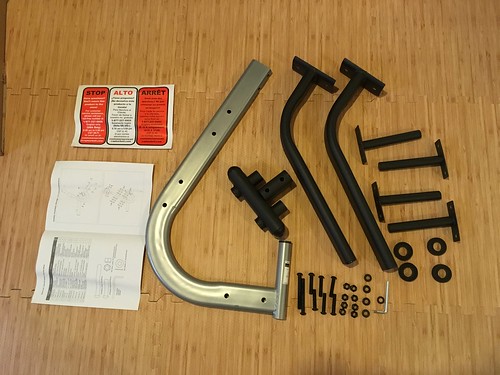
We got the rack unassembled.  Included were:


  • Main support.  
  • Two legs.  
  • Four standard plate holders.  
  • Two long 90mm bolts, 
  • six 50mm bolts.  
  • 6 nylon ocktight nuts. 
  • 17 washers (one spare).  
  • One 6 mm allen wrench.  
  • Instructions and "please call for help before declaring that this product does not work because you could not put it together properly notice"


CAP Barbell Standard Plate and Bar Storage Rack unboxed
Plate and bar storage rack parts
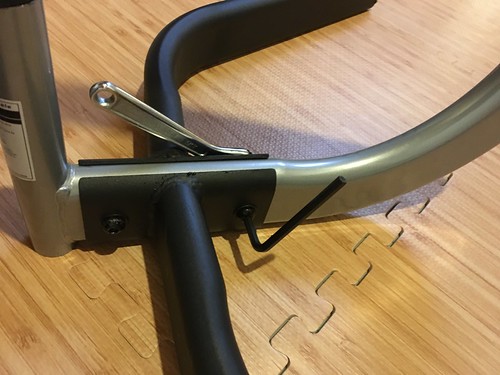
CAP says you do not need additional tools, but I don't see anyway that I could have generated the required torque on the locking nuts with the included allen wrench. So I supplied a 6mm allen wrench and a wrench to work the nuts and bolts.

Locktight nuts and bolts
Tightening locking nuts
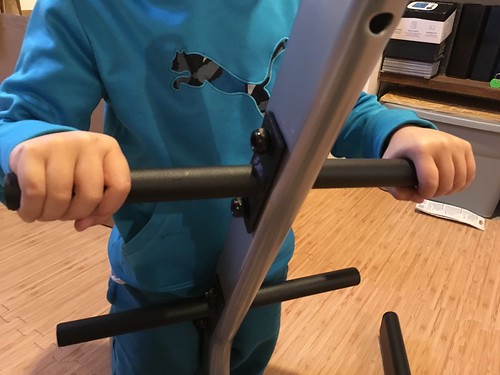
The order of assembly is to start with the legs on the main support.  Next are the four plate holders.  This is where it really helps to have additional hands, as the bolts want to fall out before you start putting on nuts.


Adding on the standard plate holders
Adding on standard (1") plate holders

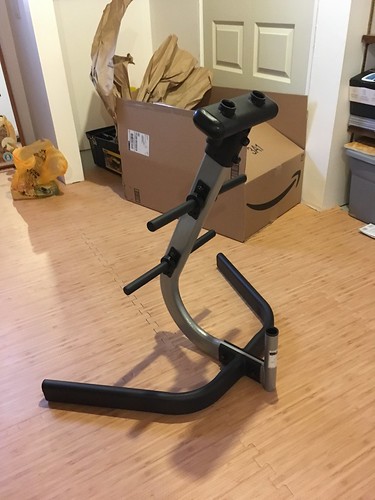
Assembled, the legs splay out 33".  The back of the main support to the line drawn between the ends of the legs is 21".  The height of the rack itself is 31".  Of particular importance is 33" for the legs. This gives it a wide base of support, wider than other plate trees so it feels very stable.

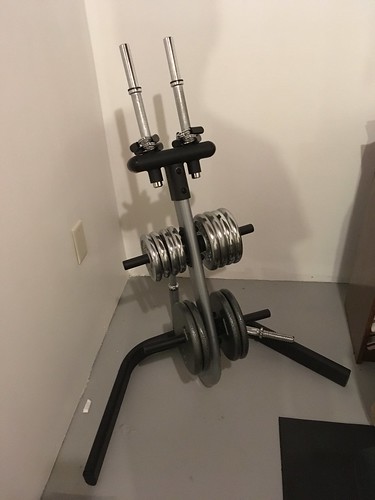
Completed weight tree and bar holder
Assembled CAP Barbell Standard plate and bar storage rack.

In addition to the four plate holders, there is room for two standard dumbbell bars on top, and a post that is meant for a standard barbell bar.


CAP barbell standard plate and bar storage rack
With dumbbell bars and weight plates
As it is, it holds a pair of dumbbell handles and I have a second pair laying across the legs (i.e. off the ground).  It feels very stable, and well able to manage the weights I have, as well as my next planned purchase of weights.  Each bar looks like they can hold 8 plates if I am careful, and 7 plates each easily.  I like the fact that it has room for the dumbbell handles and gets them off the floor and organized as well. And the fact that the base is wide discourages the kids from getting too close (and I'm not worried about the whole thing tipping over.

Overall, easy to assemble. Feels solid after tightening everything up. Feels stable.  I like the dumbbell handle holders (not a part of alternative racks).  Certainly good for dumbbell use.  I can see that if someone lifts a standard barbell, four plate holders may not be enough and you could run out of space quickly.