Showing posts with label movie review. Show all posts

Monday, May 26, 2014

Kids Are Icebound by ‘Frozen’ Fervor - New York Times

Kids Are Icebound by ‘Frozen’ Fervor Disney’s Animated Film ‘Frozen’ Has Some Children Obsessed By JOANNA COHENMAY 16, 2014


Like a very large portion of the population with children of preschool age, we were caught up in the Frozen craze.  The movie came and went without much notice, but by the time that the singalong version came out in the theater, T's entire daycare was singing it.  He had even started to learn the words to 'Let it Go', and we felt compelled to find the video so he could at least learn it properly. We saw multiple videos of it, T somehow finds everything about Frozen, even a video series of styling hair according to  the main characters.  And we put it in our Netflix queue so that when it came out we got it and watched it a few times.  But with all that saturation, I still think it is a very good movie.

1.  The Let It Go video is a great level up sequence. In addition to the song being an anthem to independence, the music video is a great sequence of a character growing in capability. The character of Elsa is shown creating ice and snow figures in increasing complexity as the song progresses, which is how people learn skills in real life.

2.  The characterization is meant for good role playing. I found myself thinking of the characters as Fate core, Fate Acceleated, or Risus characters, with strengths, weaknesses, troubles, character traits that get compelled and applied in many ways.  And the way the characters act is basically a superhero team-up story line, with the main characters learning how to work together as they go.

3. The characters have strengths, weaknesses, and character traits that help and hinder them (a plainer way of stating 2).  The things that makes each character strong and compelling are also the things that gets them into trouble. No Mary Sue or damsel in distress characters. Even the bad guys have strong characterizations (which is why it is hard to recognize the bad guy)

4. Even the ditzy one has strength of character, to include strength in the physical world, not just amorphous inner strength.

5. A female lead has as part of her characterization "likes math" (specifically geometry).  Math, physics and chemistry matter in this world.

6.  Relationships are not just about romance. The tendency of people to think that relationships are only about romanced is addressed by the problems it causes and the fact that the key plot point is that the characters make this assumption and forget that the prophecy could be referring to other types of love.

Now, we still think that other sources of songs such as Sound of Music and Les Misarables are more welcome than Frozen, but for a film that is a source of influence, Frozen is not all that bad.  And, to answer the question in The Motherlode (NYTimes) article on the subject (Parents respond to the 'Frozen' frenzy), we are of the opinion that the Idina Menzel version of 'Let It Go' over the Demi Lovato version.

Saturday, January 08, 2011

Why I write reviews

Finding a comfy spot to sleep Near the beginning of the year, the New York Times Sunday Book Review had several literary critics right about the purpose of serious book reviews. And the explicit background is the web, with many blogs where anyone with an interest can write reviews (e.g. yours truly), sites which invite reviews (such as Amazon.com). And in a world where anyone can say anything, what is the value of serious reviews (or what makes a review 'serious')?

What is not available in the crowdsourced review? Renee Fleming when she was in Pittsburgh last fall made the comment that the popular review had one flaw, that it tended to be gladitorial style, thumbs up or thumbs down. And as criticism goes, it was shallow and useless.

And there is the place for good criticism. The purpose of criticism is not to state a like or dislike, it it to describe and evaluate. There are a few things that you should be able to know after a well done review or criticism.

1. Where the work fits in its environment
2. What the work was trying to do
3. How well the work expresses its intent
4. The intended audience of the work
5. Who is not the intended audience of the work

And presumably, the reader of the review can identify if he is in 4 or 5, and if this is something he would want to read/attend/eat.

Why should I do such a thing? One, because this way I remember what I've done before. But also because every one of us is different. And these differences should result in differences in how we view a work. So when I have reviewed books, concerts, camping gear, movies, etc., the reader should be reading them with an eye for what makes us similar or different, and how would those similarities and differences change the way we would view the subject. And how does the object of the review fit into a larger whole (whether it be a set of experiences, gear taken on a backpacking trip, or a as part of a library.)

Do I do this every time? Probably not. Like many things, this is an ideal, to be followed when I am in the mood to do this, and the work is worthy of the attention. But having this ideal is a guard against a shallowness that contributes more noise than substance.

Wednesday, May 12, 2010

Why is the Silk Screen Asian Film Festival valuable?

At last Friday's Silk Screen Film Festival Gala, I was one of many who were interviewed by a local TV crew. One of the questions asked was what makes Silk Screen valuable to Pittsburgh. Now, I hardly claim to represent Pittsburgh, but I can think about what makes Silk Screen, and film festivals in general, valuable to me.

Now, for sheer variety of selection, we have things like Netflix that have an overwhelming selection of films. And what makes Netflix special is not that it mails these movies to my home, but that it has a selection of everything under the sun, including the most obscure (my wife and I imagine that the Netflix computers that analyze movie selections must have a real fun time working with us) and foreign films. But while Netflix computers can recommend movies similar to what you have seen before, what it would not do is expose you to something completely different.

Those who watch media have noted that over the last few years it has become increasingly fragmented. It is very easy now to see only what reinforces your current beliefs, views, opinions and way of life.

But, for me, life has not yet become a routine of the same. And given my age, I'm starting to wonder (and hope!) that it does not (since I think for most people have settled into a set routine by now). There is not a week that goes by that I don't have to deal with something that, if not completely new, is something I do not expect to deal with often. While it makes for an interesting life, I only get one of these, so do not have the benefit of experience (to be fair, I'm often in situations where noone involved has this benefit.) What film (and works of fiction in general) do is provide a window into different ways of seeing a situation, working out alternatives, and providing a mirror that asks what is it that you value. While it cannot be expected that the movie or book describe any real situation exactly (after all, it becomes a sample of 1), it can teach you to see things from several viewpoints. And if not teach you what to do, at least show you what you do not want to happen.

And Silk Screen. The festival takes on the role of an editor or reviewer. Of the myriad of choices out there, where to find the gems. And Silk Screen identifies films worthy of my time and attention, and brings them here to Pittsburgh. Showing me the world through a set of eyes I may not have found on my own here. And for that I am thankful.

See you at the movies of the Silk Screen Asian Film Festival in Pittsburgh.

Sunday, January 31, 2010

Movie Review: The Hurt Locker (2009)


The Hurt Locker is set soon after the 2003 U.S. invasion of Iraq and follows a 3-man Explosives Ordinance Disposal (EOD) team: Sergeant James, Sergeant Sanborn and Specialist Eldridge. Sergeant James joins the team near the end of a one-year tour of duty, following the death of Sergeant Thompson. As the senior in rank, James is the team leader. He is also the EOD Tech (i.e. the one who handles the explosive device). Sanborn is Ranger qualified and acts as a mentor to Eldridge. Eldridge is the young one, fighting his fear of dying in combat.

James has two things against him as a leader. First, he is a replacement team leader close to the end of a tour of duty. i.e. these are short timers counting the days until the end of the tour. Second, he is very aggressive, choosing to tackle difficult problems directly instead of conservatively. And this is the defining conflict of the movie.

A lot of things about the setting are very well done. The overall competence of American forces, especially American NCOs, was on full display. The difficulties in working in insurgent environments where it was hard to tell who was on which side. The desire to help the Iraqi's against the desire to take the safe way out. The tension of going into an environment where nothing is secure and everything is fluid and can easily turn deadly without warning. They even showed the tension within the Army between those who viewed their role as security and combat versus those who viewed victory as something that would only be gained by connecting with the population (in the early days, the political leadership was decidedly on the security/combat only view.)

But in the interest of setting up the story, there are many things that are unreasonable. An EOD team was a highly valuable asset, and would not have been risked travelling without an escort. They would not have been employed as light infantry (something alluded to at one point). A Colonel, (especially one that is not combat arms) would not have been allowed to be outside secure areas without escort (but at least they had the sense to tease him in film about his acknowledged incompetence in potential combat roles). And an EOD tech whose job it was to concentrate intently on a single narrow thing (the explosive device) would not be a team leader with the responsibility for an entire team. The parts taken from disarmed explosives would have been taken for investigation and study, not allowed to be hiding underneath some soldier's bed.

But all is forgiven with how well the conflict between James and Sanborn is done. Every scene becomes a way to address this tension in another way. James aggressiveness versus Sanborn's conservationism (of the "I am a soldier who intends to use my experience to complete my mission and live" variety, not the political variety). James single focus on the technical task and challenge of disarming explosives versus Sanborn's view of situations as a whole. And with all that, the fact that James is in fact the team leader, even if Sanborn is tactically more competent (note that Sanborn is Ranger qualified, something that is made explicit when he fills the role of sniper in one scene.)

One thing that the director and writer find hard to get is motivation. The feel of the environment seems pretty good, showing the confusion and lack of clarity in what can be seen. The characters seem reasonable (the writer spent time with a team, and claims the characters are composites. Even if he put character qualities that should not be in a single person together). But we don't quite get the motivations of the characters. Leaders do not get the luxury of focusing on one technical detail while they ignore their men (the Specialist track is for this group). People who are highly trained in very technical skills e.g. EOD techs) do not tend to turn into cowboys. And a Specialist (which usually implies a few years of experience) near the end of a year long combat tour does not get congratulated for not becoming frozen in a combat situation.

Even so, with what they did get right, it is probably one of the better movies on the current wars (see my other reviews). And the depiction of conflict between James and Sanborn makes it a good film.

Friday, December 25, 2009

Movie Review: Ride with the Devil by Ang Lee (1999)


Ride with the Devil is set in Missouri and Kansas during the Civil War, when pro-Southern elements waged guerrilla warfare against the Union occupation of Missouri. It is from the point of view of the Southern "bushwackers" as they raid and harass Union forces and sympathizers.

This has an incredible depiction of guerrilla or irregular warfare, known nowadays as insurgency. You see both sides attack civilians who sympathize or support the other side, or even are suspected of supporting the other side. It is shown in raids against isolated settlements, and massacres of entire villages. The use of language in shaping perceptions of one's own actions as well as the opposition. The fighters going to ground blending into the population and depending on the support of civilian supporters. All of these very familiar to anyone with familiarity of Iraq or Afghanistan in recent history, or Algeria, Vietnam or many such places.

The other theme here is the motivations of the Southern sympathizers. The focus on wanting to live their own way without interference, contrasts to the Union, who would impose their rejection of slavery on the Southerners. The portrait of the Southerners is sympathetic. And the view it shows of insurgency and its brutality, especially on civilians who are caught attacked by both sides with no security, is especially hard hitting. Well done movie by Ang Lee.

Thursday, November 26, 2009

Movie Review: Baghdad ER (2006)

This documentary follows the emergency room of the 86th Combat Support Hospital (CSH) in Baghdad in 2005. It takes it as a series of vignettes of trauma cases that enter the CSH, a mix of traumas of U.S. military, Iraqi security and Iraqi civilians.

As a documentary, it keeps a very narrow focus on the trauma department. As such, it is graphic and raw in its depiction of the effects of combat. It does some introspection, with the main point that the members of the ER don't see anything changing (likely because they are too far removed). But the narrowness of their work make it not possible to see anything else. (and they properly stay in their lane, even when pushed by the documentary makers)

While this is the documentary that got awards, I like the NOVA episode Life and Death in the War Zone, which followed the 10th CSH immediately following the invasion in 2003. considerably better. While Trauma and operating rooms are flashier and more intense, "Life and Death" covers the hospital as a whole, starting with preparing for deployment and covering the activities of the whole of the hospital, which includes interactions with the outside world (i.e. other then Americans) while "Baghdad ER" is looking at war through a soda straw.

Monday, August 31, 2009

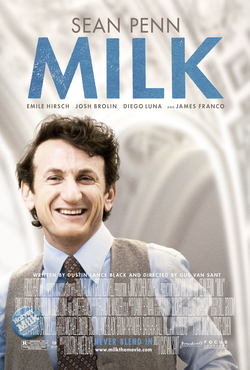
Movie Review: Milk

Milk Movie Poster
Milk is the story of Harvey Milk, a San Francisco businessman turned activist who was the first openly gay male elected official in the United States (there were lesbians elected to office, and officials elected who later declared themselves to be gay.)

Well, I think this was intended to be inspirational. But it was jumbled. In there was a story about someone who overcame obstacles to his photo business then organized a business association, then got elected. But it is constantly interrupted. There is the ever present aggressive expression of sexuality (Milk and company are very openly gay). There are numerous episodes of pettiness that looks like a distraction from the goals of the people involved. And there are the romantic relationships that see romantic rivals in every interaction, complain of neediness of time and attention. And all of it sucks away from this goal of political influence.

But this is reality. Life gets in the way of projects, no matter how big and important. But you wonder how do people who are around this, supposedly in relationships with people who are doing what they recognize as important, and they don't get the idea that supporting their people is something that has a level of priority.

As silly as this seems, it is also a reflection of the culture. There is another sub-culture that loses focus on its proclaimed mission because of focus of issues of sex. That regularly looks at the relationship status of people as their primary and overwhelming attribute and often ignores all others. And what I see in Milk, as much as it makes me think "what were they thinking", I realize that this is other sub-cultures in the U.S. as well.

Saturday, August 29, 2009

Movie Review: Julie & Julia (2009)

Julie and Julia Movie Poster

Julie and Julia is a story of two projects. Julia Child's book "Mastering the Art of French Cooking" and Julie Powell's weblog "The Julie/Julia Project". For Julia Child, the challenge was to learn French cooking and figuring out how to communicate. For Julie Powell, the challenge was to work her way through the 524 recipes of Mastering the Art of French Cooking in one year and writing about it in her blog.

So the story is of a project. But projects are not things that happen in a vacuum. And they exist in the context of life. And this movie is not just about two writing projects. It is about living life in the midst of writing projects. And in both cases, life is in the context of a marriage and job transistions. Julia Child book was written while her husband was pressured for their past work. (Julia Child and Paul Child served in the OSS during WWII in China. The OSS was the predecessor to the CIA. At the time depicted (1950s), there was a movement in the United States that considered wartime service to be reason for suspicion for treason.) And in the midst of transfers she was writing her book along with her co-authors in Paris.

In 2002 Julie was in a dehumanizing job after recently getting married and in the midst of a move, undertook this cooking and writing project. And it causes stresses at home (like any project that takes up time every day).

What do we see? We see two couples dealing with the stresses of life, of goals reached, obstacles encountered, setbacks, and successes. There are times when the everything is good, times when life is hard but the project provides energy and drive to get through the day, and times when the project threatens to suck the energy out of life. Or aspects of life become overwhelming. And the movie shows them dealing with this. Sometimes gracefully, sometimes otherwise.

Some thoughts. I had a professor who gave the advice that we should have many aspects of life, because in every aspect of life, there are good times and bad. And when life is single focused, it becomes subject to the changes of that one aspect of life. But a varied life provides a buffer that can withstand the winds of change that life inevitably provides. And the movie shows that, with both Julia and Paul Child taking terms having success and failure in their project/careers. And it allows them to support each other in each other's setbacks. In comparison Julie who allows the project to become her life, dominating their time at home.

And it is here that the movie shines. In particular with Julia and Paul Child, both living full lives, and supporting each other the good times and bad, and their relationship strengthening the whole way. Julie and Eric have it rougher. We do not see Julie supporting Eric as she uses her project to escape both her job and her family.

Now, do they learn? It does look that lessons were learned. One advice more commonly given to people who are recently married is they get into a fight, so they can learn how to make it through a fight. And so do Eric and Julie. We don't know if Julie has learned how to support Eric as he does her, but we presume that they have learned something about relating with each other as they celebrate with each other over the end of the project and her publishing deals.

It was a good movie. Not just a foodie movie, but a movie about two couples, figuring out life.

Sunday, August 23, 2009

Movie Review: Last Letters Home (2004)

HBO movie website

Last Letters Home is a documentary that is built around the letters home to family of soldiers who were killed during the first years of Operation Iraqi Freedom in a partnership between, HBO, Time-Life and The New York Times.

What is here? Yes, there are grieving parents, brothers, sisters, spouses. But these are letters of soldiers proud of their work, parents proud of their sons and daughters and how they have grown. Officers and NCOs filled with worry, pride and care for those under their command. Soldiers looking forward to going home after their combat tour. Making plans and goals for the future. Telling tales of living life among comrades in arms, even in far away places. Hoping beyond hope that their families are not worrying about them. And stories of the two officers in dress uniforms with a chaplain coming to visit homes.

What is the purpose of something like this? Or the New York Times naming casualties as they are released in "Names of the Dead" and its "Faces of the Dead" feature, even as its audience largely pays little attention to the costs of war? Or Gary Trudeau (Doonsbury) sponsoring The Sandbox, where military personnel who have blogs that talk about life at war can be given a wide audience? In "Gates of Fire" by Steven Pressfield, he has a fictional scene where the Queen of Sparta gathers the wives of those who died at Thermopylae and tells them that those who were sent were chosen because of the ability of their wives to handle the loss. Reality is nothing so melodramatic, but a country that sends its sons and daughters to war would be so lessened if it did not remember them and consider the cost to those who have lost those they have cared about them. And not thinking of them in the romantic and fantasy of waving flags and fiery speeches, but in the practical sense of remembering that these are men and women, sons and daughters and they represent the dearest coin that our country can pay for causes that it deems worth the price.

Tuesday, August 18, 2009

Movie Review: I, Robot

I remember when I, Robot came out, and the awful reviews about how it was not faithful to the source material. But while it is a different story, I find it to be in the spirit of the Asimov stories. (I don't tend to care about the special effects as much as plot.)

The focus of the Asimov stories is to take the world where robots exist and are bound by the Three Laws. And the world is full of robot who are created to serve people, and have this higher order understanding that they need to protect humans. But then something happens that seems like a paradox and the protagonist needs to figure out how it happened, within the confine of the Three Laws.

And this movie follows one of those themes. That a robot is able to take the three laws and derive the Zeroth Law from them. And then the inevitable conclusion, that people inflict so much harm on each other, the best way to protect humans is to control them, and those that could cause harm are destroyed to better protect humans. After this, the action and special effects are details.

The parallel is not unquestioned reliance on technology. The parallel is unquestioned reliance on authority to enable our protection. It is a world where we are given rules to protect us from our own good, and we are asked to trust in authority. Or, as a friend of mine in grad school said, "we have to trust that authority knows things we don't and are making the right choices" (obviously, given my career path that has included such things as speaking truth to power, I don't follow that philosophy)

The alternative, I would contend, is to ensure that people are provided the means to make proper choices. Not the choices passed on to them by the powerful (corporations, government), but choices where the individuals are given the information and the means that make their own. Does it mean anarchy? No, because anarchy inevitably breaks down to rule by the strong, because the weak become forced to seek the protections of the strong for their own protection. Full libertarianism has the same effect, the strong are left with no restraints. We are better off with the ideas of the Federalist Papers, where interest contends with interest, whether those interests are economic, political, regional, ethnic, or other grouping.

But what it leaves is what the Coase Theorem suggests, that the proper role of government is to allow for the reduction of transaction costs, so that the market will by market forces flow toward the most utility. That means that ways are found to reduce the effects of market power and that information is allowed to flow to where it is needed (e.g. regulations). And the results of choices are allowed to occur.

Sunday, August 16, 2009

Movie Review: War of the Worlds (2005)

I had watched the 1953 version of War of the Worlds a few months ago, and I wanted to see how a modern adaptation fared.

In the 2005 version, the narrator is a divorced blue-collar dock worker who shepherds his
two children to his ex-wife's family in Boston, which presumably represents safety. He is rather cocky, and presents an I-know-what-I'm-doing front to the world, which does not fool his ex-wife or his kids for a second. On top of that, the way he relates to his kids is one of I'm-the-father-I-know-what's-best, which also does not impress them.

This comes to a head during the invasion, which takes on the form of one pod not far from his house. And he sweeps his kids out of there in a stolen car, all the while trying to shelter them from knowledge of what is happening. Which leads to growing tension among the family as the little girl starts freaking out because she can tell her father and everyone else is scared and she does not know why, and the older son is getting pissed because he can tell that the father is not telling them something very important, like 'there is this big thing that is killing everyone and is unstoppable behind us'. ("Tell me what you know!!!")

It seems to have as an underlying premise that the ultimate goal is to shelter our kids from knowledge of danger and they will come out all right (witness numerous scenes where they blindfold the little daughter and comfort is not achieved by helping her deal with what she is facing, but by removal and having her forget) The son, realizes this and actively goes to help others (on a ferry) and looks for ways to help in the resistance to the invasion, because he wants to get away from his overprotective father (whom the son realizes is well beyond his level of competence.) The narrator here is constantly conflict avoidance, refusing to explain actions, include others in what he is thinking, and helping others. And while the movie shows the harm it causes, it treats this as the way to be, as he never learns.

The movie misses a lot in not dealing with the relationship between father and son. This could have been explored with the son pushing for more information on what is happening, and having this coming to a head, instead of dealing it by the son just leaving his father and sister. Also, the old deacon on several occasions identifies that he and the narrator have a conflict, but they never even try to work it out, the narrator only brings it up at the worse possible times (i.e. instead of talking it out in the quiet moments, he only brings it up at times of mortal peril.)

So, obviously, I did not like the movie. But it does potentially have the virtue of depicting one model of raising children. In this case the parent knows everything and the child only needs to blindly follow, blind to the realities of the world. My wife and I, should we have children, have determined that during the period said children are with us, they will not be hidden from the realities of life, that they will experience the world in all its splendor and horrors while we and our friends around us are there to serve as guides and guardians. So that their futures are faced in the knowledge of what is and what can be as they make their own choices for their futures.

Sunday, August 02, 2009

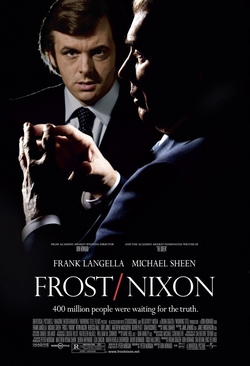
Movie Review: Frost/Nixon 2008


Frost/Nixon portrays the Nixon Interviews of 1977 between former President Richard Nixon and British talk show host David Frost. It is prominent because it was the first public interview by Nixon after his 1974 resignation. Because of the blanket pardon provided by his successor, President Gerald Ford, there was no investigation, trial or finding as to his guilt, and the U.S. was still suffering from turmoil in the aftermath of Watergate and the end of the Vietnam war as public confidence in government and public service was at a low.

The actual interviews were best known as the point where Nixon stated the philosophy "Well, when the president does it, that means that it is not illegal." The actual interviews are discussed in many places. This is about the movie.

The movie is not as much about the content of the interviews (although the interviews were the point) as it is about the two people involved and their cornermen (i.e. principle staff). You have Frost, who is more of a TV personality rather then a tough reporter, and Nixon, an experienced politician. For Frost, this was an opportunity to do something unique and special, incidentally trying to save a career that is looking like it will fall into banality. Nixon was a politician who missed the give and take of dealing that went with political life and wanted the opportunity to rehabilitate his place in history. For the people behind Frost, they wanted the opportunity to represent their generation in uncovering the truth of the events that ripped the heart out of the country, and Nixon was the demon that needed to be faced, with Frost being the very unlikely and not very qualified demon confronter. Nixon's staff viewed Frost as a lite-weight pushover.

The movie focused on the evolution of Frost in this environment. In one of the DVD special features, one of Frost's staff depicted in the movie describes how he never realized about how compressing TV was, that for everything done, TV has a way of focusing attention on one moment to the exclusion of everything. And that as bad as he felt most of the interview was, a single moment (a shot of Nixon during the interview described as grief and pain and self-loathing) saved the rest. The movie shows it this way as well, with Frost almost distracted in the midst of the interviews by the need to court investors and sponsors as opposed to preparing for the interviews, until the one focused on Watergate, which turned into the equivalent of a finals cram session as Frost prepared with an intensity he did not before.

What was good? You can see the issues of hubris. The most obvious one is Nixon and his team, confident that the inteligent Nixon can snow the pushover Frost. But also from Frost's side, who had the view that his role was to provide entertainment and a show. (Note: this was dramatic license. In reality, David Frost was a competent interview as needed, and his choice of staff was intended so he could be hard hitting, his previous interview with Nixon in the 60s aside. The idea that you can find a particular transcript that may or may not exist in courthouse records and integrate it into a TV interview in a couple days is not believable, or true.) And the purpose of the preparation was only that. And the turning point was when one side realized his hubris, which was Frost.

This is not a documentary, rather a dramatic work around a historical event. And its goal was the pointing out the effects of hubris on man, even those who could truly deserve the label great. So it was for many of the time and events in question. And, history shows, many other times and places.

Thursday, July 30, 2009

Movie Review: Harry Potter and the Half-Blood Prince

I saw this Saturday with some friends. The previous movie sees the return of the death eaters and Voldermort in the open.

The story revolves on Harry viewing his role as "The Chosen One" as his own. Of course, with all the plot lines, this is hard to catch. And, he has that teenaged I-am-special-if-only-everyone-else-could-figure-this-out world view. At least he does in the book. The movie has Dumbledore understanding perfectly how wonderful Harry Potter is, although he is apologetic about demanding so much of him. In the book this is also true, but I don't remember Harry being quite so understanding of things.

The films still suffer from too many plots going on at once. This sort of thing works out better in books, in films it gets confusing since some characters are doing double and triple duty.

I remember not liking the book so much, because the Harry Potter teen-age angst was in full form at this point, with very little redeeming virtues. But with this watered down for the movie, it is harder to figure out his motivations. Or motivations for many of the other characters (ok, all the girls in potions class are pretty easy to figure out, but lots of other people seem pretty random if you had not read the books.)

Oh, the major character development plot seems to be all the kids starting dating, and it has to be with major drama. Again, this part did seem to work out better in the movie then the books, but it still seems compressed.

Friday, May 15, 2009

Movie Review: Sparrow (China)

Part of the 2009 Silk Screen Film Festival. The Silk Screen Film Festival runs in Pittsburgh through Sunday, May 17.

http://silkscreen.bside.com/2009/films/sparrow_silkscreen2009

Johnny To brings Sparrow, a Hong Kong based movie about pickpockets. 'Sparrow' refers to a bird who appears in the life of the main characters, and is in and out of cages, as well as Hong Kong slang for 'pickpocket,' which is the main source of income for most of the principle characters.

The plot, well its silly. We have the pickpocket gang. The old-school gang who tries to show the younger upstarts how it is done. And the beautiful girl, in this case a caged sparrow yearning to get free. The plot is a silly thing, and the encounters are also a joke.

But the plot here is not the point. The cinematography is where all the work went into. The pickpockets at work montage. Various chase scenes of the sparrow trying to escape her handlers, the protagonists or the antagonists. The many now-you-see-me-now-you-don't scenes. The card table. And the final showdown of groups of people crossing the street in the rain carrying umbrellas. Silly as plot devices, but still fun to watch Johnny To set the visuals.

Enjoyable summertime nothing-serious movie

Thursday, May 14, 2009

Movie Review: Handle Me With Care (Thailand)

Part of the 2009 Silk Screen Film Festival.
. The Silk Screen Film Festival runs through Sunday, May 17.


Handle Me with Care is the story of a Thai villager (Kwan) with one special trait. He has three functional arms. In all other respects, he is quite ordinary. But it means that he is the subject of talk and teasing. And he has a hard time finding a girlfriend, because when he does find someone, she gets scared off by all the attention he gets everywhere he goes. His solace has been his mother and uncle. His mother died a year before the movie. And at the beginning of the movie, his uncle, a tailor, dies. And now the burden is too much, and he takes up the offer of a high-profile Bangkok doctor for a free amputation of one arm, with the hopes that he can blend into society like everyone else. And with limited funds (he is a poor villager) he heads off to Bangkok.

Along the way he meets up with a woman (Na) who is also trying to head to Bangkok. To see her husband who ran away a year ago to the big city. And she has a slightly more common attention getter. She is well endowed, and everywhere she goes, her breasts get the attention.

Much of the movie is Kwan trying to push Na away, and Na asking why he wants to change. The other major theme of the movie is Na observing Kwan's character in action (it is almost cliche for the physically deformed character to have a heart of gold a la the Disney version of Quasimodo.)

Kwan's question is how much changes when the physical differences are gone. People in the village still treat him the same. He has the same relationships with everyone (except his boss, who does not like the fact that his job performance went down.)

So the end of the movie, Kwan is looking at his life before, and now. And thinking about what the future holds. And he makes the observation that what makes his mother and uncle so precious is they dealt with him as a person, not as a curiousity. So he goes to join someone else who does the same. Na (who has returned to her village), who welcomes him (her mother had told her prior to the movie "you either come back with your husband, or you find a new one")

Slightly cheesy. But given the number of ways we (society) find to declare people as freaks, it works to give a bit of empathy. And having a third arm that is not an actual handicap was a good plot device to do this. It is notable that the only real handicap was other people's reactions, because it is not actually a handicap. Very much like some qualities that leads parts of society to declare people as freaks today.

Monday, May 11, 2009

Movie Review: Star Trek (2009)


Official Website

I saw this the first weekend,  like many others.  And it was in an IMAX theater.  I don't think I've had that experience recently, and when the first trailer played I thought "oh, wow, what a sound system."

Star Trek was the long waited reboot of the Star Trek series, from the original.  And its notable because of the youth of the characters.  In particular, while Spock and Scotty have some level of experience (and McCoy is still a doctor which is a different track), Kirk, Uhura, Sulu, and Chekov are fresh out of training (or abbreviated training in the case of Kirk).  

While I imagine there is the idea of an appeal to youth, the crew relationship and development is one I tend to react rather negatively too.  To make a point of it, it depicts an environment where success is due to chance and turn of events, and not decision making.  While thrilling, to me it is unsatisfying.

A very strong counterexample is the remade Battlestar Galactica.  There you have a crew made of senior and junior officers and enlisted men.  And amidst all of the pressures of war and imminent death as a consequence of failure there is a dedication to each other,  mentoring between senior and junior, with seniors making decisions based on wisdom and experience, and purposely guiding the junior personnel so they may also grow in wisdom and experience of their own.  And in the original series you saw it as well.  By the time Kirk is captain, his backstory includes a pattern of development and mentorship and experiences.  The movies have it with Decker and Sulu being protoges of Kirk.  Scotty's nephew, Spock's mentoring Saavik and Valaris.   With our new Captain Kirk, there is no sign of any development of the person, only raw intuition and emotion.  No development of leadership skills, empathy, instillment of loyalty.  It shows in the Kobayashi Moru scenes where his fellow cadets follow his orders in a bored offhand way instead of the crispness that they have been trained, even if they viewed his orders as silly (after all, they are being evaluated too).  And no indication that Kirk cares about the development of anyone around him (other then checking that they appreciate and recognize his moments of brilliance.)

But would someone follow such a person?  By the end of the movie, Kirk has good moments.  But in many ways he was merely lucky many times, and he does not show the ability to work with people that marks the other captains in the movie, or the other captains in the other Star Trek movies and series.   There is a saying that you'd rather be lucky then good, but would a crew be inspired to work by such a person?

Sunday, May 10, 2009

Movie Review: My Dear Enemy


My Dear Enemy (2008) (subtitled) was the opening night show for the 2009 Silk Screen Asian Film Festival in Pittsburgh. It is a Korean movie starring Jeon Do-Yeon and Ha Jung-Woo. The movie revolves around a man and woman who were dating at one point but broke up a year prior, and she suddenly appears demanding he pay back money he borrowed from her from back when they were dating. And for the rest of the movie, he goes around to various girls who he knows borrowing money so he can pay her back.

He comes across as somewhat of a doufus, acting on the spur of the moment, but somehow managing to keep up a wide range of relationships with women but not being able to maintain anything long term. She is depicted as being very pushy and judgmental. But we don't know anything about her motivations. Like why she decides to take a day to follow him around borrowing money from girls and occasionally feeling humiliated for their feeling sorry for her. You hear some statements, like him telling everyone that she is in a bad situation, but you don't know if he is being honest or not (and you get the idea that he is not always honest, even if he is well meaning) There are occasional asides as to problems (in the past year, he married then divorced. She broke off an engagement to someone who had lost his job.). And she mentions that all she wanted to do was yell at him, not necessarily get her money.

What it does well is complexity of characters. He comes off as a thoughtless doufus, but you get the impression that the affections and gratitude of various girls is something that had been earned by his being there in times of trouble. You admire her for being forthright and confronting him about his thoughtlessness, but you get the nagging feeling that she is only looking for someone to yell at and instead of seeing her as an advocate for the girls that he is getting money from by being slightly dishonest, you start thinking that she is envious of not having the experiences that led to their gratitude in her own relationship with him.

At the end, you see him connecting with another set of girls, talking about a plan of his that you are very unsure is for real. And you see her leaving, with an IOU that provides a means of reentering his life, and smiling at seeing his pattern of relationships continue.

Saturday, February 28, 2009

Juno: Movie review

(Wikipedia)

Juno is the story of a teenager who is pregnant. In 2007 when it came out, there was much controversy, as everyone on the pro-life/pro-choice/teenage pregnancy/values issues had a go at it. But I never saw it until now.

I was all expecting it to be one of those movies with the spunky teenage girl and clueless adults around her. But it was not. It is a teenage girl, dealing with the world through her mistakes and with the help of people around her.

Juno is a high school girl, who has gotten pregnant. The other major characters are the boy (surprise!), her best friend, and her parents. While initially she was going to have an abortion (apparently, her best friend had helped a few other girls in their school through the process) Juno changes her mind at the clinic and tries to give up her baby through adoption. The couple that is planning on adopting the baby become the other main characters in the movie.

Instead of the sassy teenager, Juno is introspective and comes to terms with what she recognizes as a mistake. And her focus is on dealing with it. There are others around her like the school nurse, some of the other classmates who look down on her. But those closest react differently. Her parents first reaction is disbelief, mostly blaming themselves for being bad parents. But they too, after first beating themselves up, switch into dealing with the situation, getting Juno through her pregnancy and the adoption.

What I liked about it was how they handle adversity. Yes, Juno and her parents (and the father) are hard on themselves for messing up. But the focus is on what has to happen next. The parents making sure that lessons are learned. The daughter learning that her parents are paying attention and care about her. And they guide her, with what wisdom they have. And in the end they have her respect.

None of the principles thinks they have it all together. Just people who have made mistakes, and need to figure out life. And in a movie, that is good.

Saturday, November 29, 2008

Roger Ebert's Journal: Death to film critics! Hail to the CelebCult!

Roger Ebert column at the Chicago Sun-Times, November 26, 2008
Death to film critics! Hail to the CelebCult!

Roger Ebert is the movie reviewer at the Chicago Sun-Times, made famous by being part of the movie review team of Siskal and Ebert (later Ebert at the Movies). This column talks about the art of being a movie critic. It's trigger.

The crowning blow came this week when the once-magisterial Associated Press imposed a 500-word limit on all of its entertainment writers. The 500-word limit applies to reviews, interviews, news stories, trend pieces and "thinkers." Oh, it can be done. But with "Synecdoche, New York?"

. . .

Worse, the AP wants its writers on the entertainment beat to focus more on the kind of brief celebrity items its clients apparently hunger for. The AP, long considered obligatory to the task of running a North American newspaper, has been hit with some cancellations lately, and no doubt has been informed what its customers want: Affairs, divorces, addiction, disease, success, failure, death watches, tirades, arrests, hissy fits, scandals, who has been "seen with" somebody, who has been "spotted with" somebody, and "top ten" lists of the above. (Celebs "seen with" desire to be seen, celebs "spotted with" do not desire to be seen.)


So, what is a film critic for? Is it just to tell about the gawking of the actors and actresses who play the character on the screen? In another forum, one of my book reviews is being severely criticized, because I have stated that my primary criteria to judging a book is the believability of the characters (after I grant to the author the scenario and situation), not the politics of the book. Ebert says this much better.

Why do we need critics? A good friend of mine in a very big city was once told by his editor that the critic should "reflect the taste of the readers." My friend said, "Does that mean the food critic should love McDonald's?" The editor: "Absolutely." I don't believe readers buy a newspaper to read variations on the Ed McMahon line, "You are correct, sir!" A newspaper film critic should encourage critical thinking, introduce new developments, consider the local scene, look beyond the weekend fanboy specials, be a weatherman on social trends, bring in a larger context, teach, inform, amuse, inspire, be heartened, be outraged.

I could only hope to move in the general direction of that goal. And mourn every sign of its passing that comes my way.

Friday, October 17, 2008

Review: Good Night and Good Luck

IMDB (2005)

No one man can terrorize a whole nation unless we are all his accomplices. (1954)

We must not confuse dissent with disloyalty. We must remember always that accusation is not proof and that conviction depends upon evidence and due process of law. We will not walk in fear, one of another. We will not be driven by fear into an age of unreason, if we dig deep in our history and our doctrine, and remember that we are not descended from fearful men — not from men who feared to write, to speak, to associate and to defend causes that were, for the moment, unpopular. (1954 on See it Now)


Good Night and Good Luck was about Ed Murrow, a broadcast journalist with CBS in the 1940s and 1950s. His fame was based on his broadcasts from England during the London Blitz, which is where his catch phrases "This . . . is London" and "Good night, and Good luck" originated. This movie describes his conflict with Senator Eugene McCarthy during the Red Scare.

What we see is a newsroom as you would hope for it, in the early days of broadcast television. Producers getting stories, and trying to determine what is known and not known, and to pitch a story, as hard as the facts may warrant it, but no more.

And you see the pressure that was put on the journalists for doing this. Senator McCarthy used intimidation, secret evidence, guilt by association, and near blackmail to further his cause. And in it all, there was almost no proof.

Ed Murrow also pushes the point, that Senator McCarthy's primary tactic was to paint people as guilty by association. The mere association with people who were communists was enough to be a target of McCarthy. But unless you live a sheltered life, outside the streams of human suffering and existence, and outside the stream of history, you cannot avoid associating with people with unsavory pasts. Murrow responds to McCarthy's accusation that a socialist author dedicated a book to Murrow by stating that author belonged to a time and tradition that allowed people to be friends with people they disagreed with. And the book dedication that McCarthy gave as evidence of communist leanings acknowledged that Murrow disagreed with the author on principles. McCarthy's argument was pure innuendo, with no substance beneath the surface.

The movie does have a 'just the facts' aura to it. Events and decisions are made bluntly, purely business. There is rejoicing after the job is done, but the actual work is deliberate. The many subplots makes the whole thing almost inhuman. Except for the McCarthy emphasis on character assassination. As the CBS crew reports it, and is a target of it, you see the cost of character assassination in careers ruined, lives ruined, people driven to suicide. All of which steels the CBS crew in their determination to resist the pressure and present the news in an manner beyond reproach.

A very good movie. The antagonist use of character assassination by association is something that has been used many times throughout history, and Good Night and Good Luck does a good job of showing the cost, foreshadowing what kind of world would result if it left unchecked, and showing what resistance to that kind of world looks like.