Showing posts with label martial arts. Show all posts

Sunday, June 13, 2021

The value of competition for youth

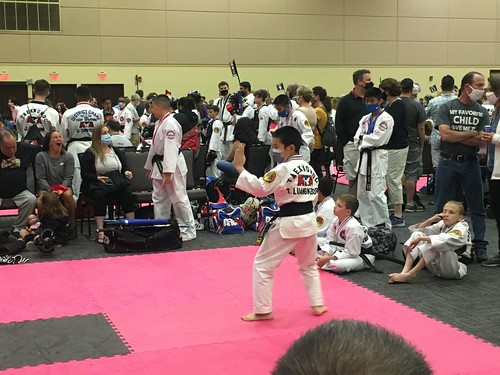
This past weekend DS10 competed at the American Taekwondo Association (ATA) Northeastern District Championships in 9-10 Blackbelt forms and traditional weapons.  Qualification was somewhat of a surprise to us.  The ATA uses a NASCAR style points system for qualifying.  You get points for placing in the many competitions hosted around the country during the year.  Then at the end of the year, state champions are determined for each of the categories based on accumulated points, and the qualifiers for districts are determined.  Because of COVID-19, last year's competitions were cancelled, and this year's qualifiers were based on last year's competitions.  While we knew that DS10 had points from last year, we were surprised to find out that he had enough to qualify (we found out when the ATA sent notices to the schools that their students qualified for District Championships).  We suspect that many of those who would have otherwise qualified had dropped out of the ATA and TKD during COVID (while DS10 had continued training through his school that supported virtual classes).  But, since both of us (parents) are in fields where careers are marked by perseverance through the events of life, the COVID-19 pandemic is merely one of those life events, but experienced by everyone, and everyone made decisions that allowed them to progress or not in their chosen areas.


ATA TKD Northeastern District Championships


ATA TKD Northeastern District Championships


After learning that he qualified for Districts, DS10 now joined the ranks of those who travel for tournaments.  We have typically only gone to tournaments that were local (i.e. no hotel stay required), but we always noticed the number of competitors that traveled to tournaments from other states (in most cases, because the points to be gained were valid in their pursuit of their state and district qualifiers at the end, but there were some traveling competitors at the novice sections as well).  When he was younger, our philosophy of tournaments was that DS10 needed to be exposed to the quality of those outside his immediate circle (school).  Again, both parents have the philosophy that the only way of assessing the quality of a person in an area is to see how they fare when directly compared to a larger population.  Because until you are compared outside your home, you can never know how good you really are.  And then knowing what is possible gives one intrinsic motivation to become better.  And not just in the area of competition, but in all areas of life (i.e. become a better human being).


ATA TKD Northeastern District Championships

In preparing for the tournament, TKD had gone from a sideline during the pandemic to an area of focus (it helped that he just had piano competitions that meant these areas were ramping down). This meant regular sessions with dad in the basement and weekly private lessons at the ATA school to ramp up his TKD over two months.


ATA TKD Northeastern District Championships


ATA TKD Northeastern District Championships

For the competition itself, we did not have high expectations.  The majority of the competitors in the ring had state and district champion patches (meaning they were state or district champions in past years).  So the goal was to do well  (i.e. not get last :-) )  And his scores were in line with reasonably good, but not exceptional.


ATA TKD Northeastern District Championships


ATA TKD Northeastern District Championships


More useful was the post-competition talk. DS10 reports that during competition his world got very small, and he noticed nothing but himself and the judge.  So we explained that this was the feeling that he wants to have, that sense of being able to concentrate and focus so that nothing else matters and he enters the zone.  This for us is the value of the competition, not winning or loosing, but understanding what it means to prepare to do your best in the moment, and how that moment feels when you are doing your best (and contrast to when you did not do your best). Because that is a feeling that can be repeated in all parts of your life.  Next, exposure to the reality that the world is bigger than your day to day life, and the people around you are not competition, but fellow travelers on that path (even if we are regularly reminded that people around us do not agree with this belief).

ATA TKD Northeastern District Championships


Wednesday, January 01, 2020

Home gym in December 2019

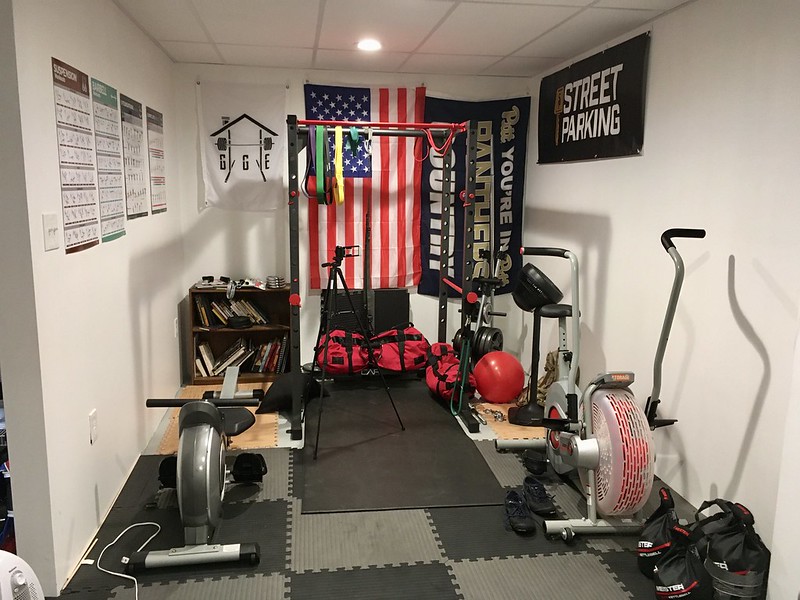
Here is the current state of my basement gym.  The basement is used by myself and my two kids for exercise of various types (we are trying to get my wife to use it too :-) )  Nothing here is too impressive, since if I ever wanted to use higher end stuff, the YMCA is available, but I think that everything here is good enough for our needs and they way we train (taekwondo, bodyweight, CrossFit)

Basement gym Taekwondo corner
Floor and taekwondo equipment
The most important part of the gym is the floor.  When we moved into the house we bought 3/4" thik squares and covered the basement floor with it with the intention of using it for taekwondo practice and bodyweight exercises.  The floor is big enough that one of us can do our taekwondo form.  It gets used for bodyweight exercises and as a workout area for CrossFit (Streetparking.com) workouts.  The second most important part of the gym are the instructional materials. We have several decks of Stack 52 exercise cards and more recently the posters illustrating various exercises for bodyweight, kettlebell, dumbbell, suspension band, stretching, etc. As my kids get older, they get cleared to use more of the posters, card decks, and equipment. This corner shows our taekwondo training equipment.  Two Century (ATA branded) Wavemaster standing bags loaded with sand (50 lbs on the small one, 100 lbs on the regular sized one).  We have a large kick pad, a pair of focus mitts, a target pad, and two kick pads.  Not pictured are our practice weapons and some agility equipment (agility ladder and cones).


Basement gym strength and cardio
Power rack and cardio
The previous owner of the house did not know what to do with this nook and used it to store junk.  In the beginning (i.e. from just after I finished grad school), I had a 40 lb dumbbell set with handles and plates along with a bench.  Over the past two years I bought a short CAP Barbell power rack, a standard barbell, and an adjustable kettlebell from Fitness Gear (Dick's Sporting Goods) that uses standard plates.  I also have been buying additional plates as my deadlifts used up all of my plates and I have around 250+ lbs of plates now.   Generally, I use the barbell for only power type lifts (deadlift, squats, presses).  For olympic type lifts (clean, jerk, snatch) I will use sandbags or kettlebell. The adjustable kettlebell is so much better for dynamic movements compared to the dumbbell handles that I don't use the dumbbells so much any more.  The power rack is used for power lifts with the barbell (and bench for bench presses).  It is also used for pullups.  And it is a mount for the suspension trainer and the resistance bands.  The rack is not bolted to the grounds, so I use the sandbags and plates on the support legs to weigh the power rack down and add stability.

I also have two RepFitness sandbags that I've had for about 1 1/2 years.  One is 50 lbs and is my normal use. The other is 65 lbs that I use for heavier olympic lifts., and as my fitness improves, I will add weight to it. In the lower right corner are sand kettlebells, 10, 15, 20, 25 lbs.  I like these because they are safe around the kids, so DS9 and DD5 are cleared for sand kettlebell use and can do deadlifts, goblet squats, upright rows. DS9 can also do presses and KB swings.  They are also good for a warmup, 20/25 lbs is a good warmup weight to get loose.  The sandbags and sand kettlebells are what I use if I want to take a workout outside, as they won't break on the driveway.  The CamelBak HAWG (in DCU) is used for rucking, I load it with a 25 lb plate.

For cardio equipment, I got the Schwinn AirDyne and the Sunny magnetic rower off of Facebook Marketplace.  I probably like the rower more, but DS9 is cleared to use it and he tends to use it when we are working out together.  I can get more intense faster on the AirDyne, but I can probably go for longer on the rower.  I had first bought a hydraulic rower off of Facebook Marketplace, but when I figured out that I would actually use cardio equipment, I bought the magnetic rower and eventually sold off the hydraulic rower, for more than I paid for it.


Basement gym Mobility and pylo
Boxes and odds and ends

Last corner is the DIY pylo box (16" x 20" x 24") and the steppers (church sale)  The kids use the stepper when I use the box for stepups or jumpovers.  Also in this corner are physical therapy equipment. The balance board, stability disc, and foam roller.  I started using these when I was in PT for IT band syndrome.  The medicine balls (6, 10, 14 lb) in the corner are also approved for use by DS9 and DD5. Also are the various electronics. The Amazon Fire stick connected to a monitor and bluetooth speaker provides background music.  A kitchen timer and Gymboss timer provides timing. Then I have a Polar H7 chest strap HRM, a ScoreIt band for counting rounds, and the obligatory whiteboard.  I have recently gotten the Polar M200 heart rate monitor, and I have started using it to record all of my workouts.

The two biggest benefits of the home gym are the convenience and that the kids can us it.  I am down here at all sorts of hours and I really don't have a regular daily schedule. So this flexibility is great.  For CrossFit, I can arrange the equipment as needed, and I pretty much have everything (at a low level). The kids often join me for the CrossFit workouts, and we have a wonderful time warming up together, and then figuring out the appropriate scaling options for each workout.  Then we have the space for TKD. We would never get this at any gym or fitness facility, where kids are quite unwelcome (for safety reasons).  It is probably my favorite room in the house, and our go-to when we need to get the kids out of a funk. (or me for that matter)

At this point, with various equipment collected over a decade, this gym looks pretty complete. I cover strength and cardio, power and olympic weightlifting, along with a pretty complete set for martial arts.  The need to keep space around the power rack clear and the desire to have a large open floor space fights any urge to collect anything else.  And behind all of this is a belief that it is better to spend effort on skill development over equipment (which is why this gym is focused on free weights)

For programming, I use StreetParking https://www.streetparking.com, which is an online CrossFit style programming at $19/mo.  This setup with free weights and lots of floor space works out just right for it.  They have several versions of the same workout (same stimulus) each day, A is dumbbell/kettlebell based and can include running and the pylo box,  B is barbell based, C has other equipment such as sandbags or the rower/air bike.  Then there is shift which is a simplified version of A.  When the kids are with me or I have also done something else (TKD), I do shift. Otherwise I do A or C (kettlebell or sandbag) depending on if I am feeling particularly badass (sandbag!).  Weekly, they also have a range of accessory programs.  I usually do endurance (run, row, or bike). They have two strength based programs, power (lifting) and olympic.  Over the summer when I started physical therapy I started doing Buts and Guts regularly, because these exercises tended to match the PT exercises hitting my legs in different directions unilaterally.  There is also a program called Suns out-guns out, which is semi-jokingly the bro-sessions you may find in most commercial gyms or fitness magazines focusing on arms and chest.  They also have special programs for specific goals.  I did a 20 back squat progression last year. This summer I was doing a pull-up progression where there were three sessions a week with added exercises built around building up to pull-ups.

So, my standard workout is to take one of the Streetparking workouts.  A second workout is focused on taekwondo (but this or physical therapy often becomes the warmup) where we (with kids) do a warmup/stretch routine, a few body weight exercises, forms (poomsae/kata), and bag work.  A third type of workout are bodyweight workouts. There are two forms.  One is the kids work off the posters and pick one upper body, one lower body, and one trunk/core exercise and we do rounds and reps.  A second form is to take the Stack 52 exercise cards and draw 10 random cards.  The last type of workout is cardio.  This is either the rower or airdyne (my son likes to claim the rower) and I pick one of the Streetparking endurance program workouts on hand depending on what type of interval we want to do.

Tuesday, December 31, 2019

Parenting Month 106: A rounded life

In one weekend in December, DS9 had the following:

  • Taekwondo mid-term testing as a 2nd degree black belt
  • Chinese final exam
  • University music prep department piano recital
  • Elementary school choral concert (Small Ensemble)
This covers sports, language, and a double dose of arts. The only thing he was missing was something in math and sciences (next year, if he continues robotics with First LEGO League, there will be something around this time of year).


One of the hazards of parenting in upper middle class suburban America is the parenting arms race, which is magnified among asians.  All of the children we are in contact with are actively participating in a range of enrichment activities, many with a goal of an admissions package to get into a college of the parent's dreams (we do not always know the children well enough to know about their dreams).  And looking down the road, from the complaints of parents whose children do not get into the desired schools despite these efforts, it does not seem to be consistently successful.


When we talk to other parents, we are dizzy trying to keep track of everything they do.  Even DS9 feels busy to us, but then there are kids who can double up on every dimension (DS9 activities are roughly orthogonal to each other)

Even though DS9 did not cover many of the standard enrichment activities that are meant to lead to a selection, DS9 has been passing most selection stages he encounters (accelerated math, advanced programs, teams, music auditions). Fortunately, he does not have an appreciation for what this means, so he has not been participating in the posturing that is already observable in his peer group.


Marshall Elementary chiral concert - Small Ensemble December 2019
DS9 is in lower right
At this point,  DS9 is happy with the activities he is in. He enjoys the competence. He enjoys the experience (most of the time) and he alternates between enjoying and despising the activities that lead to that competence (like most adults).  And at this age, there is too much between now and college admission time to know what path the kids will take as they mature and develop other interests, and there are too many kids at his level to know if his trajectory will continue.

For her part, DD5 is in the early stages of the same. She does drawing (with a chinese teacher), piano, and taekwondo, enjoys all three pretty much all of the time. And is noticeably happy, almost all of the time. Almost the ideal of what you want out of a 5 year old.


Just as with DS9 at this age, the kids in her peer group are all more heavily involved in activities than she is.  And just like him, we will see how this turns out.


Saturday, September 28, 2019

Parenting Month 103: Competition

We have been of the opinion that competition is good for the kids.  They are placed in a safe environment where they are under stress, but only after preparation.  We also believe that the benefit of the competition is not the end placement, but the preparation for the competition and the act of competing.


Mentally rehearsing his forms
Visualization prior to competition
DS8 is exposed to competition in a few forms.  The most obvious are Taekwondo and piano.  And the pattern are the same:  maintaining focus through the performance, attention to multiple details during practice, a transition from individual skills practice to sequences, an intensive ramp up to the actual competition focus on ever tinier points of performance, which closes with a focus on principles, calming techniques at the beginning of a performance.


Saang jae baang form in competition
Saang jae baang at Kaminski's ATA Steel City Songham Classic
And so far, he has done well.  In TKD DS8 competes in the competitive division, and regularly goes up against kids who sport state and district champion badges (earned through a competitive points system across tournaments over a year).  And he is competitive in forms (non-contact sequences of moves that are designed to imitate facing two opponents).  But not in sparring (he does not have the aggressiveness needed to be good at sparring).


Shim jun in Tournament competition
Shim jun at Kaminski's ATA Steel City Songham Classic
But we notice the other kids and adults.  While the ATA is pretty good about reigning in the worst of the in the moment actions of sport parents that are sometimes noticed in American culture, you still see some of the signs.  Parents keeping detailed notes on scoring and other competitors.  Kids who clearly are not used to not winning.  Kids who have clearly traveled for the purpose of tournament competition.  The types of conversations that go on the sidelines and the kids reactions.

But here in suburban America, competition exists in other venues even without tournament dates.  My son has gone through several rounds of selection within the school system. And while the intent of the selection is a good one, identifying students who can move ahead of the main group and give them the opportunity to grow a year with every year, the attitude taken by the students and families may not be so healthy.  One selection that my son went through is fairly rare, but well known among ambitious families, is placed as a goal for kids to aspire to, years before the time comes for selection.
And the kids know the stakes and what it means to be one of those selected. So much that it becomes more than just parents pride in being selected, but there is a danger of elitism among the kids, and a letdown when they are not among the selected.

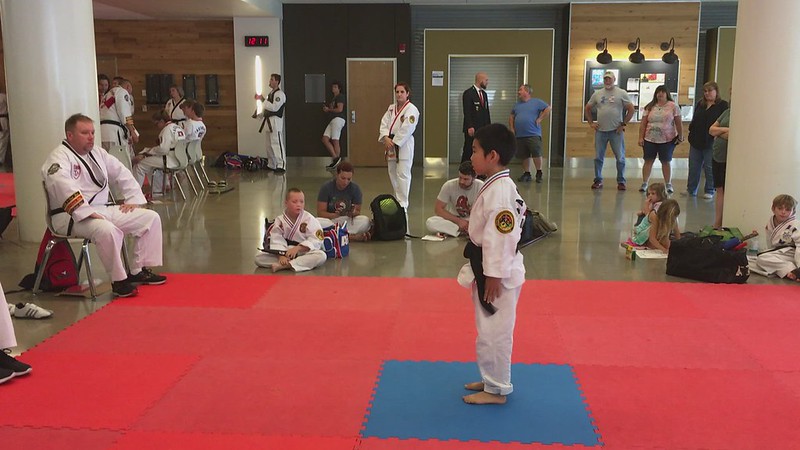
9-10 yr old boys receiving their pre-competition instructions
Pre-competition pep talk

What makes competition good is that it is always good to be in the company of those who are good. There is a saying in many domains of expertise, if you are the best in the room, you are in the wrong room.  So, for those who are who are in the ballpark, this is an opportunity to see what good really looks like and it provides something to aspire too, or to recognize there are others just as good and you can spur each other on to be better.

But, when the goal of competition is the winning, eventually, one will reach the point where the competition is better than you.  And you will no longer win. Sometimes it is because you were never exposed to that level of competition before (something we see alot of in university freshmen). Sometimes it is because you have a view of your capabilities that is not based on a sober assessment.  So a culture or attitude that you will always win runs into the hard reality provided by the outside world.


Post competition bowing out
Post-competition bowing out

Our goals in competing are to provide the experience in preparing for something hard where details matter, learning how to deal with pressure in the moment and being able to perform with no opportunity for correction, being exposed to quality competition, and knowing you have done your best and are continually getting better.  Whether that is taekwondo, piano, math, or any other aspect of life.  And experience the joy in being capable and competent.

Showing off his medals
Two third place medals

Friday, May 24, 2019

Parenting Month 99: Competitions

This past two months was marked by competitions in Taekwondo and piano. In taekwondo T moved up a division, while in piano this will be his last year in this age group.  So he did well in piano, but middle of the pack in taekwondo, where the differences between the kids who are really serious and everyone else is apparent.
In piano, we know that this is also the point where the easy progress ends and it starts to take serious work to get better.


What is the point of competition? Especially at this age? There is the standard answers of the discipline of following instructions, of being able to see what it looks like to be good. It is an opportunity to socialize with kids who are doing the same things you are and that you will grow up with through the years.

The other thing that is starting is the concept of working up to something big.  In TKD, we spent three weeks of both some individual classes and more intense time with my son in preparing for the tournament.  Similarly for piano, the teachers are telling the kids that the competition is coming and they have to be more serious.  And the kids pick up on the fact that the adults are being more serious.  Also we spend time focusing on smaller things than normal.


Piano recital at CMU
Is it worth it? Sometimes, the attention to detail taxes the attention span at this point. For TKD, we can go through the whole thing, but we can only improve a limited number of points of improvement in a session. I suspect that piano is much the same.  The benefits is the idea that the details matter, and that you are preparing for more than doing as well as the friends you see in class every day or week, but you are up against a standard that you have not seen.  And then having to deal with the stress of the event itself where a very specific performance matters with no redo. And they should be very aware of the true quality of that one performance. The ability to handle yourself under the attention of a crowd is invaluable, regardless of the quality of the performance.

Saturday, February 02, 2019

Parenting month 97: Ai yaaa * 3

This month, DD4 joined her big brother and I in doing American Taekwondo Association (ATA) classes.  Of course, she has been watching us do these classes in the basement for a few years now, so she has been looking forward actually being in the class, doing the forms, the exercises, and even the curtesies (bowing in etc)  She has been doing as expected as a third member, being fairly fluent in the conditioning exercises like ladder drills and picking up forms (at this age, they follow on forms instead of memorizing) which she has been seeing all her life.


She has enjoyed doing this at home, and we let her program part of the workout.  The  ladder drills exercises, conditioning exercises, punching bags,weapons, or forms.


T (DS8) has also been continuing.  We've been battling various illnesses over the past couple of months.  One milestone is that he has been accepted in to the National Talent Search program through the Johns Hopkins Center for Talented Youth. So we are looking forward to having access to a set of online and summer courses with a very different set of kids, who will become his peers for a lifetime.

Tuesday, May 22, 2018

My home gym circa May 2018: martial arts and free weights

One of the first things we did when we moved to a house with a semi-finished basement was to declare that the basement would be a workout room.  And our primary exercise that time was taekwondo along with bodyweight exercises for DS5 (then) and I.  In addition, I had some lightly used exercise equipment (dumbbells, a weight bench, and a Total Gym exercise machine) and this became the start of the workout room.

First, we got 1" thick tatami foam puzzle type mats from IncStores that we laid on the floor.  The thickness was for normal martial arts (i.e. some impact, but we are not wrestlers or judoki.)  This was used to cover the larger portion of the basement floor in a checkerboard pattern (gray and black squares)  These mats were not difficult to cut with box cutters, so we cut them to fit the basement and the way the walls were laid out.  This was a good way of covering a concrete floor.  The way the basement is laid out, it is big enough for me to cover half a Songham (ATA style taekwondo) square for forms.  So as long as I start in an appropriate place, I can do a form with full extensions. (which I could not do at the old house).  So this floor gets used for TKD practice, forms, and drills, along with bodyweight exercises.
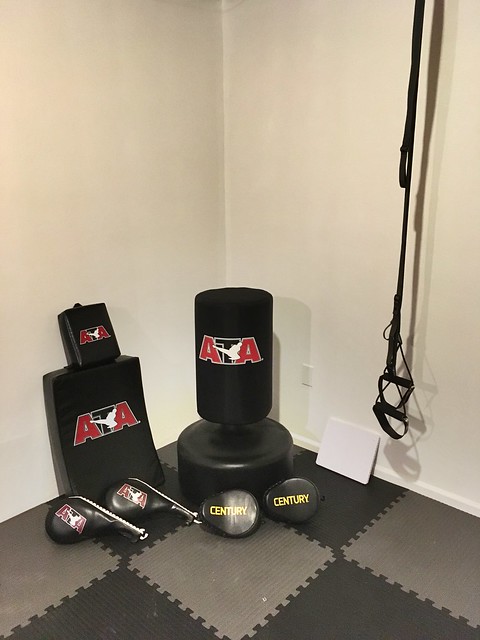

TKD gear in the workout room
Taekwondo training gear
For Taekwondo we have a assembled a fairly extensive list of practice gear.  For my son and I, we both have our gear bags with uniforms, bag gloves, sparring gloves, foot pads, chest pads, and head gear.  We also have sang jae baang (nunchucks), ba maang ee (escrima sticks), and jaang baang (bo stick).  (we have declared that jaang baang is not for indoor use because of the ceiling).  But we also have a junior standing bag (Wavemaster weighted with 80 lb of sand in the base), a double kick pad (claps when struck correctly, now we have 2), a small target, large kick pad, and a pair of focus mitts.  The matted area is good enough for pretty much any standard or sparring drill.

For bodyweight exercises, we are used to this from taekwondo, but our real use is based on a fitness cards based on Stack 52 Strength decks. (review)  So (now) DS 7 and I will draw 7-10 cards (he uses both beginner and intermediate cards) and we will do them.  DD 4 also joins in and does her analogue of the exercises as well.
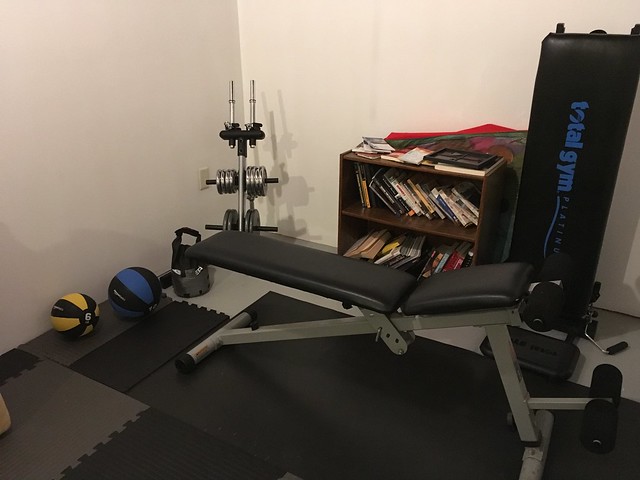
Workout room freeweight corner
Weights and Total Gym
For weights, from my pre-grad school days I had a cheap dumbbell set (the standard 4x5lb weights, 4x3lb weights, 2 handles with spin locks for a total of 40lb of dumbbells).  I had added the bench when I moved to my apartment when first started working after grad school.  Again, back then running was my primary workout, then the Total Gym for cardio.  I was not trying too hard with the dumbbells, but I knew a few exercises from when I did a few sessions with a trainer back in grad school.  And while I was not so concerned about strength, I pretty much maxed these out on the stronger exercises (e.g. bench press) soon after getting these.  Combined with not having a good place for this in my old house, I did not use this much.

After moving to the new house, I added a pair of medicine balls (6 lb and 10 lb) to the mix.  These were good complements to the bodyweight exercise, as they could be used with pretty much any bodyweight exercise to add more of a challenge. In fall, I decided that I would use the winter to add strength to my conditioning and I purchased 4x10lb weights and additional handles, which more than doubled the weight I had and allowed for switching between heavy, medium, and low weight exercises much easier.  More recently, I got the weight tree for the plates (which used to live on the mat underneath the weight bench) and a lot more weight plates (taking advantage of coupons and a sale from Dick's sporting goods), improving both the maximum weight and the range of different exercises I could be set up for in a workout.  Another use of the weight plates is for conditioning.  I have a military grade Camelbak HAWK backpack that I will load with 20 lbs of plates for rucking when going on walks with my family (so what is good exercise for the kids is also good exercise for me).  One big thing, weight training has gotten much more interesting and enjoyable once I got enough weights for it to be a challenge.  Working with the 40lb dumbbell set was essentially a messed up conditioning workout.  I could not go fast enough for a proper conditioning workout, but there was not enough resistance to actually get stronger.

For exercise equipment, I had a Total Gym from many years ago.  It was an incline based equipment that I have had from my apartment days.  It was always lightly used, generally it got the most use during winter when I ran outside less than before.  And after kids it got a little problematic because the track that the pad rolls on is an obvious pinch hazard.  And I probably had it on its steepest (hardest) setting from basically the time I bought it, so it really only was good for making my muscles move, not really for building strength or endurance.  To give me conditioning equipment to go along with the strength equipment, I got a suspension trainer (no longer available when the dominant company, which will remain nameless, used to court system to push them out of the market).  Since we have a semi-finished basement, the beams in the ceiling were exposed and I used one of these to mount the suspension trainer.  Similarly to the bodyweight exercises, I have a set of suspension exercise cards from Stack 52 to provide variety in my routine. This takes over from the Total Gym as it is easier to set up the exercise to be more difficult even as I am getting cardio in from lots of reps (at the end of the day, these are slightly harder versions of bodyweight exercises, but not as hard as using my dumbbells, so I use this for cardio as I am doing a large number of reps.  With the Stack 52 cards I have a range of exercises for upper body, core, and lower body.  And I can generate a fairly long circuit for conditioning.
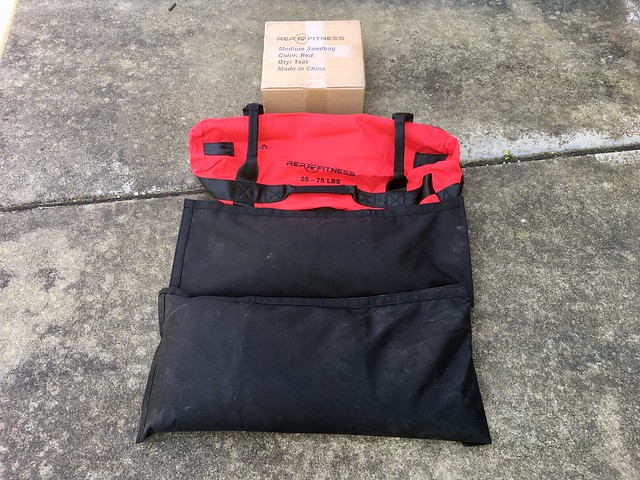

Rep fitness medium sandbag filling
Rep Fitness Sandbag with 15lb and 35lbs in filler bags
To the TKD, bodyweight, and cardio equipment, I recently added a sand kettlebell (20 lb) and sandbags (currently set at 15 and 35 lbs).  These are in the category of freeweights and along with dumbbells, were the featured equipment in the book Push, Pull, Swing by Myatt Murphy published by Mens' Health. The goal of the book was to explain that strength came from three types of motions (push, pull, swing), across three planes of motion. And if you did this, you would have all muscles in the body engaged (the contrast would be isolation training focusing on specific muscles, which is the principle behind the exercise machines you see at fitness clubs and home gym equipment).  The comparison between this and the dumbbells is that they are more unstable, so in addition to lifting the weight, you have to deal with the instability of the sand.  A second advantage is that they are made of sand, so I don't worry as much as the kids hitting or tripping over them since they have some give compared to iron plates in my dumbbells.  More recently, I've been building up my strength training so that in addition to the obvious presses and lifts, I learned more complex moves such as cleans, presses, and swings so that I can use strength training (dumbbells, kettlebell, sandbags) in exercises that hit a wide range of muscles and types of motion simultaneously.  Again, I also have Stack 52 decks for dumbbells and kettlebells. While I don't think the randomness is useful here, I have used the cards, the Push, Pull, Swing book, and YouTube to learn how to do even technically difficult exercise that require stability of the cores along with strength.
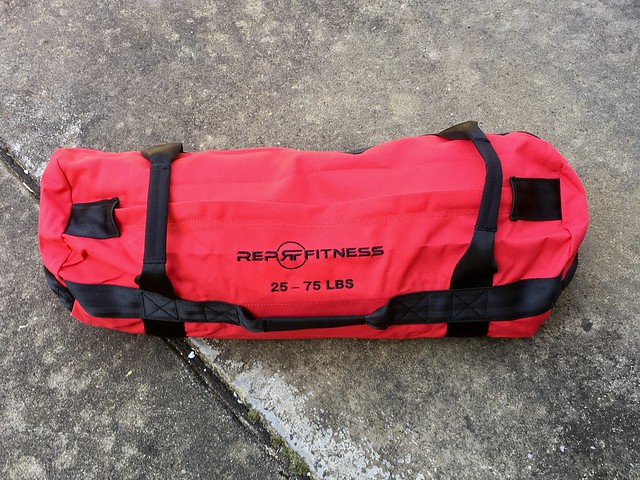

Rep fitness medium sandbag filling
Assembled 50 lb Rep Fitness sandbag
So, the current state of the home gym.  I know have 132 lbs of plates, and I am up to 86 lbs on bench presses and squats (the hightest weight exercise I do)  The dumbbells, kettlebell, and sandbag also  makes conditioning workouts more time efficient than the running or Total Gym used to be for me, with the suspension trainer and a range of kettlebell swings filling in for cardio.

I can see adding another sand kettlebell to round out my medicine ball and kettlebell weights, and I have room to add more weight to my sandbags.  My son has started using freeweights too.  I have him doing bodyweight exercises with the medicine ball (and I join in using the kettlebell) so this adds resistance. There are a few exercises designed for the kettlebell that medicine balls also work with so this will add to strength while maintaining stability and balanced development of many muscle groups at a time.  To add to the bodyweight exercises, I recently purchased an agility ladder, which both of the kids enjoy immensely.

Wednesday, May 02, 2018

Parenting Month 89: competition in youth

These past two month was dominated by competitions.  T went to a regional Taekwondo tournament, participated in a piano competition, and earned his black belt in Taekwondo. Along the way, we saw a lot of the culture around kids competitions.


Regional ATA TKD Tournament
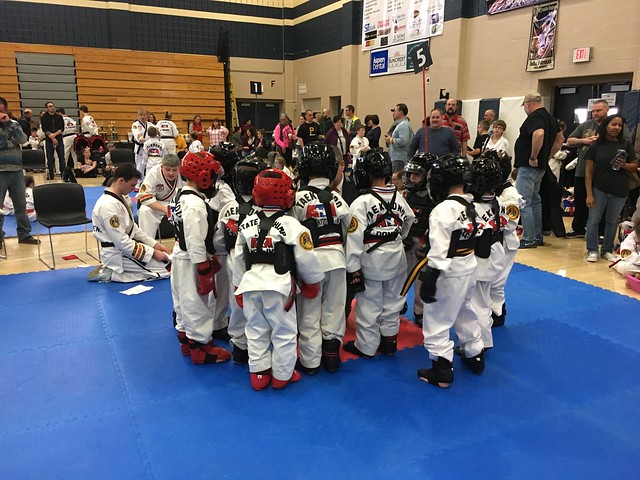
Receiving instructions prior to sparring.


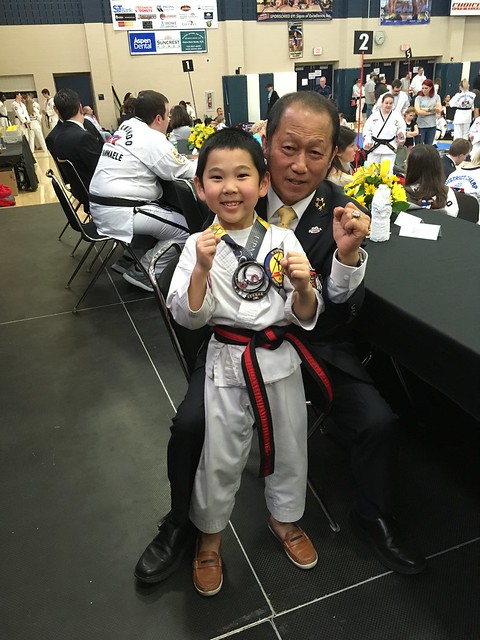
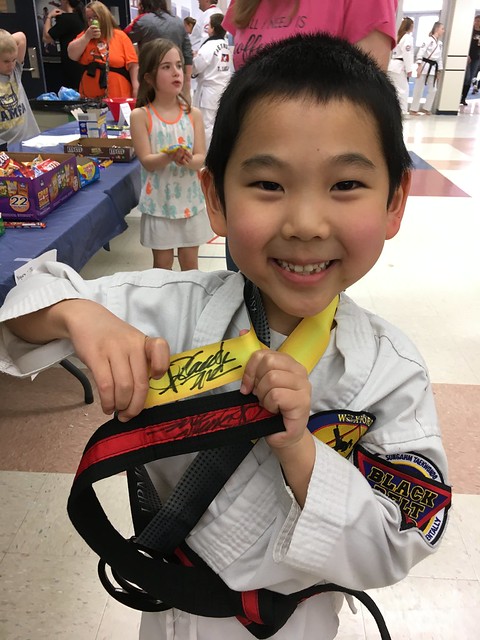
T went to a regional tournament last month. This was his second competitive tournament (meaning they award places) and much larger and more prestigious than the other one we went to in fall. But we are not competitive, so we signed up for the novice division. (as opposed to competitive). He did well, we were not expecting everything when we realized that most of the boys in his ring were in the ATA leadership program, but he got a 3rd place medal in sparring (which goes along with this 1st place medals in forms and weapons from his last tournament.)  He especially liked the fact that he met the American Taekwondo Association  Grand Master (only one of them!) and got his medals and belt signed.


Regional ATA TKD Tournament
Medals signed by Grand Master In Ho Lee
One of the things we noticed was that even though this was the novice division (as opposed to competitive, where points count over the year), most of the boys clearly had tournament experience.  The parents were very sophisticated, with several of them keeping track of judges points.  The boys were also reasonably sophisticated with outcomes. The boys were all aware that a "Spirit" award implied that they did not get any of the place awards in any category. Some of the boys were not interested at all in collecting their Spirit medals.

We also noticed that many of the "novice" boys were clearly serious about competing.  We saw a former state champion (meaning they had the most tournament points when competing in the "competitive" category in tournaments last year).  Several of the boys clearly had trained above their belt level (this was a red belt ring, and above belt level means they used moves and forms that were part of the black belt curriculum.  And our thought is why would they sign up for a novice division when they clearly usually were competitive. And if it was they were worried about being in a high prestige tournament so going novice would make the competition easier, the fact that so many others did the same thing made that fail.


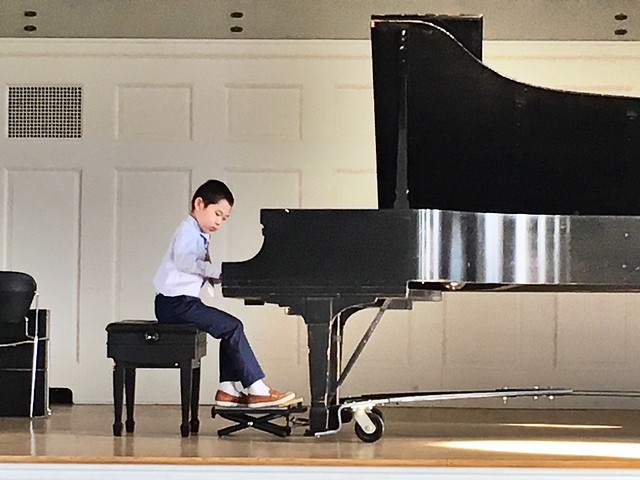
Piano competitionthey
Piano Competition hosted by Chatham College

The reason we have T (and someday A) enter competitions is not because he will win. But we want him to get a sense of how good people other than the ones they saw every day could be. And that means that we do this so he can connect with the best people in real life.  And if he is going to compete with any seriousness, that means we would enter the competitive rings. He may not win, but at this point we are pretty sure that he will win his share of things as he grows up. But he will be tested in the best way possible, where he can see and be in contact with others and get an idea of how much work it takes to be very good at something. And hopefully realize that being very good at something is both possible and enjoyable.  Whether or not medals and prizes are involved.


Regional ATA TKD Tournament
Medals and belt signed by the ATA Grandmaster In Ho Lee