Showing posts with label PIttsburgh Symphony Orchestra. Show all posts

Monday, June 01, 2015

There are pirates at Fiddlesticks!

Fiddlesticks Pittsburgh Symphony Summer Escape Concert
Bippity-Boppity-Boo

Today's Fiddlestick's concert theme was summer vacations, and as we had recently taken one we were all prepped for this concert. So we very much enjoyed having the thread and mini-story of finding a vacation story for Fiddlesticks.  And as my son is getting older, he appreciates more aspects of this. 

Now that my son is old enough to be learning to play piano himself, we are more like the intended audience of the Fiddlesticks concerts.  So what do we want to see.

1.  The experience of hearing a symphony live, in concert, in a venue with the right proportions, which sounds richer and with more layers than anything that can be played on home speakers.
2.  A sense that music can exist in a context and communicates something.
3.  An experience in a place where responding to music is acceptable.

Fiddlesticks Pittsburgh Symphony Summer Escape Concert
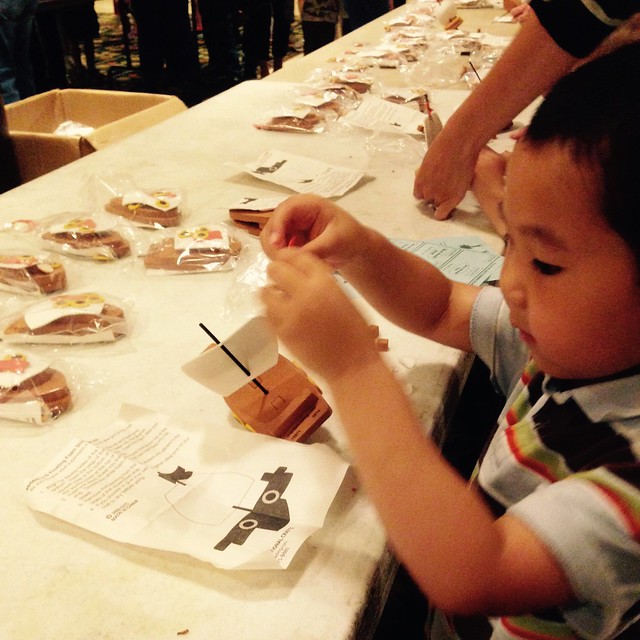
Making a pirate ship

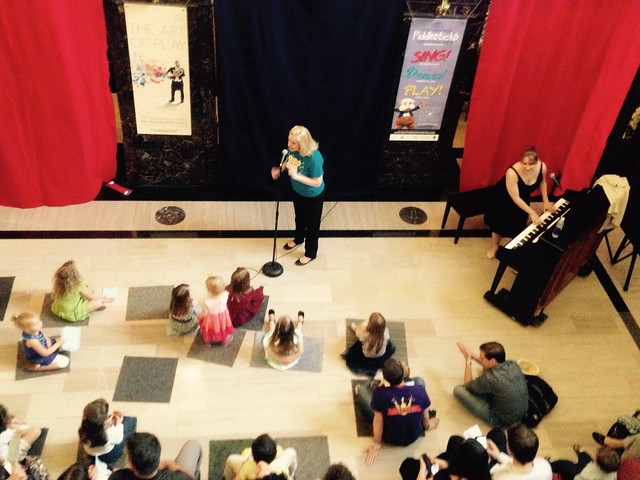
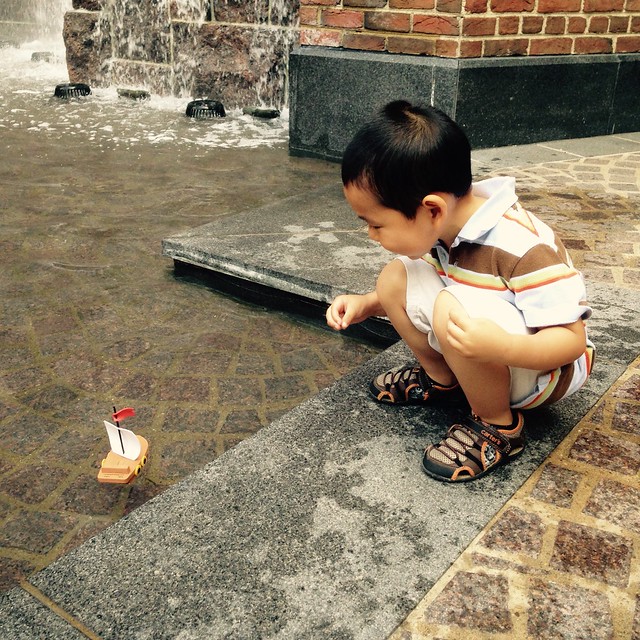
Certainly, the discovery time activities are meant to put the kids at ease. We watched and listened to the contra bassoon and heard a talk and got an autograph from an oboist.  We sang with Katy Williams to Bippity-Boppity-Boo and the Fiddlesticks song. We made a pirate ship and sailed it in the outside fountain. All of this was to make the kids comfortable.

Fiddlesticks Pittsburgh Symphony Summer Escape Concert
Sailing in the courtyard fountain

The activities in large part are making what is obviously adult space (Heinz Hall) into a place where kids have the freedom to explore, play, and interact with things musical, or even peripherally related to music. So making a pirate ship and sailing it in the fountain is related to a sing-a-long at the piano and watching and listening to symphony musicians playing in the lobby. And by the time they get to the hall, the kids and adults are comfortable with the setting.

In the concert itself, the sense is that music is meant to be responded to. Whether it is Katy, Fawzi, or Fiddlesticks running around on-stage or the symphony playing a piece, unlike a normal PSO concert, there is no need to try to stop a child (or adult for that matter) to express amusement, recognition, joy, or empathy in the moment. When an audience member reacts, we can acknowledge the reaction instead of trying to contain it. and it makes for a different experience (I noted that there were a number of adults in the audience without any obviously attached children, so this may go beyond kids.)

My son enjoyed the experience. I spent the concert watching his expressions change as the pieces developed and listening to his observations. Then the story he told my wife about the concert when we got back. We enjoy having music part of our lives, and want our kids to share the wonder and delight in listening and creating music themselves as they grow up,  And Fiddlesticks is a part of that.

Wednesday, May 08, 2013

Heinz Hall, Where the Wild Things Are

Waiting to see some Wild Things

When we found out about the 'Where the Wild Things Are', we started to prepare my two year old for it. We don't have the book, but I found videos of dramatic readings and readings set to music to get T familiar with the story. So we talked about it every day this week. Finally the day came. Today was a daytime father and son (and grandma) outing. Part 1. The train. Because while the train is a favorite toy in the house, T does not actually get to ride in one very often, and a concert during the day in Heinz Hall is a good excuse. Part 2. The concert. We said hi to one of the Pittsburgh Symphony staff who recognized T from Fiddlesticks concerts. And after walking around Heinz Hall to burn off some two year old energy, we got our seats in the family section. Front center of the Grand Tier. The best seats I have ever had!

We did not check the program, but I found the format to be a lot of fun. There was a piece with every scene of the story to fit the mood of the story. A Mendelssohn for the conversion of the room into the forest. Schumann for the voyage on the sea. Music to go with meeting the terrible Wild Things and for the rumpus. And the voyage home where there was good food to eat.

The kids enjoyed it. One of the nice things about this is that there is no artificial constraint to not respond to the music like normal concerts. So you had kids dancing in their seats. T would alternately huddle in nervousness and laugh and wiggle in glee as the scenes and the music changed.

But by the end he was ready. As the voyage home started T picked up on his cue and asked to 'go home.' And this very happy little boy enjoyed a train back home. My wife has informed me that 'Wild Things' has entered his vocabulary, so I think we are declaring this to be a successful outing.

Saturday, April 06, 2013

Going to Fiddlesticks concert, and it was a MEOW

This was our second Fiddlesticks concert. And this time around S joined T and I. First, we got early so we could enjoy the pre-concert festivities. To celebrate Fiddlestick's birthday, T decorated a birthday party hat.
Here is the hat I made.  It has a dinosaur.
Next was learning the songs for the concert. The Pittsburgh Children’s Festival Chorus was performing some of the singalong songs along with some movements. The first time T sees anything he does not really react but is very intent so we never know what he is understanding
The Children's Festival Chorus at the Fiddlesticks pre-concert
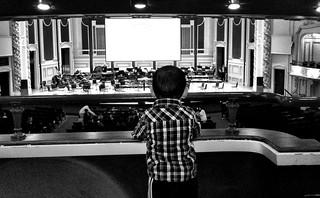
Leading up to the start of the concert we brought T up the concert hall. He loved the view from the balcony where he could see everything going on. The instruments, the performers coming on stage, the audience filing in.
What instrument is that on the stage?
But (surprisingly enough) it was the music that took first place for T. Since the theme was Fiddlestick's 20th birthday, the theme was cats (Fiddlesticks is a cat). So the first song was The Waltzing Cat by Anderson and Ms. Williams cued the audience on when the 'meow' came up so the kids could join in. Then the Cat Duet by Rossini was performed featuring Ms. Williams and Ms. Maloney. By this point T was very happy, enjoying the music, the silliness presented on stage, and generally responding to the music. When we got home, it was clear that he remembered everything. We found a video of a performance of the Cat Duet that we played in the background while eating lunch. And if we were wondering about his remembering the concert, we found that he remembered the Fiddlesticks Theme Song dance. Clearly, he spent the sing-a-long session committing it to memory. A thoroughly fun time. And something that we will do again someday. [Preconcert thoughts at the Pittsburgh Symphony Blog]

Thursday, April 04, 2013

Let's go sing Happy Birthday to Fiddlesticks! at the Pittsburgh Symphony Orchestra

[This is also at the Pittsburgh Symphony Orchestra Blog Site] It's Fiddlesticks' birthday! And we are going to a concert! This coming Saturday will be the second time we have gone to one of the PSO Fiddlesticks' Family concert. The first time we did not know what to expect. But now that we do, we'll be ready to enjoy it. Fiddlesticks Happy Birthday Concert

For both of us, music had become a part of our lives, something that we can share and we wanted our now two year old son to do so too. But the question we had was what did that meant. We've seen the fads that listening to music would make a child smarter but we did not want any part of that. Because we were also not interested in a passive child. As we have exposed him to music in our lives, he has listened to my wife's playing the piano, watched videos with music in the background and of performances, and yes, even some videos aimed at toddlers that included classical music. But he does not just listen and watch. we are thoroughly entertained by his response to the music. In the ways of a two year old with limited oral skills and coordination, he sometimes just listens, sometimes he sings along, sometimes he pretends like he is conducting the piece, and sometimes he tries to dance ballet, sometimes hip-hop, and sometimes just jumping and moving to the rhythm.

Talking about a Bass

We've brought him to concerts, recitals, and performances and appreciate the venues where you are not just a spectator, but you can react and respond to music as you experience it. And that is what I most enjoy about Fiddlesticks. The relatively modern traditions of being quiet and not responding to a performance are put aside, and we can react to what we see. We enjoy the performers interacting with the kids sharing their joy of playing.

PSO viola working the crowd before Fiddlesticks

And this is what we want our son to experience as he grows. Not a world where he is a spectator, but a world where he takes in the environment and responds to it. And someday, create something to add to this environment.

Clapping for the PSO

Sunday, June 17, 2012

A legacy in music: PSO Blogs

[Original at the Pittsburgh Symphony Blogs]

A harpist in Heinz Hall Grand Lobby

This weekend marked the end of another season for the Pittsburgh Symphony Orchestra. But it marked the end of something more. Three esteemed musicians were retiring from the PSO, Charlotta Klein Ross (cello), Ronald Cantelm (Bass), and James Gorton (Oboe). My wife has a particular connection with one, having performed alongside one. And the program reflected one type of legacy, with Gorton; his wife, Gretchen Van Hoesen; and daughter, Heidi Van Hoesen Gorton, being the soloists for Goossens' Concert Piece for Oboe/English Horn, Two Harps and Orchestra as the close for a career and a season.

Certainly one way to have a legacy is through your sons and daughters. Another is through enabling a future through gifts that allow others to flourish. But what are the things that one does to create a legacy? One is through the development of raw talent, the sort of thing that we explicitly recognize when we attend a PSO concert. But while it is memorable, it is fleeting. What does it take to create something that endures?

I can think of two ways. First is to create something based on an idea, then invite others to build upon it. It is creative not only in the creation itself, but the idea and concept that can be built on. One recent set of projects surrounds the MusOpen project, which raises funds for the development of public domain scores (including computer source that makes the score) and recordings. The first is having its first fruits, with the Open Goldberg Variations and recordings of the Prague Symphony Orchestra in support of that project. The second is to teach and train the next generation.

Always there are risks. For the first, the question that always gets stated is why do things in a different way. There are certainly scanned copies of Bach's Goldberg variations and other scores, and many editions that have been put together by dedicated scholars. But now the promise is that the music (both the description as well as the performance) can be used as a starting point in other creative works, which requires both the right to do so as well as source material that can be modified. And for the second, the question is if it makes a difference, especially when the deepest knowledge can only be passed in one-on-one interaction.

My wife and I are both at stages in our careers where we make commitments to the future. And part of that is the fact that much of what we leave behind is not going to be what we ourselves create, but in ideas and organizations passed on to students and colleagues whom we have the pleasure of working, contending, and building with, and new ideas that are developed and grown into institutional capabilities and memories.

I was listening to the stories of the musicians retiring with this season, and I was thinking about the legacies they leave behind, which was more than tales of inspired musicianship, although that was there. It was in the creation of memories, and investment in others to guide them to their futures, musical or otherwise. And in that is something worthy of the name legacy.

Monday, March 12, 2012

Pittsburgh Symphony: The rhythm of modern life

Pre-concert program at Heinz Hall Grand Lobby [Original at the Pittsburgh Symphony Blogs]
This weekend Maestro Previn returned again to conduct the Pittsburgh Symphony Orchestra, and this time to conduct the premier of his own work. As a taste, we were treated to the Brass Quartet from Carnegie Mellon University performing some of Previn's other work.
Listening to the opening of Previn's Triple Concerto for Horn, Trumpet, Tuba and Orchestra immediately following Haydn's Symphony No. 102, I was struck by a contract in feel. Haydn's Symphony sounded smooth, peaceful, and gentle; almost bucolic. And compared to that the Triple Concerto was full of rythmic brasses calling for attention along with a series of fanfares.
In many ways much like the many things that call for our attention in our modern, urban life. It had the same effect of the opening of American in Paris. I had in my mind the thought of a young person starting out in the world, with many things to call for his attention, time, and energy. The ups and downs of young adult life. And this was brought to a close with a rapid movement through the end, and then the piece was done. But it seemed to be a story in progress, because whatever was ahead for our friend, it is never the end of the story, only one more milestone of this thing called life, however momentous it may seem at the moment. And while the piece had an end, real life always has a continuation.
There are many commentators on how life has changed within memory. The speed of change, the need to adapt on an ongoing basis, and for the young, the tendency to treat immediate events out of proportion to their place in an ever-changing and on-going world.

Monday, March 05, 2012

Pittsburgh Symphony: Thinking of Classics and Enigmas

[Original post is at the Pittsburgh Symphony Blog site] Discussing Enigmas - A post-concert discussion of Elgar Enigma Variations, Pittsburgh Symphony Orchestra Overlook Room

This past Sunday’s concert included a workshop and post-concert discussion led by teaching artist Christina Farrell. For Elgar’s Enigma Variations, the easy choice of topics would be to look at three enigmas directly presented by Elgar. But as we talked, conversation covered another topic, does the direction or intent of the creator of a piece play into the performance of the piece? And from there, what makes a creative work worthy of being one of the classics?

To be sure, the use of hidden themes and puzzles within musical works has been done before and since. Several composers have pieces full of references to friends, acquaintances, and contemporaries. But this is par for the course in the classics. My high school English teacher was fond of saying that the Greek classics include everything. Participants in one web site that focuses on identifying themes in movies and TV shows delight in noting that certain themes have very old origins. But this does not lessen the treatment of these themes or use of these tropes. There must be another criteria.

I am involved in a creative field. And in my field, some works are known and viewed as seminal works, definitive in their topic over anything before or since and viewed as original contributions of high degree and quality. Yet even these explicitly reference the works of others, not all of which are in themselves worthy of the same acclaim. The creators and all those who are qualified to review the work will acknowledge it openly, but something separates these from others of their kind.

Mortimer Alder once wrote an introduction to one collection of Great Books. In it he describes three criteria that he and his fellow collaborators used to choose and cull that collection. One was the work’s contemporary significance (which implied that it was timeless beyond the period of original creation); second was its re-readability, or the fact that the work could be read again and again, with deeper understanding every time; third was its relevance to a number of great ideas that occupied a number of great thinkers before and since, the participation in the work in the great conversation through the author’s reading of related works of before, and the development of ideas that have inspired reaction from those who follow.

And here in music, it is not just the theme or subject of the work that makes it meet similar criteria. The price of admission into a classic worth listening repeatedly is the quality of the music. But if it was only quality we cared about, we may stop listening to new music, because there is more than enough of the traditional classics of quality to keep us wonderfully engaged. But to add to what has come before a work must also have something to say. A response to what has come before, and something that is worth responding to.

Wednesday, October 05, 2011

PSO Blog: Mommy and daddy need to go to a PSO concert

[Originally posted at the Pittsburgh Symphony Orchestra blogs] Daddy, you should go to the Pittsburgh symphony concert We achieved one of those major milestones in parenting this weekend. Leaving baby with a caregiver not related to us. ( Yes, we did check in during the course of the afternoon). The occasion, a PSO concert of pieces by Beethoven featuring the Eroica Trio playing the Triple concerto, as we were reminded by a mailer a couple weeks before.
I have a recording of the Triple Concerto at home. And I've been asked why I would go to a concert when I have a recording of some of the greats. And there is something to be said about the fact that every performance is unique. But there is also the fact that there is more to a piece than the notes written by the composer. There is the interpretation of the work. And when you have a group like the Eroica Trio who have been playing together for decade you get the collective interpretation of the work.
With in the first minute of the first movement I was hearing aspects of the piece I have never heard before. A good part of this can be attributed to Honeck balancing out the orchestra so that the right part has focus at any point in time. But another part of it is probably due to the fact that the Eroica Trio has played together for so long. The recording I have is by three acclaimed musicians with another world class orchestra. But the three soloists are known as soloists, not as an ensemble. And there is a difference between musicians playing together and musicians who know each other playing a single piece. It shows in the way the Eroica Trio could play off each other, more a conversation of old friends rather then a few technicians working together. And it felt more that we were privileged to bear witness to it more than just being in an audience.
When I was in graduate school I had remarked to a pianist friend that I thought a duet she was performing probably could only be mastered by pianists who were family members, because there was so much potential in how the parts worked with each other that could not be expressed by performers who knew each other in passing. This weekend's performance is the reward of having artists playing together who not only know their craft, but each other.

Wednesday, September 14, 2011

Remembering 9/11 in music

[Originally posted at the Pittsburgh Symphony Blog site] I was listening to the Pittsburgh Symphony concert from September 11, 2011 in Berlin on YouTube. As the 10th anniversary of the September 11, 2001 attacks in New York City, Washington DC and Shanksville PA, this was billed as a dedicated to the victims of the attacks. But I started to wonder, what does it mean to have a concert dedicated to an event? In particular, there was nothing different about this concert then any other concert on the tour, so it is not in the program. And it is not likely that anyone present was directly related to the attacks. So what does it mean to use music as a means of remembrance, particularly if the music was written with no specific meaning?

At the Chatham University concert commemorating the 10th anniversary of the attacks, Pauline Rovkah commented that the reason we have these concerts is that we have no other way to express what we feel. It is not just that the opportunities do not present themselves, but what we feel is beyond our ability to express them in words.

And the music is not just how we express how we feel, but also how remember later what we feel now. When I was listening to Yo-Yo Ma playing Bach Cello Suite No. 1 - Sarabande in New York for the ceremony at the 9/11 WTC memorial, I remember listening him playing another piece. On July 1, 2007, I was deployed in Afghanistan. That day, the news told us that Tuzla Air Base, Bosnia, had been turned over by the American military to the Bosnia-Croatians. Many people in my unit had deployed to serve in the Balkans during those years, and the turnover of Tuzla Air Base represented the success of that effort. And that day I listened to a recording of Yo-Yo Ma playing The Cellist of Sarejevo by David Wilde. Which was in remembrance of darker days of that conflict, of a cellist who remembered his friends by playing his cello during the Siege of Sarejevo. Music as a reminder of sorrow in the past, and the joy of the day that signified that sorrow was past.

We don't always have words to express how we feel. And the reality is that we sometimes forget what we were feeling in the past as time goes by. But when we want to remember, we can remember the music we used. Yo-Yo Ma playing the Sarabande from Bach Cello Suite #1 in 2011, or Cello Suite #5 from 2002 for the World Trade Center attacks. The Cellist of Sarejevo for those who remember the Balkan war of the 1990s. Or even the trumpet or horn solos from Mahler #5.

Sunday, April 10, 2011

PSO: A Sunday afternoon out in New Castle

[This post is originally published at Pittsburgh Symphony Blogs]

Candelabras in the Scottish Rite Cathedral in New Castle, PA On a sunny Sunday in April, my wife and I went up to New Castle to see the Pittsburgh Symphony perform at the Scottish Rite Cathedral. And this ends a drought. We have not attended a concert live since the end of September. And that is one of the things that the adventure known as an introduction of parenting can do.


So Sunday was a carefully planned day. Sunday morning was spent on an outing with the three of us, to ensure that our son got hours of interaction time with us before the afternoon (and hopefully ready for a nap). Baby was fed and changed. Grandma and Grandpa took baby as he tired out to fall asleep. And we went.


We have been told that when we had our first child our lives will change forever. Of course, that same phrase is used at marriage and many other of life's milestones. And both of us for as long as we have known each other (and likely before that) have always been changing and growing (and we hope this will be true for the rest of our days). So we expect that in the course of events our priorities, our various relationships and how we use our time will change over time, and new interest come in and old ones fade away. But one thing (among others) that our friends have no expectation of fading away is our love and enjoyment of music. And so we have looked forward to this Sunday's concert, not for an expectation of brilliance, stunning performances, enchanting interpretations, or even the expectation to meet old friends (although all of this was present), but as a touchstone, that a part of our life has not faded away.

This post has been sponsored by the services of Grandma and Grandpa Babysitting  ;-)

Thursday, February 10, 2011

PSO: Technique or Freedom

Bellefield Hall [Originally posted at Pittsburgh Symphony Blogs] As part of the Tchaikovsky Festival, some members of the PSO played in a recital on the University of Pittsburgh campus at Bellefield Hall. And, instead of playing pieces by Tchaikovsky, they played pieces by his contemporaries, starting with Anton Arensky. One thing that makes Arencky Piano Trio in D minor special is that there is an 1894 recording of a performance of the trio, with Anton Arensky playing his own piece on the piano. With him are violinist Jan Hřímalý (known by violin students for his Scale Studies) and Anoatoly Branukov.

Copeland in his book "What to Listen for in Music" states that in any piece of art, there are three actors. The composer, the interpreter (performer) and the listener. All three must do their part for a complete expression of a work. But it is fascinating to know that we have an depiction of how the composer interprets his own work. And preserved in a fashion that is not distorted by the twists of time and fashion which always occur over that period of time. At the recital, they played the recording from the Block cylinders (1894) after Ms. Orchard, Mr. Istomin and Mr. Vatchnadze performed the piece, giving us the opportunity to compare them both. And the style of play was notable in how different it was. While Hřímalý is known for his studies used to hone violinists technique, this performance is highly improvisational, taking great liberties with the rhythm, tempo, and even the written score. Almost surprising given how we view these greats.

What is different? The recordings by the original composer and his friends almost sounded like a jazz interpretation of his piece. The parts coming across as freeform expressions of personality instead of technical mastery and artistry. And if some student played like this in a recital or audition, they would surely have been snubbed.

I wonder if over the decades we have fallen completely victim to a tyranny of technique. It is very easy to hear a fast tempo performance and because the performer was even capable of hitting all the notes, in time and express the dynamics of the piece and declare it to be a great performance. And because it is easy to judge it on these quantifiable criteria, we value the mastery of techniques. Comparatively, it is considerably more difficult for us to judge artistry and expression which is not so easily quantifiable, we do not instinctively accept it as readily. And there are other fields where this is also true. The teaching of math has in many ways become the memorization of formulas and theorems. The teaching of history has become a memorization of facts, names and dates. The students subjected to this education rightly declare it useless, and the mathematicians and historians who see these students in college dispair that these students know nothing and are unable to think or reason. Despite being filled with useless facts and good test scores. And I question if this has made us better, whether it is understanding math, history or music.

Saturday, February 05, 2011

Sitting around the radio

[Originally posted at the Pittsburgh Symphony Blogs]
WQED - Pittsburgh Classical music broadcasting the Pittsburgh Symphony live

Our son is three months old now. It is Friday night and he is fussing, tired but not sleeping. We're in the family room, with the radio turned on to WQED, where the Pittsburgh Symphony is being broadcast live in concert. The Tchaikovsky Piano Concerto is one we know. So we hum along starting with the opening horns. And our son joins us in delight. But by the end of the first movement, he is asleep. Good night.

Saturday, January 22, 2011

Book review: Winter Fire by William Trotter - Meeting Sibelius in Finland:

Snow and branches


[Originally posted at the Pittsburgh Symphony Orchestra Blog]

Every month in the music department of the main branch of the Carnegie Library in Oakland, a group of music lovers gathers to discuss a book as part of the Pittsburgh Symphony Book Club. And this month, Jim Cunningham (WQED) along with Paul Silver (PSO: viola) led the discussion on Winter Fire by William Trotter.

Winter Fire follows a WWII German officer named Erich Ziegler as he serves the German Army in Norway and the Eastern Front. He is an infantry officer, who in his civilian life is a conductor. In particular, he had written an article on Jean Sibelius, the Finnish composer who was the pride of Finland. And after a period of exemplary service, he was tapped by German Army Intelligence to serve as what in the U.S. Army is known as a Foreign Area Officer, based on his expertise and special knowledge of Finnish culture. His stated mission: To ingratiate himself into Finnish society and take the pulse of Finnish leadership and military on their commitment to being allies of Nazi Germany in WWII.

In the course of his duties he is attached to a Finnish unit near the front. And he finds the wartime refuge of Sibelius. Over the course of the book, he is welcomed into the Sibelius household, falls in love, and develops deep relationships with the Finns he serves with. As the tide of war turns against Germany, he is buffeted by political forces including Nazi party members, officials more interested in promoting their careers and image then in accurate representation of the war to Hitler, and in the end, Sibelius and his Finnish hosts offer Ziegler refuge against the fall as Nazi Germany collapses, despite the Finns pledge to their new Soviet and Western Allies to expel the Germans in the last stages of World War II.

The book is of music and war, two topics that do not seem to go together. What we do see is how in both professions, Erich has to experience it intensely. When he in the combat front, every lapse of concentration has consequence, and in particularly intense areas this intensity can be debilitating. The intensity also opens him to moments where he becomes one with his environment, and his Finn comrades note that he becomes much like the Finns.

Similarly in his artistic experiences are intense. Being a conductor working with a new score, absorbing it and imagining what it can become. And with a new orchestra, turning that image into a reality. And the highs and lows of doing this, and being buffeted by his political environment of a depraved Nazi Germany where, just as has been documented in many other forms, the closer you get to Hitler the more craven officials become.

But a person can only maintain levels of intensity for so long. In this book Erich goes between the intensity of the combat front and instead of the breaks his comrades in arms would get when their units were rotated away from the front, he dives into the intensity of his art and political conflict.

In the end, a dream that Erich has been hoping for over a large part of the book is being denied. But another dream is being offered in its place. The Finns who have been alongside Erich through triumph and disappointment through the course of the war offer Erich refuge and hope for the future. And one after another, they present their dreams of a future for Erich. But it is not Erich's dream, and he has to decide if he can come to terms of a dream denied.


Sunday, September 26, 2010

PSO: Showing off talent

Yuja Wang Sonatas & Etudes


[This post was originally posted at Pittsburgh Symphony Blogs]

Before last week's opening Gala, Ann Pratchett and Renee Fleming hosted a interactive talk about their books. One question came up about the internet and Ann Pratchett criticized how commentators on websites have a tendency to give their reviews 'gladiator style', meaning thumbs up or thumbs down. What results are reviews that either excoriate the work reviewed as a pile of worthless garbage or the most incredible experience this side of heaven. But generally with no explanation or justification. And the result is only the form of interacting with the author and the creation without substance. It is a criticism that can be leveled at American society in general, valuing quick, snappy decisions based on instant impressions as sincere and authentic while being suspicious of anything that results from deep thought and study.

But these impressions turn out to be merely shallow and incomplete. I was talking over lunch this past week with a regional manager of a major shipping company who was lamenting the difficulty in identifying job applications with a particular ability. Things like grades are too one-dimensional, and the interview does not allow for depth. The only way she can evaluate the applicant, was to have them work for a year.

And so it is with the creative arts. It is a mistake to evaluate a work on one aspect, or an artist for a single work, or even work in a single environment. An evaluation needs to be across a range. And that is what made last weekend's concert rather enjoyable, it showcased a range across style in a single concert.

Michael Gandolfi's Garden of Cosmic Speculation opened up the concert. Prior to the piece, the composer spoke about it. The complete piece is actually 11 movements. But for performances the composer expects only a selection of the movements to be played, and any subset is appropriate. It becomes very much like going to a large garden or an art museum, there is no time to see the whole thing if you do it right, to experience it deeply you must go and select what parts of the museum to see, and leave the rest for another day. Musically, the four movements feel very different, almost like each was a separate work. And this provides an example of showing his range as a composer in a single work.

Having Yuja Wang play Rhapsody on a Theme of Paganini was a great choice. It is very easy to have Ms. Wang play pieces to show off technical brilliance. Certainly most publicity for her revolves around her ability to perform fast, technically demanding pieces. And many soloists use such pieces to showcase their skills. But Ms. Wang is capable of more. And in Rhapsody she was able to show this. There are the expected fast, loud and technical sections that demonstrates her command of the keyboard. But there are also flowing melodies, intricate delicate sections and textured nuance that show off not just mastery of a piece, but an understanding it to let it shine. And by not trying to dominate the piece, I am more impressed by this interpretation of it, and by Ms. Wang's artistry in addition to talent and skill.

Monday, September 20, 2010

Renee Fleming: The Inner Voice

This post was originally posted at the Pittsburgh Symphony Orchestra Blogs

The day before the opening Gala, Renee Fleming and Ann Pratchett had a book discussion at the O’Reilly Theater. It was an enjoyable conversation with two artists. They spoke of limits, of family, of talent. But what stood out, was they spoke that creating art is work.

Fleming commented that one thing that she dislikes is the belief that music is a gift, that one day someone opens her mouth and sings, then she is discovered, and then she goes to the Met. (Metropolitan Opera). Ann also has instances where people ask if she works. Because they are faced with the belief that talent is innate, it only needs to be found. But for both of them, this is not true. And it is not true in general.

Peter Orszag recently wrote two pieces in the New York Times about talent and effort. His observation that is shared by many others who have examined this (Michael Syed “Bounce”, Carol Dwed “mindset”, and others is that innate talent only gets so far, that to reach world class levels in a complex field takes practice. 10,000 hours of practice. It holds in music, mathematics, many sports, and chess. It shows in the dedication of young men and women in their teens who get up with the rising sun to practice, whether it is on the athletic field the weight room or in the studio. The students working their way through problems and proofs. My friends in martial arts working on their kata. Soldiers and FBI agents working through battle drills in the desert.

Fleming said at one point that when learning a part, it is not enough to know the words and the music, then you need to learn the meaning. And then, when you know what it means and you know it well, you are able to do more then follow the score and you are able to interpret or try new techniques to make it your own. The same is in other fields. Through practice the athlete learns the limits of her body and strength. The chess or go player can recognize patterns on the board and see the progression of the game. The soldier knows his role on his team and the overall intent of his commander even when he is unable to communicate with them. The mathematician or scientist or engineer can look at a problem and recognize what the form of the solutions or results will be even before she begins the work. Authors and writers can see how a turn of phrase can change the tone of a work. All this comes not from some gift of birth, but time and effort in practice and study, purposeful and directed effort.

The thing is, somehow one has to be convinced this is worth the effort. If you are good, you will be around people who are even better. And you will be working on things beyond your ability. And here you have a choice. You can decide you are good enough and stop. You can give up because it is too hard. Or you can look ahead and decide that it is worth the effort and pain of work to master your art. And the rewards? While Renee Fleming stated that her goal when growing up was to be good at something and it did not have to be music, I am glad that it was.

Monday, May 10, 2010

PSO: Thinking about talent

[Originally posted at Pittsburgh Symphony Orchestra: PSO Blogs]

Listening to Hilary Hahn starting off Sibelius Concerto I had to think about what constitutes talent. I have to recognize the reality that most of the performers (and just about all of our wonderful guest) are at a technical proficiency well beyond my ability to judge. The sheer volume of performers that come out of the world’s music schools and conservancy’s will ensure that only those that are the most skilled make their way into our notice. But there is more to talent than skill. And you realize this when listening to Ms. Hahn, who commands your attention without flash.

In my profession, computers are the instrument of use. Because for all the work we do, at some point our work interacts with the world through data, and through a computer program that takes our understanding and uses it to interpret the data. The risk is to forget that the value of the work lies in the understanding that went into the program and the interpretation of the results, not in the program itself. But this is easy to forget, especially if only viewing it from the outside. From a surface understanding, one can only see a computer and an operator. And in the shallowness of the moment, believe that the talent is the talent of the operator. But this is a trap. The point where you need to make the investment and have the best people is with the person who designs the analysis and interprets the results. Not the person to implements it and operates the computer. To implement the procedures and run a program is (comparatively) easy. Understanding is hard.

Similarly in arts, at the level under consideration, the technical capability of the performers is not a consideration. Everyone who graces the stage at Heinz Hall has demonstrated mastery of the instrument throughout its range. But we can ask for considerably more. We can ask from our interpreters (conductor and musicians) for not just the ability to recreate the written record of composers past, but to imagine what if some things were different, to use the creativity of the composer as a point of departure and develop an interpretation that includes the aspects that cannot be expressed in ink on paper. Then present that interpretation.

After that, Aaron Copeland said that art (music) is a collaboration between composer, interpreter and audience. Once the composer and interpreter have done their part, it is our turn to do ours.

Wednesday, April 21, 2010

PSO: What makes a classic?

[Originally posted at Pittsburgh Symphony Orchestra: Outside Perspectives]


Two pieces. One was first performed even before it was fully written, with the composer partly filling in the parts as he played. The other solid in style, but had the misfortune of opening alongside a piece that incited great and vigorous argument, and therefore went into obscurity. Clearly the outcomes are not related to the work and effort that went into them, but somewhere there is something else.


I have two students who are presenting their plans for their ongoing efforts this week. Both are engaged in a creative work, building on what has been done before, moving in directions that are unknown. Along the way they will be questioned, their beliefs and assumptions challenged, their thinking sharpened. And both do so with hopes that they are building something of enduring value (in addition to completing a project!)


But realistically, not everything is of such value. Looking at concert music, it is almost unfair comparing pieces from centuries past to music from the past century. But it is not because of the composer, but the mere fact that pieces are still played means they survived and were found worthy of remaining a part of the repertoire, while younger pieces have not finished this winnowing process. And with my students (and myself for that matter), it is not just the effort that goes into the work, but the many decisions and choices of those who come next, when they consider what is worth commenting on, and worth building upon, that will ultimately determine any enduring value in what we create.


But does that mean that the work is only of value because it is known or because others build upon it? In a sense, because what we are doing is a creative work, its value will be in part how it effects conversation in our field (measured by people choosing to react to it and build up on it or take it in new directions.) But there is more. Henri Poincare wrote about what scientists study. It is not just that the study of our world is useful (although it is), but what we study is beautiful, and in that captures our attention, and rewards us for efforts beyond the remuneration we receive. And I'm looking forward to the years to come, that they may be devoted to efforts that I can say that I delight in them, and uncover both the beautiful and useful, whether enduring or obscure.

Sunday, April 11, 2010

PSO: Avalanches and pebbles

[Originally posted at the Pittsburgh Symphony: Outside Perspectives]

Listening to Prokofiev Symphony No. 5 made me think of the tides of history. The movements started with transparent motifs that made one think of someone exploring life and his world. But each movement soon descended into a deep foreboding mass of power and force, making the initial moments of carefree joy meaningless.

When I was younger, it was easy to think that the world moved on its own, and there was nothing you could do to influence events, or even your own fate. It was easy to think that everything was chance. In the TV show "Babylon 5", a significant quote is "The avalanche has started, it is too late for the pebbles to vote."

And now? Between me and my wife's family we have direct experience in three wars. Our stories sound like history books and newspaper stories. We have no illusions about personal impact on the course of history, but neither are we merely swept along with the tides. We see and notice how people are swayed, pulled by their fears, or resigned to insignificance by those who would scream the loudest. And for Prokofiev in Stalin's Soviet Union, where work done with the approval of one set of leaders would suddenly be denounced in another time, it would seem that way, a powerless man swept by the tides of history, subject to its whims and caprices.

But, as statistician/political scientist/artist Edward Tufte remarked just yesterday here in Pittsburgh, we do not live in that kind of place or that kind of time. We live in a place and time that allows us to make choices, take risks and adapt to our changing world instead of only following the herd. And as we do so we can bear the cost, reap the rewards. And live other then as sheep who follow where those play on our fears would lead us. For all its cost, we recognise there is no other place like that on this earth, and we rejoice in it.

Wednesday, March 24, 2010

PSO: A conversation with strings that are different

[Originally posted at the Pittsburgh Symphony Orchestra: Outside Perspectives]


Having a viola as soloist was a change from the usual piano or violin guest artist. I was laughing reading the program notes saying that Berlioz Harold in Italy was written for Paganini, who complained that it did not allow him to play enough. Because Berlioz wrote a different kind of piece.


While it may not have satisfied a violin virtuoso, what Berlioz gave us was a conversation. Instead of the violin soaring exuberantly, we were treated to viola, harp, and flutes passing their lines to one another. Each different, yet fitting together like old friends engaged in conversation.


My wife and I have not been married long, but we sometimes get to enjoy the moments where we can talk about subjects ending with the wonder "you think about that too!?", the times when we can finish each other's thoughts (which is real useful when one has trouble coming up with the next word), and "magic" around the house. But, in our unsentimental times, we have some understanding of how the "magic" happens, it is the paying attention to each other and around us, and it almost seems natural. So it is with the first movements of Harold. The principals are not the type to overwhelm with brilliance, instead we hear them play with each other, bow, pluck and wind. Appreciative both of the differences and their ability to be together. And hoping life will be like that as well.

Sunday, February 21, 2010

PSO: A world of water

[Note: Originally posted at Pittsburgh Symphony Orchestra: Outside Perspectives]

We've had a long couple of weeks here in southwestern Pennsylvania. With a historic snowstorm wrecking havoc on our region everything has been been affected, including the symphony. After a week of snow storms, it was good to return to the symphony.

Snow and branches


Tonight was a night of new music. And the composer Mason Bates was here to introduce his piece. He spoke of the various movements of the piece, and described that transitions of the states of water. He reminded us that "glaciers ultimately melt." Then followed by hurricanes and floods, reminiscent of the trials experienced by the city of New Orleans.

In the audience were a number of staff and volunteers of the Red Cross. Over the past two weeks they and their community partners have been hard at work, providing shelter, warmth, comfort and food to many who have been effected by these storms and the power outages that have caused so much trouble to so many.

Forest of cots

Earlier today we had been cleaning and repacking our supplies, so many of which were used over the past two weeks. And we also remember that glaciers ultimately melt. As does snow and ice. And as in Liquid Interface following the glaciers melting comes the hurricanes and floods, we are worried about what comes when the snow covering our region melts. But we will be ready.