The Referendum by Tim Kreider, New York Times, September 17, 2009
The Referendum is a phenomenon typical of (but not limited to) midlife, whereby people, increasingly aware of the finiteness of their time in the world, the limitations placed on them by their choices so far, and the narrowing options remaining to them, start judging their peers’ differing choices with reactions ranging from envy to contempt. The Referendum can subtly poison formerly close and uncomplicated relationships, creating tensions between the married and the single, the childless and parents, careerists and the stay-at-home. It’s exacerbated by the far greater diversity of options available to us now than a few decades ago, when everyone had to follow the same drill. We’re all anxiously sizing up how everyone else’s decisions have worked out to reassure ourselves that our own are vindicated — that we are, in some sense, winning.
Tim Kreider's piece was on "arrested adolescence" for the Happy Days column. And he joked that he got the job because, he has never been married at 42. And the stereotype of someone past 30 who is not married is a slacker. Or a freak. It starts at 21 right out of college, and by 25 it is in full force. I used to joke that when I walked into a church, I was timing people before they asked if I was married or dating. (the record for a person was ~28 seconds. That person went straight to 'where is the rest of your family?'. There was no church that I was not asked in less then 10 minutes.) Some thoughts about advice I had been given in the not terrible distant past.
1. We are experiments of one. This is actually a saying of runners. It means that each one of us is different and have our own body characteristics, strengths and limitations. Therefore our goals and the training program to get there needs to be tailored to the individual. For dating/romantic relationships, I would argue that this is the case here as well. Conversely, any advice given that does not recognize that there are wide varieties of people, each of which should approach relationships with people in a way suited for them, it can be dismissed out of hand. Note that I would say broad categories are useful starting point, if the categories are defined as statements of fact rather then statements of worth (if someone cannot figure out the difference, that person probably should not be giving advice.)
3. Making a person's relationship status the first subject of concern. This gets rather old quick. It frankly is a sign that the person your talking through has gone through his/her list of potential conversation topics (none) and has grasped for the one topic they can actually talk about. Because they did not even try to find something interesting to talk about. And the thought that people have become so atrophied in their interests and their world has grown so small that they went to this is horrifying. (see above comments on expected time before relationship status is asked about)
4. ___ is the basis of relationships. There are a wide number of potential commonalities that are put forth as the key to a relationship, and many of them claim that the lack of that particular commonalities leads to broken relationships. Among the ones that are claimed are hobbies, interests in various fields, volunteer work in ___, same religious/church affiliation, racial/ethnic background. It does seem that all of them are true, and none. A professor of mine once advised that you should always more than one focus in life, because at any point in time, one of them will be going well, even if the others are not. And, as I know divorcees who had at one point had any one of these things going for them, none of these areas are sufficient. But I suspect that having a few of them can for the same reason as my professor said, when one area that you have in common takes a dive, other areas of life provide for the opportunities for two people to maintain and build their relationships (or at least keep the pain from the area in trouble from being completely overwhelming).
4. Reactions of singles to being asked about their status. I've always been able to view questions about "do you have a girlfriend" or "are you married" is a complement. Which was usually the case. Because it is usually asked when their is a belief that the answer could reasonably be considered to be yes. If it was beyond belief, the question would not be asked. Of course, there were those who used it as almost a class division. This is annoying at worst.
5. On the view of singles as slackers. This view seems to be predicated on the belief that the only part of the life that was of interest. For example, the stated purpose of the setting that this view is held in. It also is predicated on the view that having a spouse and building a family is the only goal worth discussing. And whatever criteria that a person had for a spouse (e.g. religious affiliation) was meaningless.
6. Singles are social inept/social freaks. I had pastors back in Chicago when I was in grad school tell me this. The key was I was >30 at the time. To be fair, there were a large number of people specifically included by the statement, many of whom would return the sentiment. See (3). The view requires that a person's social interactions do not have any other purpose then finding a mate. Many people can find other outlets for depth and discovery outside of finding a mate. So I was under the apparently mistaken belief in one of several alternative hypothesis (being a PhD candidate at the time) including such things as having certain criteria and being engaged in activities that are widely known as not entirely congruent with establishing romantic relationships. Fortunately, one of the criteria was easily changed to make this a non-issue. But I would still argue that reaching this conclusion without examining if alternative hypothesis exist is silliness.
7. Marriage status as a defining characteristic. This is amusing, but sometimes sad. Not that our wedding day was not a nice big and memorial event. But there have been other big memorial events before and since. And other milestones that can be life-changing as well. My feeling has been that interest in my romantic-style relationships was only amusing, unless you were interested in my other interests as well. There were a number of women who were proposed as potential interests to me that my biggest objection was the fact that the only thing I knew about them was there interest in being married some day. I have a conceit that I have a wide enough range of interests that if I could not find a topic of interest in common with a person, it is not a good sign that we will be developing a friendship at any level.
8. That is mine, and I'll rather break it then let you near it. I used to have a friend who was dating someone who we both knew from the same group. He considered it the height of disloyalty that I thought her life was precious enough so that on a camping trip I stopped her from falling down a hill side and later found her after she had become lost during the night. Now, while he has the wisdom and righteousness of God on his side, reality is I would be dead many times over if there were more people like him in my life. So I'm glad there are not. And the idea of actually living a life with someone who shares those beliefs is repulsive. It reminds me of a kid who breaks a toy instead of being forced to share with a sibling. (actually, later, it me of a story from when I was in Afghanistan, where there were riots after U.S. forces saved the life of a woman. The rioters were claiming that this defiled her and it would have been better to let her die.)
9. Timing. I recently had a friend who got married who was also over 30. And the wedding had multiple references to being married late (or waiting or seeking or any of a number of other euphemisms.) The first time it is mentioned is cute. The 10th is somewhat hammering the point a little too hard. Now, establishing relationships with a partner to go through life is a worthy goal. But there are other worthy goals as well. I would say that at any point in time, every person should have some such goal that they can claim active progress is being made (or at least work is being done). But to go the next step and say that one particular goal overwhelms all others is putting too much stock in that one goal.
10. Exclusivity. We get amused whenever one of us shows up without the other, and the one present asks "why is ___ not here?" But I never expect my partner to be interested in everything I am interested in (again, because I have this conceit that I have a very wide range of things I am interested in, I expect to find one in common with just about anyone, but someone to have all of those interests is beyond belief.) And I think it is healthy to have things that we are both interested in, and things that each of us in engaged in separately. It means there are times we do things together, times we do things apart, and we take turns in lead depending on the setting. The alternative that we only keep the parts of our lives that we have in common would mean that marriage and romantic relationships are personality destroyers rather then builders. I rather like the life I lived. While things change over time, and interests come and go in the general course of life, the the thought that a relationship would mean wholesale culling would make that very unattractive.
Sunday, November 29, 2009

PSO: Anticipation and Joy
[Original post at Pittsburgh Symphony Orchestra: Outside Perspectives]
My wife and I came to this weekend's concert with a friend and her young daughter. The whole week, she has been looking forward to the chance to go to the symphony, the music that she would hear, the dancers to see, the dress she would wear, the dresses that the musicians would wear, all part of the thrill of something that she had not experienced.The evening did not disappoint. We arrived early, because we knew that the Arthur Murray Dance company was having their demonstrations of the Waltz prior to the concert

We watched the dance class and demonstrations as they taught waltz and the polka.

As we got to our seats waiting for the concert to begin our friend was full of excitement, asking what all the instruments were, identifying the drums (timpani) various winds, violins. And she was asking about where the tuba was (answer: wait, it will come out later tonight). And wondering when the pianist was coming out (answer: when the lights dimmed). And then the lights dimmed.
As Sa Chen played with the orchestra in the concerto, we listened to the richness of the playing. The focus on the richness of the part, not the difficulty of the part. Something that we get with some of the older and mature players instead of the display of raw talent we often get from those who are younger. And to our friend, instead of listening to something clearly beyond her level of playing, she listened to music in its richness and sensitive. Then with the waltzes and polka of the second half, she heard the joy and happiness of a celebratory feel of a Vienna in celebration (and the much awaited tuba made its appearance)
We enjoyed the evening, having young friends experiencing the symphony. And other friends we had a chance to talk to throughout the evening, of holidays to enjoy, and milestones of life to celebrate over sweets and desserts.
My wife and I came to this weekend's concert with a friend and her young daughter. The whole week, she has been looking forward to the chance to go to the symphony, the music that she would hear, the dancers to see, the dress she would wear, the dresses that the musicians would wear, all part of the thrill of something that she had not experienced.The evening did not disappoint. We arrived early, because we knew that the Arthur Murray Dance company was having their demonstrations of the Waltz prior to the concert
We watched the dance class and demonstrations as they taught waltz and the polka.
As we got to our seats waiting for the concert to begin our friend was full of excitement, asking what all the instruments were, identifying the drums (timpani) various winds, violins. And she was asking about where the tuba was (answer: wait, it will come out later tonight). And wondering when the pianist was coming out (answer: when the lights dimmed). And then the lights dimmed.
As Sa Chen played with the orchestra in the concerto, we listened to the richness of the playing. The focus on the richness of the part, not the difficulty of the part. Something that we get with some of the older and mature players instead of the display of raw talent we often get from those who are younger. And to our friend, instead of listening to something clearly beyond her level of playing, she listened to music in its richness and sensitive. Then with the waltzes and polka of the second half, she heard the joy and happiness of a celebratory feel of a Vienna in celebration (and the much awaited tuba made its appearance)
We enjoyed the evening, having young friends experiencing the symphony. And other friends we had a chance to talk to throughout the evening, of holidays to enjoy, and milestones of life to celebrate over sweets and desserts.
Thursday, November 26, 2009
Movie Review: Baghdad ER (2006)
This documentary follows the emergency room of the 86th Combat Support Hospital (CSH) in Baghdad in 2005. It takes it as a series of vignettes of trauma cases that enter the CSH, a mix of traumas of U.S. military, Iraqi security and Iraqi civilians.
As a documentary, it keeps a very narrow focus on the trauma department. As such, it is graphic and raw in its depiction of the effects of combat. It does some introspection, with the main point that the members of the ER don't see anything changing (likely because they are too far removed). But the narrowness of their work make it not possible to see anything else. (and they properly stay in their lane, even when pushed by the documentary makers)
While this is the documentary that got awards, I like the NOVA episode Life and Death in the War Zone, which followed the 10th CSH immediately following the invasion in 2003. considerably better. While Trauma and operating rooms are flashier and more intense, "Life and Death" covers the hospital as a whole, starting with preparing for deployment and covering the activities of the whole of the hospital, which includes interactions with the outside world (i.e. other then Americans) while "Baghdad ER" is looking at war through a soda straw.
As a documentary, it keeps a very narrow focus on the trauma department. As such, it is graphic and raw in its depiction of the effects of combat. It does some introspection, with the main point that the members of the ER don't see anything changing (likely because they are too far removed). But the narrowness of their work make it not possible to see anything else. (and they properly stay in their lane, even when pushed by the documentary makers)
While this is the documentary that got awards, I like the NOVA episode Life and Death in the War Zone, which followed the 10th CSH immediately following the invasion in 2003. considerably better. While Trauma and operating rooms are flashier and more intense, "Life and Death" covers the hospital as a whole, starting with preparing for deployment and covering the activities of the whole of the hospital, which includes interactions with the outside world (i.e. other then Americans) while "Baghdad ER" is looking at war through a soda straw.
Monday, November 16, 2009
PSO: Steadiness in Chaos
[Originally posted at the Pittsburgh Symphony Outside Perspective]
I was listening to Danielpour's Concerto for Orchestra and noticing the recurring theme as it passed from part to part, popping up in a variety of contexts. Sometimes when the overall tone was almost melodious and sometimes when it was present in the midst of conflict and cacophony. But always there, providing a foundation for all that was going on around this and proving itself adaptable in its many settings.
Among other things, I am teaching a class on disaster preparedness and response. And one of the principles in preparedness is you have to have a framework that is usable in normal everyday situations and adaptable for all sorts of situations that can arise. Because a plan of response that cannot adapt will never be used. And here is a theme that somehow does the same, even as its environment and its place within the environment changes, the theme finds a place. Sometimes up front. Sometimes supporting. But providing a unity to the piece along the way. A good trait to have in a storm.
I was listening to Danielpour's Concerto for Orchestra and noticing the recurring theme as it passed from part to part, popping up in a variety of contexts. Sometimes when the overall tone was almost melodious and sometimes when it was present in the midst of conflict and cacophony. But always there, providing a foundation for all that was going on around this and proving itself adaptable in its many settings.
Among other things, I am teaching a class on disaster preparedness and response. And one of the principles in preparedness is you have to have a framework that is usable in normal everyday situations and adaptable for all sorts of situations that can arise. Because a plan of response that cannot adapt will never be used. And here is a theme that somehow does the same, even as its environment and its place within the environment changes, the theme finds a place. Sometimes up front. Sometimes supporting. But providing a unity to the piece along the way. A good trait to have in a storm.
Wednesday, November 11, 2009
Sunday, November 01, 2009
PSO: The lone individual in the crowd (Berlioz Symphonie fatastique)
[Note: This was originally written for the Pittsburgh Symphony Orchestra Outside Perspectives blog]
On my way to the concert, I was informed by one of the two piano professors I was attending the concert with about the story of the Symphonie fantastique, including the fact that this is the extreme example of programmatic music, to the point of including the interpretation of the music in the score. And while I tend to favor programmatic music, I think actually telling me what it meant slightly oversimplifies things for my taste. And (as my wife would tell you) I have no memory, so actually telling me what something means is slightly wasted. (At my high school, all the smart kids took art appreciation. I would have done very badly in such a class.)
What I did hear was the tension between the individual and the crowd. As the movements went on there were periods of the individual voice (the idee fix that popped up throughout the piece in different parts of the orchestra). Sometimes the individual voice was enthralled, sometimes depressed, sometimes light hearted, sometimes heavy. And there was the crowd. Sometimes detached. Sometimes driving its own way. And in the march, overwhelming. LIstening to this, I wondered at the tension. The tension of those who would wish to find their own path, who may start off as being treated with benign neglect by the crowd, but then can find themselves in direct conflict with an unforgiving multitude/mob. With a chaotic end.
Of course, re-reading the program notes, I see that what I heard was similar and different then what was intended. But if you make the claim that music and art are forms of communication, and the idea that interpreting a musical work is a collaboration between composer, performer and audience, then this was a delightful example. Even if the attempts of two music professors was somewhat wasted on this leaky memory.
Monday, October 19, 2009
PSO Notes: Mixing the media
[Originally written for the Pittsburgh Symphony Orchestra: Outside Perspective]
I've told my students that they need to learn how to ask questions about other people's work, because if they stay in our field, they will always be entering someone else's territory. For all their skills and all they bring, they will always be entering someone else's environment, someone else's situation, someone else's world. And when that is the case, the first steps are to prove to the other person that you are paying attention to them. While you can ignore the guy on the ground if you happen to have authority behind you, you can get a lot further if the guy on the ground is convinced you are working for their interests.
I enjoy classical music because of its abstractions. And that so many have chosen to take the challenge of actually communicating something within the abstractions and creating works with such range. So I look upon pieces like Danielpour's collaboration with Maya Angelou with a somewhat skeptical eye. Is it forcing something that does not need to be forced? Or is it that the music could not stand on its own, and needed to vocals to give focus that could not be done otherwise? (we already know that Angelou's poetry can stand on its own)
In the event, I confess I was barely listening to the words. I was listening to music of orchestra and voice. And hearing the hope of youth to the melancholy of age. To a combination of music and words, that seemed to do all right even without the words.
Sunday, October 18, 2009
Book Review: Welcome to Afghanistan by Benjamin Tupper
 Welcome To Afghanistan: Send More Ammo by Benjamin Tupper
My rating: 4 of 5 stars
Benjamin Tupper was a New York National Guardman sent to Afghanistan as part of an Embedded
Training Team, a two-man team that is embedded into an Afghan Army unit to train Afghan soldiers how to be real soldiers, by living with them and going into combat with them. When you see in the news discussions on giving the Afghans the ability to defend themselves, this is how it is done.
In his civilian life, Tupper is a social worker, and he describes his writing these blog entries that turned into this book as a part of his therapy. As such, the stories in the book range widely across the range of emotions. Pride in a job well done, joy in something working or a lesson properly taught, cursing at mistakes made, wonder of a disaster very nearly avoided through no fault of his own, depression of the loss of a comrade, exaltation over mere survival. And he even takes you home, as he deals with both his own demons and tries to help some of the other ETTs who have come back and have to reintegrate themselves into American society.
There is no claim of looking at a bigger picture here. It is one man discussing his experience as part of the U.S. military at war. But the ETT experience is distinctive in the world of war. Missing are the supportive comrades of arms that the soldier can lean on for support during and in between combats. The ETT works in pairs, away from the close support of other American units. The ETT is exposed to all the same hazards as the Afghan army units he is with, and because he is different, he is exposed to even more hazards and stresses as an outsider to the group he is embedded in. And even when ETTs joined the rest of the Army (like his trips to Bagram) it is like a different world. Other then special forces type units, there are none like this.
I overlapped with Tupper in Afghanistan for a month. I'm not saying I knew him, but I recognize his characterizations of people (Army and local), events and situations.
View all my reviews >>
Monday, October 12, 2009
QOTD: INFORMS 2009 Part 1
P1: What do you do?
. . .
P1: What does your wife do?
. . .
P1: You are going to have brilliant babies!
P2: (while standing between two baggage claim terminals for 5+ minutes) What baggage claim are the bags from ___ coming?
Me: I know nothing.
. . .
Me to P2: You know, I try really hard to cultivate the 'I know nothing' look, obviously I'm not doing nearly a good enough job at it.
P2: You already got your bag.
P3: "Buenos dias (more stuff in Spanish). Ooh, (aside to coworker) I just started speaking in spanish to him."
P4: I did not know anyone else was doing work on ___. How come I don't know who you are?!
. . .
P4: (to a section chair) I want to have a session on ___ (next year). (to me) You will have something, right?
Me: My student will have something ready.
Me to P5: I'm here to do what traditionally gets done at conferences, meeting someone who works one block away from me.
. . .
P1: What does your wife do?
. . .
P1: You are going to have brilliant babies!
P2: (while standing between two baggage claim terminals for 5+ minutes) What baggage claim are the bags from ___ coming?
Me: I know nothing.
. . .
Me to P2: You know, I try really hard to cultivate the 'I know nothing' look, obviously I'm not doing nearly a good enough job at it.
P2: You already got your bag.
P3: "Buenos dias (more stuff in Spanish). Ooh, (aside to coworker) I just started speaking in spanish to him."
P4: I did not know anyone else was doing work on ___. How come I don't know who you are?!
. . .
P4: (to a section chair) I want to have a session on ___ (next year). (to me) You will have something, right?
Me: My student will have something ready.
Me to P5: I'm here to do what traditionally gets done at conferences, meeting someone who works one block away from me.
Sunday, October 04, 2009
Book Review: The Unforgiving Minute by Craig Mullaney
 The Unforgiving Minute: A Soldier's Education by Craig M. Mullaney
My rating: 5 of 5 stars
The Unforgiving Minute is about the training of Captain Craig Mullaney, U.S. Army. Craig starts out at West Point as part of training to be an infantry officer. He does the usual path of West Point and Ranger school, but also takes a detour, to Oxford as a Rhodes Scholar. And then to find out if the training was right, be leads men in battle in Afghanistan as part of the American effort in Operations Enduring Freedom.
Two underlying questions: First, was the best leadership education that the United States Army could devise sufficient for bringing us into a different kind of war then we had prepared for. Second, does the finest liberal arts education in the world make a difference in what is sometimes called the graduate school of war.
The first part of the book looks at his training. Military training at West Point, Airborne School, Ranger school, Infantry Officers Basic Course. And it contrasts with his time in Oxford. Each type of education brings its merits. The stress put into military training was attributed to instill attention to detail and precision in action, even when under stress. Such discipline would be needed in a battle, when your duty must be done perfectly even under the worse conditions, or it would mean someone's death. The education and habits of thought at Oxford provide the ability to think critically, and to grasp the overall picture and understanding where details fit in the overall scheme of things. And it comes together at the end, where Craig is now teaching the next group of young officers-to-be, and he has the opportunity to put everything together as best he knows how.
Another aspect that made this book unique was how it was in the context of something else. All of us have lives, even soldiers. And much of the book had as background his family life, his relations with his father, mother and siblings, and his courtship and marriage of his wife. All in a context of an Army whose members believe that it is only one part of a full life. And the parts intrude on each other. Not just the interference in time due to duties, but all the ways that it affects the plans of life into the future.
One scene near the end was poignant. Before his wedding, he went to Arlington Cemetery with his fiance. I remember doing the same, walking through the area with the newest graves from the time I was in Afghanistan with my fiance.
View all my reviews >>
Tuesday, September 15, 2009
Teaching QOTD: This is how it will be for the rest of the semester
I'm teaching the introductory Operations Research undergraduate course. (typically taught to first semester juniors and the core usually is introduction to linear programming.) Even though it is at 8AM the first two weeks have been very lively. Out of ~60 students, there are probably 15+ that take an active part in class discussion. I have been able to teach the material almost completely using question and answer. It is not quite Socratic method, but it is very close (and lets be real, even law schools don't truly use Socratic method.)
Until today (day 1 of week 3). Most of the class was pretty dead. The usual chatter of people arriving is subdued. And I am down to a few reliables to answer questions. I felt like I was actually lecturing for the first time this semester. By 15 minutes I acknowledge the obvious and we take it nice and slow for the rest of the class.
Later today I was chatting with our undergraduate coordinator (who has a good read on the undergrads. She is a teaching professor so they are her focus.) And she told me that yes, this class is particularly good. And that now that we are in week three, the initial excitement and energy of the new semester has worn off, and this is how it will be for the rest of the semester. *sigh*
Until today (day 1 of week 3). Most of the class was pretty dead. The usual chatter of people arriving is subdued. And I am down to a few reliables to answer questions. I felt like I was actually lecturing for the first time this semester. By 15 minutes I acknowledge the obvious and we take it nice and slow for the rest of the class.
Later today I was chatting with our undergraduate coordinator (who has a good read on the undergrads. She is a teaching professor so they are her focus.) And she told me that yes, this class is particularly good. And that now that we are in week three, the initial excitement and energy of the new semester has worn off, and this is how it will be for the rest of the semester. *sigh*
Friday, September 11, 2009
PSO: Beginnings and ongoings
September. A start of a new school year, with new classes, new projects ramping up. And a new season of the PSO. We went to the gala looking forward to an entertaining time, not with the expectation of being impressed, but a sense of return to art in a form we have not partaken in a while.
Wednesday night was the opening gala. So around the concert was a cocktail hour and the Soiree for us "younger" folks. (while the gala was presumably for the not so younger folks)

My wife and I took the opportunity to have a conversation with a random couple. Or maybe not so random, as the gentleman had the distinguishing characteristic of having a Combat Infantryman Badge, earned in WWII and marked by further service in Vietnam. And the four of us went to have a wonderful, engaging conversation of the things of life, war, arts, our wonderful city, marriage (both couples being recently married).
And the rest of the evening followed the same pattern. Meeting friends old and new. Talking about a new academic year (for all the professors), families to be, projects under way, ideas and goals for the year. The things of a vibrant life. To go with a concert with Izhak Perlman that covered the range from spectacular to rich to delicate.
An evening with old friends and new. Encouragement for a creative life, and glimpses of what we hope is a foreshadowing of a full and rich life to come. And we look forward to a concert season with music and friends new and old.

Wednesday night was the opening gala. So around the concert was a cocktail hour and the Soiree for us "younger" folks. (while the gala was presumably for the not so younger folks)
My wife and I took the opportunity to have a conversation with a random couple. Or maybe not so random, as the gentleman had the distinguishing characteristic of having a Combat Infantryman Badge, earned in WWII and marked by further service in Vietnam. And the four of us went to have a wonderful, engaging conversation of the things of life, war, arts, our wonderful city, marriage (both couples being recently married).
And the rest of the evening followed the same pattern. Meeting friends old and new. Talking about a new academic year (for all the professors), families to be, projects under way, ideas and goals for the year. The things of a vibrant life. To go with a concert with Izhak Perlman that covered the range from spectacular to rich to delicate.
An evening with old friends and new. Encouragement for a creative life, and glimpses of what we hope is a foreshadowing of a full and rich life to come. And we look forward to a concert season with music and friends new and old.
Color Guard, 9/11/2009
Color Guard, Cathedral of Learning, University of Pittsburgh, 10:00 AM, September 11, 2009

Tuesday, September 08, 2009
Restaurant: Pusadee Garden, Lawrenceville, Pittsburgh, PA

Pusadee Garden
5321 Butler St.
Lawrenceville
Pittsburgh, PA
I heard about Pusadee Garden from China Millman's effusive review in the Post-Gazette. And China Millman does not do effusive reviews, so this was on the list of restaurants to go to.
The first thing to note was the outdoor garden seating. And in the urban environment of Pittsburgh, this is not common. The vines and trellis make this work, in an otherwise drab cityscape of Lawrenceville. The second thing I noticed was this was a family restaurant, meaning there is a family on the premises. Rare for a nice restaurant in the U.S. (although more common in neighborhood restaurants where everyone is family).
I had spring roll (and shared crab rolls) with plum sauce for appetizer.

Crispy Tilapia with "famous 3 flavor sauce" for the appetizer.

It is spicy and sweet, and the third flavor was somewhat overwhelmed.
A friend of mine had the spicy duck

How good is it? It is decent food. The flavors were not well balanced, but that may be the sign of a very new (< 2 months) restaurant. Atmosphere, especially if you can get outdoor seating, was wonderful. And I like the casual feel of a family restaurant (clearly they live nearby as I was noting their comings and goings.)
Friday, September 04, 2009
QOTD: Engineers seem to have an interesting, and somewhat unique, definition of fun
Engineers seem to have an interesting, and somewhat unique, definition of fun." Ask your doctor or a local public health official what defines a good time, and you are not likely to hear about the logistics of mass antibiotic distribution or mathematical models of influenza transmission. Larry Wein's opus over the last decade has been, to use a hackneyed phrase, deadly serious, and yet he notes that a personal criterion for his engagement in a project is that it be enjoyable. For those of us in public health emergency response, this provides an important insight into the workings of the engineering mind, since it is precisely those things that we often avoid (i.e., the nitty gritty, and by that I mean quantitative, evaluation of the feasibility and performance of the programs we plan and carry out in the name of health protection) that appeal to Prof. Wein and a relatively small number of colleagues.
From Nathaniel Hubert, Commentary on "Commentary on Homeland Security: From
Mathematical Models to Policy Implementation" by Lawrence M. Wein, Operations Research, OR Forum
From Nathaniel Hubert, Commentary on "Commentary on Homeland Security: From
Mathematical Models to Policy Implementation" by Lawrence M. Wein, Operations Research, OR Forum
Wednesday, September 02, 2009
Book Review: Buried Tales of Pinebox, Texas
 Buried Tales of Pinebox, Texas by Matt M McElroy
My rating: 4 of 5 stars
This is an anthology of horror stories set in present day rural East Texas. For a concept, the authors have been given a setting (which has been fleshed out as part of a table top role playing game) and a collection of story hooks (newspaper clippings that were created as part of the game setting).
The goal of horror is not to scare you out of your wits through the story. The goal of the writing is to draw you in so that you can build in your imagination something that is worthy of fear and shock, and your imagination fills in the gaps.
The stories do this admirably. Because it is a game setting that is fleshed out in several iterations and people using their imaginations, the details of the interactions feel right. You get the sense that the 'normal' inhabitants of East Texas are the practical, hard-nosed people who deal with the life on the terms they were given, which include living in a place where horrors make their appearance. In each story you are drawn in to the people who are in them, who make choices that are believable for their situations, and as the stories end, you realize what comes next (not because it is a shocking story turn, but because your imaginations fill in what the author does not get to).
I have not read much horror, as I'm pretty much turned off by the movie treatments of it. But this book was something I got into. And I would not mind more.
View all my reviews >>
Monday, August 31, 2009
Movie Review: Milk
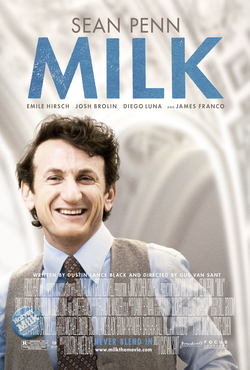
Milk is the story of Harvey Milk, a San Francisco businessman turned activist who was the first openly gay male elected official in the United States (there were lesbians elected to office, and officials elected who later declared themselves to be gay.)
Well, I think this was intended to be inspirational. But it was jumbled. In there was a story about someone who overcame obstacles to his photo business then organized a business association, then got elected. But it is constantly interrupted. There is the ever present aggressive expression of sexuality (Milk and company are very openly gay). There are numerous episodes of pettiness that looks like a distraction from the goals of the people involved. And there are the romantic relationships that see romantic rivals in every interaction, complain of neediness of time and attention. And all of it sucks away from this goal of political influence.
But this is reality. Life gets in the way of projects, no matter how big and important. But you wonder how do people who are around this, supposedly in relationships with people who are doing what they recognize as important, and they don't get the idea that supporting their people is something that has a level of priority.
As silly as this seems, it is also a reflection of the culture. There is another sub-culture that loses focus on its proclaimed mission because of focus of issues of sex. That regularly looks at the relationship status of people as their primary and overwhelming attribute and often ignores all others. And what I see in Milk, as much as it makes me think "what were they thinking", I realize that this is other sub-cultures in the U.S. as well.
Saturday, August 29, 2009
Movie Review: Julie & Julia (2009)

Julie and Julia is a story of two projects. Julia Child's book "Mastering the Art of French Cooking" and Julie Powell's weblog "The Julie/Julia Project". For Julia Child, the challenge was to learn French cooking and figuring out how to communicate. For Julie Powell, the challenge was to work her way through the 524 recipes of Mastering the Art of French Cooking in one year and writing about it in her blog.
So the story is of a project. But projects are not things that happen in a vacuum. And they exist in the context of life. And this movie is not just about two writing projects. It is about living life in the midst of writing projects. And in both cases, life is in the context of a marriage and job transistions. Julia Child book was written while her husband was pressured for their past work. (Julia Child and Paul Child served in the OSS during WWII in China. The OSS was the predecessor to the CIA. At the time depicted (1950s), there was a movement in the United States that considered wartime service to be reason for suspicion for treason.) And in the midst of transfers she was writing her book along with her co-authors in Paris.
In 2002 Julie was in a dehumanizing job after recently getting married and in the midst of a move, undertook this cooking and writing project. And it causes stresses at home (like any project that takes up time every day).
What do we see? We see two couples dealing with the stresses of life, of goals reached, obstacles encountered, setbacks, and successes. There are times when the everything is good, times when life is hard but the project provides energy and drive to get through the day, and times when the project threatens to suck the energy out of life. Or aspects of life become overwhelming. And the movie shows them dealing with this. Sometimes gracefully, sometimes otherwise.
Some thoughts. I had a professor who gave the advice that we should have many aspects of life, because in every aspect of life, there are good times and bad. And when life is single focused, it becomes subject to the changes of that one aspect of life. But a varied life provides a buffer that can withstand the winds of change that life inevitably provides. And the movie shows that, with both Julia and Paul Child taking terms having success and failure in their project/careers. And it allows them to support each other in each other's setbacks. In comparison Julie who allows the project to become her life, dominating their time at home.
And it is here that the movie shines. In particular with Julia and Paul Child, both living full lives, and supporting each other the good times and bad, and their relationship strengthening the whole way. Julie and Eric have it rougher. We do not see Julie supporting Eric as she uses her project to escape both her job and her family.
Now, do they learn? It does look that lessons were learned. One advice more commonly given to people who are recently married is they get into a fight, so they can learn how to make it through a fight. And so do Eric and Julie. We don't know if Julie has learned how to support Eric as he does her, but we presume that they have learned something about relating with each other as they celebrate with each other over the end of the project and her publishing deals.
It was a good movie. Not just a foodie movie, but a movie about two couples, figuring out life.
Sunday, August 23, 2009
Movie Review: Last Letters Home (2004)
HBO movie website
Last Letters Home is a documentary that is built around the letters home to family of soldiers who were killed during the first years of Operation Iraqi Freedom in a partnership between, HBO, Time-Life and The New York Times.
What is here? Yes, there are grieving parents, brothers, sisters, spouses. But these are letters of soldiers proud of their work, parents proud of their sons and daughters and how they have grown. Officers and NCOs filled with worry, pride and care for those under their command. Soldiers looking forward to going home after their combat tour. Making plans and goals for the future. Telling tales of living life among comrades in arms, even in far away places. Hoping beyond hope that their families are not worrying about them. And stories of the two officers in dress uniforms with a chaplain coming to visit homes.
What is the purpose of something like this? Or the New York Times naming casualties as they are released in "Names of the Dead" and its "Faces of the Dead" feature, even as its audience largely pays little attention to the costs of war? Or Gary Trudeau (Doonsbury) sponsoring The Sandbox, where military personnel who have blogs that talk about life at war can be given a wide audience? In "Gates of Fire" by Steven Pressfield, he has a fictional scene where the Queen of Sparta gathers the wives of those who died at Thermopylae and tells them that those who were sent were chosen because of the ability of their wives to handle the loss. Reality is nothing so melodramatic, but a country that sends its sons and daughters to war would be so lessened if it did not remember them and consider the cost to those who have lost those they have cared about them. And not thinking of them in the romantic and fantasy of waving flags and fiery speeches, but in the practical sense of remembering that these are men and women, sons and daughters and they represent the dearest coin that our country can pay for causes that it deems worth the price.
Last Letters Home is a documentary that is built around the letters home to family of soldiers who were killed during the first years of Operation Iraqi Freedom in a partnership between, HBO, Time-Life and The New York Times.
What is here? Yes, there are grieving parents, brothers, sisters, spouses. But these are letters of soldiers proud of their work, parents proud of their sons and daughters and how they have grown. Officers and NCOs filled with worry, pride and care for those under their command. Soldiers looking forward to going home after their combat tour. Making plans and goals for the future. Telling tales of living life among comrades in arms, even in far away places. Hoping beyond hope that their families are not worrying about them. And stories of the two officers in dress uniforms with a chaplain coming to visit homes.
What is the purpose of something like this? Or the New York Times naming casualties as they are released in "Names of the Dead" and its "Faces of the Dead" feature, even as its audience largely pays little attention to the costs of war? Or Gary Trudeau (Doonsbury) sponsoring The Sandbox, where military personnel who have blogs that talk about life at war can be given a wide audience? In "Gates of Fire" by Steven Pressfield, he has a fictional scene where the Queen of Sparta gathers the wives of those who died at Thermopylae and tells them that those who were sent were chosen because of the ability of their wives to handle the loss. Reality is nothing so melodramatic, but a country that sends its sons and daughters to war would be so lessened if it did not remember them and consider the cost to those who have lost those they have cared about them. And not thinking of them in the romantic and fantasy of waving flags and fiery speeches, but in the practical sense of remembering that these are men and women, sons and daughters and they represent the dearest coin that our country can pay for causes that it deems worth the price.
Subscribe to:
Posts (Atom)