Sunday, July 24, 2022

Basement home gym - Summer 2022 version

 The end of 2021 was marked by a burst pipe in the basement, which ruined all of the flooring, but spared all of the equipment (as they were on top of mats so did not get soaked).  So, when insurance paid for new mats, this provided an opportunity to rearrange the basement gym.  Also, the big upgrade was the addition of the Whipr, a connected (i.e. bluetooth) multi-sport ergometer which sees regular use as a rower and ski-erg, and occasional use as a paddle (kayak/canoe) erg.

First, the equipment nook, which has the big changes from last year.

This side used to have the rack, a rower and the AirDyne.  Now, the flooring was replaced with rubber flooring to better withstand the heavier weights and equipment.  The treadmill was moved here, where the tougher rubber is a better floor than mats intended for martial arts.  
Equipment nook  - Basement home gym Summer 2022

The Whipr is the big addition here.  The Whipr (https://whipr.com/) is a multi-sport ergometer. The most common version of an ergometer is a rower.  It measures power, and bluetooth enabled (FTMS) apps can use it to measure your force production.  My son and I both use it as a rower (not as good as a Concept 2, but better than any other non-fan/water based rower.  In addition, I regularly use it as a Ski-erg, and occasionally use it for canoe, kayak, or stand up paddle. (ski and SUP are mounted to the rack). The big benefit is that it measures distance and calories directly from force production, which rewards good form. (less capable machines measure stroke rate and estimate everything else from there).  Both the Whipr and the treadmill (Horizon T101 with a Runn sensor) are bluetooth enabled, so I use Kinomap to give myself a virtual course to row/run/ski/paddle on and keep track of energy and work.

The other major component to this corner is the CAP power rack.  It is designed for the barbell, in particular squats and bench press (I do deadlifts on the floor after folding up the treadmill and moving the rower).  I have a bar with standard plates (1" hole, contrast to Olympic plates with 2" hole).  It is adequate for the weights I use, because I don't plan on going that heavy (i.e. low 200lbs is going to be enough). The biggest thing lacking with a standard bar vs Olympic bar is that standard bars do not spin, so I really cannot do the olympic weights with anything serious. So my Olympic movements are done with sandbags or kettlebell.


Basement home gym Summer 2022

Attached to the rack are rings and a cable pulley.  The rings replace a cheap suspension trainer, which was starting to fray.  I got better quality, but not willing to spend on a name brand trainer, I got rings instead. The wider webbing should make it last longer.  I do dips, rows, and presses on this. The instability due to not being anchored to the ground makes for a good challenge.  The cable pulley was an experiment.  Basically, it allows for using weights where the direction of resistance is more horizontal than normal with free weights (where resistance is toward the ground).  But I get much of that from the rings.

Also attached to the rig are the ski and SUP brackets for the Whipr.

The ski attachment is mounted on top of the rack using 3/4" webbing.  I mounted initially using a buckle, then wrapped the webbing like a big, repeated clove hitch.  Done twice, it is a very stable setup.  As the skierg movement is complementary to the rower movement (anterior chain as opposed to the rower posterior chain), this is a good complement to the rower. Also good if my legs are torched and I need something reasonably easy that is upper body cardio.  The paddle and SUP are also good for that in addition to the rotation stimulus they provide.


Whipr brackets on power rack

The SUP bracket is mounted to the lower rail of the power rack.  It took me a while to realize that I needed to have the hook and brace on the webbing in this order for it to work, or the brackets would slip off if any force is applied for any reasonable length of time.  I also have to put a couple spare mats under the bracket so support the Whipr base unit so it does not flop around.


\Whipr brackets on power rack

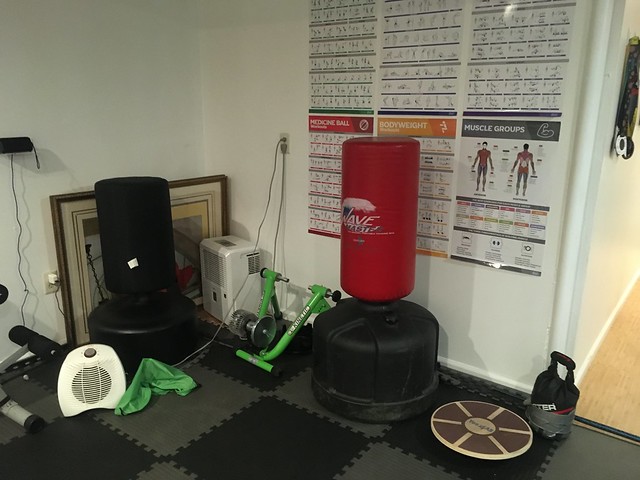
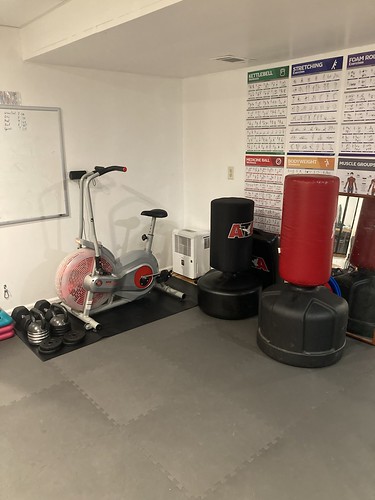
The other corner has the kettlebells, dumbbells, AirDyne, and punching bags.  The plate loaded kettlebells (variously Fitness Gear at Dick's sporting goods, or Apex, but made by the same company as Marcy.  They have a base weight of 20 pounds, but can be loaded with up to 4 5 pound standard weights. So this is my usual weight for StreetParking Crossfit-style workouts, with the weight depending on my abilities for the movement in question. The pair of 30 pound dumbbells is an aspirational weight.  For static moves, I am able to use these. But for olympic moves overhead (e.g. clean and press or snatches) I'm not there yet.  But I've been using these for dumbbell strength focused workouts.


Basement home gym Summer 2022

While the rower and treadmill are our cardio implements of choice, I get a lot of use out of the AirDyne.  The rower, treadmill, and skierg all are more technique driven while the AirDyne is more mindless (since the machine guides the motion along a fixed path). So for pure mindless work capacity, it is the goto. But also light mindless work (like taking a work break) it is good for moving when I want to listen or watch something.


Basement home gym Summer 2022

The next corner has homemade PVC dip bar, parallettes, a stepper, wobble board, and a set of sand kettlebells and medicine balls.  The dip bar is for dips and inverted rows, especially if the dip bars we have for the power rack are being claimed. The parallettes are for pushups (easier on the wrists) or as an obstacle for hop overs.  The sand kettlebells are mostly for my son(11). They are 10, 15, 20 pounds. We have another set, but they are scattered in rooms around the house for quick study/work breaks.  The medicine balls are used as wall balls. My daughter (8) uses the sand kettlebells and medicine balls for carries around the basement.  Last in this corner as the AV cart.  I have a monitor with an Amazon Fire attached which uses two bluetooth speakers for music when working out.  Also here are foam rollers and lacrosse balls for mobility, the fan for circulation, and whiteboard and cleaning supplies.


Basement home gym Summer 2022

Last corner are the jump ropes and sandbags.  We have jump ropes for both of the kids and myself, all sized appropriately (with a little bit of growing room set up for the kids.).  I have two sandbags, one at 40#, one at 65#.  I generally use the 40# bag for anything with serious volume.  Then we have shelves with the TKD gear.  I don't do TKD much anymore (a casualty of the COVID-19 pandemic), but my son still does so he uses the space for practice.

Thanks for reading about my  home gym.  It has come a long way from when we moved in and all we had were mats and a set of spin-lock dumbbells.  But like all good home gyms, we built this up a little at a time and we have most of what I can think of.  Some things that come to mind are increasing weight on the kettlebells (will need an additional one), and a spin type bike.  (we can dream, right)

Sunday, June 12, 2022

Youth competition during COVID-19

 For all the bad behaviors that surround youth competition, both of us believe that there is high value in competing as youth (and just to get it out of the way, none of the value comes from winning, except that winning enables more competing)  Competition exposes the kids to a realizing that there are standards of excellence beyond what they see every day, and to work towards a goal beyond matching those immediately around them.

The first value is the value of comparison.  In a local group (like a school), it is easy compare yourself only to the people around you.  It is also easy to believe that the people around you are your competition.  But that is patently false.  The people around you will become your friends and colleagues. And just as in the real world, the successes of those around you translate into your own circle improving as you spur each other on to excellence and share the attitudes and practices that bring you there. In youth competition where you see the same people again and again, your local competitors also become this community.  The contrast that often happens with those who only see their local area is that success is resented (especially when that success occurs outside the local group), and attacked by those who would withhold resources, denigrate, and pull back those who do well in the larger world for a variety of reasons.  

ATA TKD Northeastern District Championships


A second value of competition is to experience the ebb and flow of training/preparation cycles.  The competition itself is a mere moment in time.  The value of the competition is the preparation that leads to it.  While in school, the performance is the goal in the forms of frequent tests, the time domain is too small to reflect real life.  In competitions, the training cycle (in all fields that I know of) is measured in months.  And there is a flow of months leading up to a competition, then a rest immediately following, because human beings cannot sustain a constant high level of pressure indefinitely. This sense that we live beyond the immediate moment is not found in normal school settings (which focuses on the next test) or in normal free play (which only exists in the moment).

 Untitled

A third is an appreciation for excellence and details. In every aspect of life, there are skills that can be mastered. And doing so is through practice, repetition, and focus on details that can be improved.  And this is always grinding work.  But they payoff comes later, as the preparation cycle continues and these details are put together into a larger whole, the mastery of the details leads to performance in the field that is a thing of beauty and wonder.  And as you get better, you recognize that the struggles you went through, were shared by fellow competitors and the models of greatness in their own preparation cycles.  And this becomes the inspiration for the next training cycle, recognizing that the improvements in the details at the beginning of the cycle leads to the performance at the end of the cycle.

All of this was magnified during COVID-19.  With the lockdowns and cancellations of events due to both the pandemic and the constant political fighting between those who valued the health and safety of the kids and those who wanted to ignore the whole thing, many activities who attempted to ignore the pandemic were caught in the consequences, leading to turmoil.  Similarly the schools, so school based activities were curtailed.  Our school district had a cyber program, but it was taught in a way that isolated the students.  So students only interacted on their own initiative (or there parents).  And this magnified the tendency in our school district that growth was an individual activity (and it was everyone for themselves).  So we actively tried to create this environment where my kids would be able to compete and be exposed to the larger world.

Over the last two years, we were able to do this in a broad range of forums. My son qualified for his Tae Kwon Do organization's district championship tournament (based on a NASCAR like point system from local tournament results).  This surprise greatly improved his motivation to continue martial arts training.  He also was a member of teams in regional math competitions, with his team placing in both pandemic years.  While math is an individual activity, we were able to create online practice/prep sessions so that the team members could meet each other and get used to each other's personalities before the actual competition.  Robotics was mostly in-person team, with an organization that took COVID-19 seriously so their competitions went as normal. While the science fair this year was in person, all of the hard work was done while he was in virtual school (unfortunately we were not able to form a community around this during the preparation period).  My daughter has participated in harp recitals and judging along with submitting works of poetry to various forums.  Both of them walk away from each round of competition and judging with excitement for that field.

What we saw was how motivating it was for our kids to be involved in something where they are evaluated against an outside standard.  And it really needs to be an outside standard, the kids are understandably jaded by the feedback they get from the people in their everyday life because it feels mundane (and they also have figured out that the feedback is not objective because there are other motivations).  These competitions are something to look forward to and the preparation/training cycle becomes a way of marking the seasons, which is how personal growth works in real life.


Untitled Untitled

Wednesday, December 01, 2021

Kinomap and non-connected fitness devices

As the basement home gym is in its neverending buildout, we move to the cardio equipment.  We have a low end airbike and low end magnetic rower, a bike trainer for my bike (which is no longer road worthy since the screws on the handlebars are stripped), and recently we got a low end treadmill.  And by low end, what I really mean is at the low end of what people who actually care about this would accept (not the cheapest stuff, which tends not to survive a year of heavy use).  But one way of upgrading the equipment is to use virtual fitness apps, and Kinomap in particular has been designed to make it possible even with low end stuff like we have, and it makes long workouts a lot more interesting.


Long duration endurance indoors is unspeakably boring, which is the source of the joke that most exercise equipment is used as clothes hangers.  In recent years, one way to combat this are virtual fitness apps.  So, unlike mere exercise videos, virtual fitness apps are characterized by having their play be dependent on how hard you are working on the equipment, typically by measuring your power output and adjusting your in-app speed accordingly.  Zwift is a graphics game version of this, you run or bike inside a computer game and your avatar goes through the course along avatars of everyone else on the platform.  Peloton and Hydrow are a different breed within this category, they try to replace a studio class with videos and measures your performance and progress.  Kinomap, which I use, has real world videos, but plays them at a speed that is based on your power.


One thing virtual fitness requires is equipment that measures power, which is used by the game to track performance and set the speed of play. But this tends to be mid to high end equipment (the sensors and the data displays that goes with them is a big part of the cost for the $1000+ equipment).  Those who have lower end equipment without the sensors (identifiable by cheap data displays that have no accuracy to speak of) cannot take part in that.  Enter Kinomap with use of the camera sensor.


Kinomap, like all such apps, is based on connecting smart exercise equipment to the app via Bluetooth. It connects to a very wide range of exercise equipment by a wide range of companies.  The very opposite of vendor lock-in.  And in addition to supporting a wide range of equipment, it includes a feature that uses the app device (smartphone or tablet) camera as a sensor to estimate power so the app will still work.  This works through computer vision.  For running, it sees your head jump up and down to estimate cadence (step counters effectively do the same thing, except using accelerometers).  For rowers, the camera can measure distance and watches you go back and forth to measure stroke rate (I'm a little hazy on how cycling works, it seems to track your pedaling cadence but I cannot tell what it does next)

Why is this important?  

1. It is fun.  Rowing to blue sky and blue oceans listening to the boat cutting through water and birds in the distance is a lot more fun than staring at walls. Even with music.

2. It is motivating.  The virtual apps let you row/run/cycle along with others and you can use them as rabbits or chasers.

3. Collecting performance data is the key to improvement. The big difference between athletic training and exercise is in training you record your performance and use performance over time to show progress.  And Kinomap allows that even when using equipment that does not.

So, my contribution to the internet.  As the people who make virtual fitness app reviews and demos are generally serious enough to have the connected, smart fitness equipment that virtual fitness apps use to work, there are not much in the way of demos on using non-connected equipment with these apps. So here is my demonstration of the use of Kinomap with a very low end magnetic rower (good enough that reviewers say it is not bad, but not good enough to collect data) with the Kinomap camera sensor.  


Saturday, November 06, 2021

Book Review: The Last Dance by Martin Shoemaker

The Last Dance (The Near-Earth Mysteries, #1)The Last Dance by Martin L. Shoemaker
My rating: 5 of 5 stars

This is a collection of short stories about one Captain Aames, whose has had a role in the initial stages of the exploration and colonization of Mars. And is now Captain of the main transport to Mars, the Aldrin. And the framing device is that of an Inspector General Park as she has conversations with crew and past crew of Aames. And we find that Aames is not nice, to put it mildly. But he is highly competent, and those who stay with him say that this level of competence is what has saved their lives, and in the lessons they learned saved the lives of those they were with.

So, each of the stories is told as a conversation between IG Park and the crew member about a historical episode that is meant to provide Park with some background intended to sway Park to their preferred outcome, and Park is very aware that she is dealing with unreliable narrators who are in some way self-serving. And this dynamic makes the characters believable. Everyone, including Captain Aames, who does not actually appear until late, is flawed (and Captain Aames explicitly states that he knows it, which makes him even more larger than life in the eyes of his crew). All of the sympathetic characters (Aames, his crew, and IG Park) grow over the course of each story.

Yes, the overall story is competence porn, and I'm a sucker for those. And the better versions of that are those where things go wrong, even if the hero is part of how it happened, because things go wrong in life. But the hero does not give up. And it is not one heroic act that makes it work, it is the development of a plan that can work, and everyone doing their part to make it work, because that is how real life works too. And here, the hero is not the hero because of what he does, it is because he gets everyone around him to rise to the occasion and take their role in making everything work.

View all my reviews

Sunday, June 13, 2021

The value of competition for youth

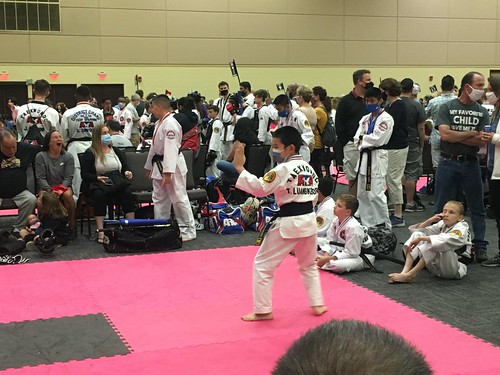
This past weekend DS10 competed at the American Taekwondo Association (ATA) Northeastern District Championships in 9-10 Blackbelt forms and traditional weapons.  Qualification was somewhat of a surprise to us.  The ATA uses a NASCAR style points system for qualifying.  You get points for placing in the many competitions hosted around the country during the year.  Then at the end of the year, state champions are determined for each of the categories based on accumulated points, and the qualifiers for districts are determined.  Because of COVID-19, last year's competitions were cancelled, and this year's qualifiers were based on last year's competitions.  While we knew that DS10 had points from last year, we were surprised to find out that he had enough to qualify (we found out when the ATA sent notices to the schools that their students qualified for District Championships).  We suspect that many of those who would have otherwise qualified had dropped out of the ATA and TKD during COVID (while DS10 had continued training through his school that supported virtual classes).  But, since both of us (parents) are in fields where careers are marked by perseverance through the events of life, the COVID-19 pandemic is merely one of those life events, but experienced by everyone, and everyone made decisions that allowed them to progress or not in their chosen areas.


ATA TKD Northeastern District Championships


ATA TKD Northeastern District Championships


After learning that he qualified for Districts, DS10 now joined the ranks of those who travel for tournaments.  We have typically only gone to tournaments that were local (i.e. no hotel stay required), but we always noticed the number of competitors that traveled to tournaments from other states (in most cases, because the points to be gained were valid in their pursuit of their state and district qualifiers at the end, but there were some traveling competitors at the novice sections as well).  When he was younger, our philosophy of tournaments was that DS10 needed to be exposed to the quality of those outside his immediate circle (school).  Again, both parents have the philosophy that the only way of assessing the quality of a person in an area is to see how they fare when directly compared to a larger population.  Because until you are compared outside your home, you can never know how good you really are.  And then knowing what is possible gives one intrinsic motivation to become better.  And not just in the area of competition, but in all areas of life (i.e. become a better human being).


ATA TKD Northeastern District Championships

In preparing for the tournament, TKD had gone from a sideline during the pandemic to an area of focus (it helped that he just had piano competitions that meant these areas were ramping down). This meant regular sessions with dad in the basement and weekly private lessons at the ATA school to ramp up his TKD over two months.


ATA TKD Northeastern District Championships


ATA TKD Northeastern District Championships

For the competition itself, we did not have high expectations.  The majority of the competitors in the ring had state and district champion patches (meaning they were state or district champions in past years).  So the goal was to do well  (i.e. not get last :-) )  And his scores were in line with reasonably good, but not exceptional.


ATA TKD Northeastern District Championships


ATA TKD Northeastern District Championships


More useful was the post-competition talk. DS10 reports that during competition his world got very small, and he noticed nothing but himself and the judge.  So we explained that this was the feeling that he wants to have, that sense of being able to concentrate and focus so that nothing else matters and he enters the zone.  This for us is the value of the competition, not winning or loosing, but understanding what it means to prepare to do your best in the moment, and how that moment feels when you are doing your best (and contrast to when you did not do your best). Because that is a feeling that can be repeated in all parts of your life.  Next, exposure to the reality that the world is bigger than your day to day life, and the people around you are not competition, but fellow travelers on that path (even if we are regularly reminded that people around us do not agree with this belief).

ATA TKD Northeastern District Championships


Sunday, February 14, 2021

Theatre during COVID-19: The Catastrophist by Lauren Gunderson and the Marin Theatre


Live artistic performances is something that has been impacted by the COVID-19 pandemic.  We have somewhat filled in that gap in our lives by watching performances by the Pittsburgh Ballet, the Front Row series by the Pittsburgh Symphony, and embracing the online performances by various artists (and paying for them). Because, just like we do with restaurants and other businesses, life just makes much more sense when we take advantage of the experiences that are available instead of dwelling on the experiences that are not.  (and not being in the privileged upper 1%, the peak level experiences like being close enough to see the eyes of the performers that are the hardest to replicate with social distancing were not available to us anyway so these virtual performance give a pretty good experience)

The Catastrophist is a one man play by Lauren Gunderson, commissioned and written during the COVID-19 pandemic. And while many writers try to research their works by immersing themselves, Ms Gunderson was not able to claim COVID-19 restrictions as an impediment. She is married to the virologist who is the basis for the play (Ms Gunderson is known for writing plays centered on scientists, but she usually does not have this close access to them).

Dr. Nathen Wolfe is known as a virologist who achieved some notoriety during the 2014 Ebola outbreak which was more widespread than the normal and threatened to spread into the U.S.  He is one of the virologists that persuaded then U.S. administration to take this seriously and prepare for its arrival.  (I remember being taught procedures we would take in my role as a Red Cross volunteer if it was necessary to support Ebola quarantine by delivering food.)

There are two threads in the play.  

First is Dr. Wolfe's development as a scientist.  There is an discussion woven throughout with his development as a scientist (Jewish grandma: "Why would you go to Harvard Medical School if you were not going to be a medical doctor?")  and a developing conversation on philosophy of science.  But the meat is doing virology, especially in his specialty of zoonotic viruses, viruses that jump from animals to people.  He talks about doing field work in Camaroon (which was partially under Dr. Donald Burke, of the University of Pittsburgh Graduate School of Public Health) going into the countryside and working with people living there and both teaching best practices and doing research with both the people as well as the animals they hunted.   And how this field research led to the discovery in the lab of proof that viruses jumped from animals to people.  (and for those who are linking this to COVID-19, this is the same work that the Wuhan virology lab does in the forests of Asia, they can discover a virus in the lab from sample they take, but any virus they discover is already existing in the forests and caves of Asia).  Then, after going from field work to lab work, how this naturally grows to the insights that showed that the 2014 Ebola outbreak was different and more of a threat to the world than earlier Ebola outbreaks, and led to the warnings that the rest of the world prepared for it and was ready for it when it arrived outside of Africa.  (there is a sidenote here about the accusations that occur whenever anyone actually tries to do anything in the real world saying that the response was botched because of it was not perfect.  But after 2020, we know know what a botched response looks like, i.e. what would have happened if his team was not involved)

Another major thread was about risk and mortality.  In part the conversation about risk was about philosophy of science, but then it becomes personal. There is an abstract conversation about risk, like he promised his wife that he would not do anything that exceeded a certain value on a risk measure. But then it gets more personal. Like the reality that every male in his family dies in their 40s from a heart condition.  So it covers his relationship with his father, and then with his sons. (and that his sons never met their grandfather, who died just before the first was born).

Watching this with family (and after watching Dr. Wolfe's TED talk), we have to remember that theatre requires its actors to exaggerate emotion because voices and body are all they have to communicate, especially in one-man shows where there they cannot use the reactions of the other characters (my wife, who does not like musical theatre, finds this comment amusing). So the play is a caricature of Dr. Wolfe. But is it a very good picture on what it is to be in science, the joys of discovery, and the thrills and hazards of actually doing work that has impact, especially in the politicized world of real life where there are plenty of people who want to blame those who save them.  Highly recommended as a way of understanding how viruses and pandemics work (and the subfield of zoonotic diseases, think how hunters interact with the animals they hunt)

The Catastrophist is streaming on demand at the Marin Theatre through the end of February. Note that there is a one day delay from when you order tickets to when you get the link, so plan accordingly.  For those with young children, note that theatre requires actors exaggerate their emotions, so there is cursing in anger sprinkled throughout the play.

Saturday, February 06, 2021

The home gym in January 2021: An ode to StreetParking

The Basement Gym Equipment

Here is the current state of the basement gym.  When we bought this house, we decided to make the basement a gym (the previous owner basically used it as a messy closet), so we had ordered mats that would arrive just after we moved (and before the movers moved our stuff). So the main part of the basement was immediately covered in 3/4" mats suitable for exercise.


Home gym in COVID-19


The floor is the main feature. The open floor is meant for TKD, so it is always (ha!) clear to do forms. And we move equipment there as needed. The floor is used for our workouts (usually CrossFit or HIIT style workouts), my daughter uses it to dance to music and music videos.  In the corner is the screen with an Amazon Fire stick.  Two bluetooth speakers on the walls provide surround sound music for the workout. The shelves in the corner hold any electronics (remotes, timers, HRM chest strap), accessories, and mobility equipment (foam roller, lacross balls, yoga blocks).  Also along the wall are a pylo box (home made) and steppers (garage sale)

A new addition is along the wall with the mirrors and whiteboard (which is now hanging). We have hooks that we use for resistance band training.  We have started using resistance bands for swimming dryland training, so the bands are clipped into the hooks, and we can practice our strokes, either on our back, or using the weight bench.  I also use the upper hooks to do ski-erg type motions.


Home gym in COVID-19

This corner has all of the TKD equipment. In addition to two Century Wavemaster standing bags for striking and kicking, we have kick and hand targets for taekwondo.  Also various ATA TKD weapons.  Also important are the posters. We have posters for kettlebell, medicine ball, bodyweight, stretches, foam roller, anatomy, (and other wall) dumbbell, barbell, suspension band, and cable machine, along with posters illustrating the foundational powerlifting and Olympic lifts. And various card decks with exercises when we need to build a semi-random circuit workout.


Kinetic by Kurt Road Machine with InRide power meter.

Another new addition is the bike trainer. I got a Kinetic Road Machine off of Facebook Marketplace over the summer (someone was selling it for her brother-in-law, so the goal was to clear it out of the hosue)  I added the Inride Power Meter, and now I have a bike trainer that measures power (previously, I used the calories estimated by my HRM to measure power)  Training to power adds a new dimension to training, and a third cardio machine, because power meters measure output, as opposed to the HRM, which effectively measures input (effort), which as any engineer knows, is not what you should be measuring.  I have been using it with the Kinetic.fit app to record power based workouts.  I do this once or twice a week (depending on if I use this for the Streetparking Endurance workout for the week)


Home gym in COVID-19

Here is the equipment nook.  This area is organized around the power rack and its mats. I have a standard bar (1" diameter weights), with about 250 lbs of weights for use with a barbell, dumbbells, and an adjustable kettlebell that is usually loaded up to 30-40 lbs of weight.  I also have three sand kettlebells (10#, 15#, 20#) that the kids use and I use for warmups.  And there are two sandbags, a 50# and a 65# that I joke are great for when I need to feel particularly badass :-).  I have a suspension trainer on the back upper bar that I will use for warmups.  And a new addition is a cable pully I have on the front upper bar for cable exercises (also using standard plates)

For cardio we have two machines, a magnetic rower and an airdyne.  My son has started using these as well, although he is not quite tall enough.  For longer workouts, he can use the rower, (because I don't like using the Airdyne for workouts > 30 minutes, I usually pull out the bike trainer for these.)

What we do


This was the COVID-19 pandemic year, which meant that schools became virtual, and even after school activities struggled to figure out how to work with the kids.  Some places really did not figure this out, others went all in to remote (video) training, and others basically became video classes (no interaction).  We had an immense advantage that my main fitness programming was Streetpakring (https://streetparking.com/), which is an online CrossFit style programming. So I'm used to this.  My daughter is used to joining me on my workouts (I scale, so she scales too).  And now she discovered the Just Dance series of games, and now dances for hours on end, so she is taken care of.  My son was a little harder. His TKD first stopped completely, and his school did not really get the hang of the virtual teaching, so we have been trying to get a routine.  So now, we have 4 types of workouts over the week.

1. 20 minutes of intervals (0:30/0:30, 0:40/0:20, 1/1, 0:90/0:30) (rower or airdyne)
2. Dryland bodyweight HIIT (usually a 20 minute video aimed at swimmers, but SP Shift is also an option.
3. Resistance band 
4. Long, either ~40 minute run or 40 minutes of intervals (rower)

Streetparking

Streetparking is an online CrossFit style programming (constantly varied across broad modal and time domains) aimed at home gym owners.  It has two mantras:  more than nothing, and consistency is key.  The center piece are the CrossFit style workouts.  5 days a week there are 4 versions, A (dumbbell centered), B (barbell centered) and C (sandbag or other odd object based), and shift (simpler movements for those who have not mastered the movement. They are big on scaling with options for movements to match available equipment and skills that maintain the stimulus. Next, there are accessories workouts, strength focused (power, olympic, and sandbag), skillwork (gymnastics), endurance, and, for those who just can't get away from gym bodybuilding workouts, accessories for that.

They have a very wide range of people doing this, the two largest populations are (1) stay at home moms and (2) active military (and families).  So their mantra is More than nothing, meaning they encourage everyone to do what is intense for them (weight, reps, movements).  (intensity is the another component of CrossFit)   And the generally accepted way of knowing that you got the intensity right, you complete the workout in the goal time and you die (or as DD6 knows, you plop at the end of a workout)

But what makes Streetparking different than other online programs is the amount of interaction between the members.  The focus is on the Facebook and Instagram accounts associated with Streetparking, and members are encouraged to video workouts and post them.  As many people are unwilling to put themselves out in the public (because people on the Internet in general are strange), many people create private accounts or have accounts that are solely for Streetparking, and will only connect to other people who are also in Streetparking (there is a Streetparking account for publicity purposes, and another account that only follows Streetparking members, so we know to look for that to identify each other).  And it very clearly is not meant to be a focused on the strongest, but on those who maintain intensity.  There is the CrossFit vibe of always cheering on those who struggle through (regardless of what that means), and in posts, I think one of the rewards of honesty is reading others reports of workouts, and saying "that is what I was feeling, at the exact same point in the workout".  So social media becomes a lot of "me two" types posts, which builds that sense of shared community, that is missing in places that try to deliver video to people working at home.  And the sheer range of people involved.  I feel that Streetparking has the broadest cross-section of people out of any association I am in, and it encourages using it as a place where people can have conversations about life (with a little bit of moderation to move any antagonistic conversations elsewhere).  For example as COVID-19 made its way to through the U.S. and different states had different experiences, members from the various areas discussed their experiences dealing with life, the shutdowns, and getting (and recovering) from COVID (and occasionally a story that someone did not).  The type of connection that keeps us all sane in a time when we don't get enough face to face interaction, and one way video interaction does not provide.


Monday, January 04, 2021

Fitness in 2020

Yes, this was a strange year for fitness. An infectious disease that spreads through respiratory transmission meant that group fitness centers, like gyms and martial arts studios, had restrictions on operations. And owners and operators of gyms and other group fitness establishments varied considerably in their following general guidelines for operating those types of activities (and the CDC was prohibited from telling Americans what they were, leading to other organizations recreating the standard proceedures the rest of the world had in place.

My primary training program was CrossFit, through Streetparking, which is an online program that was founded by two former CrossFit Games athletes (one of whom was on CrossFit Seminar staff).   So this included metabolic conditioning workouts (combination of strength and stamina), endurance, and power workouts.  Second, was martial arts through the American Taekwondo Association (ATA).  And starting in 2019, I started tracking workouts through Polar (I have a Polar Ignite heart rate monitor), so between my workout logs and my Polar logs, I have a quantified fitness


Heart rate zones and training benefit
So, these plots show the disruption in April (although part of it was just my loosing my HRM that month), then a steady increase as I got into the swing of things in Summer.  Summer was also when I did the Street Parking Endurance program.  And then got injured.  So Fall was recovery (note a gradual increase in intensity over time) and then December, when I was doing two-a-days during the Christmas and New Year holidays.  We also see that HRM have a bias toward endurance workouts, as it is really hard to get into the Red zone unless you are running or cycling.

Looking at my Streetparking logs, I see the following:


Bassically, I continued to do about 5 workouts a week.  But a lot more endurance (run, row, cycle), in part because of doing the endurance program (many of which did not get counted here).  I increased Buts and Guts.  This is generally bodybuilding type workouts, but focused on core and unilateral lower body, which helps in preventing injury. After I went to physical therapy for IT band syndrome in summer 2019, I did Butts and Guts on a regular basis.  And less use of the sandbag, since I had other things to concentrate on.  (Program A is a kettlebell/dumbbell focused, Program B is a barbell version, Program C is a sandbag version of the same workout)

Other things of note: in 2020 I completed The Vault challenge, which was a weekly test workout (in Crossfit there are normal everyday workouts, then there are tests, which are intended to help measure your progress). So The Vault was 25 weeks of one test workout a week. (and done twice each in 2020)

Goals for the coming year

1. Complete the 2021 version of the Vault.
2. Complete a challenge that involves nutrition.  While there are competition type events in CrossFit, challenges tend to be based on consistency in lifestyle changes, so a challenge is over a month or two and involves nutrition and other lifestyle tracking in addition to workouts.  Consistency in workouts is easy for me. (that is just discipline).  Tracking nutrition is a new anmial.
3.  Do Aerobic Capacity.  Aerobic capacity is a program that focuses on stamina and endurance in CrossFit. While the roots are in endurance sports, this program is done in the context of a CrossFit program, so it recognizes that the endurance and stamina are not ends in themselves, but are as part of a broader fitness goals  (CrossFit Metcons can be anywhere from 2 to 20 minutes in duration)  But the core of Aerobic Capacity is still the endurance sports (running, cycling)\
4.  Do a power meter workout weekly and work through the introductory power meter program.  I got a Kinetic Road Machine off of Facebook Marketplace and added a power meter sensor to it, so I effectively have a metered bike trainer. So the plan here is to do at least one workout a week on the bike trainer and take a one month training program that is based on the power meter)
5. Monitor strain vs tolerance on Polar Flow. This is the measure that correlates to injury risk, and if I had my current heart rate monitor in August, it would have been flagged that I was at a heightened injury risk. (strain is the recent workout load, tolerance is the workout load over the past four weeks, so strain vs tolerance tells if my workout load has been increasing faster than my ability to adapt to it properly)

Thursday, December 31, 2020

Book review: Weapons of Math Destruction: How Big Data Increases Inequality and Threatens Democracy by Cathy O'Neil

Weapons of Math Destruction: How Big Data Increases Inequality and Threatens DemocracyWeapons of Math Destruction: How Big Data Increases Inequality and Threatens Democracy by Cathy O'Neil
My rating: 5 of 5 stars

There is a popular diagram that describes data science as a combination of math and statistics, computer programming skills, and subject domain expertise; and describes the dangers of what happens when one of those three are not available. But among academics, there is an opposed line of thought that says that math and statistics methods are pure and subject independent. This book is firmly against the idea that algorithms are a defense against bias. The reason may be that while the mathematician/machine learning modeler may be naive, the setting of the implementation is not, and the questions that are being asked as well as the data being used to train models are both affirmative choices where the analyst and customer have agency. And pretending to be a naive analyst leads to errors in the result that have real consequences.

O'Neil goes through a number of cases. But while many accounts will go into the "evils" of big data and machine learning, she does suggest good practices that can prevent the dangers. First evaluation of the model. The model should be tested by actually looking at its predictions and seeing if they are true. In statistics this is done through control groups. In data science this is done through holdout test sets. And in her case studies, she points out this is not done. Next, compare the model input data set to the population that will be applied. Again, she regularly points out where this is not done. A third one is the well known make sure that you are not using machine learning to perpetuate an undesirable status quo. (but this argument is too easy)

Read this at a book club at work. It spurred a great discussion, that has carried over into other conversations. Definitely recommended to those involved in data science/analytics where people are impacted, and in areas where data analysis is becoming a bigger part of life, so as someone who works with the results of analysis you can ask good question, both while the analysis is planned and performed, and in understanding and questioning the results.

View all my reviews

Thursday, August 06, 2020

A data point on the efficacy of fitness trackers

 You may not realize this, but if you own a smartphone, it comes with a step counter.  Because it tries to count steps while in your pocket.  (my son can explain to you how step counters work).  But the magic in step counting is not being able to count steps, it is mental, it gets you to be more active based on the "if it gets measured it gets done" principle. Meaning you actually have to look at the numbers every now and then to get the motivation to do something about it.

So, I'm a lapsed runner, but I run a decent amount.  I got my iphone 5 somewhere in 2017 (I think) and that is when I now got Apple Health, which lets me see the iPhone step counter.  So this is what it shows me for those first few months.


Increasing steps as I get better fitness watches

So, I'm hovering around 5,000 steps per day.  But I'm not paying that close attention.  In early 2018, I get a fitness tracker.  A Huawei Fit, because I want it to double as a watch.  And it has an immediate effect.  I start actually looking at my step count.  And realize that the only thing between me and a consistent 5,000 steps a day is taking the stairs 10 flights to my office.  And I start doing that every day, at least once. Because when I do that, 5,000 steps in a day is easy.


Increasing steps as I get better fitness watches

Now, 5,000 steps per day is easy.  But I actually do real stuff.  Like CrossFit, taekwondo, and I occasionally run.  And I realize I am actually getting use out the fitness tracker, so I figure it is worth getting a real sports heart rate monitor.  Being a former runner (and I already have a Polar H7 chest strap), I stay in the Polar ecosystem (because Polar's definining trait is that it caters to athletes and does not have anything that an athlete does not need) and get a Polar M200.  Because it is already generations out of date and I can pick it up for pretty cheap.  And then this is what happens around December 2019 (early Christmas present)


Increasing steps as I get better fitness watches

Another jump.  Actually, Polar does not actually reports steps, it reports activity, which is much more useful.  So, instead of thinking about whether or not I am walking up and down 10 flights of stairs, I'm more interested in making sure I take activity breaks (to avoid movement alarms), and getting my activity(ies) in every day.

So, I am a poster child for how having a gadget gets someone to be more active.  And in the era of COVID-19, you can see that April was when we all went into stay at home, and by the next month I had my routine set (10 minute exercise sessions in the morning and around lunch to replace walking up and down the office stairs, and I get my main activity in the evening).  And yes, I think I am making my heart rate monitor worth it.

Saturday, June 06, 2020

Teaching kids micro:bit and makecode during COVID-19 quarantine

A couple of weeks into social distancing, as the kids various activities had shut down with no plan on how to open, we were faced with the question of how to keep our kids occupied.  We have generally followed the principle of having one artistic, one physical, and one STEM activity ongoing per child (plus chinese), and for the older one we were trying to fill in the space opened as his robotics (First LEGO League) activity had closed down.  And we wanted to have it be somewhat social, as we also wanted him to maintain his connections, as well as make sure there was a community of friends and relationships that may endure.

For classmates, our first community that we reached out to were the other kids from his LEGO robotics group.  I already had a number of email addresses from organizing an outing, and these were all kids who knew blockly style programming (or Scratch like) and programming in the physical world.  The next source was a local chinese parent WeChat group.  And we were looking for kids roughly the same age as DS9.  And we found one more from a camp that DS9 was in last year.

The goal was teaching programming, and for this, I choose block style programming, specifically on the BBC Micro:bit.  The micro:bit was created for teaching introduction to computer science in Britain.  They goal was a microprocessor that had on-board physical inputs and outputs, the ability to connect to other components, and could by taught by middle school teachers, who had a wide range of comfort level in teaching technology, and likely no comfort in teaching programming. Blockly style programming (using makecode) is particularly suited as it had enough range to allow the application of computer science basic concepts, but without issues such as syntax, which in normal text based programming often dominate an introductory computer science course.  (in computer science, the concepts are the important part, syntax is merely the implementation.  The focus in time and energy on syntax is considered a distraction)

For materials, my mainstays of Adafruit and SparkFun were both unavailable.  Adafruit was designated an essential business, but was focusing on medical suppliers. SparkFun was closed. So we had to source kits from Amazon.com, who was working from stock.  The micro:bit itself was available, but kits tended to be from one of the multitude of unknown suppliers.

For curriculum, I used the book micro:bit in Wonderland from Tech will save us.  The target audience was people who could not program, and it was craft based, where the projects all had a programming component and a craft component (that interfaced with the micro:bit board through alligator clips and the touch pads. As an added bonus, there was a motivating reading, from Alice in Wonderland (which many people already owned, but was also free as it was in the public domain on Project Gutenberg.)

Some unit notes:

  • Impacts of shutdown. The micro:bit was generally available on Amazon.com, but the kits of basic supplies were not.  There were two sources that were left, the https://www.techwillsaveus.com/site and various no-name kits on Amazon.com  The no-name kits tended to be breadboard based kits as opposed to alligator clip based kits.  For elementary and middle school classes, the alligator based kits would have been much better
  • Block coding on micro:bit was something the kids took to easily. Even the one who had no programming experience (meaning not even having background in Scratch).  Using makecode was easy. By the second week everyone had a microbit (not necessarily a kit) and getting working makecode onto the micro:bit was not hard.
  • First hard lesson was the control of the LED light, which was the first lesson that got off the micro:bit board. As this was really the first experience in physical computing, I believe that this is also considered a first milestone in electrical engineering.  It took a lot of one-on-one attention to get everyone through this.  But all of the other physical computing lessons (touch pads, connecting to sound speaker, other LED light projects) went much easier.
  • If-else was not a problem
  • Kids enjoyed the sound projects. Both the buzzer, then the music box.
  • They also had no problem working through complicated if-else trees 
  • The big assignment here was to use the microbit as a musical instrument, which meant making lots of sounds (kids like noise)

Really, the only difficult week was the first experience with lighting a light bulb.  While many students had experience with LEGO robotics and things like SPHERO, those kits deliberately hide the difficulties in connecting a controller to something off the controller. So after that, it becomes easier.

One thing I would do differently if I had to do this again, I would use the Sparkfun gator:circuit kit.  It breaks out many comment electrical components and packages them along with resistors (needed to make sure that low resistance components like LED lights do not get burnt out) to make a alligator clip friendly board, which is much easier than trying to connect components on a bread board (I think Adafruit has components that do this to, but not packaged in a named kit).  Leave the breadboard work for high school or later.


As this whole teaching kids programming experience was not nearly as traumatic as I thought it could be  :-)   there is going to be a follow-on.  But instead of having the focus be technology and computing, the goal will be to actually use these skills to do something, so we are going to take the Sparkfun gator:science kit, which has electronic sensors that can be used with the microbit to create data collection lab instruments, as the basis for an investigative science course. And in true co-op style, there will be a team of parents who will be trying to teach the kids science.  :-)


Monday, May 25, 2020

Parenting month 111: Online school during COVID-19

So, everyone in the world is dealing with COVID-19. One universal experience are the kids experiencing shelter in place.  Schools around the world closed or moved to remote learning.

So our kids have both moved to online learning.  Just as both of us academic parents moved to online teaching.  They have gone through many rounds as everyone; kids, parents, teachers, administrators; have been figuring things out as we go, trying new things, discarding things that were too hard, trying for what works while minimizing the pain over the perfect.

We do have the advantage that our kids generally like being around us.  So the first few weeks they were very happy to have both of us around all of the time.  Of course, DS9 eventually started to realize that mommy and daddy school is considerably more demanding than regular school (the cost of having picked two academics to be parents.  From the day he was born we joked that he clearly was not thinking things through when he picked his parents, probably was thinking about food)

Our schedules have settled into a pattern.  In the morning both kids have to check their schools communication channels.  Both schools at one point had several information channels to check, which definitely caused problems, but they have settled into one location for DD6, and two places for DS9.    Both kids generally finish their school work before lunch (with minimum help from parents).  Then comes mommy and daddy school, which generally includes piano, chinese, math, and extra curriculars.

Most enrichment programs closed down due to COVID-19 at the same times the schools did.  Although a large number of asian parents in the area were talking about pulling kids out of school for a couple weeks before PA schools actually closed down (we were only one day ahead of the PA announcement).  Eventually, many enrichment activities went online, using Zoom (just like all of our work places).  TKD started up online fairly quickly, and our kids joined in once a whole cycle started as online.  Ballet started online with the Pittsburgh Ballet using online kids classes as an outreach to maintain contact, and now the closer in schools are starting up online classes starting with the summer camps.  The LEGO robotics school DS9 is in is going online for camps, they have procedures of how to do in person (limited numbers, distancing) but we'll see if they actually carry them out (if WPA remains in yellow, I expect that they would definitely do so if WPA goes to green status).

For math, we are somewhat putting it on hold while they still go through school.  It is a little easier now that our university work is done, but as their school winds down we will add that back in.  DS9 will go back to Beast Academy to finish off level 5 (which will reach the end of the Art of Problem Solving Beast Academy series for the younger students).  We will be exploring the main AoPS at some point. DD6 is still not ready for Beast Academy, so she will do a couple of books from the Life of Fred series.  Like Beast Academy, it is a math series that promotes learning to think about math instead of drill and kill (the way most American learn math, and learn to hate it).  She is doing it online with a friend, which seems to be cause for much laughter in the room.

My contribution to teaching kids during COVID-19 has been teaching a programming with micro:bit to kids we have met from a few sources, mostly the LEGO robotics (their online program had not started yet) and chinese families.  In addition to the materials at microbit.org and micromag, we used a book "microbit in Wonderland", which had a craft feel to it for relating computing to the physical world.  Most (but not all) of the kids had exposure to Scratch (scratch.mit.edu), but generally the act of connecting physical items like lights, speakers, and conductive surfaces (aluminum foil) was new (outside of packages systems like LEGO robotics).  I suspect most electrical engineering professors would tell me that my experience of everything getting much smoother after we go to the point of controlling light bulbs is a known fact of life.  The whole "teaching pre-teens programming online" experience has gone off much better than expected, with the parents telling me that the kids show off the weekly homework projects.  And having 7 out of 9 effectively make it to the end is probably a good record :-)

So, the end of the online school year is in sight, and I sense that teachers and kids are going for survival to the finish line (my university reminded faculty from the beginning of the online teaching period that the goal was survival, not perfection) So the next phase will be replacing the usual summer camps with either online versions or us working at home (or parent run groups, coop style)

Monday, May 04, 2020

Senior capstone during COVID-19

This is the month of COVID-19.  Both University of Pittsburgh and Geneva College (our employers) announced that they would be delayed the week after spring break on March 11 (pushing back opening until March 20. The Commonwealth of Pennsylvania declared that all educational institutions be closed on March 17.  Which also meant that our kids were not returning to school.

For looking ahead, I had told our senior capstone course during their midterm presentations on March 6 that COVID-19 was coming, and that they should expect it to be here before they returned from spring break.  Chatter among the Chinese community in the north hills of Pittsburgh was about when to pull the kids out of school, first in dread of the return of college students from spring break, then after that watching COVID-19 march toward us when it reached Cleveland. And we pulled our kids Friday March 13. That day, our school district announced that everyone should be prepared to not come back to school from the weekend, somewhat jumping the gun on the Commonwealth's announcement, but basically being correct.

All the schools (universities and kids schools) went on a one week pause while all of the teachers figured out how to convert their classes to online for the foreseeable future. For me, this first affected the Pitt Industrial Engineering Senior Capstone course, which had corporate sponsors.  Once Pitt announced the delay of school, I sent a message to all of the students:

As you have heard, the University of Pittsburgh is postponing the start of classes until Monday March 23.  The extra week is to give faculty a chance to make a plan to move to online delivery of classes.  While the university and school of engineering are working on setting policies and plans, I can offer the following:


1. Note that while the classes are suspended, society as a whole, including your clients, is moving forward. Please contact your sponsors and discuss working arrangements.
2. For team meetings, have a discussion on how to hold these as many students may not be on campus.  I recommend the use of collaboration software. For my own work, I am planning on using Microsoft Teams and I recommend it as one alternative. For those who do not know, MS Teams is a collaboration suite that comes with Microsoft 365 Online (those of you who use Outlook online or MS Office online with Box are using 365 Online)  Information is located at https://www.technology.pitt.edu/services/microsoft-teams It includes text chat as well as video chat, screen sharing, and whiteboard sharing.
3. After you have determined how your group will work, please contact your faculty mentor and discuss how you will continue to work with your mentor.  Note that faculty are still available to assist.
4. One major issue that was highlighted in the methodology presentation was how to work with the lack of data.  You are encouraged to discuss this with faculty (subject to your mentor).  In particular, the field of input modeling within simulation includes methods for working with limited data (I have discussed this with many projects, and the long term feedback from the clients is that the resulting models have been useful). In addition, many subject areas have standard methods of soliciting expert opinion.
5. For end of term activities, there will be meetings at the school of engineering this week and next to discuss how these will be modified.  I will inform you as they get made.

Specifically, was the need for a continuity of operations plan On March 16 I sent out:

 Reminder to all groups. 
 1. Please send me and your faculty mentor the report specified in 2 by the end of today. Also, let me know as much as you know about (3), (4), (6). 
 2. You should have your next meeting with your mentor scheduled. As per recommendations, this should be a virtual meeting. Make sure that you have a videoconference method that you have complete access to (i.e. no time limits) (Note: as Pitt provides you with an account MS Teams is such a method. The faculty should be getting enterprise Zoom accounts soon, but that requires the faculty be present in the meeting.) 
 3. Professional Note: What we are doing is called a Continuity of Operations Plan (COOP). While not always done, there are many management recommendations that any organization have one that covers loss of key personnel, loss of access to facilities, and potential disasters. Ideally (but not always done) this is exercised on occasion. E.g. I volunteer with Red Cross for disaster response operations in western PA. Every now and then, we have an exercise where the staff are hands off, to confirm that the volunteers can manage a regional disaster response in it entirety without staff participation. 
 ---- 
 The Capstone program coordinators had a meeting this afternoon. 

  1.  The Design EXPO is cancelled. 
  2. Please inform your sponsors. 
  3. I need a report from each of the teams by Monday to understand your status and resource needs. 
    1. What is your plan on remote collaboration (again, I am recommending Microsoft Teams as a collaboration platform if you have not chosen one). Have you tested the collaboration platform? 
    2. What is the status of team members (i.e. where are they geographically) 
    3. For teams that are not substantially done (substantially done means you are running models and analyzing results), what needs are remaining? What is your plan on meeting those needs? 
      1. If your needs are data related, you should anticipate the possibility of not being able to collect data. Do you have the expertise to work with minimal available data and generate appropriate probability distributions (Note: these are topics from probability and from simulation) Is your faculty mentor able to help you? If not, I (Luangkesorn) am the faculty with the most research and practical experience with knowing what can be done with limited to no data.
  4.  Discuss with your sponsors your plan for ongoing collaboration. In particular, how the final presentation will be done. Note: Pitt has Microsoft Teams accounts for all of you (see previous message) and I recommend that as a presentation platform if they do not have one. 
  5.  As the EXPO is cancelled, your company presentation (if recorded) will be your final presentation. You should have the presentation recorded and have your faculty mentor(s) and myself invited. Check with your sponsor if there are any security considerations. If you are not able to make a recording or invite the faculty to your company presentation (or if there is not a company presentation before finals week), we will have to make another arrangement (i.e. a presentation over Microsoft Teams) 
  6. For all teams, check with your faculty on if there are any limitations on your reaching out to other faculty and getting assistance. You must do this. In the past, there are faculty who have gotten very angry about their team consulting with other faculty, even at the point where the team was fearful of project failure. You need to have an affirmative response that consulting other faculty is acceptable with no reservations. Do not wait until you need help to get this taken care of. My instructions from the department are to ask for permission to respond to your request from help, and to allow the team to fail if the answer is no. 
  7. As I mentioned on the first day of class, during senior design, life happens. Back then, I was thinking of individual events, but this is clearly something much larger. Just as I said on the first day, be flexible and take care of each other. While I asked about geographic locations earlier, also check on everyone's physical and mental states. We are all human, and everyone's situation, especially those at home, is different. 
  8. If you have questions or concerns, or even if you need a human contact, contact me.
Over the next few weeks, as classes were in turmoil from uncertainty, a number of students were sending me notes of thanks for providing structure for how to work with all the turmoil.  Many noted the slight irony that one of the most unstructured courses they had (capstones are supposed to be about the students taking on management roles and providing their own direction) suddenly became one of the most structured courses they had (my directives were to create a Continuity of Operations Plan, so they had a well defined task that gave the rest of their semester structure) while all of their other faculty were still figuring out what the rest of the semester was going to look like.