Thursday, August 17, 2017
Parenting Month 81: Travels
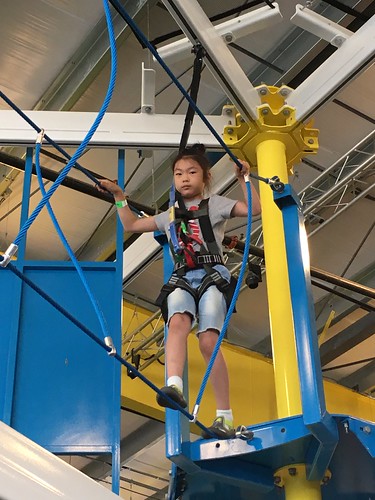
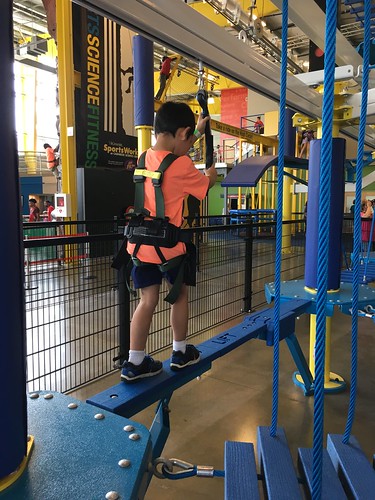
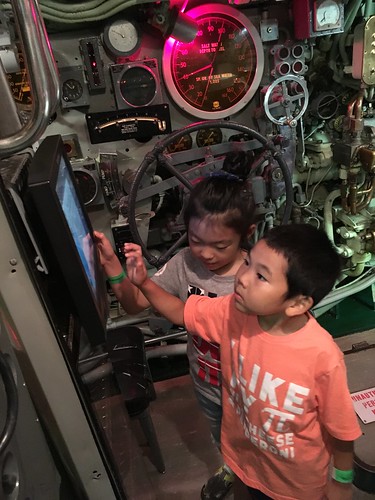
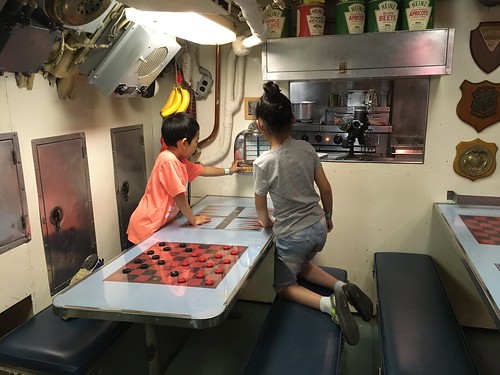
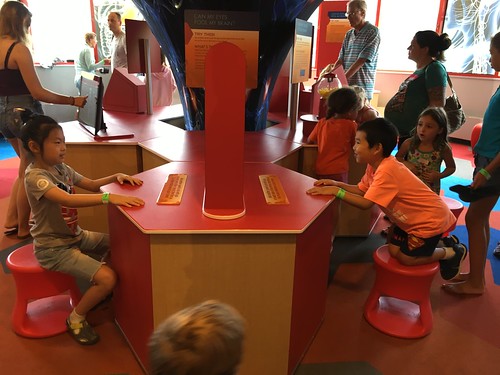
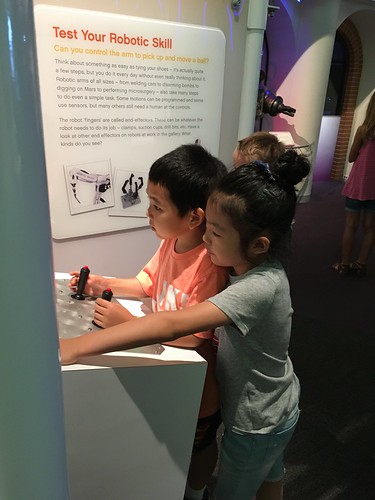
The notable thing about the mid-summer months has been trips. Either they have visited others or others visit us. We have: One trip to perform at Carnegie Hall Guests from the Carnegie Hall recital staying with us Visit to Cleveland and Cuyahoga National Park to visit all the uncles and aunties and cousins who met us halfway. Red Crossers visiting Pittsburgh from headquarters.


Tuesday, July 18, 2017
Setting up the Raspberry PI with the 7 inch touch screen and SmartiPi Touch display mount.
I recently got the Official Raspberry Pi touch screen and the SmartiPi Touch display mount. The main reason I got it was that I was getting a couple things that are intended to work with a computer, and I wanted said computer to be portable. And the Raspberry Pi with Touch screen could be run off of a USB battery. And this also means I (or my kids) won't be tying up a computer (or a desk) that I would rather be using for work while they do their explorations.
The standard references for assembling the SmartiPi Touch are the videos by the creator, Thomas Murray, and and a more complete video by Francesco Vannini (both videos embedded at end for reference)
However, many commentators have noted that there is not a good set of written directions, and I think the big disadvantage of an expert commentator is that they don't always remember to say things that a non-expert may have a hard time figuring out. I mostly followed Francesco Vannini's video, so here are a few additional notes.
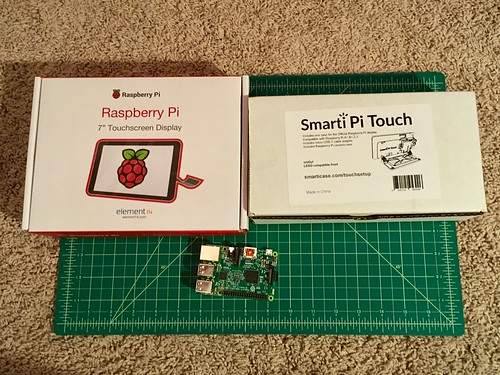
Here are the boxes, with a Raspberry Pi. Not pictured is the Sense HAT that I will also put on.
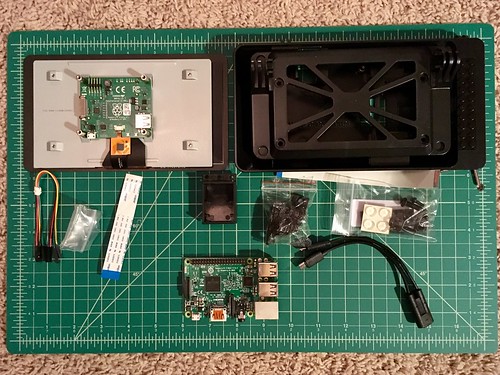
All the components from both boxes. Note that not everything will be used.
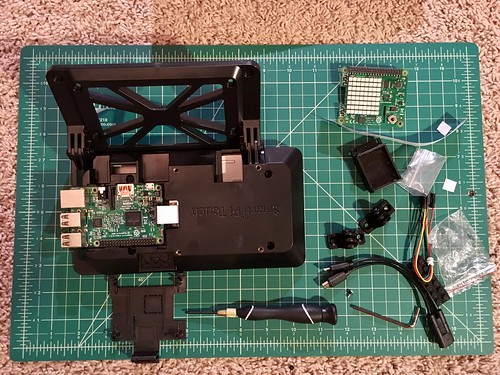
At this point I have:
Raspberry Pi camera module with mounted Raspberry Pi and SmartiPi Touch case. Note that the ribbon that comes with the camera will be just long enough to mount to the top or side LEGO studs. A longer camera cable will be useful since the Raspberry Pi with display and case is going to be placed on a table top, which is not necessarily where you want the camera.
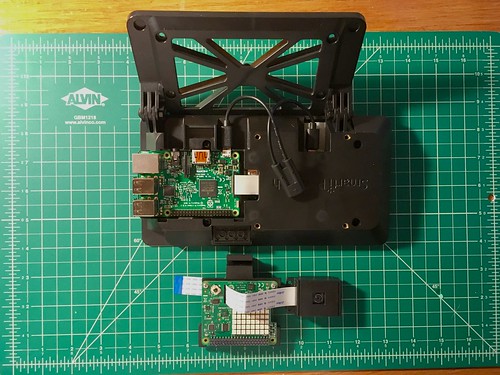
Here is the camera attached to the Raspberry Pi. Note that it goes through the slots in the door and the Sense HAT.
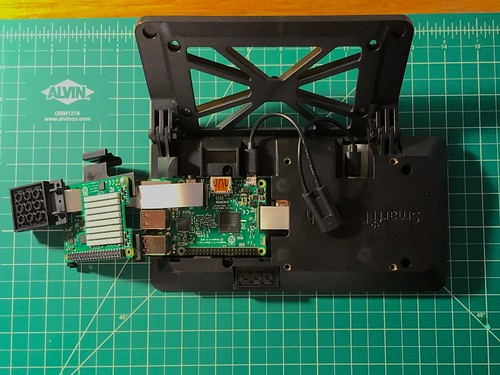
Now, attach the door, then mount the Sense HAT and tighten the screws on the Sense HAT. Note that the screws come with rubber spaces that put the HAT the right distance above the door.
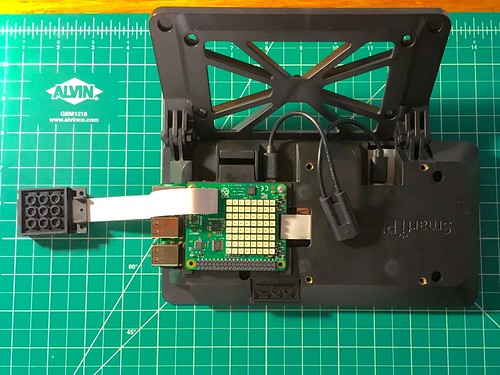
Picamera added to Raspberry Pi in SmartiPi Touch Case on the top LEGO pieces. I used a 4X6 plate because it is long enough to reach the back LEGO mount for the top. (mounting to the side could be done with camera mount as is)
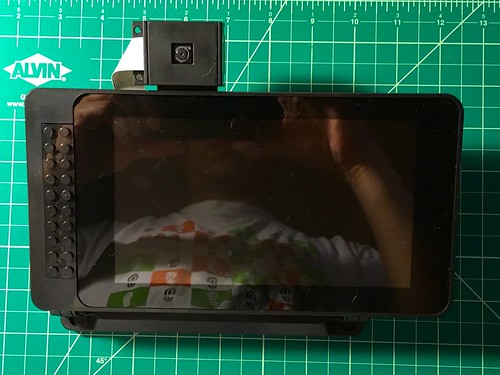
Pi camera mounted to LEGO from back
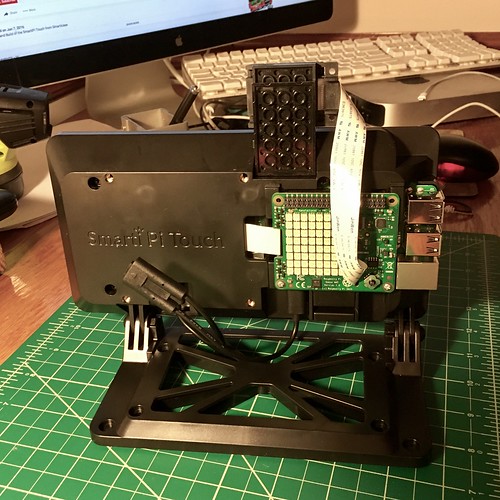
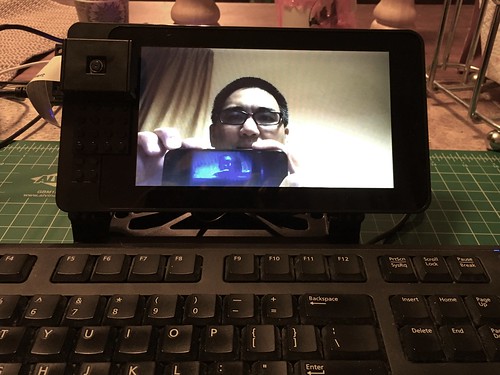
The working camera. Note that I have the whole thing running off a USB battery. I usually have this connected to a keyboard, and use a touch screen to serve as a mouse. It really needs a longer camera connector ribbon. I tried to mount it on a LEGO stand, but the SmartiPi case had to be right next to the stand.
The standard references for assembling the SmartiPi Touch are the videos by the creator, Thomas Murray, and and a more complete video by Francesco Vannini (both videos embedded at end for reference)
However, many commentators have noted that there is not a good set of written directions, and I think the big disadvantage of an expert commentator is that they don't always remember to say things that a non-expert may have a hard time figuring out. I mostly followed Francesco Vannini's video, so here are a few additional notes.
Here are the boxes, with a Raspberry Pi. Not pictured is the Sense HAT that I will also put on.
All the components from both boxes. Note that not everything will be used.
At this point I have:
- Added rubber feet to the corners of the stand (back side of the part that is mounted on the hinges).
- Attached stand to case body using included nut and bolt.
- Connected the display connector ribbon to both the display driver and the Raspberry Pi. I used the one that came with the touch display. I should have used the one that came with the SmartiPi case because it was longer and would have been easier.
- Mounted the Raspberry Pi to the display case. the instructions state I could either use the screws to mount the Raspberry Pi or I could use the hinge cover (bottom of picture). The cover has plastic that is sized to touch the Raspberry Pi when closed so I choose that option.
- Screwed the case back to the display. Note that one of the screws will be covered by the cover and any HAT so I tightened this now instead of waiting until the end to tighten everything.
Raspberry Pi camera module with mounted Raspberry Pi and SmartiPi Touch case. Note that the ribbon that comes with the camera will be just long enough to mount to the top or side LEGO studs. A longer camera cable will be useful since the Raspberry Pi with display and case is going to be placed on a table top, which is not necessarily where you want the camera.
Here is the camera attached to the Raspberry Pi. Note that it goes through the slots in the door and the Sense HAT.
Now, attach the door, then mount the Sense HAT and tighten the screws on the Sense HAT. Note that the screws come with rubber spaces that put the HAT the right distance above the door.
Picamera added to Raspberry Pi in SmartiPi Touch Case on the top LEGO pieces. I used a 4X6 plate because it is long enough to reach the back LEGO mount for the top. (mounting to the side could be done with camera mount as is)
Pi camera mounted to LEGO from back
The working camera. Note that I have the whole thing running off a USB battery. I usually have this connected to a keyboard, and use a touch screen to serve as a mouse. It really needs a longer camera connector ribbon. I tried to mount it on a LEGO stand, but the SmartiPi case had to be right next to the stand.
Tuesday, May 30, 2017
Parenting Month 79: A voice and a will
Our little threenager is definitely willing to let her views be known. Every day is punctuated by cries of 'Mine!' 'I want! and the occasional 'please' and 'thank you.' So not nearly as agreeable as big brother was at that age. On the other hand, she is more daring, willing to try things for a moment. More active in her play and coloring, less able to keep a long term focus on anything. Also is as possessive as a three year old usually is (big brother was not)
Favorite song: How far I'll Go (Moana)
Favorite toy: Duplos
Favorite food: Strawberries
What is mommy good for: food and sleeping
What is daddy good for: reading and exercising
What is gege good for: hitting and pushing
What is laulau good for: food
What is yehyeh good for: playing
Favorite song: How far I'll Go (Moana)
Favorite toy: Duplos
Favorite food: Strawberries
What is mommy good for: food and sleeping
What is daddy good for: reading and exercising
What is gege good for: hitting and pushing
What is laulau good for: food
What is yehyeh good for: playing
 |
| First media appearance - Pittsburgh Post-Gazette |
Sunday, April 30, 2017
Parenting Month 78: he is still a bean
Every now and then we get a startling reminder that our 6 1/2 yr old is still quite young, and not so big. In this case it has been in Taekwondo, which for him has been an arena where his sense of focus for his age has shined. Now, he has moved up to the 7-12 year old group (at our school, kids move up in age group from the 4-6 yr old group after they turn 7 or when they reach 3rd grade decided (i.e. the next testing is for brown belt ). T was the only one in his group to promote out of the 4-6 yr groupings (as opposed to aging out). So he is the youngest one in his class, and the second smallest.
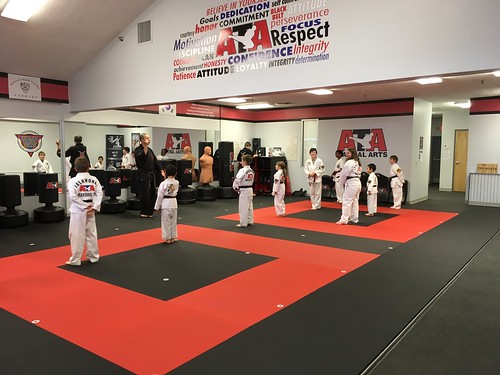 |
| T is the bean in the second row, and smallest in the room |
Being one of the two smallest in this age group class leads to a few oddities. The mother of the smallest kid asking if T was going to be in the in-school tournament, because she wants to know if there will someone else of approximately the same size. An earlier conversation with the same mom where we agreed to present a united plan about a class that we are pretty sure the kids will be asking about at some point. Practicing self-defense techniques (arm bar) with someone about twice his size.
Our other highlight this month was being a host to his cousin. Said cousin is two years older, and that still makes a big difference as T is still the happy bouncing bean that you expect in early elementary. But they still are close enough that they can play and explore together.
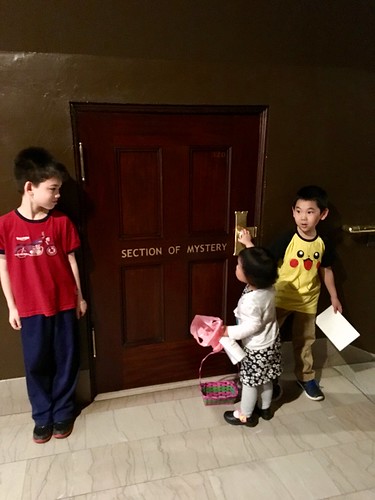 |
| What is in the Section of Mystery? |
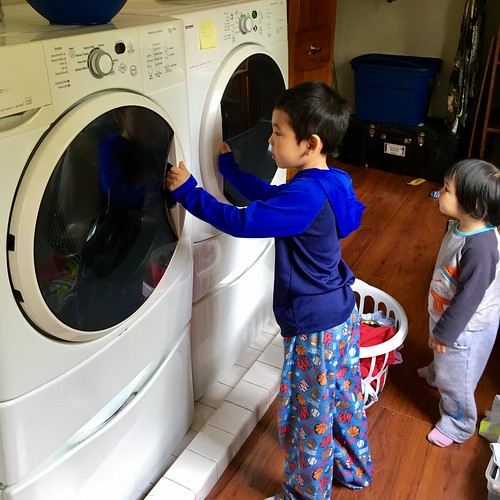 |
| Time to unload the washer |
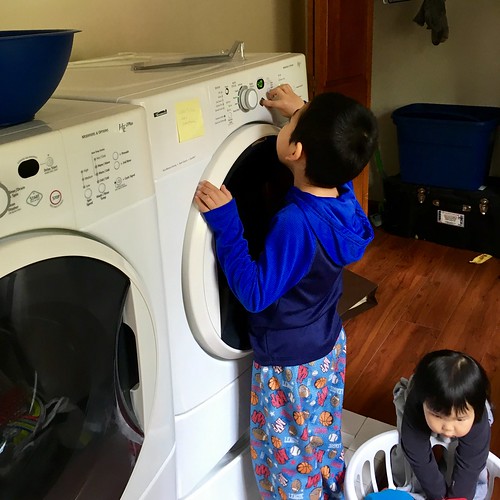 |
| Starting the dryer (and get the next load for the washer ready) |
Saturday, April 08, 2017
Parenting month 77: Moves and changes
This month was marked by a move. We did not move far, close enough that all of our commute patterns are essentially unchanged. But it was a move. And for our kids, we told them what would happen, they would leave home to go to school, then when they came back, it would be to a new house. And so it was.
One thing I appreciate about my kids is how adaptable they are. Especially my son (who is older), it seems that anyplace we take him, no matter what the situation, he will enjoy himself with us. Of, course, the key is that we are with him (he is slow to open up to strangers), but with that in mind, he pretty much adapts to anything, any place. This makes traveling very easy, and the move was a non-issue as far as the kids were concerned.
My son is pretty good about following me around doing small tasks. Anything that involves a screwdriver, he is good for. And little assemblies of things are fair game as well.
In other news, his academic rank in his school is now in competition. In the online math exercises his school does, there is someone else in First grade who suddenly discovered the website in earnest. So while T and a few others at the school were in the lead getting 100-200 points a week all year, this boy suddenly did 1000 points in a week, followed by 500 points in a week. So, now T is not the first in first grade anymore. If anyone has been paying attention, the 8th and 7th graders should have noticed that there is a 1st grader in the school lead, and that there is a first grade class is in the lead by classes as well. But not being first is something that T notices, and he is not way ahead of everyone anymore. And that is good to know at this age.
Other notes: with a new house means we have rooms for things we did not do before. We turned out basement into a workout area where we have covered a large section with exercise mats, which is big enough to do taekwondo forms. So we practice taekwondo. We also practice stretches and bodyweight exercises. I have a set of cards from Stack52.com that we use. T can pick from the basic exercise cards, and this leads to a reasonable workout that he can lead that covers many of the exercises we do at taekwondo (and a few new ones) He very much enjoys it, and he also wants to use the equipment we have (but I think he is too young for weight equipment, bodyweight strength exercises is good for now.
Both of them have a bit of combativeness and resistance in them. We probably are still in the realm of not noticeable for most families with young children, but it is a noticeable deterioration in behavior that we see.
One thing I appreciate about my kids is how adaptable they are. Especially my son (who is older), it seems that anyplace we take him, no matter what the situation, he will enjoy himself with us. Of, course, the key is that we are with him (he is slow to open up to strangers), but with that in mind, he pretty much adapts to anything, any place. This makes traveling very easy, and the move was a non-issue as far as the kids were concerned.
My son is pretty good about following me around doing small tasks. Anything that involves a screwdriver, he is good for. And little assemblies of things are fair game as well.
In other news, his academic rank in his school is now in competition. In the online math exercises his school does, there is someone else in First grade who suddenly discovered the website in earnest. So while T and a few others at the school were in the lead getting 100-200 points a week all year, this boy suddenly did 1000 points in a week, followed by 500 points in a week. So, now T is not the first in first grade anymore. If anyone has been paying attention, the 8th and 7th graders should have noticed that there is a 1st grader in the school lead, and that there is a first grade class is in the lead by classes as well. But not being first is something that T notices, and he is not way ahead of everyone anymore. And that is good to know at this age.
Other notes: with a new house means we have rooms for things we did not do before. We turned out basement into a workout area where we have covered a large section with exercise mats, which is big enough to do taekwondo forms. So we practice taekwondo. We also practice stretches and bodyweight exercises. I have a set of cards from Stack52.com that we use. T can pick from the basic exercise cards, and this leads to a reasonable workout that he can lead that covers many of the exercises we do at taekwondo (and a few new ones) He very much enjoys it, and he also wants to use the equipment we have (but I think he is too young for weight equipment, bodyweight strength exercises is good for now.
Both of them have a bit of combativeness and resistance in them. We probably are still in the realm of not noticeable for most families with young children, but it is a noticeable deterioration in behavior that we see.
Saturday, March 11, 2017
Parenting Month 76: No longer one of the little kids
The major milestone of the kids is the 6 year old has had his last American Taekwondo Association (ATA) Tigers belt testing. In the ATA, the Tigers is the group for 4-6 year olds where they allow for follow the leader in testing and advance at half speed (in each testing, they cover half of the form that the older groups do. Developmentally, this makes a lot of sense, somewhere around 7-8 kids begin to reliably tell left from right and there sense of time and sequencing develops. However, at this school, they join the older kids (7-12) after the first half of blue belt (i.e. they will test for brown belt with the older kids). At this testing cycle, he is the only one to advance due to belt promotion (there are two others doing the same, but because they turned 7)
One thing we have appreciated about his taekwondo classes and tournaments is that he has been one of the smallest ones, but has generally been one of the more focused kids, which results in him being noticeably more in line with the class than the others his age. And the way that manifests itself is that the teachers use him to flex pairings during sparring or self-defense testing, he will match his partner. While generally they try to match kids on size and temperament, they can pair him with smaller or shyer kids because he won't bully people over. And with the bigger kids, he has enough skill that he will not get knocked over or hurt.
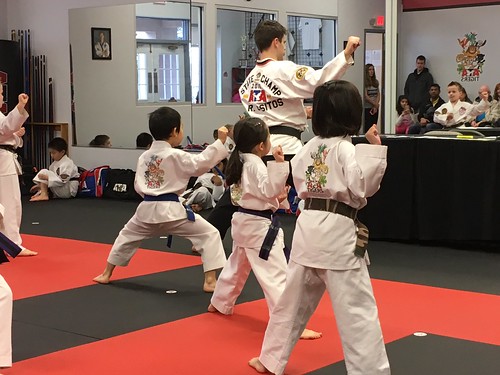 |
| Blue belt testing. |
One thing we have appreciated about his taekwondo classes and tournaments is that he has been one of the smallest ones, but has generally been one of the more focused kids, which results in him being noticeably more in line with the class than the others his age. And the way that manifests itself is that the teachers use him to flex pairings during sparring or self-defense testing, he will match his partner. While generally they try to match kids on size and temperament, they can pair him with smaller or shyer kids because he won't bully people over. And with the bigger kids, he has enough skill that he will not get knocked over or hurt.
But now that he is with the older kids, as the youngest and one of the smallest in the room (there is one smaller). And we actually like it that way. We have always felt that we wanted him to be comparing himself to kids who were older, bigger, and smarter than him, so that there would always be someone ahead of him and he would always know what better looks like. We have appreciated this in Taekwondo, where the teaching philosophy is that at whatever level a student was, the aim of the day's lesson was to always get better.
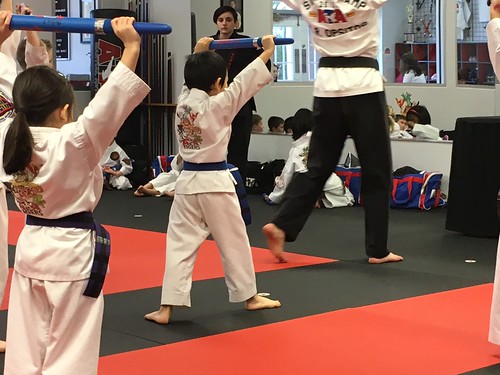 |
| High block |
We think that T has shined in this setting, and anyplace like that where we have been able to create that. We get worried when he gets too many accolades this young, because we want him to be ready for the challenges in the future. And at this age, it is best if he is always learning and competing with people who have natural advantages over him, so when that changes, he will do well.
Friday, February 03, 2017
Parenting Month 75: A is for Attitude
Our two year old is speaking more and more. As foreshadowed by many events, she talks, pretty much non-stop. And if she was able to proclaim her will when she was 18 months and not actually knowing words, she show guile now that she actually has english and chinese vocabulary. While big brother is getting pretty good to, it is even money on whether he is learning from his classmates, or if he is learning guile from his little sister.
On the other side of the equation, we are seeing that there is tradeoff. While little sister clearly is well beyond what big brother was like verbally and socially, we remember how generally agreeable and happy he was in simple ways. And especially the fact that big brother could concentrate on something for extended periods of time. And the effect is that while there are things that little sister does that big brother did not at the same age, there were many opportunities we could provide big brother at that age because he was so well controlled and he could focus and be satisfied with one thing for extended periods of time. If you asked us who is smarter, we both would say little sister, but big brother could maintain his attention and stick to things longer that she can now. And that is starting to show the difference.
T has been learning how to lie. And we suspect he is picking this up at school, because when he does, he has this habit of looking to see if it was successful. So whenever we notice that pause, we start to think about what has he just said. At this point, it is experimentation. He is also still very bad at hiding things. One little habit he has is when he makes a mess on something. He will come along and ask for things that happen to be cleaning supplies, and inform us that there is no need for us to go look at ___. At this point, while we immediately go look, we are being good at merely helping him clean up after himself. And hoping he does not get better at hiding.
Last, we have a couple more events. His first college basketball game:
On the other side of the equation, we are seeing that there is tradeoff. While little sister clearly is well beyond what big brother was like verbally and socially, we remember how generally agreeable and happy he was in simple ways. And especially the fact that big brother could concentrate on something for extended periods of time. And the effect is that while there are things that little sister does that big brother did not at the same age, there were many opportunities we could provide big brother at that age because he was so well controlled and he could focus and be satisfied with one thing for extended periods of time. If you asked us who is smarter, we both would say little sister, but big brother could maintain his attention and stick to things longer that she can now. And that is starting to show the difference.
T has been learning how to lie. And we suspect he is picking this up at school, because when he does, he has this habit of looking to see if it was successful. So whenever we notice that pause, we start to think about what has he just said. At this point, it is experimentation. He is also still very bad at hiding things. One little habit he has is when he makes a mess on something. He will come along and ask for things that happen to be cleaning supplies, and inform us that there is no need for us to go look at ___. At this point, while we immediately go look, we are being good at merely helping him clean up after himself. And hoping he does not get better at hiding.
Last, we have a couple more events. His first college basketball game:
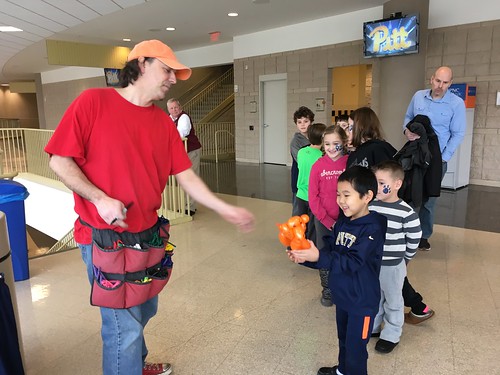 |
| Getting a tiger named T, because then if there is trouble, he can say that T did it without lying. |
 |
| Presenting the colors for the national anthem |
 |
| Pitt colors at the Pitt game |
Friday, December 30, 2016
Parenting Month 74: New environments
The highlight of the month has been two weeks in Thailand. We have had a desire to make sure that our kids experience a world that is different than the upper middle class suburbia we live in. In contrast, our family in Bangkok, Thailand is in the middle of a city of 8 million people and is a place where wealth lives side-by-side with poverty, much different than the U.S. where we are very segregated economically.
Our general approach to raising our children has been encouraging competence. This has included skills such as woodworking, using tools, and generally toys that involve building. But we also want to include social competence, meaning that they can function in a world different than the suburban upper middle class world we live in. So on this trip we did some normal tourist things like going to the malls and temples, but we also did things that were closer to how life was lived, like going to the local street market every day to get food for breakfast, or traveling by river boat on commuter boats (as opposed to the tourist boat). We taught him how to read maps for train and boat, to practice social curtesies with everyone, and to become more aware of his surroundings.
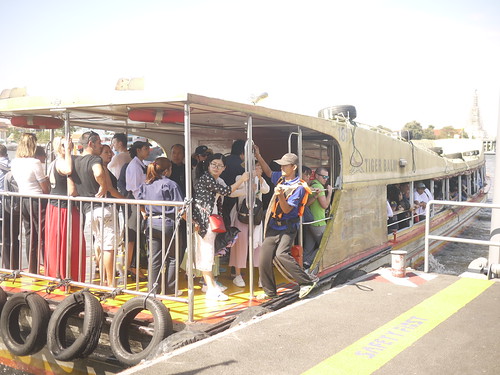 |
| Someone jumping onto a riverboat before it leaves the pier |
T experienced a number of new experiences. He used a river boat that was a means of transportation (not just a tourist boat), he rode a tuk-tuk (2 stroke engine powered tricycle-cab), and walked down a street market daily.
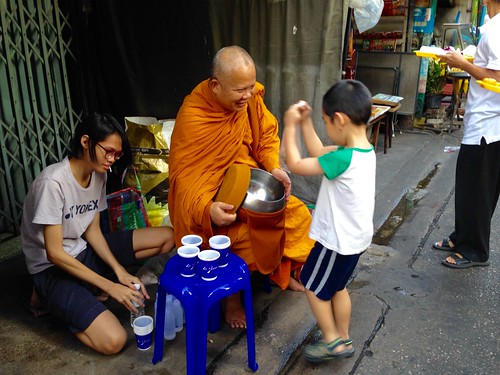 |
| Wai Phra to a monk on the street market on Petchburi Soi 5 |
 |
| Letting some cars go by in the morning street market |
He obviously stands out. The very casual dress compared to school kids, the fact that he bounces along as he walks would make him stand out even if he was not speaking english. And in social status conscious Thailand, this particularly makes him stand out as many service personnel have gotten used to not having their curtesies returned by those of higher social class, so my six year old stands out from greeting everyone he interacts with properly.
When I was in Afghanistan, I had spoken frequently with a former CIA officer on a range of topics. One day he commented that I was someone who could go anywhere in the world and learn to interact with anyone. Now, that is not true, I spent much of my growing up years just trying to reduce how much I got yelled at instead of building competencies, and I was still getting used to being in a place where it was acceptable to act when lives were in danger. But being a parent, I can think about what it would take to actually be such a person. And that would include learning to function in new environments, with new social rules and requirements, and new patterns of life. Even now as someone this young.
We hope that he will experience three cultures growing up: the U.S., Thailand, and China. And that this could be a springboard for being the type of person my colleague talked about.
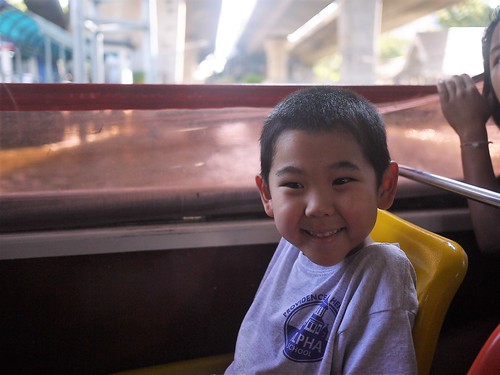 |
| Riding a river boat |
Thailand 2016 Trip anecdotes part 2
- T playing with a 4 year old Thai girl. They do not have a common language, but one of their games is to whisper in each other's ear.
- Realizing that said 4 year old has never colored (with crayons) before.
- Said 4 year old trying to quiet down A's tantrum by shushing her.
- We think that she likes the fact that there is someone in the family compound that is younger than her.
- Our go to method for shortstopping a two year old tantrum, get her singing. A sang alot this trip.
- People on the BTS train offering us their seats because we have young children with us. This happened every single time. (Except Christmas Eve, which is why A singing was so exceptional that night.)
- I got a lot of exercise carrying around A in a ring sling.
- The boys went to see Rogue One. This is T's third movie in a theater.
- At my father's one year remembrance, T was told to watch the door and greet (wai) everyone who came in, and he did.
- T going to the street market on his last morning to give food to the monk, and chatting with the monk after the blessing.
- I don't think I'll get used to being greeted by 'sawasdee pii' from professional adults ('pii' refers to someone older, I'm used to using it to refer to older kids, not adults)
- A likes to pass the time by singing songs she knows from daycare or YouTube videos. Our soundtrack from the vacation is highlighted by Everything is Awesome, the LEGO Movie theme song by The Lonely Island
- T passes time by singing songs from school. We are starting to suspect that he is making up lyrics for the songs.
- On the trip back, we had to walk a long way between gates to catch a connection, A saying to T "keep walking" (they had been watching Finding Dory on the plane, Dory's catch phrase is "keep swimming")
- Waiting at O'hare for the last leg, A was singing and dancing in the waiting area. Completely inappropriate for a 2 year old who left grandma's house over 24 hours ago.
- A woke up around 2 AM for her morning concert. Which is when I am writing this.
Saturday, December 24, 2016
Thailand 2016 trip Part 1
- T 6yrs old. On encountering turbulence. "This is fun!" By the end of a flight which included an aborted landing due to a wind shear alarm, he threw up. 2yr old sister was not far behind.
- By the end of the D.C. -Tokyo leg, commentary from other passengers, if they are this agreeable when tired and uncomfortable, they must be wonderful children from day to day.
- Tokyo airport play area. We meet someone we know and our kids play for a while.
- 5:30 in the morning wake up to roosters crowing. 2 yr old had been awake since 3 and thinks she has company in her morning concert. She knows that roosters say Cock-a-doo-doo
- First of many trips to the next soi (small street) market over to get morning breakfast. T learns to give food to the local monk. The next day we find out that the monk we picked can speak English. Wai phra becomes our daily ritual and we are usually not rushed by others waiting their turn so we can talk with the monk.
- Cousin has a piano. That means T has daily piano practice.
- Visit great-grandma. T is getting the wai for hello thing down.
- By the third morning T and I have made the first trip with just the two of us. T has learned to wai and say sawasdee khrab to every vendor we buy something from. We have gotten a discount from one vendor who knows that a 6 yr old boy is learning how to wai phra. People ask about his mother. Random people want to say hello. We get freebies when we buy things in the morning market.
- Take train and boat to go to Museum of Siam. They are closed for renovation for the month. Major fail. T thinks that the boat trips on the river express boat were really cool. Maybe not so bad.
- Go to Kasetsart to give a talk. The guy picking me up from the train station asks what am I wearing so he can recognize me. Thailand is in morning so everyone is wearing white or black, including me. I suggest my green bag is more identifiable.
- Change the morning workshop based on the conversation over the drive. Three hour workshop, with two hours created as we go. It did not completely fall apart. Everyone learned a lot.
- Faculty member teased because we were talking about exchange programs, and she is thinking about what her daughter will do. Said daughter is currently 5.
- Conversations at a couple of universities focusing on the difficulty in teaching programming to engineers. Everyone is relieved to know that they are not the only ones. Conversation then moves to how some places are trying to improve it.
- This morning's market run was with grandma and granddaughter, but without grandson. Everyone asks what happened to grandson. We do not get our usual freebies. We can now put an economic value on the difference in cuteness between a very well behaved 6yr old boy vs a shy 2 yr old girl.
- T and I go without mommy and sister to Siriraj medical Museum. We get to see actual hearts, lungs, etc in various states of health, including smokers, gun shot victims, stabbing victims. We are pretty sure that is unique in his first grade class.
- Shop girls love T. Museum staff girls want pictures with him. Maybe we should charge for the privilege.
- 2 yr olds having a get home by __ spell means we can define an effective radius that we can have dinner if we want to go out.
- Go out for a late dinner that involves taking a boat. We get recognized by a family that was on the boat with us this morning.
- Lunch, I find a table with a sleeping A while everyone is finding lunch at a food court. Lady comes over and tries to help wake up and feed A. (If you did not know, Thai girls rival Japanese girls in their attraction to things cute, and my kids count when they are with us)
- Christmas Eve on a very crowded BTS system with lots of tired and cranky people. A is sitting in a sling and is singing away happily. Most people are too tired to appreciate how cute that is, but there were a few.
- Tired T, very happy to take a trip in a Tuk-tuk. Includes laughing at another family who was also crammed in another tuk-tuk and a motorcycle riding Santa Claus.
Thursday, November 24, 2016
Sally Steel and the Miniature Menace by Cally Harris: Book Review
Sally Steel series are pulp fiction aimed at young adults (middle school). What pulp means is that the characters are generally or specifically competent. The young adult target implies that some of the conflicts are those that are of special interest to young adults.
The setting is midwestern farm country in the early 1900s, and Sally Steel is a teenage girl. Who happens to be gifted in all things mechanical. This leads to a number of problems in her life. Largely due to the fact that she is a girl. And there are expectations of girls in that setting. So she gets teased because she is a girl with her interests, because she is good, she is prevented from getting recognition by society so she does not upstage the boys. Her father chooses to be blind to her abilities (but her mother and brothers all see it).
The meat of the story is Sally being caught up in an adventure with her good friend, Jet Black (whose main character trait seems to be fearlessly going into danger). And, it turns out that there are intelligent, reasonable, and capable adults that she runs into who are also allies. but, this being a Young Adult novel, she has to learn that she does not handle everything by herself.
As a story, it is a fun one. Sally and friends get into and out of trouble at a pretty good pace. The meet friends and enemies, and false friends one after another. For those who are familiar with the Dinocolypse series from the same publisher that features older versions of the same characters, it seems like the book was trying a little to hard to fit everyone in (it is a bit of a stretch to think that the people whose actions will affect the world happened to be the same age and cross paths in rural Illinois as teenagers).
But at its heart, pulp is a story about heros who are capable, in this case, even a hero that is a teenage girl. And it is a fun story at that.
The setting is midwestern farm country in the early 1900s, and Sally Steel is a teenage girl. Who happens to be gifted in all things mechanical. This leads to a number of problems in her life. Largely due to the fact that she is a girl. And there are expectations of girls in that setting. So she gets teased because she is a girl with her interests, because she is good, she is prevented from getting recognition by society so she does not upstage the boys. Her father chooses to be blind to her abilities (but her mother and brothers all see it).
The meat of the story is Sally being caught up in an adventure with her good friend, Jet Black (whose main character trait seems to be fearlessly going into danger). And, it turns out that there are intelligent, reasonable, and capable adults that she runs into who are also allies. but, this being a Young Adult novel, she has to learn that she does not handle everything by herself.
As a story, it is a fun one. Sally and friends get into and out of trouble at a pretty good pace. The meet friends and enemies, and false friends one after another. For those who are familiar with the Dinocolypse series from the same publisher that features older versions of the same characters, it seems like the book was trying a little to hard to fit everyone in (it is a bit of a stretch to think that the people whose actions will affect the world happened to be the same age and cross paths in rural Illinois as teenagers).
But at its heart, pulp is a story about heros who are capable, in this case, even a hero that is a teenage girl. And it is a fun story at that.
Saturday, November 05, 2016
Parenting month 72: Maker vs consumer
Another year. Since T's birthday I've probably said that he was five at least five times. It is hard to get into the mindset that they don't freeze in time.
Some highlights of this year:
1. Movies on the big screen: The Martian and MacGillivray Freeman's Humpback Whales.
2. Live professional sporting events: The Washington (PA) Wild Things and the Pittsburgh Pirates
3. Playing on a sports team: Eagles Soccer
4. Taekwondo rank. Purple belt (ATA taekwondo)
5. Starting first grade
Some changes over the past month.
1. Social - Teachers report that he is apparently everyone's best friend. However, he is still a relatively controlled one in the class. They report that he regards the overall silliness and chaos of first grade but does not actually take part.
2. Making - We have been trying to get him to regard activities as one where he is a consumer to one where he is an active part in its creation. So it means showing people how things work and being part of the entertainment (i.e. playing piano in public) His old habit of freezing in public performance seems to be overcome, with a few public performances without a hitch. He is freer about talking to strangers, but not on command (i.e. we would like him to be able to demonstrate things he knows, not talk to random strangers without cause). One thing is that he is better about asking questions and requesting opportunities, which got him some nice experiences at times.
3. Soccer is over. While a good experience, we're pretty sure he does not have any desire to do this again. Nothing against soccer, but he realizes that he sacrificed taekwondo for it, and he also notices that a lot of things he used to do on Saturdays got pushed out because soccer takes out the flexibility of his weekends.
4. Sense of urgency/speed. His teachers observed that he knows how to do anything asked of him, but he does it slowly. A big reason is that we did not drill him in anything over the summer, which is how you develop speed, especially in arithmetic. So we started him on the online math program his school uses (some of the activities are timed, the first times he did them he timed out, he has gotten much better) and mommy school has started to include drilling.
We had one existential crisis. We found out from one of the teachers that some of the other kids in first grade learned multiplication over the summer. And we did no such thing, making us wonder if there was anything else we did not do! The teachers have assured us that they did not actually want us to teach him multiplication or other things, but the fact that they noted that some of the kids did (and that they had immediate recall from memorizing their times tables) makes us take that skepticism with a dash of salt.
A (2 1/2 years) has become more comfortable with day care. Now she waves goodbye at dropoff without a glance back. Teachers report that she sings alot. What we notice is that she is much more talkative. Her extended babbling at 18 months have converted to non-stop talking and singing. We just took a 2 hour road trip where she was singing and telling stories to herself for the entire trip.
Some highlights of this year:
1. Movies on the big screen: The Martian and MacGillivray Freeman's Humpback Whales.
2. Live professional sporting events: The Washington (PA) Wild Things and the Pittsburgh Pirates
3. Playing on a sports team: Eagles Soccer
4. Taekwondo rank. Purple belt (ATA taekwondo)
5. Starting first grade
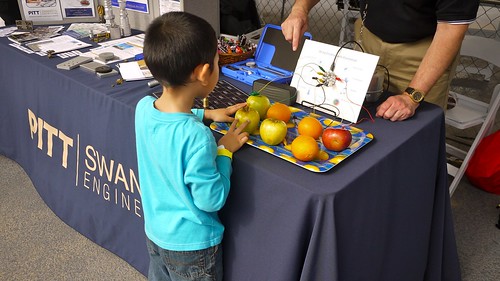 |
| Demonstrating a fruit piano |
1. Social - Teachers report that he is apparently everyone's best friend. However, he is still a relatively controlled one in the class. They report that he regards the overall silliness and chaos of first grade but does not actually take part.
2. Making - We have been trying to get him to regard activities as one where he is a consumer to one where he is an active part in its creation. So it means showing people how things work and being part of the entertainment (i.e. playing piano in public) His old habit of freezing in public performance seems to be overcome, with a few public performances without a hitch. He is freer about talking to strangers, but not on command (i.e. we would like him to be able to demonstrate things he knows, not talk to random strangers without cause). One thing is that he is better about asking questions and requesting opportunities, which got him some nice experiences at times.
3. Soccer is over. While a good experience, we're pretty sure he does not have any desire to do this again. Nothing against soccer, but he realizes that he sacrificed taekwondo for it, and he also notices that a lot of things he used to do on Saturdays got pushed out because soccer takes out the flexibility of his weekends.
4. Sense of urgency/speed. His teachers observed that he knows how to do anything asked of him, but he does it slowly. A big reason is that we did not drill him in anything over the summer, which is how you develop speed, especially in arithmetic. So we started him on the online math program his school uses (some of the activities are timed, the first times he did them he timed out, he has gotten much better) and mommy school has started to include drilling.
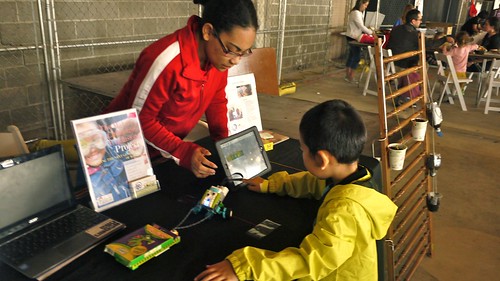 |
| Learning to program a LEGO robot |
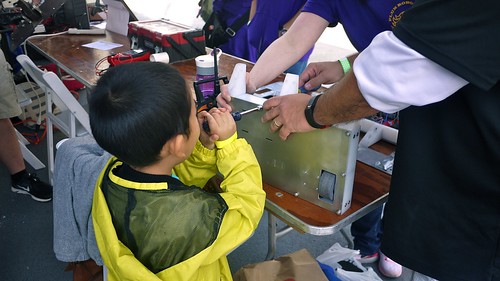 |
| Taking part in maintenance of a battle bot |
A (2 1/2 years) has become more comfortable with day care. Now she waves goodbye at dropoff without a glance back. Teachers report that she sings alot. What we notice is that she is much more talkative. Her extended babbling at 18 months have converted to non-stop talking and singing. We just took a 2 hour road trip where she was singing and telling stories to herself for the entire trip.
Friday, October 28, 2016
ESP8266 Thing board based environmental monitor
The goal of this project was to create an automatic temperature and light level monitor for a bioshelter (greenhouse +) run by The Bible Center Oasis Project (Pittsburgh, PA). Because it would be used to grow flora and fauna, it needed ongoing monitoring of temperature and light levels to confirm that it would support the growth of food, and to monitor the effectiveness of measures being explored to control environmental conditions.
As an off-grid, solar powered greenhouse, the bioshelter is not connected to any utilities. So any environmental monitoring solution needed to be low powered and use wi-fi for communication (i.e. no phone line). We also preferred solutions that did not force a subscription to a specific data logging service.
I developed a solution based on the Sparkfun ESP8266 Thing development board. This board provided the Arduino microcontroller to control the project and on-board wifi with antenna. The other major components of the board were:
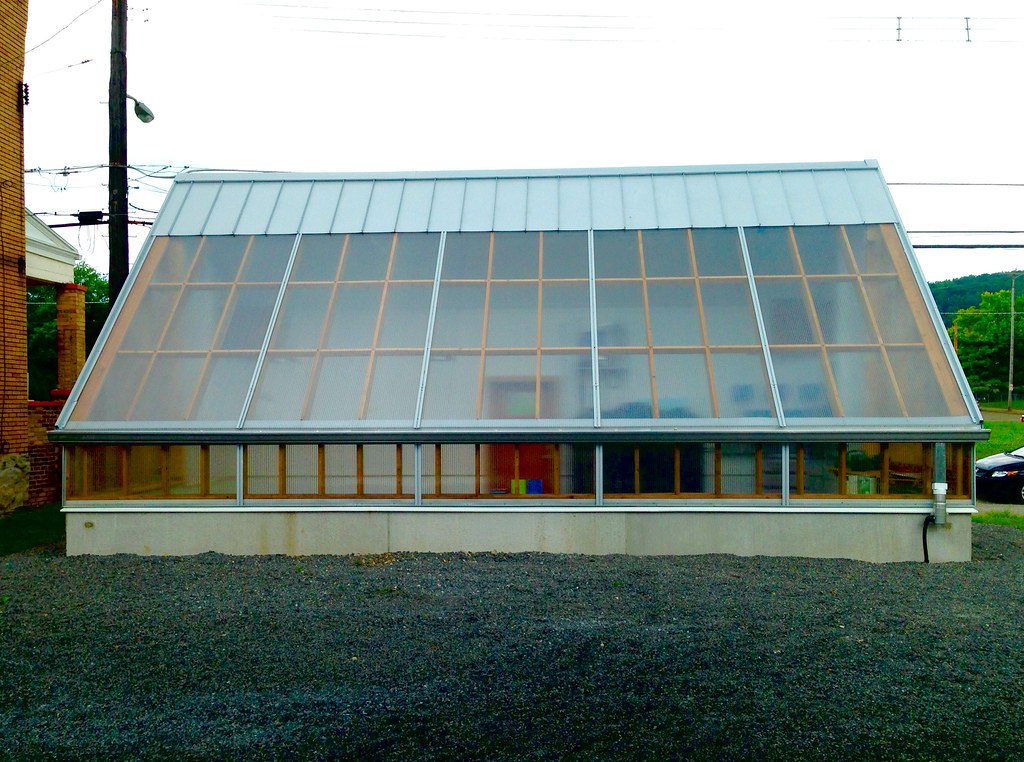 |
| Bible Center Oasis Project bioshelter in Homewood (Pittsburgh), PA |
As an off-grid, solar powered greenhouse, the bioshelter is not connected to any utilities. So any environmental monitoring solution needed to be low powered and use wi-fi for communication (i.e. no phone line). We also preferred solutions that did not force a subscription to a specific data logging service.
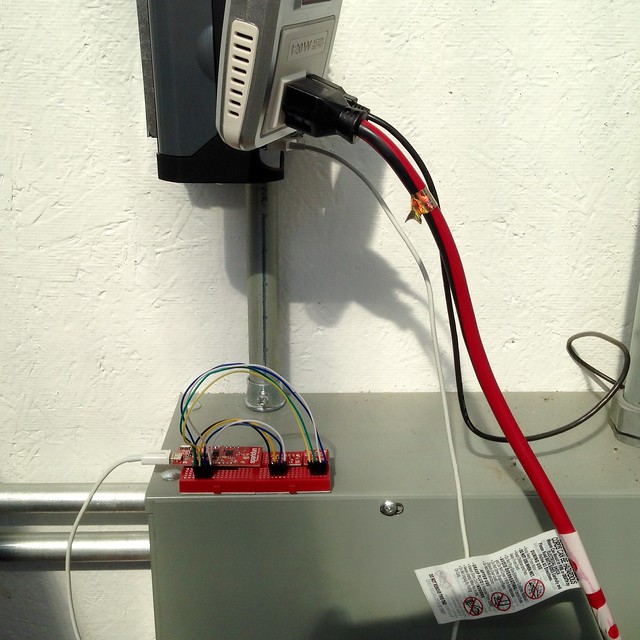 |
| Sparkfun ESP8266 Thing Dev board based monitor |
I developed a solution based on the Sparkfun ESP8266 Thing development board. This board provided the Arduino microcontroller to control the project and on-board wifi with antenna. The other major components of the board were:
- Sparkfun ESP8266 Thing Dev board
- SparkFun Atmospheric Sensor Breakout - BME280 for temperature, humidity, and barametric pressure sensors
- SparkFun Luminosity Sensor Breakout - TSL2561 for the luminosity sensor
I first soldered headers onto the ESP8266 Thing dev board and the BME280 and TSL2561 breakout boards. These allowed for use of two mini-breadboards to develop the monitor, which also served as a base for the project when deployed.
The Thing dev board and both breakout boards were set up with Inter-integrated Circuit (I2C), protocol, so both sensor boards were connected to the I2C inputs on the Thing dev board.
The Thing dev board was then programmed to transmit the response to a phant server. Specifically, the data.sparkfun.com server that is made freely available by Sparkfun. In addition to being a data display, the phant server allows for accessing the data as csv or json files for further analysis, or using analog.io (link opens up the live graph of data. analog.io an IoT platform made available by Luke Beno). Because phant also exposes the data in JSON format, my usual way of working with the data is to use the jsonlite package within R.
Arduino *.ino code
The Thing dev board and both breakout boards were set up with Inter-integrated Circuit (I2C), protocol, so both sensor boards were connected to the I2C inputs on the Thing dev board.
The Thing dev board was then programmed to transmit the response to a phant server. Specifically, the data.sparkfun.com server that is made freely available by Sparkfun. In addition to being a data display, the phant server allows for accessing the data as csv or json files for further analysis, or using analog.io (link opens up the live graph of data. analog.io an IoT platform made available by Luke Beno). Because phant also exposes the data in JSON format, my usual way of working with the data is to use the jsonlite package within R.
 |
| Breadboard diagram of ESP8266 with BME280 and TSL2561 |
Arduino *.ino code
1:  // Include the ESP8266 WiFi library. (Works a lot like the
2:  // Arduino WiFi library.)
3:  // Uses BME280 and TSL2561 to record temperature, pressure, humidity, and lux data to phant
4:  // Code
5:  //
6:  #include ;
7:  #include ;
8:  #include ;
9:  #include "Wire.h"
10:  #include "SPI.h"
11:  // Include the SparkFun Phant library.
12:  #include ;
13:  // Include SparkFun BME280 library
14:  #include "SparkFunBME280.h"
15:  //Global sensor object
16:  BME280 mySensor;
17:  // SFE_TSL2561 object
18:  SFE_TSL2561 light;
19:  //////////////////////
20:  // WiFi Definitions //
21:  //////////////////////
22:  const char WiFiSSID[] = "ssid";
23:  const char WiFiPSK[] = "psk";
24:  /////////////////////
25:  // Pin Definitions //
26:  /////////////////////
27:  const int LED_PIN = 5; // Thing's onboard, green LED
28:  const int ANALOG_PIN = A0; // The only analog pin on the Thing
29:  const int DIGITAL_PIN = 12; // Digital pin to be read
30:  ////////////////
31:  // Phant Keys //
32:  ////////////////
33:  const char PhantHost[] = "data.sparkfun.com";
34:  const char PublicKey[] = "publickey";
35:  const char PrivateKey[] = "privatekey";
36:  /////////////////
37:  // Post Timing //
38:  /////////////////
39:  const unsigned long postRate = 1000*60 * 30;
40:  unsigned long lastPost = 0;
41:  // Global variables for TSL2561:
42:  boolean gain;   // Gain setting, 0 = X1, 1 = X16;
43:  unsigned int ms; // Integration ("shutter") time in milliseconds
44:  void setup()
45:  {
46:   // initHardware(); // Setup input/output I/O pins
47:   connectWiFi(); // Connect to WiFi
48:   digitalWrite(LED_PIN, LOW); // LED on to indicate connect success
49:   //For I2C, enable the following and disable the SPI section
50:   mySensor.settings.commInterface = I2C_MODE;
51:   mySensor.settings.I2CAddress = 0x77;
52:   //***Operation settings*****************************//
53:   mySensor.settings.runMode = 3; // 3, Normal mode
54:   mySensor.settings.tStandby = 0; // 0, 0.5ms
55:   mySensor.settings.filter = 0; // 0, filter off
56:   //tempOverSample can be:
57:   // 0, skipped
58:   // 1 through 5, oversampling *1, *2, *4, *8, *16 respectively
59:   mySensor.settings.tempOverSample = 1;
60:   //pressOverSample can be:
61:   // 0, skipped
62:   // 1 through 5, oversampling *1, *2, *4, *8, *16 respectively
63:    mySensor.settings.pressOverSample = 1;
64:   //humidOverSample can be:
65:   // 0, skipped
66:   // 1 through 5, oversampling *1, *2, *4, *8, *16 respectively
67:   mySensor.settings.humidOverSample = 1;
68:   // Initialize the SFE_TSL2561 library
69:   // You can pass nothing to light.begin() for the default I2C address (0x39),
70:   // or use one of the following presets if you have changed
71:   // the ADDR jumper on the board:
72:   // TSL2561_ADDR_0 address with '0' shorted on board (0x29)
73:   // TSL2561_ADDR  default address (0x39)
74:   // TSL2561_ADDR_1 address with '1' shorted on board (0x49)
75:   // For more information see the hookup guide at: https://learn.sparkfun.com/tutorials/getting-started-with-the-tsl2561-luminosity-sensor
76:   light.begin();
77:   Serial.begin(57600);
78:   Serial.print("Program Started\n");
79:  // The light sensor has a default integration time of 402ms,
80:   // and a default gain of low (1X).
81:   // If you would like to change either of these, you can
82:   // do so using the setTiming() command.
83:   // If gain = false (0), device is set to low gain (1X)
84:   // If gain = high (1), device is set to high gain (16X)
85:   gain = 0;
86:   // If time = 0, integration will be 13.7ms
87:   // If time = 1, integration will be 101ms
88:   // If time = 2, integration will be 402ms
89:   // If time = 3, use manual start / stop to perform your own integration
90:   // Use time = 1 so that the midday sun does not lead to an error
91:   unsigned char time = 1;
92:   // setTiming() will set the third parameter (ms) to the
93:   // requested integration time in ms (this will be useful later):
94:   Serial.println("Set timing for TSL2561...");
95:   light.setTiming(gain,time,ms);
96:   // To start taking measurements, power up the sensor:
97:   Serial.println("Powerup light sensor...");
98:   light.setPowerUp();
99:   // The sensor will now gather light during the integration time.
100:   // After the specified time, you can retrieve the result from the sensor.
101:   // Once a measurement occurs, another integration period will start.
102:   Serial.print("Starting BME280... result of .begin(): 0x");
103:   delay(10); //Make sure sensor had enough time to turn on. BME280 requires 2ms to start up.
104:   //Calling .begin() causes the settings to be loaded
105:   Serial.println(mySensor.begin(), HEX);
106:  }
107:  void loop()
108:  {
109:   unsigned int delaytime;
110:   Serial.println("Posting to Phant!");
111:   if (postToPhant())
112:   {
113:    lastPost = millis();
114:    Serial.println("Post Suceeded!");
115:   }
116:   else // If the Phant post failed
117:   {
118:    Serial.println("Post failed, will try again.");
119:   }
120:   delaytime = postRate;
121:   delay(delaytime); // Short delay, then next post
122:  }
123:  void connectWiFi()
124:  {
125:   byte ledStatus = LOW;
126:   Serial.println();
127:   Serial.println("Connecting to: " + String(WiFiSSID));
128:   // Set WiFi mode to station (as opposed to AP or AP_STA)
129:   WiFi.mode(WIFI_STA);
130:   // WiFI.begin([ssid], [passkey]) initiates a WiFI connection
131:   // to the stated [ssid], using the [passkey] as a WPA, WPA2,
132:   // or WEP passphrase.
133:   WiFi.begin(WiFiSSID, WiFiPSK);
134:   // Use the WiFi.status() function to check if the ESP8266
135:   // is connected to a WiFi network.
136:   while (WiFi.status() != WL_CONNECTED)
137:   {
138:    // Blink the LED
139:    digitalWrite(LED_PIN, ledStatus); // Write LED high/low
140:    ledStatus = (ledStatus == HIGH) ? LOW : HIGH;
141:    // Delays allow the ESP8266 to perform critical tasks
142:    // defined outside of the sketch. These tasks include
143:    // setting up, and maintaining, a WiFi connection.
144:    delay(100);
145:    // Potentially infinite loops are generally dangerous.
146:    // Add delays -- allowing the processor to perform other
147:    // tasks -- wherever possible.
148:   }
149:   Serial.println("WiFi connected");
150:   Serial.println("IP address: ");
151:   Serial.println(WiFi.localIP());
152:  }
153:  void initHardware()
154:  {
155:   Serial.begin(57600);
156:   pinMode(DIGITAL_PIN, INPUT_PULLUP); // Setup an input to read
157:   pinMode(LED_PIN, OUTPUT); // Set LED as output
158:   digitalWrite(LED_PIN, HIGH); // LED off
159:   // Don't need to set ANALOG_PIN as input,
160:   // that's all it can be.
161:  }
162:  int postToPhant()
163:  {
164:   // LED turns on when we enter, it'll go off when we
165:   // successfully post.
166:   digitalWrite(LED_PIN, LOW);
167:  // Retrieve the data from the device:
168:   unsigned int data0, data1;
169:   double lux;  // Resulting lux value
170:   boolean good; // True if neither sensor is saturated
171:   if (light.getData(data0,data1))
172:   {
173:    // getData() returned true, communication was successful
174:    Serial.print("data0: ");
175:    Serial.print(data0);
176:    Serial.print(" data1: ");
177:    Serial.print(data1);
178:    // To calculate lux, pass all your settings and readings
179:    // to the getLux() function.
180:    // The getLux() function will return 1 if the calculation
181:    // was successful, or 0 if one or both of the sensors was
182:    // saturated (too much light). If this happens, you can
183:    // reduce the integration time and/or gain.
184:    // Perform lux calculation:
185:    good = light.getLux(gain,ms,data0,data1,lux);
186:    // Print out the results:
187:    Serial.print(" lux: ");
188:    Serial.print(lux);
189:    if (good) Serial.println(" (good)"); else Serial.println(" (BAD)");
190:   }
191:   else
192:   {
193:    // getData() returned false because of an I2C error, inform the user.
194:    byte error = light.getError();
195:    printError(error);
196:   }
197:   // Declare an object from the Phant library - phant
198:   Phant phant(PhantHost, PublicKey, PrivateKey);
199:   // Add the three field/value pairs defined by our stream:
200:   phant.add("temp_f", mySensor.readTempF());
201:   phant.add("humidity", mySensor.readFloatHumidity());
202:   phant.add("pressure_kpa", mySensor.readFloatPressure()/1000);
203:   phant.add("lux", lux);
204:   // Now connect to data.sparkfun.com, and post our data:
205:   WiFiClient client;
206:   const int httpPort = 80;
207:   if (!client.connect(PhantHost, httpPort))
208:   {
209:    // If we fail to connect, return 0.
210:    return 0;
211:   }
212:   // If we successfully connected, print our Phant post:
213:   client.print(phant.post());
214:   // Read all the lines of the reply from server and print them to Serial
215:   while(client.available()){
216:    String line = client.readStringUntil('\r');
217:    //Serial.print(line); // Trying to avoid using serial
218:   }
219:   //Print each row in the loop
220:   //Start with temperature, as that data is needed for accurate compensation.
221:   //Reading the temperature updates the compensators of the other functions
222:   //in the background.
223:   Serial.print(mySensor.readTempC(), 2);
224:   Serial.print(",");
225:   Serial.print(mySensor.readTempF(), 3);
226:   Serial.print(",");
227:   Serial.print(mySensor.readFloatPressure(), 0);
228:   Serial.print(",");
229:   Serial.print(mySensor.readFloatAltitudeMeters(), 3);
230:   Serial.print(",");
231:   Serial.print(mySensor.readFloatAltitudeFeet(), 3);
232:   Serial.print(",");
233:   Serial.print(mySensor.readFloatHumidity(), 0);
234:   Serial.print(",");
235:   Serial.print(lux);
236:   Serial.println();
237:   // Before we exit, turn the LED off.
238:   digitalWrite(LED_PIN, HIGH);
239:   return 1; // Return success
240:  }
241:  void printError(byte error)
242:   // If there's an I2C error, this function will
243:   // print out an explanation.
244:  {
245:   Serial.print("I2C error: ");
246:   Serial.print(error,DEC);
247:   Serial.print(", ");
248:   switch(error)
249:   {
250:    case 0:
251:     Serial.println("success");
252:     break;
253:    case 1:
254:     Serial.println("data too long for transmit buffer");
255:     break;
256:    case 2:
257:     Serial.println("received NACK on address (disconnected?)");
258:     break;
259:    case 3:
260:     Serial.println("received NACK on data");
261:     break;
262:    case 4:
263:     Serial.println("other error");
264:     break;
265:    default:
266:     Serial.println("unknown error");
267:   }
268:  }
Sunday, October 23, 2016
Going to MakerFaire Pittsburgh 2016
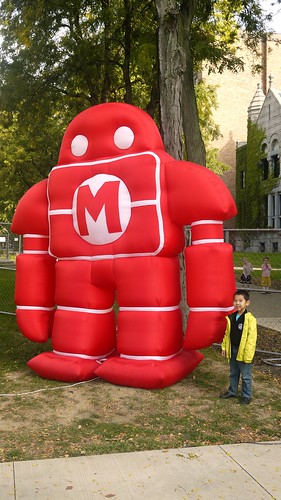 |
| Standing next to Makey at Makerfaire Pittsburgh |
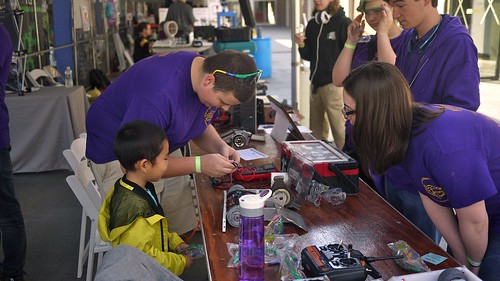 |
| Battlebot being repaired |
One of the advantages to getting there early in the morning is that the crowds have not yet arrived. So he got access to things that would have been hard to do. And being associated with a booth marks him as a fellow maker, who does not just look at things for entertainment but can appreciate hard work and effort to make something work.
|
| Taking apart a battlebot |
 |
| Driving a battlebot |
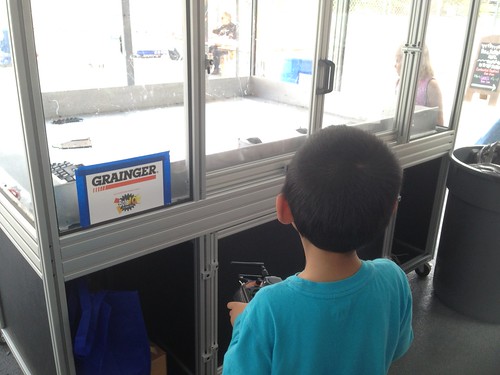
He got to help repair a robot, drive robots, both those that are much like toys and some that definitely were not toys. He did the whole set of crafts set up by schoolchild oriented maker spaces, both low tech and high tech.
|
| Programming the Lego robot to make it across the line. |
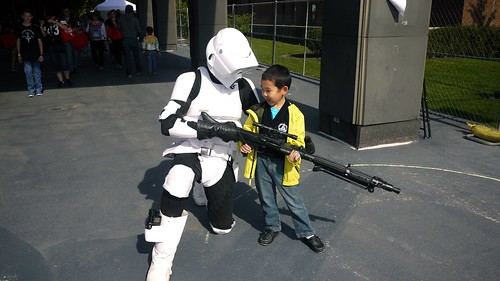 |
| Inspecting a Scout Trooper rifle |
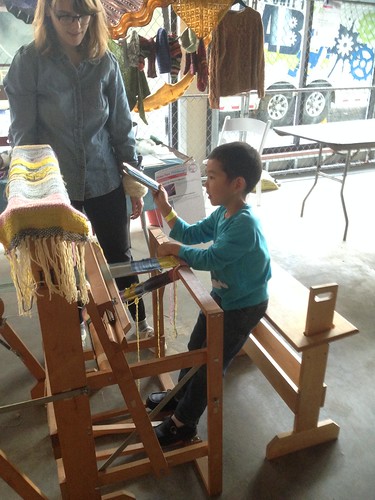 |
| Weaving with a loom |
The point of this gathering is not so much to show off or teach, but to inspire. For everything he sees, he can recognize the precursors, so everything that he touches, is within aspiration, if many years from now.
|
| Demonstrating the fruit piano |
This was our first MakerFaire, but it will not be the last. The Adafruit Circuit Playground fruit piano was something we threw together, next year we will actually think about making this work. And T will have something more polished to show off. And his interactions with the other makers more meaningful.
Friday, October 07, 2016
Parenting month 71: soccer
This month we tried our hand at being soccer parents. T signed up for first-second grade soccer, after we got many rounds of recruitment messages. And not taking part in either spring or summer soccer camps held at the school.
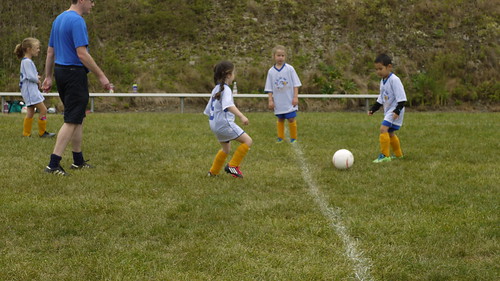 |
| Circle drill |
Well, he has taken part. And when he is in games he runs around happily, but we also noticed that he does not get the ball. Reality is, he has no concept of taking possession of anything, much less in a competitive game.
Someone asked me if he enjoys playing. He enjoys being out there with friends running around, but the actual games are rather lost. What he wants to do is interact with everyone on the field (and which team they are on is not really a consideration). And he is too nice to get the ball when he is fast enough to get to it, pulling up and letting someone else get it. And he has his 'tells' of discomfort, in particular, he will occasionally get into a taekwondo stance while out in the field. Taekwondo forms and curtesy is one of his go-to actions when he is frustrated (much preferred over a tantrum).
So, we don't see this as being a long term thing, especially as he already has a sport (taekwondo) that he enjoys and he is good at (relatively speaking). Were there benefits? Well, he really does not learn teamwork out there, as he never actually has the ball or the opportunity to work with his teammates as teammates. We have had many conversations about keeping commitments (i.e. finishing out the season), and that there are times that you are doing things that you are not interested in, and that we are glad that he keeps up a good attitude when at practice and at games. But all in all, he is looking forward to the end of the season so we can go back to taekwondo and the various activities we used to have on Saturdays.
 |
| At PNC Park for his first Pirates game |
In other news, T went to his first major league baseball Pittsburgh Pirates game. After last month's minor league game, he knew the drill, although there were a lot more people this time, and he did not get to go on the field or interact with the team and mascot.
A has started day care. She cried at drop off and pick up for the first few weeks (but nothing like her big brother, who would cry from drop off to pick up with only breaks for eating). At week 4 she seems to be enjoying it, even having some regular play mates while there.
Next month, first grade ramps up as the assessments that went on the first month are completed and what they cover becomes more tailored.
A has started day care. She cried at drop off and pick up for the first few weeks (but nothing like her big brother, who would cry from drop off to pick up with only breaks for eating). At week 4 she seems to be enjoying it, even having some regular play mates while there.
Next month, first grade ramps up as the assessments that went on the first month are completed and what they cover becomes more tailored.
Saturday, October 01, 2016
The Honor Was Mine: A Look Inside the Struggles of Military Veterans by Elizabeth Heaney: Book Review
 The Honor Was Mine: A Look Inside the Struggles of Military Veterans by Elizabeth Heaney
My rating: 5 of 5 stars
This is the story of a civilian counselor who joined a program to provide off-the-record counseling services at domestic military bases. She spent short term assignments at each base, with the intention that it was part of a portfolio of provided services, attracting members of the military community who would not be willing to engage the more traditional mental health resources that were already available. It is a view of the military that I very much relate to, as I was attached to a deployed unit as a civilian for a similar period of time.
The first chapter starts slow, she talks about the trauma in her life prior to her taking this assignment as a way of resetting her life (and this gets dropped in the rest of the book). But once you get past the first chapter you get into the story. Two themes that permeate are her being a civilian learning her way around the military environment, which sets up the theme of veterans returning from deployment and those around them responding in their different ways.
The first theme is that of a civilian entering the military community and the differences. She tells the story of her first assignment, of encountering military discipline and curtsy first as a shock, but then respect for the stability that it provides. She goes on to what she realizes the purpose of many of attitudes and rhythms of the military. First, the realization that those in the military must be prepared for anything at any time, and military discipline and curtsy is intended to build the attitudes needed to enable that. Second, that there are a range of overall attitudes held by those in the military, with a considerable more diversity than she expected when she was in a civilian life. But one set of values that holds people together is a focus on duty (towards country and each other, not necessarily in that order) and integrity. And the dissonances between those values and what they see in the civilian world (and in what I called Big Army for that matter) causes many of the problems they have in adapting to home.
But what this long discussion of the difficulties she had in getting used to the military culture does is leads to her discussion about the issues that veterans and their families and the problems that veterans who have returned from a combat zone and their families. And she has gone through the same type of struggle in the first chapter with what she dealt with in her life and the reactions of those around her, and dealing with the same culture shift in the other direction. This part is the deepest, she alternates between telling the stories of the people she meets during the course of her assignments and the story of her processing these. Stories of working with the returning soldiers, the transition between combat and their families, soldiers and spouses trying to deal with the uncertainty of life in general and of soldiers returning after a year of combat, spouses worried about infidelity when the returning soldier is still working through the transition between combat and peacetime, of the care that soldiers have of the wounded and fallen brothers (and sisters) in arms.
Through it all, what shows through is her thankfulness that she has seen this part of life, the pride, dedication, and duty to others that permeates the military. And the recognition that this is not the norm in U.S. society at large. In my own experience, I've been told to view the lives of companions as not precious, had offers to refer me to counselors who would tell me that I should have ignored the calls for help from someone in the backcountry. And this contrasting incredibly with being deployed to a combat zone where I was with people who did their duty and tried to do right by those that they were along side. And when I returned, my then girlfriend and I spent a month trying to figure out if I had changed. (and when we were all settled, I figured that I had a good thing going and proposed to her!)
It is a wonderful book. It has a great treatment of PTSD, because it takes the first step of having to experience some of the causes (the need to be constantly aware, the sense that your world and your attitude may have to shift in a heartbeat, and you have to be ready for it, and having to deal with a civilian world that does not generally value duty or integrity) It does not preach, but it gives a set of eyes that had to go through similar experiences and uses that as an analogy into that world.
Note: I received a free electronic copy of this through the Goodreads Giveaways program. The opinions are my own and were not subject to any review.
View all my reviews
Saturday, August 27, 2016
Parenting: Month 70 - A summer vacation ends
So, tomorrow we head back for the back-to-school social. There have been some preliminaries. We were amused to learn at the mommy coffee time (no, I was not there) that T was the subject of some of his K classmates conversations over the summer (T is too internally focused to talk about people whom he has not recently been in contact).
For our first summer since school started, we ended with a trip, and lots of family time. The kids were remarkably happy when on vacation. We think it is all of the constant attention from the parents in addition to all of the novelty. My son still regularly asks when are we going back to the places we went.
Some other summer notables:
Things to come
1. Sports. T is signed up for soccer this year, after much pleading from the school team. Given that he did not take part in the various camps in spring and summer, we are not expecting much. But he may have fun.
2. Taekwondo - T is taking a break, which will allow daddy to catch up somewhat in rank.
3. School. One of T's favorite teachers is not coming back. One thing that we really liked about her was that she let T essentially find his own level, letting him do things well in advanced of grade level in and out of class. It was one of the things that highlighted his Kindergarten year, so we are somewhat apprehensive in how the coming year will work out.
For our first summer since school started, we ended with a trip, and lots of family time. The kids were remarkably happy when on vacation. We think it is all of the constant attention from the parents in addition to all of the novelty. My son still regularly asks when are we going back to the places we went.
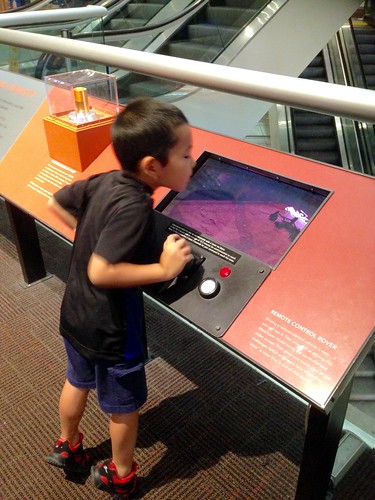 |
| Driving a rover at the Great Lakes Science Center in Cleveland |
Some other summer notables:
1. First baseball game. And completely spoiled, he got to go on the field and take part in a high five line of the home team. He probably thinks that this is normal.
2. Mommy school and daddy school. Mommy school was as expected. Daily piano and chinese. Daddy school still means lots of LEGO, and this summer we added Technic and simple machines. We also had a little Scratch, board games, electronics, and an average of a session (5 problems) of math a week.
3. Grandma and grandpa school turned into a not-success. We are starting to have discipline problems. Given that we pretty much has a free pass on the toddler years with T, it was not going to be that easy forever.
4. A has gone from a little chatterbox babbling along to a little chatterbox that is talking all the time. Usually about something she wants. Alternatively, singing (which is much more entertaining). But there are not very many quiet moments.
4. A has gone from a little chatterbox babbling along to a little chatterbox that is talking all the time. Usually about something she wants. Alternatively, singing (which is much more entertaining). But there are not very many quiet moments.
 |
| High fiving a Washington Wild Things baseball player |
1. Sports. T is signed up for soccer this year, after much pleading from the school team. Given that he did not take part in the various camps in spring and summer, we are not expecting much. But he may have fun.
2. Taekwondo - T is taking a break, which will allow daddy to catch up somewhat in rank.
3. School. One of T's favorite teachers is not coming back. One thing that we really liked about her was that she let T essentially find his own level, letting him do things well in advanced of grade level in and out of class. It was one of the things that highlighted his Kindergarten year, so we are somewhat apprehensive in how the coming year will work out.
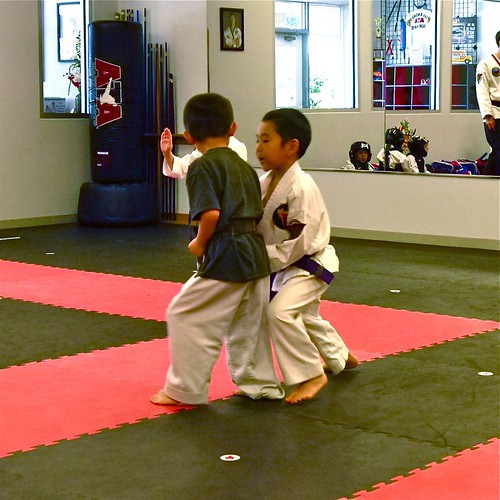 |
| Taekwondo self defense testing |
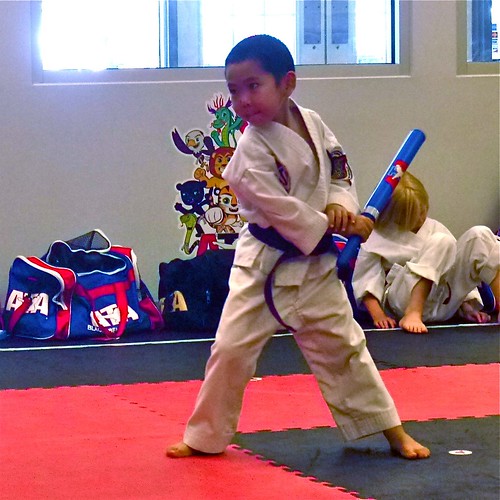 |
| Ba mang ee form |
Thursday, August 04, 2016
Book review: The Three Body Problem by Liu Cixin
 The Three-Body Problem by Liu Cixin
My rating: 4 of 5 stars
The Three body problem is a hard sci-fi novel that is a combination of a detective thriller and a horror story.
The detective thriller is what the main POV character thinks he is in, and how most of the novel reads. The backdrop are top scientists in China suffering strange accidental deaths, and the protagonist having strange results in his experiments. As part of the backdrop, is the cultural revolution. The nature of science means that senior scientists in the present day all had to survive the cultural revolution, and a large part of the story is through a secondary POV character who lived through it, and as the book goes on you see the actions and experiences of those who were were targeted by the cultural revolution, who were the ones who carried out its actions, and who were instigators, then targets. This comes to a head as providing the motivation of several of the key actors in the book.
The horror story has two aspects. One as experienced by the main POV character. Like a good horror story, it is a case of an impending and unstoppable doom that is made known to a generally competent subject, who, for all of his/her knowledge and skills, cannot stop. The second is an online computer game, which initially presents itself as a side line. In the game, the players take I he role within a civilization, which because of its environment is doomed to failure, the players try to understand their environment and build a civilization that can survive and thrive.
The trick to having several parallel story lines is to bring them together naturally. And this is what I experienced in this book. The horror thread that is in the book makes you understand the POV of the characters who experienced the Cultural Revolution as their motivations are revealed. The actions and beliefs of the principle characters make sense. The temptations faced by the main character are definitely there (as he had been courted by both sides that are revealed) and you can see how he could have turned the other way.
I, like most, do not have much exposure to Chinese fiction that deals so directly with the events of the Cultural Revolution, which I have always thought to be a sensitive topic even through i have had informal conversations with those who went through that and the generation of their offspring. It was well worth the time.
View all my reviews
Saturday, July 30, 2016
Parenting Month 69: enrichment
This summer is the first time that we have participated in the suburban parenting practice of (non-school) enrichment activities in earnest. We've noted others in activities started when T was 3, but we always favored grandparent time over putting him in things after school, weekends, or summers. Now that we have a full year of real school behind him, we did enroll him a few activities, piano, a couple of weeks at the natural history museum, and a computing/robotics course (in addition to continuing Tae Kwon Do).
What were the results? In a sense, it should not be necessary, we are regular visitors to the natural history museum and have covered multiple times every corner. We certainly have the expertise for piano in the house, and we could have done computing and robots as well. Why not? In addition to the fact that we have jobs, what we got was interaction with other, older kids (the staff of these camps). I once read that the reason that kids should interact with kids of a range of ages is so they learn how to be bossed around by others, how to boss others, and how to take and give instruction. In addition, T interacted with a wider range of kids. Our first questions after every day were "what did you do?" and "who were you partnered with?"
The other thing that was good was the fact that the economics of summer camps mean that the kids do get more autonomy than the usual school year (otherwise, staff would get overwhelmed with the workload) so what T got was a lot more initiative and curiosity. And more confidence which shows in his playing piano and more exploration in his play.
Yes, we probably could push him further than any enrichment program would in piano, science, programming, math, or robotics; but that is not the goal. The goal is someone who learns how to learn, has curiosity, and enjoys himself along the way. We are skeptical of a lot of the offerings that we have seen, but what T did do, we think went a long way towards this goal.
What were the results? In a sense, it should not be necessary, we are regular visitors to the natural history museum and have covered multiple times every corner. We certainly have the expertise for piano in the house, and we could have done computing and robots as well. Why not? In addition to the fact that we have jobs, what we got was interaction with other, older kids (the staff of these camps). I once read that the reason that kids should interact with kids of a range of ages is so they learn how to be bossed around by others, how to boss others, and how to take and give instruction. In addition, T interacted with a wider range of kids. Our first questions after every day were "what did you do?" and "who were you partnered with?"
The other thing that was good was the fact that the economics of summer camps mean that the kids do get more autonomy than the usual school year (otherwise, staff would get overwhelmed with the workload) so what T got was a lot more initiative and curiosity. And more confidence which shows in his playing piano and more exploration in his play.
Yes, we probably could push him further than any enrichment program would in piano, science, programming, math, or robotics; but that is not the goal. The goal is someone who learns how to learn, has curiosity, and enjoys himself along the way. We are skeptical of a lot of the offerings that we have seen, but what T did do, we think went a long way towards this goal.
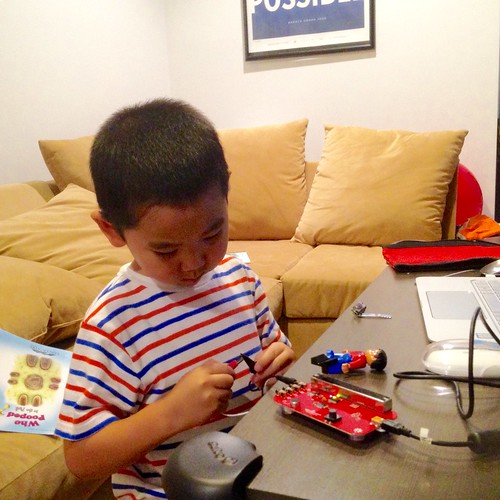 |
| Testing something for conductivity using a Picoboard |
Saturday, July 02, 2016
Parenting month 68: One year of school in the books
And we have survived our first year of Kindergarten! At the beginning of the year we considered this to be the time when as parents are overwhelmingly dominant influence on our child's life is melded with the large amounts of time now spent with school teachers and classmates (not that we are no longer important, but others now play a role). We also find out where he is in comparison with others in all aspects of life.
Things that have changed over the past academic year:
1. His confidence has increased greatly. He had always been uncertain in public, especially when the object of attention. The first area that his confidence grew was in internalizing the curtesies of taekwondo and Catholic school. This became a safe way for him to interact with others. Then, as he grew in confidence that he was competent, and that he could be listened to, he began to be more confident in dealing with others, speaking to people we interact with on a daily basis (like those working at stores, restaurants) or with people he interacts with in activities (like those at the same exhibit as him in museums).
2. His confidence has grown almost too much. He is much willing to interact with others and also to speak his mind and give his opinions (catching up to his peers in this respect). Also, he is less afraid to go off and strike out on his own, which means we need to keep an eye on him to make sure he does not get too far since we cannot rely on his cautiousness to keep him in check anymore.
3. He is much more social. Our shy quiet boy somehow became the one everyone knows at school. Part of it is the notoriety of being the smallest kid in the school (everyone knows who the smallest and who the tallest kids in the school are). And apparently he says hi (or returns 'hi') to pretty much everyone. His other source of notoriety is that he seems to be happy all the time, every day. He is pretty happy by the time we get to school (the wake up sequence is not always so), and after school in the pickup line he is the bouncing bean among the kids waiting for pickup.
4. He is starting to attend to the needs of others. We have been surprised to watch him at play in public settings where he keeps an eye on those smaller than him and tells other kids not to play too rough. I remember watching him at an Easter egg hunt, where after he got his allowed limit he started helping the little kids find eggs.
5. At Taekwondo, he is someone that gives the instructors flexibility when doing paired activities (sparring, self-defense practice, two-person drills). He is good enough to pair with better or most bigger kids (as long as they don't get too wild and run people over, but there are not many of those at his rank), and he does not overwhelm the kids who are less secure in themselves (especially smaller and shy kids. Several of the moms mention that their kids specifically mention liking being paired with T). Not that long ago, he was the smaller and shy kid. When he is in a class of mixed ages, he can be with his own age group (4-6), but if he is the only one, the instructors are comfortable putting him in the next group up (normally, the 4-6 group has simplified combinations and they use 1/2 forms, so putting him in the next group requires more physical coordination and stamina than he is used to).The other nice thing about taekwondo is that his teachers are deliberately harder on him than other kids of his age and experience, meaning they do not let him get away with sloppiness when they know he can do better.
6. Over-confidence pt 2. He takes advantage of the fact that he can read (and most kindergarteners cannot do so effectively). His teachers report that he has taken to reading the instructions for activities instead of waiting for the teachers to read the instructions for everyone. The effect is that he is done with the activity before everyone else has started. This causes problems because it means he is not practicing listening to instructions from the teachers. It also means he gets bored because he has nothing to do when everyone else is doing the activity.
7. Ahead academically. The school he goes to has one member of the staff who does not really believe that kids differentiate early. One time she was visiting a class and she noted that T was going through an exercise very smoothly. His teacher noted that it was easy for him, because "it was only first grade material."
Our major concern for the future. We know a lot of kids who are very bright, their parents report that they find their school exercises very easy, who have lost their ability to handle difficulty or correction. Many research articles suggest that part of the issue is that they have a lot of feedback from school and other settings saying they are good and smart, so they resist hearing it from parents or others who suggest that they are not attaining mastery without effort. On our end, we are trying to nip this early. We make sure he is challenged at least some of the time with reading (if he reads with us, it is material that stretches him), our math activities are selected from a source designed to focus on thinking (by using material they are very unlikely to learn in school). And it is very easy to make sure his piano and taekwondo are pushing him at all times. My way of wording our goal is that we try to make sure he is challenged, but he can still succeed (if he does not give up along the way). For the school, they are instituting a framework for kids to move ahead in reading (individualized reading based on standardized test results), and they are looking at ways to do something similar in math.
Our other major concern is about the areas he is not strong in, how much should we care? He is still adverse to public performance (a major concern of mommy, who is a concert pianist) and he is not always self-assertive (although this may be due to a lack of desires to assert for). He will probably always be among the smallest of his grade, which makes contact team sports problematic. And there is a cultural thing about not being better than peers, which has an implication we should not let him move forward where he is capable of doing so.
Things that have changed over the past academic year:
1. His confidence has increased greatly. He had always been uncertain in public, especially when the object of attention. The first area that his confidence grew was in internalizing the curtesies of taekwondo and Catholic school. This became a safe way for him to interact with others. Then, as he grew in confidence that he was competent, and that he could be listened to, he began to be more confident in dealing with others, speaking to people we interact with on a daily basis (like those working at stores, restaurants) or with people he interacts with in activities (like those at the same exhibit as him in museums).
2. His confidence has grown almost too much. He is much willing to interact with others and also to speak his mind and give his opinions (catching up to his peers in this respect). Also, he is less afraid to go off and strike out on his own, which means we need to keep an eye on him to make sure he does not get too far since we cannot rely on his cautiousness to keep him in check anymore.
3. He is much more social. Our shy quiet boy somehow became the one everyone knows at school. Part of it is the notoriety of being the smallest kid in the school (everyone knows who the smallest and who the tallest kids in the school are). And apparently he says hi (or returns 'hi') to pretty much everyone. His other source of notoriety is that he seems to be happy all the time, every day. He is pretty happy by the time we get to school (the wake up sequence is not always so), and after school in the pickup line he is the bouncing bean among the kids waiting for pickup.
4. He is starting to attend to the needs of others. We have been surprised to watch him at play in public settings where he keeps an eye on those smaller than him and tells other kids not to play too rough. I remember watching him at an Easter egg hunt, where after he got his allowed limit he started helping the little kids find eggs.
5. At Taekwondo, he is someone that gives the instructors flexibility when doing paired activities (sparring, self-defense practice, two-person drills). He is good enough to pair with better or most bigger kids (as long as they don't get too wild and run people over, but there are not many of those at his rank), and he does not overwhelm the kids who are less secure in themselves (especially smaller and shy kids. Several of the moms mention that their kids specifically mention liking being paired with T). Not that long ago, he was the smaller and shy kid. When he is in a class of mixed ages, he can be with his own age group (4-6), but if he is the only one, the instructors are comfortable putting him in the next group up (normally, the 4-6 group has simplified combinations and they use 1/2 forms, so putting him in the next group requires more physical coordination and stamina than he is used to).The other nice thing about taekwondo is that his teachers are deliberately harder on him than other kids of his age and experience, meaning they do not let him get away with sloppiness when they know he can do better.
6. Over-confidence pt 2. He takes advantage of the fact that he can read (and most kindergarteners cannot do so effectively). His teachers report that he has taken to reading the instructions for activities instead of waiting for the teachers to read the instructions for everyone. The effect is that he is done with the activity before everyone else has started. This causes problems because it means he is not practicing listening to instructions from the teachers. It also means he gets bored because he has nothing to do when everyone else is doing the activity.
7. Ahead academically. The school he goes to has one member of the staff who does not really believe that kids differentiate early. One time she was visiting a class and she noted that T was going through an exercise very smoothly. His teacher noted that it was easy for him, because "it was only first grade material."
Our major concern for the future. We know a lot of kids who are very bright, their parents report that they find their school exercises very easy, who have lost their ability to handle difficulty or correction. Many research articles suggest that part of the issue is that they have a lot of feedback from school and other settings saying they are good and smart, so they resist hearing it from parents or others who suggest that they are not attaining mastery without effort. On our end, we are trying to nip this early. We make sure he is challenged at least some of the time with reading (if he reads with us, it is material that stretches him), our math activities are selected from a source designed to focus on thinking (by using material they are very unlikely to learn in school). And it is very easy to make sure his piano and taekwondo are pushing him at all times. My way of wording our goal is that we try to make sure he is challenged, but he can still succeed (if he does not give up along the way). For the school, they are instituting a framework for kids to move ahead in reading (individualized reading based on standardized test results), and they are looking at ways to do something similar in math.
Our other major concern is about the areas he is not strong in, how much should we care? He is still adverse to public performance (a major concern of mommy, who is a concert pianist) and he is not always self-assertive (although this may be due to a lack of desires to assert for). He will probably always be among the smallest of his grade, which makes contact team sports problematic. And there is a cultural thing about not being better than peers, which has an implication we should not let him move forward where he is capable of doing so.
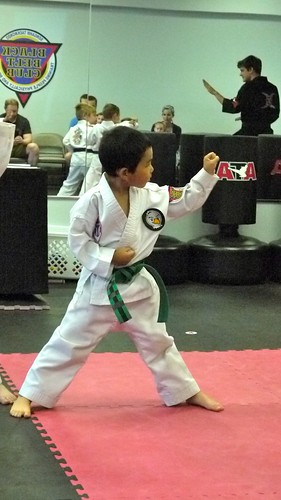 |
| Double forearm block as part of his ATA Taekwondo poomsae |
Subscribe to:
Posts (Atom)