Wednesday, November 14, 2007

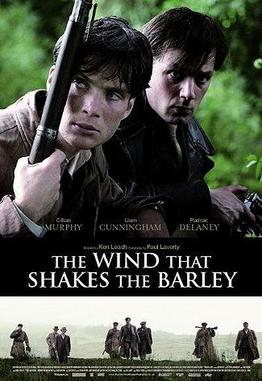
Movie Review: The Wind that Shakes the Barley (2006)


IMDB link
Wikipedia


This is a movie that is set during the Irish War for Independence and the Irish Civil War that follows. It follows two brothers, Damian and Teddy in County Cork.

The movie shows the brutality of the British occupation, with the paras (paramilitary) Black & Tans terrorizing the countryside looking for Republicans (Irish Republican Army) and the effect of this, namely outraged irishmen signing up for the IRA. There is the brutality of the British occupation, and the terrorism of the IRA against those irish who were suspected to cooporate with the British. In it all, Damian (who was going to study to be a doctor before witnessing the needless killing of a friend and the beating of a rail engineer) openly observes his character changing, to the point where he executes a childhood friend as a collaborator.

The violence and brutality make the war personal for many. And after independence is granted, the movie moves on to the next stage of the Irish suffering, the Irish Civil war, fought because some, like Damian, wanted a complete break with Great Britain, not just being a republic in the commonwealth.

And you see Ireland cry in the eyes of the priests who watch a country they had prayed for borne, and shatter from within. And like other civil wars, pits brother against brother.

You ask, what is it that drives men to go to war? What are the ideals that drive them to kill, not just the strangers and outsiders, but those they have known and even fought alongside. During the sections on the Irish Civil War, you see scenes that repeated those of the war for independence. And it seems senseless in this era where the hand of Great Britain lies very lightly on the commonwealth (to this the Canucks, Aussies and Kiwis would laugh at the idea that the British yoke is heavy), but back then the passions of the people were high. And you go away sad at the senselessness of the civil war, for the cause of the perfect instead of the good.

Saturday, November 10, 2007

Open source develop: assertAlmostEqual

I've been working on a project at work while using Python/Jython. And I'm using unittesting to drive and test the development along the way. Because I deal with things like real data, the usual assertEqual runs into problems when you use floating point computation, because you just don't test for equality in floating point. To much potential for rounding errors at the 20th digit or some other insignificant problem. So you need to use assertAlmostEqual.

And everything is working fine, until I try to run my tests in Jython. And then all my floating point tests start to fail, because assertAlmostEqual does not exist. So, did I spell it wrong, but it worked under normal Python. So a quick google search reveals that assertAlmostEqual was added a bit later, so it was not in Python 2.2 (which Jython is written against). And there is a newsgroup posting in the Python-checkins list about the adding of assertAlmostEqual to the PyUnit testing library (which is what I use for my unit tests).

http://mail.python.org/pipermail/python-checkins/2002-December/032079.html
Sat, 28 Dec 2002 22:11:50 -0600
[Python-checkins] python/nondist/sandbox/twister test_random.py,1.1,1.2

Raymond> To accomodate single precision platforms, only test to seven
Raymond> digits.

The SciPy folks have added an assertAlmostEqual method to their unit tests.
I believe it more-or-less just wraps what you've done in a callable method
(which takes a number of digits of precision). Might be a good idea to add
something like it to unittest.py so the wheel doesn't keep getting
reinvented. They actually have a few variants, coded as functions here:


http://www.scipy.org/site_content/remap?rmurl=http%3A//scipy.net/cgi-bin/viewcvsx.cgi/scipy/scipy_test/testing.py

Skip
Ok. That explains that. But something else looks oddly familiar. I remember doing something with SciPy around the same time
.

http://projects.scipy.org/pipermail/scipy-user/2002-January/008545.html

Sun Jan 20 21:38:03 CST 2002
[SciPy-user] unittests for scipy.stats: assert_almost_equal question
Hmmm, I think that I would like to be testing in terms of
significant digits as opposed to decimal places, especially when
working with floating point. Since you are asking for such a test,
here it is. The attached file has a function meant to go into the
scipy_test.py module. I wrote assert_approx_equal following the
same form as assert_almost_equal
assert_approx_equal(actual,desired,significant=7,err_msg='',verbose=1):
compares 'actual' and 'desired' and determines the first
'significant' significant digits and checks for accuracy. Let's
see, I think I counted significant digits correctly. Can anyone
tell?

Louis
> From: "eric"
> To: <scipy-user at scipy.org>
> Subject: Re: [SciPy-user] unittests for scipy.stats:
> assert_almost_equal question
> Date: Sun, 20 Jan 2002 05:36:31 -0500
> Organization: enthought
> Reply-To: scipy-user at scipy.net
>
> Hey Louis,
>
> A thousand blessing upon you. I immediately commited it to the
> CVS!
>
Oh, now I know why this problem looks so familiar. Way back when I was a grad student, I was trying to test some functions. And I ran into the problem about unittesting floating point. So I wrote unittest code to test floating point in SciPy. And it was added to SciPy. And the main Python language developers noticed (since those folks looked to the SciPy/Numpy folks about all things numerical computation related) and added it to the main language. And here I am, five years later, taking advantage of something I did as a grad student.

Add to reasons for "why contribute to open source programming" story.

Wednesday, November 07, 2007

Computer development platform Part 2

Last month I started working on a model development aspect of a project. And I figured I'd take the time to learn the use of a new toolkit for programming. An update.

I had a project meeting yesterday that went very well. The approach was sound. The work on the model that I've done already has uncovered issues that have not been addressed by prior work, and this is going to lead to major policy recommendations. All the things that a model developer hopes will happen.

In addition, discussion uncovered some details in the system being modeled that I did not realize (helps when multiple heads get together to tease details out). And we are talking deployment when all is said and done. So, I have a few issues:
  1. The business logic of the model needs to be modified to handle my improved understanding of the process.
  2. A number of additional scenarios need to be considered, preferably without breaking anything else.
  3. The whole thing needs to be deployable. And that usually means MS Excel, a Visual Basic application, or Java (because these are things that can be sent to any computer without much trouble)
Number 3 leads to an additional complication. I've been developing the whole thing in Python, using Eclipse. I'm going to decide that for deployment, I will convert the whole thing to Jython, since that makes it deployable on a Java Virtual Machine (and everyone has Java installed). But Python is at version 2.5, while Jython is at version 2.2, so it is a couple years behind.

Well, this whole thing just screams out, unit testing. As it turns out, I've separated the building block objects from the business logic portions and the database access, which makes the whole thing easier. So, I build my test suite in PyUnit that takes the specifications and builds the model. Then the fun starts.
  1. I was still working on the business logic that allocates resources. It was messy, but it did provide output. So I wrote test cases that tested discrete stages along the way and rewrote the logic into smaller functions.
  2. Converting to Jython broke some functions, because newer versions of Python had some features that were not in Jython (some forms of introspection). So, I had to rewrite these so they worked under the older language specification, without breaking my test cases.
  3. Next on the list, write test cases that implement some of the newly described scenarios, and make them work.
Some of this involved serious work. In particular, rewriting the code to version 2.2 vs. 2.5. Right before I did this, I did a commit to version control (Subversion) just in case I completely messed up. The IDE also helps alot since it takes care of version control, checking Python and Jython, and running the unit tests.

A very productive day. I almost think that I'm getting the hang of this programming stuff.

Tuesday, November 06, 2007

Cold Brew Coffee: Attempt # 1

My fiancee was complaining about coffee withdrawal. And one thing we share is a love for good coffee. But doctor's orders. But I half remember that there is a way to make less acidic coffee. And a bit of research revealed cold brew coffee.

The basic premise is the acids and oils are extracted from the coffee bean by the hot water in the brewing process. But cold water will still extract the coffee flavor, without the acids and oils. It just takes a little longer. Like hours instead of minutes. Now, you could buy the Toddy system (created by a guy named Tod) that does this. But that just seems silly. So I figured I'd use my french press for this. Because that is what a french press does, allow ground coffee to soak in water. And I could sacrifice use of my french press for a day. After all, it is going for a good cause.

1. Grind coffee on coarse (i.e. French Press style) for 6 cups worth. I was using Agate Pass Blend from Grounds for Change (a medium-roast bean)
2. Add 1/3 of the ground coffee to the French Press. Add water and ensure that the ground coffee is soaking (i.e. not clumping). Wait 5 minutes
3. Repeat (2). Wait 5 minutes and repeat again with the remainder of the coffee and fill the French Press beaker. If needed, mix gently to ensure the coffee is soaking.
4. Cover press and set aside at room temperature. Time 8:38 AM.
5. Time 10:30 PM. Use French press to separate out the grounds. Pour coffee concentrate into Lexan bottle. Yields 700 ml of concentrate. Refridgerate (for storage. If this was morning, I would have a cup and store the remainder.)

First batch of cold brew coffee

The next morning I made myself two test cups of coffee. The first cup was done at 1 part coffee to 2 parts water (that had been brought to a boil.)

Cold brew coffee 1 to 2

It was ok. Like normal drip coffee (which I find to be weak).

So next I tried again, at 1 part coffee to 1 part water.

Cold brew 1 to 1

Well, this did taste ok. But a bit cold. Next time I should heat up the coffee concentrate first, to make it warmer.

Trial #2


So, after delivering batch #1, try again. This time I set the grinder on a setting halfway between what I use for drip and what I use for French Press.

Brew from 6:00 PM to 7:15 AM. Since it is a finer grind, pour the concentrate through a filter to strain out the silt. This time I filled the French Press up a bit higher so it yielded 800 ml of concentrate.

Prepare at 1 to 1, first microwaving the concentrate before adding the hot water.

It is a decent cup of coffee. Very smooth. Not as flavorful as I would like, but that is probably because of the oils and acids not being in the coffee.

Supposedly, cold brewing coffee yields 1/3 the acidity of drip coffee and people whose stomachs are affected by drip coffee can take this. Hopefully the customer is happy.

Monday, November 05, 2007

In the Company of Soldiers by Rick Atkinson

Rick Atkinson is a historian, who sometimes works for the Washington Post. He took a break from writing his WWII trilogy to be embedded with the U.S. 101 Airborne Division with then Major General Petraeus during the U.S. led invasion of Iraq during 2003.

It is an engrossing picture of a military commander in the midst of a war. The emphasis on logistics (his subordinate commands have to deal with tactics). All the little things that need to be ready. The things that an army prepares out of practicality, even when the political leadership says something completely different (e.g. grappling hooks, battering rams and ladders for urban fighting, when the political and military leadership tells all the U.S. Army does not fight in cities).

When the actual fighting starts, you soon realize that the shooting is elsewhere while the commanders are dealing with other aspects of reality. The maintenance of equipment. The changing and unexpected tactics of the opponents (there is a precious vignette that surrounds General Wallace's quote "this is not the enemy that we wargamed against", and the many generals who said they needed many more troops to do the job right. Both were severely chastized by the political leadership. Both were viewed by those with experience in war as being straightforward and open.) Having to deal with details great and small, unexpected events, the plans of the enemy, and the pressures of a national leadership that may or may not be aware of reality.

It is easy to forget that the senior leadership in war are men themselves. The myriad of details is something impossible to comprehend, and the genius of those who can put it all in their heads, even with the assistance of an able staff, is intimidating to behold. "In the Company of Soldiers" does this well. Not a beatification, but a portrait of a man and an army at war.

Thursday, November 01, 2007

Beauchamp and the Rule of Second Chances: Pass it Along

At Michael Yon

A few months ago a soldier wrote an article for The New Republic about his ongoing experiences as a soldier in Iraq. He wrote about the activities of his unit. And it was full of stories of how sadistic, cruel, uncaring they had become while deployed to war in Iraq. And for those soldiers who did not become sadistic, how apathetic they became to the violence and depravity around them. Almost like a Hollywood movie about Vietnam with all the expected stereotypes and more. And, as it turned out, completely untrue. Essentially, this soldier wrote the story, and as the editors understanding of war essentially came from Hollywood movies about the Vietnam war, the fact checking was rather spurious.

Now, as the article came out in a prominent forum, the real fact checking began. And in addition to the fact that the stories were false, one other fact that came out was the writer's name. And his unit.

So now we have a problem. Here is a soldier in a combat zone. And he has written an article in a major national magazine that depicts his fellow soldiers as a group of depraved psychopaths. Back in the states, there are individuals writing on internet message boards that he should be punished. Severely. The wolves were calling out for blood. And he is surrounded by the people whom he dragged through the mud. And they all have guns. And they regularly see combat.

So, his company commander gives him a choice. Does he want to transfer. And his commander tells him something else. He is welcome to stay. And he did so.

No doubt there was some awkwardness there. A soldier having to face people whom he had publicly painted as cruel dimwits, when none of the events he described. And it probably was not a pretty thing, of going to battle with people whose relationship is, well, not the best. But there are other realities here. And part of this is the nature of war.

As a society, we (Americans) are generally not a forgiving bunch. Our churches, which like to use words like 'grace' and 'reconciliation' feel free to throw people away (at least the churches I've been to) and forget them as if they did not exist. Our polity is one where perceptions replace truth. And many things are unforgivable. Where disputes are solved by demonizing.

But when life and death is at stake, there is another principle. You have to be able to trust that the person next to you will sacrifice on your behalf. Because you depend on them for your life. And you realize that person, just by being there, also depends on you for theirs. And there are many other things like this, even in non-lethal environments. The fact that there is a common goal overcomes mistakes.

Part of the way we have changes is the separation of our lives from reality. As a society, we have valued a buffer between ourselves and the world, and attempted to insulate ourselves from the pain, hurt, suffering. And along the way sacrifice, trust, and caring for one another have gone as well. There is a saying "no good deed goes unpunished." and a reality that those who would consider helping others, are told that to save a life, is to put your future at risk, and that it is better to turn away from the one in danger, and leave them to their own devices.

With this soldier, for all he has done wrong, there is an understanding that he is there. He still goes out into harms way, alongside others that he is trusting his life with. And they are trusting their lives with him. There may be no way to "pay" for his mistakes. But he is still a comrade in arms. And a very different reaction then "pulling out the hanging rope" for every mistake. It is a different attitude. One of the things observed with the number of soldiers who are coming back from Iraq and Afghanistan, there is now a large pool of people who are Heinlein's human being.

A human being should be able to change a diaper, plan an invasion, butcher a hog, conn a ship, design a building, write a sonnet, balance accounts, build a wall, set a bone, comfort the dying, take orders, give orders, cooperate, act alone, solve equations, analyze a new problem, pitch manure, program a computer, cook a tasty meal, fight efficiently, die gallantly. Specialization is for insects.

So the question, are these enough people who can change a society by their presence? People who are not as self-absorbed, self-righteous, insulating themselves from their environment and others in their faux self-reliance that American society has become. Or will these returning soldiers become examples of people who remember what it is like to stand alongside people from all walks of life, and to depend on one another to succeed and survive.
Monday, October 22, 2007

What I did last Saturday

AKA the engagement story

Lighted sentinals


I'm given to understand there is a much better story teller who may be available to you. But, here is my version.

1. Morning - Woken up at 5:00 AM to go to a house fire on the South Side. And by the time I get to the Red Cross, I find out there was a second fire on the North Side. Go and perform damage assessment, case work with clients, and get home around 9:00 AM, and go to bed.

2. Woke up, again, around 12 Noon. Afternoon was with S at a house warming party of a former neighbor of mine (Hi R and T). We ate real well, with home cooked Thai food that I have not had in years. And there were lots of kids running around (they ranged from 21 months to 6 years, yes, they were running). I cooked an apple cobbler for dessert. S played the piano (very happy piano).

3. After being stuffed with Thai food, we went to Phipps Conservatory, where we went to the Chihuly exhibit (glass sculptures in garden [ok, I'll skip some not so necessary details, but the blog post is titled "What I did last Saturday"]). It was open that evening because, well, Chihuly glass sculptures that are lit a night in a gardenare rather romantic-y sort of things, so gardens can make a lot of money with all the couples who like going on walks in lit gardens with beautiful glass sculptures around. Or so I am led to understand (I'm a member, got to understand these things.)

4. When we were done, there was this one sculpture that I suggested might look real nice close up, which would require going outside. Where there was a very handy bench that looked into the proper window.

5. And, yes, said sculpture looked very nice. And I asked S if she would marry me. And I gave her a certain ring that I had in my pocket. Which also looked very nice.

6. Oh, she did say "yes"

Congratulations on making it to the end. And thanks for reading.

Sunday, October 21, 2007

I wonder if anyone reads this


Something shiny given away
Originally uploaded by LugerLA
If so, this may be interesting news (understanding that reasonable people may disagree). Anyway, as of last week, S and I are engaged.

Saturday, October 20, 2007

The Utility of Force: The Art of War in the Modern World by Rupert Smith

Amazon.com link

General Rupert Smith (UK, Ret.) wrote this after reflection on 40 years of service, including UN duty in the Balkans. The theme of the book is that the nature of conflict has changed, and those who think about the use of national power (diplomatic, information, military, economic). Smith identifies 6 major trends:

- The ends for which we fight are changing
- We fight amongst the people
- Our conflicts tend to be timeless
- We fight so as not to lose the force
- On each occasion new uses are found for old weapons
- The sides are mostly non-state

As he discusses the evolution of modern conflict, and the information(media) and intelligence focus (as opposed to purely physical) of future conflict, he has as a backdrop the United Nations intervention in the Balkans during the 1990s. And the ineffectiveness of the UN forces there, culminating in the massacre of 7,000+ Bosnians by the Serbs in the "safe area" of Srebrenica. Smith points out that the UN members essentially employed a tactic (use of blocking forces) to counter a strategy (Serbian desire to dominate the Balkans) and the Serbians used a wide range of means (propaganda, military, diplomatic) to make the UN military forces irrelevant.

Smith is mostly documenting a problem, one that he views as difficult, and something for U.S. and western nations need to deal with. Because as long as there is a desire to have a world that is not full of the arbitrary violence, ethnic massacres, generators of hate, the west and those that have allied with them will ask their militaries and other instruments of power to enter these parts of the world. And these militaries will have to learn how to operate in these settings. Smith's challenge is that they be sent in a thoughtful way, that the ends are considered with the quality, quantity and purpose of the forces made appropriate to the ends desired. And just how you decide this, are lessons yet to be learned.

This is not an easy book to read. Every passage is meant to be read, then the consequences of every idea thought through. Even the descriptions of historical events have to be mulled in consideration of many facets and the environment around them. But the reader is rewarded with many considerations of thought and issues to debate. And a context for reading anything else in this subject area.

Thursday, October 18, 2007

Why is the use of anthropology a contentious issue?

From an Anthropological Perspective

There has been a debate that has been going on for years among social scientist, in particular anthropologists. Should anthropologists cooperate with the military (or any other government organization for that matter)? The negative side points out that anthropology was created as a colonial tool (to put it bluntly) and that as a discipline, they should repudiate all such work. The affirmative side argues (1) pretty much everything in applied anthropology causes effects on the society examine, whether on behalf of corporate interests, or non-profit (whose motives don't always look much more noble then the colonial white-man's-burden) (2) the negative side seems to imply that anthropology should not be used to mitigate or prevent cultural damage. If they can't do that, what is the use of anthropology (other than for corporations to exploit people or non-profits to manipulate a society)? I'm being slightly simplistic here. The link provides a much more nuanced view. Searches for 'anthropology' and 'military' should find articles in the New York Times, the BBC and various anthropology and military sites.

In one sense, the issue is somewhat moot. The military (at least the American tradition) is bound to fill the mission given to it by its civilian leaders. If accomplishing that mission is best done by having people study the society that exists in the environment to avoid the use of destructive force when it can be avoided, the military would do so. Whether or not people who have the word "anthropologist" in their resumes are involved is quite irrelevant. Even if it would make things easier if there were some at hand. (if not, the military will make do with who they can find who is available.)

There is a bigger question on the anthropologists side. What is the role and substance of ethics? Is ethics an avoidance of labels that don't sound nice? Is ethics a list of "thou shalt nots." Are both the ends and the means irrelevant, if the perceived "ultimate end" is "wrong" (the quotes are because the "ultimate end" and "wrong" are not as defined by the doer, but by an uninvolved party who has noone's interests in mind, namely the anthropological profession, which is divided.)

In general, this is probably the problem with ethics, especially as practiced in non-practitioner settings. Ethics tends to be discussed as what is wrong, not what should be done. In other words, what not to do. And the principles that are seized on to decide the what not to do become absolute and definitive. To the exclusion of all others. Including human life. In my interaction, people will hold to these principles even when the life that is to be lost has been identified (which is the case here as well.)

For many professions, the focus of training is on what (and how) to do. In an environment where everything is focused on acting, negatively based ethics quickly becomes irrelevant. (i.e. the U.S. Army will study the cultures it works among to determine non-destructive ways of solving conflict, regardless of the collective decision of the anthropological community.) And the members of the academic disciplines that would prefer to actual engage their world for positive ends, rather than withdraw to avoid breaking rules, or look for areas of activity that are not addressed (such as social anthropology by marketers and advertising), are faced with professional isolation, or creating a new profession.

Friday, October 12, 2007

and at night you become a superhero - and other quotes

I spent the last weekend doing a lot of emergency service work, both as a ham radio operator at the Head of the Ohio and for a Red Cross exercise. Some quotes:

"Next time there is someone who is vitally important to the running of the whole show and she refuses a shadow, give her one anyway."

Me: "Hi. I'm your shadow. Your not allowed to get lost anymore."

Me: "You are going to sit down, under a tent, in the shadow, and I am going to watch you drink this bottle of water and eat a protein bar." (at 3PM, on a very hot day)

"I told them that they needed to turn around, and they started telling me how the river was free for everyone. Then I told them that is ok, and the Coast Guard will be coming by to talk to them. They said, 'The Coast Guard?!' Yes, the same U.S. Coast Guard that issues your licenses and put up the Notice To Mariners that is on your marina board saying that the river is closed today, and has been broadcasting messages on Marine Radio every half hour telling you that the river is closed. And they are coming to you."

Coast Guard: "Oh, we saw them. And we stopped to chat. And they were very agreeable."

Coast Guard: "I think we will go over there and say hi. And discourage anyone from heading in the river too fast."

Actress playing resident who was not quite all there and was trying to 'escape': "I want to go for a walk."
Me: "Oh fun, I want to go for a walk with you. Over here is a go outside for a walk place (pointing at a door that led to a courtyard, that was not out)"
Actress: "Oh, you're no fun. I can't even be mean to you."

Actress from a previous exercise: "Hi, remember me?"
Later in the day: "I'm hurt, you were avoiding me all day."

Disaster volunteer: "I work in marketing, it is so boring."
Me: "So then at night you put on your Red Cross shirt and become a superhero."
Volunteer: "I should show you what my phone says. 'Wonder Woman'"

Monday, October 08, 2007

[Chicago Tribune] Man dies in heat-shortened (Chicago) marathon

Chicago Tribune article

My sister sent me a text message yesterday letting me know that the Chicago Marathon was shortened. Other than my general interest in running marathons, I did try to enter this one back in May, but it was already full.

So, the issues, other then the obvious. Actually, one person dieing is not enough cancel an event like this. Or even to dissuade potential participants. People participate in physical events because of the harsh reality that they represent. Most people live in worlds that are governed by perception, not reality. Activities in the physical world such as running, bicycling, backpacking, etc. are a forum where reality and truth are incontestable, and the laws of the natural world provide a court that is often without appeal. And the grim fact is, you need to acknowledge this on the course. (this does not really apply to school athletic teams. For high schools and colleges, part of what the kids are learning are these very limits, and coaches are supposed to be teaching this, and about other aspects of the realities of life.) Those who can't or won't acknowledge this, suffer and sometimes die.

But the bigger issue is what is going on outside the race. Reports are that 315 runners were removed by EMTs for heat-related conditions, and 146 people were taken to hospitals. That many hospitalizations due to a single event is known as a disaster. The American Red Cross of Greater Chicago activated the patient connection program, which is usually done for major disasters. And realizing that it was going to get worse, as the morning went into early afternoon, turning off the clocks and telling people to walk was acknowledging reality as emergency rooms throughout the city and suburbs took in patients.

No doubt that this as well as the Rotterdam (?) marathon that were cut short earlier this year will be case studies for all those who organize these types of events. One thing I've been learning as I get older, and see these events from the points of view of participant, organizer, emergency support, communications, etc. is seeing how all these different priorities are balanced out. And how people make tough decisions.

Book Review: Usagi Yojimbo - Fathers and Sons

(written at Goodreads: Amazon link)
The hero, Usagi, is a ronin (unattached samurai) in a historical Japan after the great wars. As such, he is in the midst of a time of change, which much conflict, but most of it is not in the open. The social order is changing, and Usagi is finding his place in it. Along the way, he is joined by his son, Jotaro. But Jotaro does not realize he is Usagi's son, and knows Usagi as an uncle.

In this volume and volume 18 they travel through Japan to Jotaro's new teacher (who was Usagi's teacher). Along the way they meet many of Usagi's friends, encounter those who are also trying to carve out places for themselves in a new Japanese society (some of them through intimidation and violence), and other fathers, who are also trying to provide for and teach their sons the ways of the world and their place in it. One recurring bit of amusement occurs when Usagi's friends and others that encounter them along the way identify Jotaro as Usagi's son, even as they are introduced to Jotaro as a nephew, as they observe how they interact with each other.

Stan Sakai creates an engaging world with characters that are rich in motivation and backgrounds. Many lessons are taught and learned. Many mistakes are made, and there is even nobility and courage. And when you are done, you wish them well, those that continue their journey, and those that are left behind.

There is a strain of the arts that presents the purpose of the arts is to present the human condition, in its richness, grandeur, and in the mundane. And this is a fine example of this.

Saturday, October 06, 2007

Shadowing The Head of the Ohio

The Head of the Ohio (HOTO) was this past Saturday. (Hi Jonathan) Like the other Head of . . . races, it is the capstone of the rowing season for Pittsburgh, and probably the biggest event of the year. In Pittsburgh, the main sponsoring organization seems to the be the Three Rivers Rowing Association. I was there as amateur (ham) radio support to the race organizers, and I was shadowing the volunteer coordinator. Regattas like this all have a similar structure. Most people thing of these as intercollegiate (or even high school) events, because most of us get exposed to this because of our college friends who row crew. But these are bigger. Unlike most sporting events, the Head of . . . series are a lot more then one division. There are high school, collegiate, and club teams competing (each in their own division) and they do it together.

There are lots of sports/activities that make claim to being like family. This bunch has as good a claim as any, as you see an entire cross section of ages at these. The high school and college students (like you expect), the high school parents, but you also get the adults who row who like to race. And their families (both younger generation and older generation.) the result is even the high school kids get to see a whole community of people, all taking part in the same activity at various levels. And these people have been around each other for years (especially the club rowers), so the usual high school athlete parent gets integrated with a large community that his/her child is being brought up into, a community of adults the child can respect on many levels, and all eager to be present as they mature.

So what do you see at such things? With such a cross section of people, engaging each other in a very public place, a wide range. In addition to the usual frustrations and joy of working with a wide range of people in a big event, you see generosity, selfishness, grace under pressure, people cracking under pressure, the range of motivations, courtesy, response to discourtesy, deciding what battles to fight, and which ones not to. How to influence others without using authority. How to use authority wisely (and effectively). A whole host of lessons. Both for the kids, and for the not very old (like me) to learn. And many people who are hoping we (including me) learn them, so as we take our places in the community, we are able to take their places.

This was my second event as part of Amateur Radio Emergency Services (ARES). And this was the classic scenario. Radio operator shadows official, provides multi-modal communications between official and others, sometimes when other modes are not operational. There were various fires (metaphoric) to be put out. Minor crisis. And one medical. Oh, and a couple older hams who could explain what they did, how they did it, and a bit of institutional knowledge that comes from doing things over years. And yes, there are a couple roles that I could be playing in that community in the years to come, if I stick around and get more training and experience. These are people who know how to look into the future.

Wednesday, October 03, 2007

Computer development platform

Well, I've started modeling work on a project at work. So far it has been data gathering planning (what kind of data do we need) and asking lots of questions about the system I'm trying to model. And, while that is not over, now that I'm back in Pittsburgh, time to get started. Right now, I'm actually doing the "make the first one to throw away" thing. Because this is so amorphous, I'm not sure just how to solve this just yet anyway. I told the project manager this, and he actually likes the idea as a risk management principle. (because version 2 is supposed to be deployable, let's just forget about that until I have a model that works, then worry about making it deployable)

Now, a lot of this is the fact that I'm working in a domain that not too many modelers have gone in. Slides that I've built for presentations in the past have gotten real good reception, as people who have seen this get the idea, and the possible impact. Of course now I have to deliver.

Since I get to work on that most idealized of environments, clean slate and zero previous work to build on, I thought I would actually try to do things right. And take the opportunity to build up a new tool chest. For now, documentation is in LaTeX, with Dia to build up flow charts and UMLish diagrams. I'm reading Head First Design Patterns by Freeman and Freeman, and some ideas have gotten in my head.

For the model building, there is an idea in the back of my head that deployment will be inside MS Excel and Visual Basic (because everything quantitative is deployed inside MS Excel and Visual Basic). But because the tools are just hard to develop in, and it quickly turns unmanageable, even when done right, I'll probably use Python and/or R to develop the initial model. One big benefit is the various algorithm libraries that are readily available in Python and R as well as the automatic documentation tools like Docstrings, PyUnit and Sweave. And I've actually used all of them.

For the tool chain, LaTeX and Dia and Python. But, since I had to get a new laptop anyway, and needed to reinstall my tools, why not try something new. I'm doing almost everything inside of the Eclipse IDE, specifically the EasyEclipse version of it. In addition to Java development (which I may end up doing non of, unless I switch into Jython), it handles LaTeX (through TeXlipse), Python, through Pydev), database access, and version control through Subversion. First time I've used many of these tools before. It is rather nice. TeXlipse is much better then the JEdit or Vim that I've used in the past since it does command completion, and it seems even better then TeXnicCenter that I did my thesis in. Having version control as an integral part of the IDE is wonderful. I've tried it in the past and it just got too bulky, even with a graphic interface. Now it is just a button click. Auto-build in Eclipse is nice too. Having a window with the results updated with every save means near-realtime feedback. Since Dia saves diagrams as XML, that works in a version control system also. So all my notes, the documentation, diagrams and the source code will all be in version control. I almost feel like I know what I am doing with this development thing.

Of course, the real fun starts next. Going from all my diagrams to actual code and data.

Booknerd stuff

I just put in a first batch of books into Goodreads. So, where did I start (anyone who has seen my apartment or looked at my boxes when packing to move realizes that this is a serious undertaking)? I started with all 36 books that I have reviewed on Bookshelved

One thing that means is for this first batch, I have real reviews actually written up. So I'll probably get them moved over to Goodreads soon, and I'll actually have content.

Anyway, this sort of stuff is somewhat more valuable if people I know were on it. In particular, people who read books that I may like. So, if you read things about:

history
current affairs
science fiction
nature
computer (programming and software design)
science/math

Well, it would be nice to see you on it. (oh, yeah, most of my book club is already on there. No, we do not read books on any of the above topics in my book club.) Oh, and invite me :-)

Monday, October 01, 2007

Book social network: Goodreads, Shelfari, iRead, LibraryThings ??

Something that caught my eye, social networks for reading. Ok, what first got me was my fellow book club members inviting me onto Goodreads. And Goodreads is on Facebook as well. Now, in the past, I have put my book reviews on Bookshelved. But I don't actually know anyone else on there in real life. And there is a rather high effort required to enter a book (you have to create a page on a wiki. And I feel obligated to write something somewhat serious.) But these networks with their automatic linking to other people that you know seems to be interesting.

So, all of you book readers, question: Are you on one of these networks and are you putting up book reviews (either star ratings or actual reviews)?

The big ones I've found are Goodreads, iRead, LibraryThing, Shelfari. Of these, iRead is ONLY on Facebook (a big negative to me). Goodreads and Shelfari can be subscribed separately from Facebook, but can be integrated. Goodreads also has a widget like Flickr does to put a sidebar on a web site like Blogspot sites. LibraryThings I think has a fee after 200 books (I think I'm going to get above that eventually). And I rather like the idea of Facebook integration.

Right now, it seems I have friends on Goodreads and iRead, but I'm curious as to what other people are doing before I go through the effort of putting books on them.

Pittsburgh Great Race Sunday 30 September 2007


Running for Joe
Originally uploaded by LugerLA
Another running of the Great Race, the capstone race in the Pittsburgh season now that the marathon is no longer being run. This will be my third running (and I arrived in Pittsburgh a year too late to run the marathon). The biggest difference, I only ran the 5K instead of the 10K.

S, A and I took the bus from downtown to Oakland at the starting line on Fifth amidst the University of Pittsburgh and the behemoth of UPMC. Some highlights:

The Pitt Men's Glee Club singing the national anthem, straight up. Just the way I like it. You can play with "God Bless America" all you want, but the "Star Spangled Banner" is impressive by itself.

Mayor Luke greeted the runners, noting that his wife was running the race. Now, while I'm glad he made it out there, and I hope he enjoyed it, the one thought: Wuss! Your wife is running a biggest race in Pittsburgh and your not! Whose the man here!? Ah, the days when Murphy would greet the runners and then get in the starting area with the rest of us.

There were a few new sponsors (Someone from KDKA got to speak). I hope they got a good show. I heard a rumor of the return of the Pittsburgh Marathon, and happy sponsors would be a good step in that direction.

It is fun seeing the city again. Running through Oakland. Along the Mon. Past Duquense with the rump band and cheerleaders. And flying down the ramp onto Boulevard of the Allies to the end. Oh, and the usual Eat 'n Park Smiley cookie.

And all three of us had our "Running for Joe" shirts. Had to wear something, right?

Wednesday, September 26, 2007

Letters from Iwo Jima

Directed by Clint Eastwood

This is the kind of film that only an American could make. A film of war, from the point of view of the enemy. It is of Japanese forces who were assigned the task of defending Iwo Jima against the oncoming Americans during World War II. And, in stark contrast to any other war movie, it portrays the imperial Japanese forces as human. With fears, wondering about the what is to come, and wondering about what the enemy is like. Iwo Jima was known as a place where the Japanese were particularly crafty, forsaking some of the stark militarism and bravado for a well prepared defense. The industrial war that the United States had developed to such effectiveness in air and naval bombardment turned out to be ineffective, and the Marines involved won the island at high cost, against an adversary that forced them to pay dearly for the island.

One of the chief lessons that I took care to emphasize in Afghanistan was the craftiness of our opposition. When I worked with newly arriving sergeants I made a point of reminding them of this, and giving examples. One thing that "Letters" does well in the first half is show the dilemma that opposing leaders have when fighting the United States, how do you combat an opponent who has what seems to be unlimited resources? And the intelligence that is needed to do this with honor.

The movie is based on the records of letters home from the Japanese commanding general, written in the days leading up to the American invasion. And they are very human, without the blind bravado that Hollywood usually casts upon the enemy (historical or fictional). They are a mix of fanatic, afraid, fearful of the future, honorable, and driven by shame, sometimes in sequence and sometimes many at once.

Some of the most touching parts are the scenes where the general or the main character are writting letters home. What they are doing that day, what they feel. And reading letters from their wives about the home front. It is very human, and very real. And I can completely relate, having spent the last 20 minutes reading all the letters I received while deployed.