Saturday, December 12, 2009

Book Review: The Fourth Star: Four Generals and the Epic Struggle for the Future of the United States Army by David Cloud and Greg Jaffe

The Fourth Star: Four Generals and the Epic Struggle for the Future of the United States Army The Fourth Star: Four Generals and the Epic Struggle for the Future of the United States Army by Greg Jaffe

My rating: 4 of 5 stars
This book follows four Generals who have had various levels of command responsibility during the U.S. war and occupation of Iraq from 2003 and on. John Abizaid, Commander CENTCOM from 2003 - 2007. George Casey, Commander MNF-Iraq in 2004-2007 and current Chief of Staff of the Army, Peter Chiarelli, Commander MNC-Iraq (under Casey), and David Patraeus, Commander MNF-Iraq 2007-2009 and current Commander CENTCOM. These were the commanders who took over the occupation of Iraq after Tommy Franks and Ricardo Sanchez. Of importance for this book, these were also officers that recognized that Iraq was not a conventional war and what the U.S. faced in Iraq was an insurgency, one that the military and its political leaders were ill-equipped to fight from an attitude, doctrinal and training standpoint.

The first part of the book was about their training. Abizaid, Chiarelli and Patraeus were all given assignments and training experiences that encouraged them to be thinkers as well as soldiers. Abizaid having spent a few years on a college fellowship in Jordan, Chiarelli and Patraeus both spent time on academic assignments, with graduate school followed by teaching stints at West Point in the Department of Social Sciences, which the book depicts as a wellspring of unconventional ideas, which trained those who spent a tour as instructors in the willingness to question what who the Army prepared for and fought its wars. The book returns to this theme of Sosh as the place where officers were taught to think, which served them well in learning a new kind of war.

The book makes it clear that those that came before them, Franks and Sanchez were completely out of their element. And while Abizaid, Casey and Chiarelli began to understand that things were wrong and had ideas of what needed to be done, they were hampered by and Army that did not want to change, and a political leadership that was more interested in managing U.S. involvement then they were interested in winning in Iraq. And this interest in merely managing gave a growing insurgency (which was being willfully ignored by the U.S. political leadership) room to blossom, and cause the large scale casualties over 2004-2006.

The star of the book is David Petraeus (with Odierno as his understudy). With the exception of his assignment into the hinterland of the Combined Arms Center, which would have been better then the career ending assignment that was another option. But still a disappointment after the lauded 101st Airborne which was one of the brightest spots in the immediate post-invasion occupation of Iraq. The book paints Petraeus as a hard driving genius who was a stickler for detail and drove his people hard. It was evident in his field level commands detailed in the book, and his first combat command as Commander 101st Airborne in the invasion of Iraq and the occupation of Mosul. And his return to the combat zone as Commander MNF-Iraq after rewriting the new Army Counterinsurgency doctrine had the feel of the rescuing hero, taking over from the exhausted Casey and Chiarelli who had to fight off their political supervisors in Washington as much as the insurgency.

How does it fare? Many of the current conventional wisdom does not credit Abizaid, Casey and Chiarelli since they presided over the worst period of the Iraq occupation, even if the seeds were planted before their arrival and they were hamstrung by a civilian leadership that was in denial of the reality of the situation and was more interested in perception then fact. The book notes what they recognized and tried to create, an Army that recognized that it's goal was to win the population, not necessarily just build up a body count. But they were not able, and that failure hung over them. And the lauding of Petraeus may not be misplaced. I remember a Command Sergeant Major preparing me and some other civilian analysts for deployment to Iraq and Afghanistan describing Petraeus as a 'warrior-poet', and this was before Petraeus took his position as Commander MNF-I.

The driving point of the book is the requirement for a military to be flexible in thought and adaptable in the face of an enemy. It is a lesson that is learned with every new war. A peacetime military rewards conformity to standard. An actual war against an adaptable enemy requires leaders who can themselves adapt. The book identifies Charielli and Petraeus as officers of this type. And it also identifies them as generals who are actively raising and promoting the careers of other officers of this mode, in many cases against the desires of some of the institutional army. It means creating room for inventiveness and dissent, which is not always the easiest thing in an institution that is necessarily conservative like the Army. But, even if the heady responsibilty of the life of its soldiers requires some level of conservativism, it also requires innovation in the face of an innovative opponent. The book makes the argument that the Army needs these officers and leaders. And more importantly, it needs institutions that will provide these officers and leaders room to grow, and the ability to question and provide dissent in safety, so that the Army can benefit from them.

View all my reviews >>

Sunday, December 06, 2009

PSO: Relections on Death

[This post is originally published at Pittsburgh Symphony Orchestra: Outside Perspectives]

At the beginning of Mozart's Requiem the Pittsburgh Symphony put a commentary noting that while Death was no stranger to Mozart's life, in modern U.S. society we have tried our hardest to make it a stranger to ours.  And I am not an exception.  While I have deployed to war, have been an volunteer EMT, regularly respond to fires and other disasters and take part in activities that entail some degree of risk, like the veteran cop who has never fired his service weapon in anger, I have not had anyone die on me (not for lack of some people trying).  So in a sense, I do not know how I will respond (but a line of counsellors are ready to talk to me when it does.)  And in my professional life, I regularly am faced with the fact that while society may cry out that it values life above all else, and that it refuses to put a price or limit on how much it would pay to keep life, that society indeed does put a price on life, and reacts badly when this is pointed out.

There is a community that does face its own mortality.  And is willing to write about it.  I follow the writing of blogs of soldiers and others involved in our wars in Afghanistan and Iraq on The Sandbox, a project of Gary Trudeau (Doonesbury).  Along with commentary about the absurd in daily life that is common to every first person account of war there are essays on fears, humor, relief, anguish, and sometimes the understanding that this is a serious business that can result in death.

And occasionally there is an essay by someone who has, like Mozart, prepared for his own mortality.  The willingness to acknowledge who you were.  Realising that you had long passed the point where dreams were there for you to reach, but what you have accomplished something in life, and it was worthy of having lived (for most of these writers).  A thankfulness for those who you were privileged to live your life alongside.  And a recognition that you probably did not deserve to have it so good.

My wife and I long since have recognized that some of the things I do are risky.  But it has been a choice that is a part of a rich life, full of joy, laughter, truth, and companionship that I would not trade for the safety and comfort of a life spent in fear and worry.  Already, I have had opportunity to pass on lessons to others who do the same.  And while there are no guarantees in this sort of thing, we treasure the memories and stories that we have been able to add to our families histories.

Sunday, November 29, 2009

NYTimes: The Referendum

The Referendum by Tim Kreider, New York Times, September 17, 2009

The Referendum is a phenomenon typical of (but not limited to) midlife, whereby people, increasingly aware of the finiteness of their time in the world, the limitations placed on them by their choices so far, and the narrowing options remaining to them, start judging their peers’ differing choices with reactions ranging from envy to contempt. The Referendum can subtly poison formerly close and uncomplicated relationships, creating tensions between the married and the single, the childless and parents, careerists and the stay-at-home. It’s exacerbated by the far greater diversity of options available to us now than a few decades ago, when everyone had to follow the same drill. We’re all anxiously sizing up how everyone else’s decisions have worked out to reassure ourselves that our own are vindicated — that we are, in some sense, winning.

Tim Kreider's piece was on "arrested adolescence" for the Happy Days column. And he joked that he got the job because, he has never been married at 42. And the stereotype of someone past 30 who is not married is a slacker. Or a freak. It starts at 21 right out of college, and by 25 it is in full force. I used to joke that when I walked into a church, I was timing people before they asked if I was married or dating. (the record for a person was ~28 seconds. That person went straight to 'where is the rest of your family?'. There was no church that I was not asked in less then 10 minutes.) Some thoughts about advice I had been given in the not terrible distant past.


1. We are experiments of one. This is actually a saying of runners. It means that each one of us is different and have our own body characteristics, strengths and limitations. Therefore our goals and the training program to get there needs to be tailored to the individual. For dating/romantic relationships, I would argue that this is the case here as well. Conversely, any advice given that does not recognize that there are wide varieties of people, each of which should approach relationships with people in a way suited for them, it can be dismissed out of hand. Note that I would say broad categories are useful starting point, if the categories are defined as statements of fact rather then statements of worth (if someone cannot figure out the difference, that person probably should not be giving advice.)

3. Making a person's relationship status the first subject of concern. This gets rather old quick. It frankly is a sign that the person your talking through has gone through his/her list of potential conversation topics (none) and has grasped for the one topic they can actually talk about. Because they did not even try to find something interesting to talk about. And the thought that people have become so atrophied in their interests and their world has grown so small that they went to this is horrifying. (see above comments on expected time before relationship status is asked about)

4. ___ is the basis of relationships. There are a wide number of potential commonalities that are put forth as the key to a relationship, and many of them claim that the lack of that particular commonalities leads to broken relationships. Among the ones that are claimed are hobbies, interests in various fields, volunteer work in ___, same religious/church affiliation, racial/ethnic background. It does seem that all of them are true, and none. A professor of mine once advised that you should always more than one focus in life, because at any point in time, one of them will be going well, even if the others are not. And, as I know divorcees who had at one point had any one of these things going for them, none of these areas are sufficient. But I suspect that having a few of them can for the same reason as my professor said, when one area that you have in common takes a dive, other areas of life provide for the opportunities for two people to maintain and build their relationships (or at least keep the pain from the area in trouble from being completely overwhelming).

4. Reactions of singles to being asked about their status. I've always been able to view questions about "do you have a girlfriend" or "are you married" is a complement. Which was usually the case. Because it is usually asked when their is a belief that the answer could reasonably be considered to be yes. If it was beyond belief, the question would not be asked. Of course, there were those who used it as almost a class division. This is annoying at worst.

5. On the view of singles as slackers. This view seems to be predicated on the belief that the only part of the life that was of interest. For example, the stated purpose of the setting that this view is held in. It also is predicated on the view that having a spouse and building a family is the only goal worth discussing. And whatever criteria that a person had for a spouse (e.g. religious affiliation) was meaningless.

6. Singles are social inept/social freaks. I had pastors back in Chicago when I was in grad school tell me this. The key was I was >30 at the time. To be fair, there were a large number of people specifically included by the statement, many of whom would return the sentiment. See (3). The view requires that a person's social interactions do not have any other purpose then finding a mate. Many people can find other outlets for depth and discovery outside of finding a mate. So I was under the apparently mistaken belief in one of several alternative hypothesis (being a PhD candidate at the time) including such things as having certain criteria and being engaged in activities that are widely known as not entirely congruent with establishing romantic relationships. Fortunately, one of the criteria was easily changed to make this a non-issue. But I would still argue that reaching this conclusion without examining if alternative hypothesis exist is silliness.

7. Marriage status as a defining characteristic. This is amusing, but sometimes sad. Not that our wedding day was not a nice big and memorial event. But there have been other big memorial events before and since. And other milestones that can be life-changing as well. My feeling has been that interest in my romantic-style relationships was only amusing, unless you were interested in my other interests as well. There were a number of women who were proposed as potential interests to me that my biggest objection was the fact that the only thing I knew about them was there interest in being married some day. I have a conceit that I have a wide enough range of interests that if I could not find a topic of interest in common with a person, it is not a good sign that we will be developing a friendship at any level.

8. That is mine, and I'll rather break it then let you near it. I used to have a friend who was dating someone who we both knew from the same group. He considered it the height of disloyalty that I thought her life was precious enough so that on a camping trip I stopped her from falling down a hill side and later found her after she had become lost during the night. Now, while he has the wisdom and righteousness of God on his side, reality is I would be dead many times over if there were more people like him in my life. So I'm glad there are not. And the idea of actually living a life with someone who shares those beliefs is repulsive. It reminds me of a kid who breaks a toy instead of being forced to share with a sibling. (actually, later, it me of a story from when I was in Afghanistan, where there were riots after U.S. forces saved the life of a woman. The rioters were claiming that this defiled her and it would have been better to let her die.)

9. Timing. I recently had a friend who got married who was also over 30. And the wedding had multiple references to being married late (or waiting or seeking or any of a number of other euphemisms.) The first time it is mentioned is cute. The 10th is somewhat hammering the point a little too hard. Now, establishing relationships with a partner to go through life is a worthy goal. But there are other worthy goals as well. I would say that at any point in time, every person should have some such goal that they can claim active progress is being made (or at least work is being done). But to go the next step and say that one particular goal overwhelms all others is putting too much stock in that one goal.

10. Exclusivity. We get amused whenever one of us shows up without the other, and the one present asks "why is ___ not here?" But I never expect my partner to be interested in everything I am interested in (again, because I have this conceit that I have a very wide range of things I am interested in, I expect to find one in common with just about anyone, but someone to have all of those interests is beyond belief.) And I think it is healthy to have things that we are both interested in, and things that each of us in engaged in separately. It means there are times we do things together, times we do things apart, and we take turns in lead depending on the setting. The alternative that we only keep the parts of our lives that we have in common would mean that marriage and romantic relationships are personality destroyers rather then builders. I rather like the life I lived. While things change over time, and interests come and go in the general course of life, the the thought that a relationship would mean wholesale culling would make that very unattractive.

PSO: Anticipation and Joy

[Original post at Pittsburgh Symphony Orchestra: Outside Perspectives]

My wife and I came to this weekend's concert with a friend and her young daughter.  The whole week, she has been looking forward to the chance to go to the symphony, the music that she would hear, the dancers to see, the dress she would wear, the dresses that the musicians would wear, all part of the thrill of something that she had not experienced.The evening did not disappoint. We arrived early, because we knew that the Arthur Murray Dance company was having their demonstrations of the Waltz prior to the concert

Waltz demonstration at Heinz Hall

We watched the dance class and demonstrations as they taught waltz and the polka.

Polka at Heinz Hall

As we got to our seats waiting for the concert to begin our friend was full of excitement, asking what all the instruments were, identifying the drums (timpani) various winds, violins. And she was asking about where the tuba was (answer: wait, it will come out later tonight). And wondering when the pianist was coming out (answer: when the lights dimmed). And then the lights dimmed.

As Sa Chen played with the orchestra in the concerto, we listened to the richness of the playing. The focus on the richness of the part, not the difficulty of the part. Something that we get with some of the older and mature players instead of the display of raw talent we often get from those who are younger. And to our friend, instead of listening to something clearly beyond her level of playing, she listened to music in its richness and sensitive. Then with the waltzes and polka of the second half, she heard the joy and happiness of a celebratory feel of a Vienna in celebration (and the much awaited tuba made its appearance)

We enjoyed the evening, having young friends experiencing the symphony. And other friends we had a chance to talk to throughout the evening, of holidays to enjoy, and milestones of life to celebrate over sweets and desserts.

Thursday, November 26, 2009

Movie Review: Baghdad ER (2006)

This documentary follows the emergency room of the 86th Combat Support Hospital (CSH) in Baghdad in 2005. It takes it as a series of vignettes of trauma cases that enter the CSH, a mix of traumas of U.S. military, Iraqi security and Iraqi civilians.

As a documentary, it keeps a very narrow focus on the trauma department. As such, it is graphic and raw in its depiction of the effects of combat. It does some introspection, with the main point that the members of the ER don't see anything changing (likely because they are too far removed). But the narrowness of their work make it not possible to see anything else. (and they properly stay in their lane, even when pushed by the documentary makers)

While this is the documentary that got awards, I like the NOVA episode Life and Death in the War Zone, which followed the 10th CSH immediately following the invasion in 2003. considerably better. While Trauma and operating rooms are flashier and more intense, "Life and Death" covers the hospital as a whole, starting with preparing for deployment and covering the activities of the whole of the hospital, which includes interactions with the outside world (i.e. other then Americans) while "Baghdad ER" is looking at war through a soda straw.

Monday, November 16, 2009

PSO: Steadiness in Chaos

[Originally posted at the Pittsburgh Symphony Outside Perspective]

I was listening to Danielpour's Concerto for Orchestra and noticing the recurring theme as it passed from part to part, popping up in a variety of contexts. Sometimes when the overall tone was almost melodious and sometimes when it was present in the midst of conflict and cacophony. But always there, providing a foundation for all that was going on around this and proving itself adaptable in its many settings.

Among other things, I am teaching a class on disaster preparedness and response. And one of the principles in preparedness is you have to have a framework that is usable in normal everyday situations and adaptable for all sorts of situations that can arise. Because a plan of response that cannot adapt will never be used. And here is a theme that somehow does the same, even as its environment and its place within the environment changes, the theme finds a place. Sometimes up front. Sometimes supporting. But providing a unity to the piece along the way. A good trait to have in a storm.

Sunday, November 01, 2009

PSO: The lone individual in the crowd (Berlioz Symphonie fatastique)

[Note: This was originally written for the Pittsburgh Symphony Orchestra Outside Perspectives blog]

On my way to the concert, I was informed by one of the two piano professors I was attending the concert with about the story of the Symphonie fantastique, including the fact that this is the extreme example of programmatic music, to the point of including the interpretation of the music in the score.  And while I tend to favor programmatic music, I think actually telling me what it meant slightly oversimplifies things for my taste.  And (as my wife would tell you) I have no memory, so actually telling me what something means is slightly wasted.  (At my high school, all the smart kids took art appreciation.  I would have done very badly in such a class.) 

What I did hear was the tension between the individual and the crowd.  As the movements went on there were periods of the individual voice (the idee fix that popped up throughout the piece in different parts of the orchestra). Sometimes the individual voice was enthralled, sometimes depressed, sometimes light hearted, sometimes heavy.  And there was the crowd.  Sometimes detached.  Sometimes driving its own way.  And in the march, overwhelming.  LIstening to this, I wondered at the tension.  The tension of those who would wish to find their own path, who may start off as being treated with benign neglect by the crowd, but then can find themselves in direct conflict with an unforgiving multitude/mob.  With a chaotic end.

Of course, re-reading the program notes, I see that what I heard was similar and different then what was intended.  But if you make the claim that music and art are forms of communication, and the idea that interpreting a musical work is a collaboration between composer, performer and audience, then this was a delightful example.  Even if the attempts of two music professors was somewhat wasted on this leaky memory.

Monday, October 19, 2009

PSO Notes: Mixing the media

[Originally written for the Pittsburgh Symphony Orchestra: Outside Perspective]


I've told my students that they need to learn how to ask questions about other people's work, because if they stay in our field, they will always be entering someone else's territory. For all their skills and all they bring, they will always be entering someone else's environment, someone else's situation, someone else's world. And when that is the case, the first steps are to prove to the other person that you are paying attention to them. While you can ignore the guy on the ground if you happen to have authority behind you, you can get a lot further if the guy on the ground is convinced you are working for their interests.

I enjoy classical music because of its abstractions. And that so many have chosen to take the challenge of actually communicating something within the abstractions and creating works with such range. So I look upon pieces like Danielpour's collaboration with Maya Angelou with a somewhat skeptical eye. Is it forcing something that does not need to be forced? Or is it that the music could not stand on its own, and needed to vocals to give focus that could not be done otherwise? (we already know that Angelou's poetry can stand on its own)

In the event, I confess I was barely listening to the words. I was listening to music of orchestra and voice. And hearing the hope of youth to the melancholy of age. To a combination of music and words, that seemed to do all right even without the words.

Sunday, October 18, 2009

Book Review: Welcome to Afghanistan by Benjamin Tupper

Welcome To Afghanistan: Send More Ammo Welcome To Afghanistan: Send More Ammo by Benjamin Tupper


My rating: 4 of 5 stars
Benjamin Tupper was a New York National Guardman sent to Afghanistan as part of an Embedded
Training Team, a two-man team that is embedded into an Afghan Army unit to train Afghan soldiers how to be real soldiers, by living with them and going into combat with them. When you see in the news discussions on giving the Afghans the ability to defend themselves, this is how it is done.

In his civilian life, Tupper is a social worker, and he describes his writing these blog entries that turned into this book as a part of his therapy. As such, the stories in the book range widely across the range of emotions. Pride in a job well done, joy in something working or a lesson properly taught, cursing at mistakes made, wonder of a disaster very nearly avoided through no fault of his own, depression of the loss of a comrade, exaltation over mere survival. And he even takes you home, as he deals with both his own demons and tries to help some of the other ETTs who have come back and have to reintegrate themselves into American society.

There is no claim of looking at a bigger picture here. It is one man discussing his experience as part of the U.S. military at war. But the ETT experience is distinctive in the world of war. Missing are the supportive comrades of arms that the soldier can lean on for support during and in between combats. The ETT works in pairs, away from the close support of other American units. The ETT is exposed to all the same hazards as the Afghan army units he is with, and because he is different, he is exposed to even more hazards and stresses as an outsider to the group he is embedded in. And even when ETTs joined the rest of the Army (like his trips to Bagram) it is like a different world. Other then special forces type units, there are none like this.

I overlapped with Tupper in Afghanistan for a month. I'm not saying I knew him, but I recognize his characterizations of people (Army and local), events and situations.

View all my reviews >>

Monday, October 12, 2009

QOTD: INFORMS 2009 Part 1

P1: What do you do?
. . .
P1: What does your wife do?
. . .
P1: You are going to have brilliant babies!

P2: (while standing between two baggage claim terminals for 5+ minutes) What baggage claim are the bags from ___ coming?
Me: I know nothing.
. . .
Me to P2: You know, I try really hard to cultivate the 'I know nothing' look, obviously I'm not doing nearly a good enough job at it.
P2: You already got your bag.

P3: "Buenos dias (more stuff in Spanish). Ooh, (aside to coworker) I just started speaking in spanish to him."

P4: I did not know anyone else was doing work on ___. How come I don't know who you are?!
. . .
P4: (to a section chair) I want to have a session on ___ (next year). (to me) You will have something, right?
Me: My student will have something ready.

Me to P5: I'm here to do what traditionally gets done at conferences, meeting someone who works one block away from me.

Sunday, October 04, 2009

Book Review: The Unforgiving Minute by Craig Mullaney

The Unforgiving Minute: A Soldier's Education The Unforgiving Minute: A Soldier's Education by Craig M. Mullaney


My rating: 5 of 5 stars
The Unforgiving Minute is about the training of Captain Craig Mullaney, U.S. Army. Craig starts out at West Point as part of training to be an infantry officer. He does the usual path of West Point and Ranger school, but also takes a detour, to Oxford as a Rhodes Scholar. And then to find out if the training was right, be leads men in battle in Afghanistan as part of the American effort in Operations Enduring Freedom.

Two underlying questions: First, was the best leadership education that the United States Army could devise sufficient for bringing us into a different kind of war then we had prepared for. Second, does the finest liberal arts education in the world make a difference in what is sometimes called the graduate school of war.

The first part of the book looks at his training. Military training at West Point, Airborne School, Ranger school, Infantry Officers Basic Course. And it contrasts with his time in Oxford. Each type of education brings its merits. The stress put into military training was attributed to instill attention to detail and precision in action, even when under stress. Such discipline would be needed in a battle, when your duty must be done perfectly even under the worse conditions, or it would mean someone's death. The education and habits of thought at Oxford provide the ability to think critically, and to grasp the overall picture and understanding where details fit in the overall scheme of things. And it comes together at the end, where Craig is now teaching the next group of young officers-to-be, and he has the opportunity to put everything together as best he knows how.

Another aspect that made this book unique was how it was in the context of something else. All of us have lives, even soldiers. And much of the book had as background his family life, his relations with his father, mother and siblings, and his courtship and marriage of his wife. All in a context of an Army whose members believe that it is only one part of a full life. And the parts intrude on each other. Not just the interference in time due to duties, but all the ways that it affects the plans of life into the future.

One scene near the end was poignant. Before his wedding, he went to Arlington Cemetery with his fiance. I remember doing the same, walking through the area with the newest graves from the time I was in Afghanistan with my fiance.

View all my reviews >>
Toyota as Bait

I'm in a couple of Call of Cthulhu games, and I found this to be hilarious

Tuesday, September 15, 2009

Teaching QOTD: This is how it will be for the rest of the semester

I'm teaching the introductory Operations Research undergraduate course. (typically taught to first semester juniors and the core usually is introduction to linear programming.) Even though it is at 8AM the first two weeks have been very lively. Out of ~60 students, there are probably 15+ that take an active part in class discussion. I have been able to teach the material almost completely using question and answer. It is not quite Socratic method, but it is very close (and lets be real, even law schools don't truly use Socratic method.)

Until today (day 1 of week 3). Most of the class was pretty dead. The usual chatter of people arriving is subdued. And I am down to a few reliables to answer questions. I felt like I was actually lecturing for the first time this semester. By 15 minutes I acknowledge the obvious and we take it nice and slow for the rest of the class.

Later today I was chatting with our undergraduate coordinator (who has a good read on the undergrads. She is a teaching professor so they are her focus.) And she told me that yes, this class is particularly good. And that now that we are in week three, the initial excitement and energy of the new semester has worn off, and this is how it will be for the rest of the semester. *sigh*

Friday, September 11, 2009

PSO: Beginnings and ongoings

September. A start of a new school year, with new classes, new projects ramping up. And a new season of the PSO. We went to the gala looking forward to an entertaining time, not with the expectation of being impressed, but a sense of return to art in a form we have not partaken in a while.

Wednesday night was the opening gala. So around the concert was a cocktail hour and the Soiree for us "younger" folks. (while the gala was presumably for the not so younger folks)

Heinz Hall garden at the Gala cocktail hour

My wife and I took the opportunity to have a conversation with a random couple. Or maybe not so random, as the gentleman had the distinguishing characteristic of having a Combat Infantryman Badge, earned in WWII and marked by further service in Vietnam. And the four of us went to have a wonderful, engaging conversation of the things of life, war, arts, our wonderful city, marriage (both couples being recently married).

And the rest of the evening followed the same pattern. Meeting friends old and new. Talking about a new academic year (for all the professors), families to be, projects under way, ideas and goals for the year. The things of a vibrant life. To go with a concert with Izhak Perlman that covered the range from spectacular to rich to delicate.

An evening with old friends and new. Encouragement for a creative life, and glimpses of what we hope is a foreshadowing of a full and rich life to come. And we look forward to a concert season with music and friends new and old.

S & two fairies at the Enchanted Evening Soiree

Color Guard, 9/11/2009

Color Guard, Cathedral of Learning, University of Pittsburgh, 10:00 AM, September 11, 2009

Tuesday, September 08, 2009

Restaurant: Pusadee Garden, Lawrenceville, Pittsburgh, PA


Outside at Pusadee Garden
Originally uploaded by LugerLA


Pusadee Garden
5321 Butler St.
Lawrenceville
Pittsburgh, PA

I heard about Pusadee Garden from China Millman's effusive review in the Post-Gazette. And China Millman does not do effusive reviews, so this was on the list of restaurants to go to.

The first thing to note was the outdoor garden seating. And in the urban environment of Pittsburgh, this is not common. The vines and trellis make this work, in an otherwise drab cityscape of Lawrenceville. The second thing I noticed was this was a family restaurant, meaning there is a family on the premises. Rare for a nice restaurant in the U.S. (although more common in neighborhood restaurants where everyone is family).

I had spring roll (and shared crab rolls) with plum sauce for appetizer.

Spring roll and crab roll at Pusadee Garden

Crispy Tilapia with "famous 3 flavor sauce" for the appetizer.

Tilapia at Pusadee Garden

It is spicy and sweet, and the third flavor was somewhat overwhelmed.

A friend of mine had the spicy duck

Spicy duck at Pusadee Garden

How good is it? It is decent food. The flavors were not well balanced, but that may be the sign of a very new (< 2 months) restaurant. Atmosphere, especially if you can get outdoor seating, was wonderful. And I like the casual feel of a family restaurant (clearly they live nearby as I was noting their comings and goings.)

Friday, September 04, 2009

QOTD: Engineers seem to have an interesting, and somewhat unique, definition of fun

Engineers seem to have an interesting, and somewhat unique, definition of fun." Ask your doctor or a local public health official what defines a good time, and you are not likely to hear about the logistics of mass antibiotic distribution or mathematical models of influenza transmission. Larry Wein's opus over the last decade has been, to use a hackneyed phrase, deadly serious, and yet he notes that a personal criterion for his engagement in a project is that it be enjoyable. For those of us in public health emergency response, this provides an important insight into the workings of the engineering mind, since it is precisely those things that we often avoid (i.e., the nitty gritty, and by that I mean quantitative, evaluation of the feasibility and performance of the programs we plan and carry out in the name of health protection) that appeal to Prof. Wein and a relatively small number of colleagues.

From Nathaniel Hubert, Commentary on "Commentary on Homeland Security: From
Mathematical Models to Policy Implementation" by Lawrence M. Wein
, Operations Research, OR Forum

Wednesday, September 02, 2009

Book Review: Buried Tales of Pinebox, Texas

Buried Tales of Pinebox, Texas Buried Tales of Pinebox, Texas by Matt M McElroy


My rating: 4 of 5 stars
This is an anthology of horror stories set in present day rural East Texas. For a concept, the authors have been given a setting (which has been fleshed out as part of a table top role playing game) and a collection of story hooks (newspaper clippings that were created as part of the game setting).

The goal of horror is not to scare you out of your wits through the story. The goal of the writing is to draw you in so that you can build in your imagination something that is worthy of fear and shock, and your imagination fills in the gaps.

The stories do this admirably. Because it is a game setting that is fleshed out in several iterations and people using their imaginations, the details of the interactions feel right. You get the sense that the 'normal' inhabitants of East Texas are the practical, hard-nosed people who deal with the life on the terms they were given, which include living in a place where horrors make their appearance. In each story you are drawn in to the people who are in them, who make choices that are believable for their situations, and as the stories end, you realize what comes next (not because it is a shocking story turn, but because your imaginations fill in what the author does not get to).

I have not read much horror, as I'm pretty much turned off by the movie treatments of it. But this book was something I got into. And I would not mind more.

View all my reviews >>

Monday, August 31, 2009

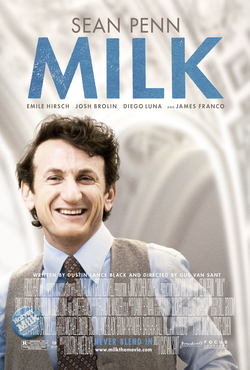
Movie Review: Milk

Milk Movie Poster
Milk is the story of Harvey Milk, a San Francisco businessman turned activist who was the first openly gay male elected official in the United States (there were lesbians elected to office, and officials elected who later declared themselves to be gay.)

Well, I think this was intended to be inspirational. But it was jumbled. In there was a story about someone who overcame obstacles to his photo business then organized a business association, then got elected. But it is constantly interrupted. There is the ever present aggressive expression of sexuality (Milk and company are very openly gay). There are numerous episodes of pettiness that looks like a distraction from the goals of the people involved. And there are the romantic relationships that see romantic rivals in every interaction, complain of neediness of time and attention. And all of it sucks away from this goal of political influence.

But this is reality. Life gets in the way of projects, no matter how big and important. But you wonder how do people who are around this, supposedly in relationships with people who are doing what they recognize as important, and they don't get the idea that supporting their people is something that has a level of priority.

As silly as this seems, it is also a reflection of the culture. There is another sub-culture that loses focus on its proclaimed mission because of focus of issues of sex. That regularly looks at the relationship status of people as their primary and overwhelming attribute and often ignores all others. And what I see in Milk, as much as it makes me think "what were they thinking", I realize that this is other sub-cultures in the U.S. as well.

Saturday, August 29, 2009

Movie Review: Julie & Julia (2009)

Julie and Julia Movie Poster

Julie and Julia is a story of two projects. Julia Child's book "Mastering the Art of French Cooking" and Julie Powell's weblog "The Julie/Julia Project". For Julia Child, the challenge was to learn French cooking and figuring out how to communicate. For Julie Powell, the challenge was to work her way through the 524 recipes of Mastering the Art of French Cooking in one year and writing about it in her blog.

So the story is of a project. But projects are not things that happen in a vacuum. And they exist in the context of life. And this movie is not just about two writing projects. It is about living life in the midst of writing projects. And in both cases, life is in the context of a marriage and job transistions. Julia Child book was written while her husband was pressured for their past work. (Julia Child and Paul Child served in the OSS during WWII in China. The OSS was the predecessor to the CIA. At the time depicted (1950s), there was a movement in the United States that considered wartime service to be reason for suspicion for treason.) And in the midst of transfers she was writing her book along with her co-authors in Paris.

In 2002 Julie was in a dehumanizing job after recently getting married and in the midst of a move, undertook this cooking and writing project. And it causes stresses at home (like any project that takes up time every day).

What do we see? We see two couples dealing with the stresses of life, of goals reached, obstacles encountered, setbacks, and successes. There are times when the everything is good, times when life is hard but the project provides energy and drive to get through the day, and times when the project threatens to suck the energy out of life. Or aspects of life become overwhelming. And the movie shows them dealing with this. Sometimes gracefully, sometimes otherwise.

Some thoughts. I had a professor who gave the advice that we should have many aspects of life, because in every aspect of life, there are good times and bad. And when life is single focused, it becomes subject to the changes of that one aspect of life. But a varied life provides a buffer that can withstand the winds of change that life inevitably provides. And the movie shows that, with both Julia and Paul Child taking terms having success and failure in their project/careers. And it allows them to support each other in each other's setbacks. In comparison Julie who allows the project to become her life, dominating their time at home.

And it is here that the movie shines. In particular with Julia and Paul Child, both living full lives, and supporting each other the good times and bad, and their relationship strengthening the whole way. Julie and Eric have it rougher. We do not see Julie supporting Eric as she uses her project to escape both her job and her family.

Now, do they learn? It does look that lessons were learned. One advice more commonly given to people who are recently married is they get into a fight, so they can learn how to make it through a fight. And so do Eric and Julie. We don't know if Julie has learned how to support Eric as he does her, but we presume that they have learned something about relating with each other as they celebrate with each other over the end of the project and her publishing deals.

It was a good movie. Not just a foodie movie, but a movie about two couples, figuring out life.

Sunday, August 23, 2009

Movie Review: Last Letters Home (2004)

HBO movie website

Last Letters Home is a documentary that is built around the letters home to family of soldiers who were killed during the first years of Operation Iraqi Freedom in a partnership between, HBO, Time-Life and The New York Times.

What is here? Yes, there are grieving parents, brothers, sisters, spouses. But these are letters of soldiers proud of their work, parents proud of their sons and daughters and how they have grown. Officers and NCOs filled with worry, pride and care for those under their command. Soldiers looking forward to going home after their combat tour. Making plans and goals for the future. Telling tales of living life among comrades in arms, even in far away places. Hoping beyond hope that their families are not worrying about them. And stories of the two officers in dress uniforms with a chaplain coming to visit homes.

What is the purpose of something like this? Or the New York Times naming casualties as they are released in "Names of the Dead" and its "Faces of the Dead" feature, even as its audience largely pays little attention to the costs of war? Or Gary Trudeau (Doonsbury) sponsoring The Sandbox, where military personnel who have blogs that talk about life at war can be given a wide audience? In "Gates of Fire" by Steven Pressfield, he has a fictional scene where the Queen of Sparta gathers the wives of those who died at Thermopylae and tells them that those who were sent were chosen because of the ability of their wives to handle the loss. Reality is nothing so melodramatic, but a country that sends its sons and daughters to war would be so lessened if it did not remember them and consider the cost to those who have lost those they have cared about them. And not thinking of them in the romantic and fantasy of waving flags and fiery speeches, but in the practical sense of remembering that these are men and women, sons and daughters and they represent the dearest coin that our country can pay for causes that it deems worth the price.

Tuesday, August 18, 2009

Movie Review: I, Robot

I remember when I, Robot came out, and the awful reviews about how it was not faithful to the source material. But while it is a different story, I find it to be in the spirit of the Asimov stories. (I don't tend to care about the special effects as much as plot.)

The focus of the Asimov stories is to take the world where robots exist and are bound by the Three Laws. And the world is full of robot who are created to serve people, and have this higher order understanding that they need to protect humans. But then something happens that seems like a paradox and the protagonist needs to figure out how it happened, within the confine of the Three Laws.

And this movie follows one of those themes. That a robot is able to take the three laws and derive the Zeroth Law from them. And then the inevitable conclusion, that people inflict so much harm on each other, the best way to protect humans is to control them, and those that could cause harm are destroyed to better protect humans. After this, the action and special effects are details.

The parallel is not unquestioned reliance on technology. The parallel is unquestioned reliance on authority to enable our protection. It is a world where we are given rules to protect us from our own good, and we are asked to trust in authority. Or, as a friend of mine in grad school said, "we have to trust that authority knows things we don't and are making the right choices" (obviously, given my career path that has included such things as speaking truth to power, I don't follow that philosophy)

The alternative, I would contend, is to ensure that people are provided the means to make proper choices. Not the choices passed on to them by the powerful (corporations, government), but choices where the individuals are given the information and the means that make their own. Does it mean anarchy? No, because anarchy inevitably breaks down to rule by the strong, because the weak become forced to seek the protections of the strong for their own protection. Full libertarianism has the same effect, the strong are left with no restraints. We are better off with the ideas of the Federalist Papers, where interest contends with interest, whether those interests are economic, political, regional, ethnic, or other grouping.

But what it leaves is what the Coase Theorem suggests, that the proper role of government is to allow for the reduction of transaction costs, so that the market will by market forces flow toward the most utility. That means that ways are found to reduce the effects of market power and that information is allowed to flow to where it is needed (e.g. regulations). And the results of choices are allowed to occur.

Monday, August 17, 2009

Book Review: The Namesake by Jhumpa Lahiri

[Originally posted at Goodreads]


The Namesake The Namesake by Jhumpa Lahiri


My rating: 2 of 5 stars
The Namesake follows an Indian-American from birth through middle-age. The focus is on his relationships with his parents and how that affects his attitudes towards life and relationships, and the outcome of those relationships. The McGuffin in the book is his naming, which was planned to be done in a traditional manner but complications prevented that from happening.

One of the things to remember is that as immigrants, the principle's parents had choices on how to engage their new world. His father chooses to engage in it as a professional, but not any further. His mother chooses not to engage, and withdraws into remembrances of home. And as an arranged marriage, there is no reason to expect that his mother has the same ability to adapt that his father showed as a graduate student in the United States. The cliche is that his parents inability to causes problems in his ability to relate to his world, in particular his relationships which capsize because he lacks the ability to adapt the bigger and more varied worlds of his partners.

So the question is: was he doomed because of his parents? His sister seems to do well, which his mother observes in her not-so-traditional marriage as compared to his traditional one. Or are there choices he makes, like his hangups on his name, both the originally given one and the formal one that he has claimed as his own. He spends much effort trying to flee his background, and conforming to its surface for the sake of his parents, both his efforts to avoid his background and the compromises he makes to conform lead to tragedy.

Many books of this type seem to have as their point the need to let the American born child go (e.g. the protagonists sister who goes far away from home for school, but ends up much better adjusted and even closer to their mother.) But I would claim that it is still his choice on how he chooses to engage in the world. For all their hopes that their children follow traditional (home) ways and their complaints when their children do not, most immigrant parents in the end are satisfied with children who maintain relationships with them when they are grown, a truism that is implied in the protagonists sister and her fiancee at the end of the book. The conflicts and separation in the interim is more of a tragedy then anything else, and is magnified by the protagonist's repeated dwelling on issues of his name and background.

The other theme is on relationships. In particular the unbalanced relationship where one person has a more adventurous history then the other and the less adventurous one has no desire to partake in the expansive life of the other.

The book is good in the sense that it has a lot of material, and it has an honest feel to it. But there is a lot of conflict avoidance. Certainly on the part of the principal characters, and maybe on the part of the author as well. It is very hard to write good characters when a big part of their personality is avoidance, even though lots of authors seem to try (because it is angsty and it has the appearance of depth) But the whole thing suffers because as a reader who recognizes the situations, I can see the issues, but they are not dealt with in the narrative.

View all my reviews >>

Sunday, August 16, 2009

Movie Review: War of the Worlds (2005)

I had watched the 1953 version of War of the Worlds a few months ago, and I wanted to see how a modern adaptation fared.

In the 2005 version, the narrator is a divorced blue-collar dock worker who shepherds his
two children to his ex-wife's family in Boston, which presumably represents safety. He is rather cocky, and presents an I-know-what-I'm-doing front to the world, which does not fool his ex-wife or his kids for a second. On top of that, the way he relates to his kids is one of I'm-the-father-I-know-what's-best, which also does not impress them.

This comes to a head during the invasion, which takes on the form of one pod not far from his house. And he sweeps his kids out of there in a stolen car, all the while trying to shelter them from knowledge of what is happening. Which leads to growing tension among the family as the little girl starts freaking out because she can tell her father and everyone else is scared and she does not know why, and the older son is getting pissed because he can tell that the father is not telling them something very important, like 'there is this big thing that is killing everyone and is unstoppable behind us'. ("Tell me what you know!!!")

It seems to have as an underlying premise that the ultimate goal is to shelter our kids from knowledge of danger and they will come out all right (witness numerous scenes where they blindfold the little daughter and comfort is not achieved by helping her deal with what she is facing, but by removal and having her forget) The son, realizes this and actively goes to help others (on a ferry) and looks for ways to help in the resistance to the invasion, because he wants to get away from his overprotective father (whom the son realizes is well beyond his level of competence.) The narrator here is constantly conflict avoidance, refusing to explain actions, include others in what he is thinking, and helping others. And while the movie shows the harm it causes, it treats this as the way to be, as he never learns.

The movie misses a lot in not dealing with the relationship between father and son. This could have been explored with the son pushing for more information on what is happening, and having this coming to a head, instead of dealing it by the son just leaving his father and sister. Also, the old deacon on several occasions identifies that he and the narrator have a conflict, but they never even try to work it out, the narrator only brings it up at the worse possible times (i.e. instead of talking it out in the quiet moments, he only brings it up at times of mortal peril.)

So, obviously, I did not like the movie. But it does potentially have the virtue of depicting one model of raising children. In this case the parent knows everything and the child only needs to blindly follow, blind to the realities of the world. My wife and I, should we have children, have determined that during the period said children are with us, they will not be hidden from the realities of life, that they will experience the world in all its splendor and horrors while we and our friends around us are there to serve as guides and guardians. So that their futures are faced in the knowledge of what is and what can be as they make their own choices for their futures.

Sunday, August 02, 2009

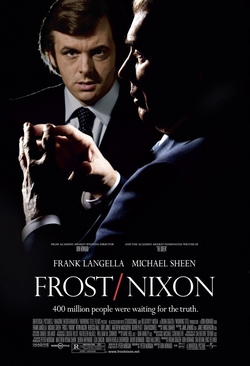
Movie Review: Frost/Nixon 2008


Frost/Nixon portrays the Nixon Interviews of 1977 between former President Richard Nixon and British talk show host David Frost. It is prominent because it was the first public interview by Nixon after his 1974 resignation. Because of the blanket pardon provided by his successor, President Gerald Ford, there was no investigation, trial or finding as to his guilt, and the U.S. was still suffering from turmoil in the aftermath of Watergate and the end of the Vietnam war as public confidence in government and public service was at a low.

The actual interviews were best known as the point where Nixon stated the philosophy "Well, when the president does it, that means that it is not illegal." The actual interviews are discussed in many places. This is about the movie.

The movie is not as much about the content of the interviews (although the interviews were the point) as it is about the two people involved and their cornermen (i.e. principle staff). You have Frost, who is more of a TV personality rather then a tough reporter, and Nixon, an experienced politician. For Frost, this was an opportunity to do something unique and special, incidentally trying to save a career that is looking like it will fall into banality. Nixon was a politician who missed the give and take of dealing that went with political life and wanted the opportunity to rehabilitate his place in history. For the people behind Frost, they wanted the opportunity to represent their generation in uncovering the truth of the events that ripped the heart out of the country, and Nixon was the demon that needed to be faced, with Frost being the very unlikely and not very qualified demon confronter. Nixon's staff viewed Frost as a lite-weight pushover.

The movie focused on the evolution of Frost in this environment. In one of the DVD special features, one of Frost's staff depicted in the movie describes how he never realized about how compressing TV was, that for everything done, TV has a way of focusing attention on one moment to the exclusion of everything. And that as bad as he felt most of the interview was, a single moment (a shot of Nixon during the interview described as grief and pain and self-loathing) saved the rest. The movie shows it this way as well, with Frost almost distracted in the midst of the interviews by the need to court investors and sponsors as opposed to preparing for the interviews, until the one focused on Watergate, which turned into the equivalent of a finals cram session as Frost prepared with an intensity he did not before.

What was good? You can see the issues of hubris. The most obvious one is Nixon and his team, confident that the inteligent Nixon can snow the pushover Frost. But also from Frost's side, who had the view that his role was to provide entertainment and a show. (Note: this was dramatic license. In reality, David Frost was a competent interview as needed, and his choice of staff was intended so he could be hard hitting, his previous interview with Nixon in the 60s aside. The idea that you can find a particular transcript that may or may not exist in courthouse records and integrate it into a TV interview in a couple days is not believable, or true.) And the purpose of the preparation was only that. And the turning point was when one side realized his hubris, which was Frost.

This is not a documentary, rather a dramatic work around a historical event. And its goal was the pointing out the effects of hubris on man, even those who could truly deserve the label great. So it was for many of the time and events in question. And, history shows, many other times and places.

Friday, July 31, 2009

Teaching Facility Location: Lessons Observed

This summer I taught Facility Location to a mix of seniors and graduate (mostly professional masters) students. As usual, lessons observed.

OVERVIEW
The course is billed as Logistics and Supply Chain Management. In particular, it is a course number that has not been used for a while. The department has pledged to have a couple courses offered every summer, so this was one of them. Of the other courses in the department, there is one course titled supply chain management, but it focuses on production. So, in consultation with that professor, this course was focused on Outside-the-plant rather then inside-the-plant.

The original intention was to make this a combination of facility location problems and vehicle routing. The texts for the course were Facility Location: Applications and Theory (eds Drezner and Hamacher) and Logic of Logistics (Simchi-Levi, Chen and Bramel).

The plan for the course was for me to teach the first half of the course covering the basic models. After that, my sense is the goal is for the students to see as many models as possible, but it probably did not matter which ones. So I had the graduate students teach a module of their choosing while the undergraduates would present an application paper found in an academic journal (usually Interfaces).

LESSONS OBSERVED

1. Software and programming: For the course, I informed enrolled students about a month before the course that we would use programming (C was expected, but any language of the student's choosing was allowed). Early on there was an assignment that required implementation of an algorithm, this was very difficult. What this really means is we need to expose students to programming more often so they get used to the idea they have to implement what they are learning, not just learn equations. For linear programming, we used GLPK. The original plan was to try to use Pennsylvania based data and the student versions of the LP solvers could not handle that. And is it turns out, noone remembered how to use LINDO/LINGO anyway. But because they are not used to programming, this was hard too. Most of them got GLPK to work, and I suspect that it is easier to figure out then LINGO was.

2. In class exercises: The first day of class I reviewed linear programming, then made them do a formulation in class to see what you remembered. And, it was useful to know just where the students were. It was a good thing I did this. I did have to scale down the course, and I changed topics.

3. Class interests: The other thing I did was ask the students for their interests. Based on this I (i) switched out one of the major topics and (ii) for grad students that did not have a preferred topic, oriented them towards topics that people were interested in.

4. Textbooks: The Facility Location book was good, but there were no exercises and a few editing errors. Most of the grad students who presented topics covered here found it dense, and did not catch critical aspects of their topics (generally, we figured this out when they scheduled time with me to review the topic and I explained the essentials) The Logic of Logistics book is probably too technical for undergrads and professional masters, as students with these backgrounds are not used to doing proofs. I ended up using Nahmias Operations Management to cover inventory and forecasting.

5. Forecasting: If I'm covering inventory, I need to cover forecasting. This was covered as part of one of the graduate student presentations, but I probably needed to do this topic and the graduate presentation can build on it.

6. Graduate presentations: Of the 9 presentations, I'd say 2 were very good, 4 were adequate (although 2 of these were on more difficult topics, so these would probably be considered good), 1 was marginal, 2 were strikes. One of the effects was a substantial increase in variance in the homework and test questions related to the graduate presentations as opposed to mine. Part of the presentation grade was the performance of the class on the related homework problem, which did correlate with my impressions. A few of the graduate students mentioned that they have been able to apply the topic of their talk almost immediately at work, which is rather gratifying. So overall, I think the idea is sound for this topic. But I need to find time to review the topics afterwards for quality control to ensure that the topic is learned.

7. Homework: This class was compressed during the summer, so I did not get as many homework problems as probably were needed. Most topics were only covered by one assignment and one exam problem. Even at this, they seemed to take a very long time on homework. In a normal length term, I would get out twice as many questions. In addition, I think we could get their computer skills up in the first couple weeks so that their performance on the homework would improve and become more efficient.

8. Undergrad presentations: The undergraduates reviewed one application article in the literature and write a short paper and presentation. First issue is for most of them, the first article submitted for approval (I wanted to approve the articles they selected), most were not applications. As one stated "I did not understand the article, I just saw symbols I recognized" This probably means I needed to discuss the difference between application and theory better, and how to read an article. (Yes, I had pointed them to Interfaces, but somehow people found the Journal of the Operations Research Society and thought that would be a good source.) For the papers and presentations, the students were much better presenters then writers. We've apparently done a good job creating powerpoint rangers, who cannot read or write (I've called them out on their inability to read on several occasions, and letting students know on their homework that I'm pretty sure they would have done better if they read the problem more carefully. I bullet point the relevant details in the assignment.) In addition, everyone went way over the desired length (~5 pages) At the beginning of the course, all of them were concerned with how long it was and I was assuring them that there was more then enough material for them to get 5 pages of material. I should have impressed on them that the real problem was getting the paper short and concise.

Homework and exam problems: The problems I gave were a mix of computational problems and formulation problems. During a teaching workshop, one comment a more experienced teacher made that the standard for teaching and evaluation was that he determined what questions someone in the class got correct, and that was his potential score. His goal was to keep the potential score in the 90s. For me, it was 100. And I'm pretty sure that they learned the material from me, so I feel pretty good about that. But I need to find ways of shortening the feedback loop, and have more points of comprehension checking, because I suspect that could have helped some.

NEXT STEPS
I am teaching in the fall the undergraduates the prerequisite course to this. The department is going to a direction where there is a lead professor on the main undergrad courses, so we've talked some on how to teach it. The focus is going to be pushing formulations more then the actual algorithm (which none of them will ever implement it because we always use solvers). Also, we're going to try to teach a modeling language as well as Excel (and in place of LINDO/LINGO, which are essentially matrix generators) The theory being that the modeling language has a nearly direct correspondence with the math formulation, so that they will reinforce each other for later.

My other plan is to ask the students to write a paper on a journal article, which was something that I did when I took this course as an undergrad. And my thought is to have them do two papers on the same article. First the 5 page paper (with a strict limit on the five pages). Then, after they get feedback, the two page summary paper, to force them to be concise.

Thursday, July 30, 2009

Movie Review: Harry Potter and the Half-Blood Prince

I saw this Saturday with some friends. The previous movie sees the return of the death eaters and Voldermort in the open.

The story revolves on Harry viewing his role as "The Chosen One" as his own. Of course, with all the plot lines, this is hard to catch. And, he has that teenaged I-am-special-if-only-everyone-else-could-figure-this-out world view. At least he does in the book. The movie has Dumbledore understanding perfectly how wonderful Harry Potter is, although he is apologetic about demanding so much of him. In the book this is also true, but I don't remember Harry being quite so understanding of things.

The films still suffer from too many plots going on at once. This sort of thing works out better in books, in films it gets confusing since some characters are doing double and triple duty.

I remember not liking the book so much, because the Harry Potter teen-age angst was in full form at this point, with very little redeeming virtues. But with this watered down for the movie, it is harder to figure out his motivations. Or motivations for many of the other characters (ok, all the girls in potions class are pretty easy to figure out, but lots of other people seem pretty random if you had not read the books.)

Oh, the major character development plot seems to be all the kids starting dating, and it has to be with major drama. Again, this part did seem to work out better in the movie then the books, but it still seems compressed.

Thursday, July 23, 2009

Restaurant Review: Tamari, Lawrenceville


Tamari
3519 Butler St.
Pittsburgh, PA 15201


We arrived around 6:30 and they were busy. We hung out at the bar and had a fun conversation with the bar staff as well as the owner's father (of China Palace) At first, they tried to seat our group outside, and we were eventually seated, but we eventually were chased in by the rain. So we ended up at the sushi bar, where we had front row seats of the chef at the stove. So we had a treat watching a hopping kitchen as the orders came through with head chef Roger Li keeping an eye on things from the side (it was a narrow kitchen).

I had the 16 spice rubbed in pork tenderloin and I was able to taste wrapped shrimp (pictured). The confidence of the kitchen showed when their medium rare was done like it should have been (i.e. not overcooked). The purpose of this restaurant is not feeding volume, in fact the portions are nicely sized. The focus is providing good food. Seasoned uniquely and intended to be savored. And I did so, one bite at a time.

Following lessons learned from his father, owner Allen Chen was wondering the floor chatting with customers. At our front row seat we watched Roger Li manage his kitchen, mentoring younger staff and even exchanging a few words with us watching. A wonderful eating experience, and something creating that makes eating in Pittsburgh fun.

Recommend this review

Saturday, July 18, 2009

Book Review: A Rumor of War by Philip Caputo

A Rumor of War A Rumor of War by Philip Caputo

My rating: 4 of 5 stars
This was a book club selection. And not by me :-)

Philip Caputo was a marine lieutenant among the first units in Vietnam in 1965. And his unit, like all such who are the first of their generation to go to war, was unsure of what they would find, looking to their few veterans from Korea to what it would be like, and the guidance from above. And the guidance from above was that it would be easy.


It was not. And Caputo shows what it was like at the ground, the walking into the unknown, not knowing what was ahead. A war where they did not know who was the enemy, and in every village, they did not know how to tell who was who. Their good intentions on dealing with the local population, spoiled by the fact that their opposition was embedded with that same local population and using that as their striking ground for their attacks on Caputo and his marines.

It is this description of dealing with the uncertainty of war that makes this stand out. And to make the example more stark, the second part of the book takes Caputo on his next assignment, staff officer in Vietnam. Far from the unknown of the battlefield, he is now in a war that is measured in numbers on a board, where the planners of war create their plans in willful ignorance of conditions on the ground, asking for certainty that does not exist. And you realize what others like Halberstrom and McMaster have stated in their books on the same era, that this pattern of making decisions in ignorance was even higher as you got further away from the battlefield.

Caputo also shows what a difference it makes to have a commander who desires to get beyond this. He describes a change of command, where the new commander insists on recognizing the reality of war, almost in opposition to the staff that he inherited. And the two commanders contrast with Rick Atkinson's description in "In the Company of Soldiers" of the general of the 101st Airborne during the 2003 invasion of Iraq , whose recognition of facts on the ground which higher levels were denying changed the way the 101st went into battle.

This was a good war book, not one that focused on glory or horrors, but what it meant for men on a battlefield to deal with all the unknowns of war. Very apart from those who speak with assurance based on ideology instead of experience.


View all my reviews >>

Monday, July 13, 2009

Book Review: Beginning Databases with PostgreSQL: From Novice to Professional by Neil Matthew

Originally at Goodreads

Beginning Databases with PostgreSQL: From Novice to Professional, Second Edition (Beginning from Novice to Professional) Beginning Databases with PostgreSQL: From Novice to Professional, Second Edition by Neil Matthew


My review


rating: 5 of 5 stars
This has proven to be a very good book. I'm not a database expert, but I happen to need PostgreSQL because I am working on a project that involves GIS, and PostGIS turns out to be a very appropriate tool for what I am doing. This book got me started and has helped me through the importing of data, understanding basic functions, and incorporating PostgreSQL into my programs (I use a combination of R, Python/Jython and Java. The book does not talk about them all, but what is in there carries over pretty well.) I've also used this to use BIRT and Openoffice.org to link my PostgreSQL databases. Again, it is not spelled out, but what was in here brought me well along the way to making it work.


View all my reviews.

Sunday, July 12, 2009

Book Review: Applied Spatial Data Analysis with R by Bivand, Pebsma, and Gomez-Rubio

Originally posted to Goodreads. Applied Spatial Data Analysis with R (Use R) Applied Spatial Data Analysis with R by Roger S. Bivand

My review


rating: 5 of 5 stars
Applied Spatial Data Analysis with R (ASDAR) is written by the same people who wrote and maintain the spatial sp class in R. The book is not a statistician's text on mathematical geo-statistics, rather is focuses on taking geospatial (e.g. GIS) data and applying analysis within R. Not being a statistician, I used the book to learn how to manipulate geospatial data for my own analytical purposes. The mark of a good technical book, not only did I learn about how to work with the standard geospatial data types, I was able to implement analyses using the material in the book.


The book has three parts. First is an introduction to spatial data. Much of it is orienting the reader to the vocabulary of geospatial data such as point, line, polygon, grid, coordinate system, projection. It also motivates why using R for spatial analysis. (The other options would be within a GIS such as GRASS or ARCInfo, custom functions using C++ or Java, or Python, which has been incorporated into many GIS environments). In particular, it looks at the many packages and analysis built up that uses the sp package and data structure, allowing many developed analytical methods to be used together to build a complex analysis. (this is similar to my purpose, taking advantage of the fact that R provides a standard entry point to several computational toolkits that I use.)


The second part discusses accessing and using geospatial data in R, which fulfilled my purpose. It is detailed documentation on the various spatial classes and the methods that are applicable. There are descriptions and examples of how to visually display geospatial data. The chapter on data import and export covers GDAL/OGR, coordinate reference systems, projections and transformations, and what you would need to work with formats such as shapefiles, PostGIS, KML, image files such as tiff files and Google Earth overlays (PNG), or directly with GRASS, TerraLib, or Python interfaces with ArcGIS, RPyGeo.


The last part is on implementing geostatistical methods such as for pattern analysis, geostatistics, areal analysis (geographic aggregation), or epidemiology. I cannot comment too much on this as this is not an area that I have expertise, but the methods look both adequate as well as practical to use.


While the intended audience of this book are statisticians working with geospatial data, I would also recommend this to those who do data analysis or modeling with geospatial data. Most of the analytical texts I've seen discuss algorithms. This text gets into the practicalities of working with real data formats and real data issues that are the inevitable first step in a project. And it does so at a more analytical level then the point and click interface instructions that are enabled by standard GIS systems alone.


View all my reviews.

Wednesday, July 08, 2009

PSO: Independence day at Hartwood Acres

[also posted to the Pittsburgh Symphony Website (give them a couple days) http://pittsburghsymphony.blogs.com/outside/]

I went to school in the north suburbs of Chicago, and every year one of the highlights was the Ravinia music festival, where the Chicago Symphony and others would perform outdoor concerts on summer nights. My friends and I would pack a picnic dinner and picnic and enjoy ourselves, and then be treated to a wonderful concert under the darkening sky.

And a friend let me know about this July 4, when PSO was playing a summer night outdoor concert not too far away from home. So we went in anticipation of just a fun concert.

PSO plays at Harrison Hills Park


For an outdoor concert it was a bit of ambitious. Strauss, and Beethoven, with a cello concerto by Herbert for the first pieces in the program, with the rest of the program the more conventional Americana of Copland, Ives, and the Armed Forces Salute. Finishing with the almost obligatory 1812 Overture and Stars and Stripes Forever.

The Strauss, Herbert and Beethoven pieces were almost trying to hard. While nice pieces, they seemed to get swallowed up in the open air and grass and trees (and the ambient noise of the park).

Copland's Variations on a Shaker Melody from Appalachian Spring reminded me of Gabriela Montero's concert back in January, when she brought with her Air and Simple Gifts for its live debut after the presidential inauguration. This and the Ives Variation America provided a feel of Americana that you would want in a concert on that day.

The Armed Forces Salute as well as 1812 Overture and Stars and Stripes Forever are almost mandatory for a July 4 concert (it was getting dark by then, so I did not see our veterans stand in their turns).

But something was missing. Oh. "Musical fireworks" were advertised, but no actual fireworks??? It would have been a fun way to cap the night if this happened to be coordinated with some nearby town holding their fireworks to coincide with the last part of the show. *sigh*

Wednesday, June 24, 2009

Rachel Carson Challenge 2009

This marked the third time I've hiked (not run) the Rachel Carson Challenge. The previous two times were in 2006 and 2008. (I was here in 2007). And of course, this time I aimed to finish on time. The past two times I was coming in right at the time limit at a full run (or I was trying to go at a full run, I was usually with people who got tired faster.

As usual, there was another task being accomplished. Last time, I was trying listen in on a 2M amateur radio (which I could do.) This time, I was running another experiment. I carried a GPS tracker that was connected to a 2M (VHF) transmitter that would broadcast my location on APRS. If all went well, it would be recorded by a digipeater that would record my position and track. All of this using equipment loaned by members of the Pitt Amateur Radio Club.

APRS setup

APRS setup

We began in North Park, going east. So it meant the fast part was at the beginning.

Start sign of the rachel carson

We waited in the dark, punctuated by reflective piping on everyone's shoes and gear, and the flourescent green shirts of the volunteers running the challenge.

Waiting before the challenge

I started out with a group that was part of an exercise club at Pitt, including a couple people from my department. We started out by crossing the stream at the beginning, helped by Mark E. the lead of the trail maintainers. Of course, B. went for a spill, filling the need to get muddy out of the way for the rest.

Moving on out

And it was important not to be concerned about getting muddy, because the trails were very muddy, a remnant of the heavy rains that caused major flooding in Turtle Creek, Pitcairn and Forest Hills earlier in the week (and yours truly was doing damage assessment for the Red Cross.) This slowed down progress through North Park to Route 8 significantly, as the mud sucked on our shoes as we went through.

Rachel Carson photographer at Route 8

Halfway through I met up with S and J, who I trained with for the 2008 Challenge, both of whom had traveled back to Pittsburgh for this.

Three of us at checkpoint 3

As usual, there were the many hills to climb and descend, with the twist that I was going in the opposite direction then I had in the past.

Climbing up

And then we pushed to the end. The clouds that were forecast throughout the day were over the finish at Harrison Hills Park, and as two of us raced through Harrison Hills Park (and made one wrong turn, that I figured out) the rains hit. Just as we got to the Bobwhite shelter, which USED to be the finish point. We pushed through the uphill through last part of the course through a downpour, which turned the trail into a torrent of muddy water. And when we got to the end, we emerged out of the woods to wild cheers of volunteers and other late finishers, who probably were not expecting anyone to navigate their way through the now skies after the setting sun and downpour.

Shoes after the Rachel Carson Challenge

And we were soaking wet, from shoes that were completely inundated with mud pressed in by the current, to clothes that were completely soaked. D, one of the volunteers, gave me a hug, and the water being squeezed out of my clothes was very visible. We wolfed down some burgers, I got a massage and a ride back home that evening.

And the experiment, well, it did not really work. But we knew this would be a problem because of the hills and valleys blocking the radio signal from the digipeater, and all the forest cover that blocks GPS signals. But we have some ideas for the second time we send someone with an APRS transmitter down the trail. All we need to do is find someone crazy enough to do the Rachel Carson Challenge while carrying a radio and GPS tracker . . .

APRS points taken during Rachel Carson challenge

Monday, June 15, 2009

Using shp2pgsql to import Shapefiles to PostGIS

I covered some of this in a previous post on Converting Lat/Long data to PostGIS. But now my problem is to import Shapefiles into PostGIS.

First, why do this. While Shapefiles are good for distributing and looking at data, it is difficult to do any analysis. To do anything, you end up using OGR/GDAL to examine the shapefile and then do something with it. PostGIS takes the spatial and data components of the Shapefile and exposes them in database format, allowing anything that can be done with a database to be done with the Shapefile. In addition, it enables Simple Features for SQL which allows for using set operations on geographic objects (as opposed to only sets). Think of all the Venn diagram pictures back in High School. And other spatial operations that may come to mind when dealing with points, lines and shapes.

The key, of course, is to get the PostGIS database started. So, first, within PostgreSQL, create a database

CREATE DATABASE PA;

Next, load PostGIS onto the database. The first step is to load PL/PGSQL

CREATE LANGUAGE plpgsql;

Next, within the database, load the lwpostgis.sql and spatial_ref_sys.sql into the database. I used the pgAdmin III GUI.

Next, use the shp2pgsql tool The format is:

shp2pgsql [] > .sql

This should be run from the directory with the .shp file. refers to the name of the shapefile. is the name of the table to be created within the database. You can also enter this in schema.tablename form if you want. database name is the name of the database on the local server that it is being entered into. Usual practice is to pipe this to an SQL file that will be read in later (with all the necessary permissions. For option, the common one is to enter the -s of the EPSG (if known).

So, for example, using the NHPN shapefile for Pennsylvania (FIPS: 42), which is to be imported into a database named PACities, in the 'public' schema as the table 'NHPN' with the projection NAG 83 (ft) (Pennsyvania South) EPSG=2272, I get:

shp2pgsql -s 2272 S42NHPN public.NHPN PACities > nhpnImport.sql

And now it is in.

Saturday, June 06, 2009

PSO: Back from China

[Note: Originally posted at the Pittsburgh Symphony Orchestra website. Original here]

My wife and I went to Friday's concert, after a long break while the PSO went on their tour of China. We quickly found the board of pictures from the trip, including the picture of 'No horn' sign among those taken by Chuck Lirrett and Stephanie Tretick.

No Horn

I especially enjoyed it because I had just returned from a trip to China myself, and like Chuck was amused by the "No horn" sign, especially when it was found outside a concert hall or school of music. And during our trip, we encountered a few friends who noted the PSO's appearances in Beijing and Shanghai not long before.

My wife's family has an association with the Tianjin Conservatory of Music, and when visiting the school and various faculty there, we came upon their Wall of Fame, with pictures of illustrious alumni and staff from over the years. And another picture, of some distinguished alumni and friends from the United States who had recently come to teach and inspire the next generation of musicians.

Pittsburgh Symphony in Tianjin

It seems that Adam Liu, Cello and alumni of the Tianjin Conservatory of Music, and a few other PSO friends came to the Tianjin Conservatory of Music ahead of us. We laughed at the many interwoven connections we have in our lives, and how small and how rich our world is.